
 Eduardo Hernández-Hernández1, Ricardo Oliveros-Ramos2, Leandro Miranda3, Antonio García-Fernández1 and Oswaldo Tovar-Bohórquez3

PDF: Download Here | Supplementary: Sup | Cite this article
Associate Editor: Elizete Rizzo
Section Editor: Fernando Pelicice
Editor-in-chief: José Birindelli
Abstract
La reproducción estacional de los peces está modulada por la interacción entre factores ambientales, fisiológicos y endocrinos. Se evaluó la modulación ambiental de la oogénesis en el pez potamódromo neotropical Prochilodus magdalenae (bocachico) en ambientes naturales (Ciénaga y Río) y de acuicultura. La oogénesis se analizó histológicamente, se cuantificó el estradiol plasmático (E2) y se monitorearon siete variables ambientales, incluyendo la fisicoquímica del agua y el fotoperiodo, durante aproximadamente un ciclo y medio reproductivo. En la Ciénaga, la oogénesis progresó desde crecimiento primario hasta vitelogénesis avanzada durante el periodo de baja precipitación, mientras que en el Río alcanzó los estadios de maduración y desove durante la temporada de lluvias. En acuicultura, los ovarios alcanzaron vitelogénesis avanzada, pero no completaron la maduración ni el desove. La concentración de E2 fue máxima durante la vitelogénesis avanzada. El análisis de componentes principales (PCA) y los modelos aditivos generalizados (GAM) mostraron que la oogénesis estuvo influenciada por múltiples variables ambientales. Los dos primeros ejes del PCA explicaron el 78,8 % de la variación ambiental. Un GAM explicó el 45,3 % de la desviación en la fase ovárica, y otro el 79 % de la variación en E2. En conjunto, la oogénesis dependió de interacciones no lineales entre factores ambientales, estacionalidad y tipo de hábitat, evidenciando la sensibilidad de la reproducción a la variabilidad ambiental.
Palavras-chave: Agua dulce, Cambio climático, Parámetros fisicoquímicos, Peces tropicales, Reproducción.
Introduction
Teleost fish oogenesis and ovulation are seasonally modulated by the interaction between environmental factors, water physicochemical properties, and physiological processes (Lubzens et al., 2010; Elisio et al., 2014; Tokarz et al., 2015; Waddell, Crampton, 2020; Šmejkal et al., 2023). However, the mechanisms linking environmental variability to reproductive regulation remain poorly documented, particularly in tropical freshwater systems (Servili et al., 2020).
In temperate and subtropical freshwater fishes, temperature and photoperiod are recognized as major environmental cues regulating ovarian progression and reproductive timing (Bobe, Labbé, 2010; Falcón et al., 2010; Miranda et al., 2013). Photoperiod has also been reported to positively influence oogenesis in several species from the southern Neotropics (i.e., Argentina, Uruguay, and South Brazil) (Silva et al., 2003; Schaan et al., 2009; Elisio et al., 2014). In contrast, the influence of photoperiod may be less pronounced in equatorial Neotropical fishes, where annual variation in day length is relatively small (Kramer, 1978; Goulding, 1980; Waddell, Crampton, 2020). Instead, equatorial Neotropical floodplains undergo rapid changes in hydrology and aquatic physicochemical characteristics associated with annual flood pulses (Melack, Forsberg, 2001; Crampton, 2011; Affonso et al., 2015). Circannual fluctuations in temperature, dissolved oxygen, total dissolved solids, electrical conductivity, and pH regulate essential biological processes in tropical and subtropical teleost, including feeding activity, reproductive timing, and oogenic progression (Melack, Forsberg, 2001; Silva et al., 2003; Cognato, Fialho, 2006; Durant et al., 2007; Crampton, 2011; Affonso et al., 2015). Despite their ecological importance, the specific environmental cues required within tropical reproductive habitats and migratory routes remain insufficiently understood (Loury et al., 2021; Woods et al., 2022).
In teleost fishes, oogenesis is regulated by the hypothalamic–pituitary–gonadal axis through endocrine interactions that integrate physiological state with external environmental signals. Among sex steroids, 17β-estradiol (E2) plays a central role in ovarian development by stimulating hepatic vitellogenin synthesis and oocyte growth during vitellogenesis, with circulating levels typically peaking during early and mid-vitellogenesis and declining prior to oocyte maturation (Nagahama, Yamashita, 2008; Lubzens et al., 2010). In migratory characiform fishes, including Prochilodus spp., plasma estradiol levels closely track ovarian stage and reproductive condition and may be modulated by environmental factors such as temperature and hydrological regime (Arantes et al., 2010, 2011a; Hainfellner et al., 2012). However, for P. magdalenae, the influence of environmental variability on endocrine regulation of oogenesis remains poorly characterized, particularly under contrasting natural and captive conditions.
In many migratory fish species, water temperature acts as a primary trigger of the reproductive cycle, initiating oocyte development that is later completed during migration to spawning grounds (Bailly et al., 2008; Suzuki et al., 2009). Therefore, oogenesis, spawning, and larval development often occur in different environments, increasing exposure to environmental variability and enhancing vulnerability to climate change (Bialetzki et al., 2005; Silva et al., 2017; Rosa et al., 2020). Non-optimal variations in environmental conditions, especially elevated temperatures, have been shown to disrupt estrogen synthesis and impair reproductive performance in both natural and aquaculture conditions (Silva et al., 2003; Mylonas, Zohar, 2007; Elisio et al., 2012; Okuzawa, Gen, 2013; Lopes et al., 2020).
Dissolved oxygen availability and oxygen saturation are also critical modulators of reproductive performance. Hypoxic conditions can disrupt endocrine regulation, alter steroidogenesis, and reduce vitellogenic activity, with documented effects on sex steroid levels and gonadal development (Arantes et al., 2010; Servili et al., 2020). In Neotropical migratory fishes such as Prochilodus argenteus, deviations in optimal temperature and oxygen conditions are associated with reduced estradiol levels and the interruption of final oocyte maturation and spawning (Arantes et al., 2010).
Electrical conductivity and total dissolved solids (TDS) act as integrative proxies of ionic conditions and solute load, influencing osmoregulatory costs and potentially modulating reproductive development. In Neotropical gymnotiform and characiform fishes, decreases in conductivity, often coupled with rising water level, have been associated with oogenesis and gonadal recrudescence under both natural and experimental conditions (Kirschbaum, 1979; Kirschbaum, Schugardt, 2002; Silva et al., 2003; Chellappa et al., 2003; Schugardt, Kirschbaum, 2004). At broader spatial scales, rainfall is a major predictor of gonadosomatic index increases in Neotropical floodplain and terra firme teleosts, with additive effects of river discharge and water chemistry, including pH (McConnell, 1964; Goulding, 1980; Waddell, Crampton, 2020). Together, this evidence supports the ecological relevance of temperature, oxygen availability, conductivity, TDS, and pH shaping oogenic progression, while highlighting persistent gaps in species-specific reproductive requirements (Sverdrup-Jensen, 2002).
Prochilodontidae fishes are detritivores, highly abundant in South America rivers, and play key roles in ecosystem functioning and small-scale fisheries (Flecker, 1996; Yazbeck, Kalapothakis, 2007; Rueda et al., 2011; Melo et al., 2013). P. magdalenae is a potamodromous species endemic to the Magdalena-Cauca basins and adjacent river systems in Colombia (Mojica et al., 2012), where it is subject to intense fishing pressure (MADR, 2013). Size at first sexual maturity in P. magdalenae has been reported at approximately 28–32 cm of total length (Mojica et al., 2012; Atencio-García et al., 2013; Doria-González et al., 2021). Its reproductive cycle is synchronized with the bimodal hydrological regime of the Magdalena-Cauca basin, with spawning associated with rising water levels and the occurrence of two main reproductive periods per year (Jiménez-Segura et al., 2010; Mojica et al., 2012). Females exhibit group-synchronous oocyte development and a single main spawning event per reproductive season, consistent with reproductive patterns documented in other Prochilodus species (Arantes et al., 2010, 2011a; Doria-González et al., 2021). Although reproductive timing and size at maturity have been described, detailed histological and endocrine characterization of oogenesis in P. magdalenae remains limited, and current knowledge largely relies on related species of Prochilodus (Arantes et al., 2011a; Hainfellner et al., 2012).
From both conservation and aquaculture perspectives, improving our understanding of reproductive regulation in tropical fishes is increasingly important, particularly in the context of climate change. Climate models predict greater variability in abiotic conditions in tropical and subtropical regions, coupled with heightened vulnerability of tropical ectotherms to thermal stress due to narrow thermal tolerance ranges (Volpato, Trajano, 2005; Perkins-Kirkpatrick, Lewis, 2020; Waddell, Crampton, 2020; Servili et al., 2020; Nati et al., 2021). Temperature regimes outside natural ranges can disrupt spawning timing and reproductive synchrony, while pH has been suggested to affect early developmental processes in related characiform species, although direct experimental evidence remains limited (Durant et al., 2007; dos Santos et al., 2007). Nonetheless, future insights into the repercussions of climate change on tropical freshwater ecosystems are still scarce and barely accurate (Roland et al., 2012; Servili et al., 2020). Notably, Neotropical regions have received much less attention for reproductive physiology and environmental regulation studies in teleost fishes (Schugardt, Kirschbaum, 2004; Woods et al., 2022). In addition, understanding the environmental cue requirements for teleost fish reproduction could contribute to climate-change impacts, aquaculture sustainability, species distribution management, programs addressing interactions between endemic and invasive species, and the planning of river regulation and dam construction.
In this context, the aim of this study was to evaluate the relationships between oogenesis, plasma estradiol levels, and the seasonal and spatial variation in key environmental variables, including water temperature, dissolved oxygen, oxygen saturation percentage, total dissolved solids, electrical conductivity, pH, and photoperiod, in P. magdalenae under natural and aquaculture conditions.
Material and methods
Study area and environments. Fish were sampled in three different environments within the Magdalena River basin, Santander, Colombia (Fig. 1). Species identification followed the P. magdalenae lectotype, NMW 56627 (type locality: Río Magdalena, Colombia, Naturhistorisches Museum Wien), originally described by Steindachner in 1879. Two natural environments were sampled: (i) the Opón Swamp (06º54’17”N 73º53’50”W), hereafter “Swamp”, and (ii) the Opón River (06°56’47.38”N 73°53’14.50”W), hereafter “River”. The river site was selected based on local ecological knowledge identifying it as a spawning and reproductive area. A third environment corresponded to the aquaculture facility Piscícola San Silvestre S.A. (PSS, 07°06’31.2”N 73°51’23.14”W). The PSS group was included as a captive reference to evaluate ovarian development and endocrine activity under relatively stable water physicochemical conditions and in the absence of natural spawning cues, allowing direct comparison with wild populations.
Broodstock maintenance and handling. A group of 80 males and 106 females was randomly selected from the PSS 90 days before the beginning of the study period. Fish were sexually mature (≥ 2 years old, Fig. S1) and were stocked in 1,500 m2 artificial ponds prepared eight days in advance by fertilization with 3 kg of dry bovine manure and 0.2 kg of CaCO3 for each m2. Fish were fed three times daily with a commercial diet (Italcol, Girón, Colombia) containing 24% crude protein, 6% lipids, 8% fiber, and 12% ash.
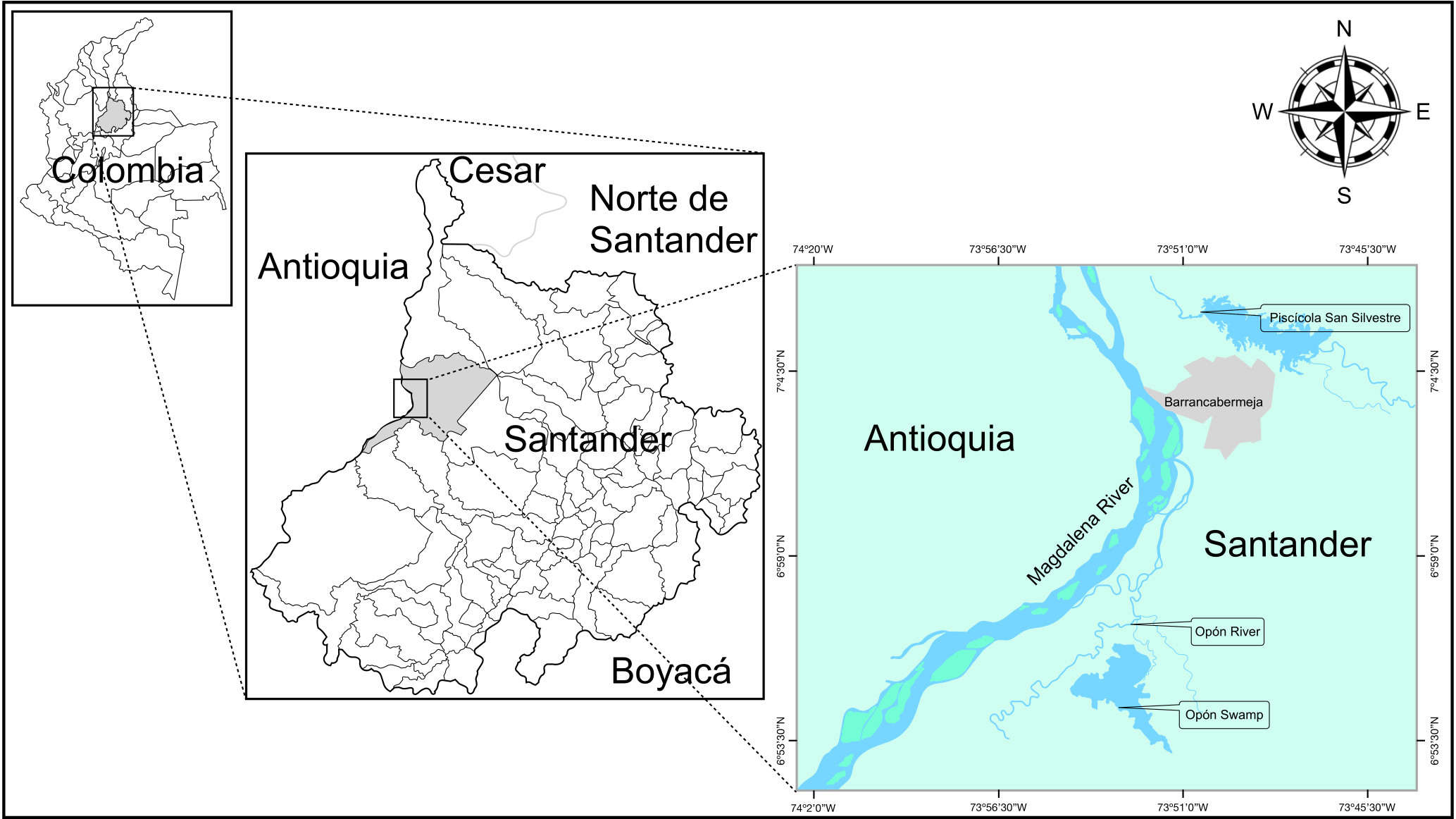
FIGURE 1 | Map of the study area showing the geographic context and location of the sampling sites. A. Regional map of Colombia indicating the Magdalena-Cauca River basin. B. Detail of the study region in the Middle Magdalena Valley. C. Local map showing the locations of the three study environments: Swamp, River, and Piscícola San Silvestre (PSS).
Sampling was conducted twice per month over a nine-month period (July to March), spanning one complete reproductive cycle and the onset of a second, consistent with the bimodal hydrological regime of the Magdalena River basin. At each sampling site, fish were captured with a cast net, temporarily held in cages, anesthetized, and measured for total length and body mass.
Wild animal collection. Wild fish were sampled twice per month over the same nine-month period in the Swamp and River environments using a cast net. No individuals were captured in the River during March due to reduced catchability. Captured fish were transported alive to the PSS facilities and anesthetized with clove oil (Syzygium aromaticum) at 500 µL L⁻¹ prior to processing.
Sampling collection. Fish from all environments were measured for total length and weighed to obtain total weight (TW). Blood was collected from the caudal vein using EDTA-coated syringes, kept on ice, centrifuged at 4 ºC (3,000 x g for 20 min), and plasma was stored at -20 ºC until analysis. Fish were then euthanized by overdose of clove oil. Ovaries were dissected and weighed to obtain gonadal weight (GW). The gonadosomatic index (GSI) was calculated as GSI = 100GW/TW.
Histological analysis. A central portion of each ovary from the 261 captured females was fixed in 4% buffered formalin, dehydrated through a graded ethanol series, embedded in Paraplast®, and sectioned at 5µm, and stained with hematoxylin and eosin. Oocyte developmental stages were classified following descriptions established for Prochilodus species and other Neotropical characiform fishes with group-synchronous ovarian development, particularly P. argenteus (Nagahama, 1994; Santos et al., 2008; Arantes et al., 2011b), complemented by general teleost reproductive frameworks (Tyler, Sumpter, 1996; Lubzens et al., 2010). Ovarian condition was assigned based on the most advanced follicular stage observed and categorized as primary growth (PG), cortical alveoli (Cort_Alv), initial vitellogenesis (VtgA), final vitellogenesis (VtgB), mature (Mat), spawning (Spawn), or follicular atresia (Atr). It should be noted that oocytes in the mature ovarian stage are prone to structural disorganization during fixation and paraffin processing due to rapid hydration, which may limit the quality of histological sections at this stage.
Follicular atresia was identified as a follicle-level degenerative process characterized by oocyte resorption and structural disorganization, which may occur throughout the reproductive cycle. This process was distinguished from ovarian regression, a seasonal whole-ovary transition following spawning marked by the cessation of vitellogenesis and return to a resting primary growth condition (Tyler, Sumpter, 1996; McMillan, 2007; Nagahama, Yamashita, 2008).
Although ovarian regression is a normal component of the reproductive cycle in wild Prochilodus populations (Arantes et al., 2011b; Hainfellner et al., 2012), females in a clear regressing phase were not captured in the natural environments sampled in this study. In contrast, follicular atresia was more prevalent in females maintained under aquaculture-PSS conditions. Atretic females were therefore included only in the descriptive analysis of ovarian stage distribution and excluded from multivariate analyses (PCA and GAM), which were designed to evaluate environmental modulation of active oogenesis.
Estradiol (E2) measurement. Plasma estradiol (E2) concentrations were measured by enzyme-linked immunosorbent assay (ELISA, Cayman® Chemicals, Ann Arbor, MI, USA) according to the manufacturer’s protocols, as previously reported for other teleost species (Pham et al., 2010; Selvaraj et al., 2013; Elisio et al., 2014; da Silva et al., 2022). Estradiol was quantified in plasma samples from 40 females collected in the Swamp, 47 from the River, and 39 from the PSS environment. Steroids were extracted from plasma using the diethyl ether method (Asahina et al., 1995). The dried extracts were reconstituted in ELISA buffer to the original plasma volume, and a standard curve was included in each assay plate. The assay detection limit was 6.5 pg/ml, with intra- and inter- assay coefficient of variation of 8.6% and 6.2%, respectively.
Water-quality monitoring. Water temperature (Temp, ºC), total dissolved solids (TDS, mg/L), water conductivity (Cond, µSm/cm2), dissolved oxygen (DO, mg/L), oxygen saturation (Sat, %), and pH, were monitored throughout the study using a Professional Plus multiparameter instrument (YSI 555, Yellow Springs, OH, USA). Measurements were taken twice daily (at 08:00 and 16:00 h) during two consecutive weeks each month. In wild environments, measurements were consistently taken at mid-depth (~1–2 m depending on the hydrological period) at fixed locations. Photoperiod (h) was estimated from sampling dates and geographic coordinates using astronomical calculations implemented with the “suncalc” package in R (Thieurmel, Elmarhraoui, 2022).
Statistical analysis. Normality and homoscedasticity were evaluated using the Kolmogorov-Smirnov and Levene’s test. When assumptions were violated, non-parametric tests were applied (Wilcoxon rank-sum and Kruskal-Wallis test with Dunn’s post hoc comparisons). No significant differences were detected between morning and afternoon water-quality measurements (p = 0.919).
Gonadosomatic index (GSI) among months, ovarian stages, and environments were analyzed using Kruskal-Wallis tests, with results presented as boxplots (median and interquartile range). Monthly water-quality data were standardized (z-scores) to assess temporal variability among environments, and across-month variability metrics were calculated for each variable.
Principal component analysis (PCA) was performed on standardized environmental variables using R (stats and factoextra packages) to explore multivariate patterns (Kassambara, Mundt, 2020). Differences among environments were evaluated using pairwise Wilcoxon tests with false discovery rate correction.
To evaluate the relationships between ovarian developmental stage and environmental conditions, an ordinal Generalized Additive Model (GAM) was fitted using the mgcv package in R (Wood, 2011). Ovarian stage was treated as an ordered categorical response and modeled using an ordered categorical family (ocat) with an identity link, such that predictors act additively on a latent continuous scale underlying ovarian developmental progression. The model included smooth terms for selected environmental variables (water temperature, total dissolved solids, dissolved oxygen, oxygen saturation percentage, electrical conductivity, pH, and photoperiod), as well as categorical effects of season and environment. Seasonal variation was incorporated by grouping months into three periods (first non-reproductive: July-August; reproductive: September-November; second non-reproductive: December-March).
The final model was expressed in Wilkinson-Rogers notation as:
Stage ~ s(TDS) + s(Temp) + s(DO) + Month + Environment + Intercept.
Highly correlated predictors (|ρ| > 0.8, p < 0.05) were excluded prior to model fitting to minimize concurvity. Smooth terms were fitted using thin-plate regression splines with default basis dimensions, and model parameters were estimated by restricted maximum likelihood (REML). Model adequacy was assessed through inspection of residuals, explained deviance, and basis-dimension diagnostics.
To assess robustness to uncertainty in ovarian stage assignment, additional GAMs were fitted using conservative alternative classifications, including reassignment of maturation-stage oocytes to advanced vitellogenesis, exclusion of the maturation stage, and collapsing of vitellogenic stages. Model structure and smoothing specifications were kept identical across scenarios.
To evaluate the effects of environmental conditions on plasma estradiol (E2) concentrations while accounting for endogenous reproductive processes, E2 was analyzed using a generalized additive model (GAM) in mgcv package (Wood, 2011). Estradiol concentrations were log-transformed to improve normality and homoscedasticity, and the model was fitted using a gaussian family with identity link. Ovarian developmental stage, seasonal period (month-group/Season), and environment were included as parametric predictors to control for intrinsic reproductive state and site effects, whereas non-linear relationships with the seven environmental variables were modelled using smooth terms. Model parameters were estimated by restricted maximum likelihood (REML), and model adequacy was assessed using standard residual diagnostics and basis-dimension checks.
The E2 model was expressed in Wilkinson-Rogers notation as:
log(E2) ~ Stage + Month + Environment + s(TDS) + s(Temp) + s(Sat) + s(Cond)
As for the ovarian-stage model, highly correlated predictors (|ρ| > 0.8, p < 0.05) were excluded prior to fitting to reduce concurvity. The differences with statistical significance in all the statistical tests performed had a p-value <0.05. The analysis was performed with R (v. 4.2.1) programs (R Development Core Team, 2024).
Results
Histological description and biometrics. Histological analysis revealed a group-synchronous pattern of ovarian development in P. magdalenae (Fig. 2). Early development was characterized by oogonial nests and PG oocytes in nuclear chromatin and perinucleolar stages organized within ovarian lamellae (Figs. 2A, B). The Cort_Alv stage was characterized by numerous cortical alveolar vesicles distributed at the oocyte periphery, together with the onset of zona pellucida formation (Fig. 2C). The VtgA stage was identified by the appearance of early yolk inclusions within the ooplasm, while cortical alveoli and the zona pellucida remained evident (Fig. 2D). The VtgB stage was defined by the progressive accumulation of abundant yolk granules throughout the ooplasm, resulting in extensive yolk filling and well-defined follicular layers (Fig. 2E).
The mature ovarian stage (Mat) was identified based on histological features associated with final oocyte maturation, including germinal vesicle migration toward the animal pole, yolk granule coalescence, and incipient oocyte hydration. Representative micrographs of this stage could not be obtained because rapid hydration and cytoplasmic reorganization characteristic of maturing oocytes render the tissue mechanically fragile during fixation and paraffin processing, resulting in oocyte shrinkage, detachment from follicular layers, and structural disorganization that preclude faithful histological preservation. Nevertheless, ovarian-stage assignment was performed consistently whenever oocytes displaying these diagnostic features were observed, and mature-stage ovaries were included in the statistical analyses. Spawning was identified by the presence of postovulatory follicles and/or collapsed ovigerous lamella indicative of recent ovulation (Fig. 2F). Follicular atresia was identified as a degenerative, follicle-level process, characterized by oocyte resorption, yolk coalescence, and disruption or fragmentation of the zona pellucida, reflecting degeneration of vitellogenic oocytes rather than progression of oogenesis (Fig. 2G).

FIGURE 2 | Histological sections of Prochilodus magdalenae ovaries from different environmental groups. A. Oogonial nests and early primary growth oocytes showing nuclear chromatin and perinucleolar stages (Swamp female). B. Primary growth oocytes within ovigerous lamellae, characterized by prominent nucleoli and basophilic cytoplasm (Swamp female). C. Cortical alveoli stage (Cort_Alv), with numerous cortical alveolar vesicles distributed at the oocyte periphery and initial formation of the zona pellucida (PSS female). D. Initial vitellogenesis (VtgA), showing early yolk inclusions within the ooplasm while cortical alveoli and zona pellucida remain visible (Swamp female). E. Final vitellogenesis (VtgB), characterized by extensive accumulation of yolk granules filling most of the ooplasm and surrounded by follicular layers (River female). F. Post-ovulatory follicles (PF) with adjacent perinucleolar oocytes and eosinophilic granular cells (River female). G. Follicular atresia (Atr), showing yolk coalescence and fractures of the zona pellucida (Piscícola San Silvestre female). Bv, blood vessel; CA, cortical alveoli; Ct, cytoplasm; EGC, eosinophilic granular cells; FL, follicular layer; Gr, granulosa cells; N, nucleus; n, nucleolus; NC, nuclear chromatin; Oo, oogonia; PN, perinucleolar stage; VtgA, vitellogenesis A oocyte; VtgB, vitellogenesis B oocyte; Yolk, yolk granules; YolkCo, yolk coalescence; ZP, zona pellucida; ZPf, zona pellucida fractures. Hematoxylin and eosin staining. Scale bars as indicated.
Ovarian cycle progression differed markedly among environments. In the River, females exhibited the complete reproductive sequence, including initial and final vitellogenesis, mature, and spawning. In the Swamp, ovarian development was characterized by primary growth, cortical alveoli, and vitellogenic stages, but mature and spawning ovaries were not observed during the study period. In contrast, females from the PSS reached final vitellogenesis but did not undergo the mature or spawning stages, and follicular atresia was frequently observed, indicating disrupted reproductive progression under captive conditions.
A total of 261 females were captured: 72 from the Swamp environment, 83 from the River, and 106 from the PSS (Tab. S2). Mean total length and body mass were 30.4 ± 2.3 cm and 289.7 ± 22.0 g for the Swamp, 29.8 ± 2.3 cm and 306.2 ± 23.1 g for the River, and 34.4 ± 2.2 cm and 455.6 ± 29.2 g for the PSS. Both total length and body mass were significantly higher in the PSS compared to the wild environments (p < 0.001). Most females fell within or above the reported size range at first sexual maturity for P. magdalenae (≈28–32 cm total length), and all individuals at cortical alveoli and vitellogenic stages exceeded 28 cm TL, consistent with the reported size range of sexually mature adults. A subset of primary growth females, particularly from the Swamp, had total lengths below 28 cm TL (Fig. S1). Although these may represent reproductively resting adults, juvenile status cannot be excluded for the smallest individuals based on size or histology alone, as primary growth ovaries are histologically similar in pre-pubertal and reproductively resting adults.
Frequency distribution and GSI analysis. The frequency distribution of the ovarian stages in the Swamp (Fig. 3A), River (Fig. 3B), and PSS (Fig. 3C) showed that ovaries in PG were widely distributed throughout the sampling period in all three environments. Cortical alveoli and vitellogenic stages (VtgA and VtgB) were observed during five months of the study in both the Swamp and PSS environments. In contrast, Mat and Spawn stages were observed exclusively in the River between July and December.
Monthly comparisons of GSI values (Fig. 4; Tab. S3) revealed the highest mean GSI during July to October (5.77 ± 6.88% to 11.9 ± 8.67%), whereas the December-March period showed lower values (0.6 ± 0.8% to 4.79 ± 5.04%) (Fig. 4A). Among ovarian stages, VtgB (10.7 ± 5.17%) and Mat (16.4 ± 7.21%) exhibited the highest GSI values, with significant differences relative to other stages (Fig. 4B). GSI values in the PSS (7.10 ± 5.33%) were significantly higher than those in the River (4.68 ± 7.40% p = 0.0002) and Swamp (3.57 ± 6.75%, p = 2.2 x 10⁻⁹) (Fig. 4C).

FIGURE 3 | Spatio-temporal distribution of ovary stages (%) of Prochilodus magdalenae in the three environments: A.Swamp, B. River, C. Piscícola San Silvestre (PSS). Numbers in the columns indicates total individuals collected. Stages: Atr, atretic; Cort_Alv, cortical alveoli; Mat, mature; PG, primary growth; Spawn, spawning; VtgA, initial vitellogenesis; VtgB, final vitellogenesis.

FIGURE 4 | Spatio-temporal variation in the gonadosomatic index (GSI) of Prochilodus magdalenae females. A. Comparison of GSI values among months. B. Comparison of GSI values among ovarian developmental stages. C. Comparison of GSI values among environments. Data are presented as boxplots showing medians and interquartile ranges. Differences among groups were assessed using Kruskal-Wallis tests followed by Dunn’s post hoc comparisons with Bonferroni correction, as appropriate. Different lowercase letters indicate statistically significant differences (p < 0.05). Stages: Cort_Alv, cortical alveoli; Mat, mature; PG, primary growth; Spawn, spawning; VtgA, initial vitellogenesis; VtgB, final vitellogenesis.
Physicochemical variability among environments. Standardized monthly profiles revealed clear differences in temporal variability among environments (Fig. S4). The PSS environment exhibited smaller month-to-month fluctuations across multiple physicochemical variables compared with the Swamp and River, indicating lower temporal variability. This pattern was supported by lower across-month variability metrics for several parameters in the PSS, consistent with multivariate results showing reduced dispersion and weaker seasonal effects relative to the natural environments.
Variation of plasma estradiol (E2) concentration. Monthly variations in plasma E2 concentrations (Fig. 5A; Tab. S5) showed the highest values in March (1287 ± 206.1 pg/ml) significantly exceeding those in July (p-value = 0.0014) and September (p-value = 0.0353). Comparisons across ovarian stages revealed that E2 concentrations were significantly highest during VtgB (1901.8 ± 258.1 pg/ml) (Fig. 5B). Furthermore, comparisons of E2 concentrations among environments revealed significantly higher levels in females from the PSS compared with those from the Swamp (p = 0.005) and the River (p = 0.0004) (Fig. 5C).

FIGURE 5 | Spatio-temporal variation in the plasma estradiol concentration (E2, pg/mg) of Prochilodus magdalenae females. A. Comparison of E2 concentrations among months. B. Comparison of E2 concentrations among ovarian developmental stages. C. Comparison of E2 concentrations among environments. Data are presented as boxplots showing medians and interquartile ranges. Statistical differences were evaluated using Kruskal-Wallis tests followed by Dunn’s post hoc comparisons with Bonferroni correction, as appropriate. Different lowercase letters indicate statistically significant differences (p < 0.05). Stages: Cort_Alv, cortical alveoli; Mat, mature; PG, primary growth; Spawn, spawning; VtgA, initial vitellogenesis; VtgB, final vitellogenesis.
Environmental modulation of oogenesis – PCA analysis. ThePCA revealed that the first two principal components explained 78.8% of the total variance in the data (Fig. 6A). All seven environmental variables significantly contributed to the PCA structure. The PCA identified two distinct clusters of ovarian stages (Tab. 1): one comprising the PG, Cort-Alv, VtgA, and VtgB stages, and the other consisting of the Mat and Spawn stages. PC1 explained 48.4% of the variance and was primarily associated with dissolved oxygen (p = 2.31e-54), oxygen saturation percentage (p = 2.59e-49), and pH (p = 4.18e-29). PC2 explained 30.4% of the variance and was mainly characterized by a positive association with water temperature (p = 2.50e-24) and negative associations with electrical conductivity (p = 1.11e-21), and total dissolved solids (p = 3.34e-24). Photoperiod was significantly associated with both PC1 and PC2 (p < 0.001), but showed its strongest contribution to PC3, which explained 11.4% of the total variance, indicating that photoperiod represented a secondary and relatively independent source of environmental variation. ANOVA of the PCs scores showed that both PC1 (Fig. 6B) and PC2 (Fig. 6C) differed significantly across the three environments, reflecting environmental segregation driven primarily by oxygen-related variables, temperature, and dissolved solids.
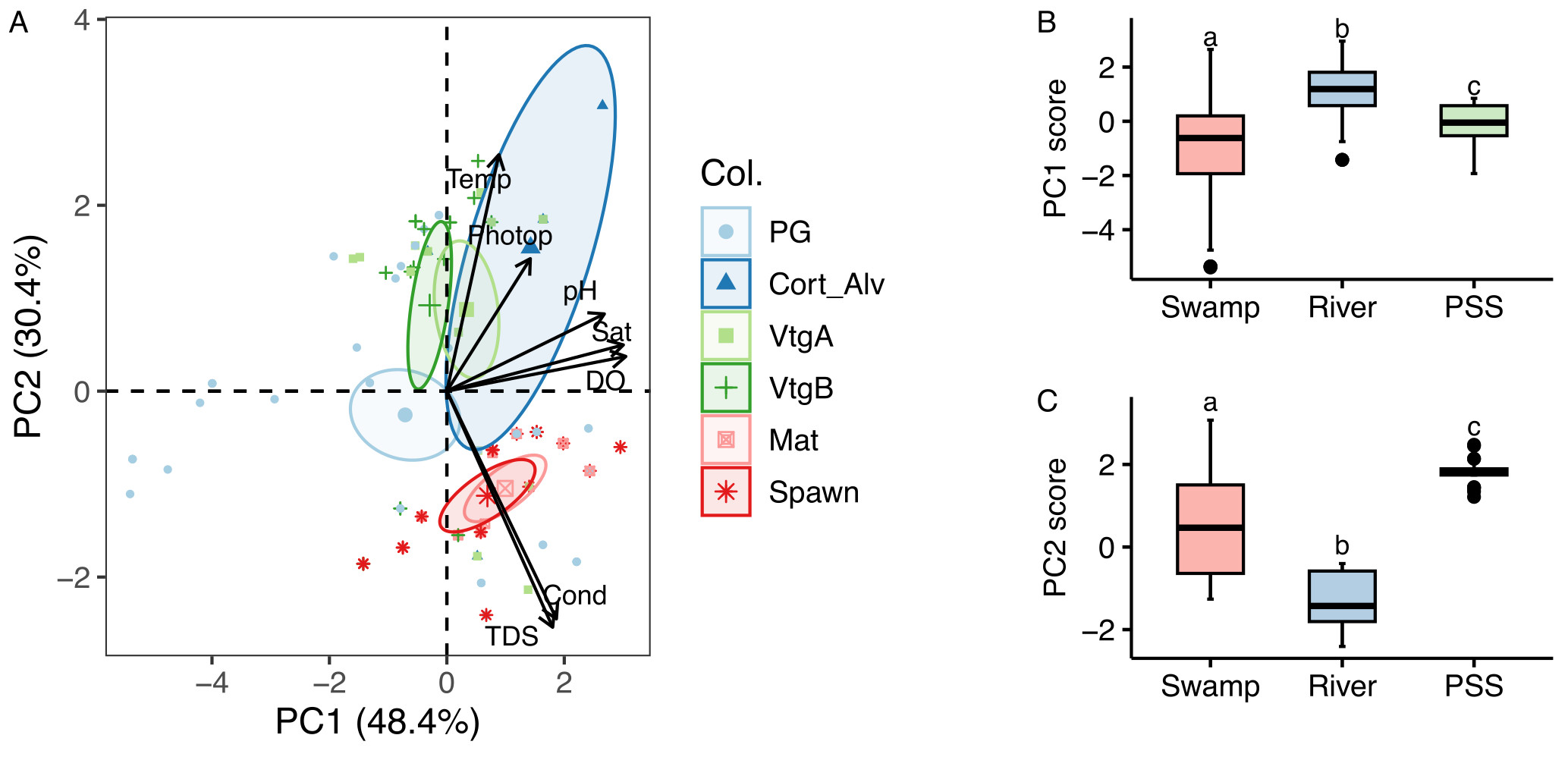
FIGURE 6 | Principal component analysis (PCA) describing relationships between ovarian developmental stages of Prochilodus magdalenae and environmental variables across environments. A. PCA ordination biplot showing individual observations (points) and environmental variables (arrows), and ovarian developmental stages. Large labels and colored symbols represent the centroids of each ovarian stage, with confidence ellipses indicating the dispersion of observations around each stage. B. Boxplots of PC1 scores by environment. C. Boxplots of PC2 scores by environment. Differences in PC scores among environments were assessed using pairwise Wilcoxon rank-sum tests with false discovery rate correction. Different lowercase letters indicate statistically significant differences (p < 0.05). Cond, electrical conductivity; Cort_Alv, cortical alveoli; DO, dissolved oxygen; Mat, mature; PG, primary growth; Photop, photoperiod; Sat, oxygen saturation percentage; Spawn, spawning; TDS, total dissolved solids; Temp, water temperature; VtgA, initial vitellogenesis; VtgB, final vitellogenesis.
TABLE 1 | Description of the significant variables associated with the given principal component across the three environments. Cond, electrical conductivity; DO, dissolved oxygen; PC1, principal component 1; PC2, principal component 2;pH, water pH; Sat, oxygen saturation percentage; TDS, total dissolved solids; Temp, water temperature. p-value <0.05.
Component | Variable | Correlation | p-value |
PC1 | DO | 0.94 | 2.92 x 10-51 |
Sat | 0.92 | 9.15 x 10–46 | |
pH | 0.81 | 2.38 x 10⁻²⁶ | |
PC2 | Temp | 0.80 | 6.70 x 10⁻²⁵ |
Cond | -0.72 | 1.87 x 10⁻¹⁸ | |
TDS | -0.74 | 4.00 x 10⁻²⁰ |
TABLE 2 | Significance of the smooth terms for environmental cues included in the Generalized Additive Model (GAM), which explained 45.3% of the deviance. DO, dissolved oxygen; TDS, Total dissolved solids; Temp, water temperature. p-value <0.05, significant values of the explanatory variables.
Environmental cue | EDF | Ref.df | Chi2 | p-value |
TDS | 1.79 | 2.16 | 6.79x10-01 | 0.7453 |
TDS Jul – Aug | 4.64 | 5.26 | 20.10 | 0.0006 |
TDS Sep – Nov | 1 | 1 | < 0.01 | 1 |
TDS Dec – Mar | 2.79 | 3.35 | 4.96 | 0.21 |
Temp | 2.16 | 2.69 | 59.45 | < 2e-16 |
Temp Jul – Aug | 5.42x10-05 | 9.43x10-05 | 4.94x1005 | < 2e-16 |
Temp Sep – Nov | 1 | 1 | 31.63 | < 2e-16 |
Temp Dec – Mar | 3.70 | 4.52 | 18.38 | 0.0018 |
DO | 1 | 1 | 5.72 | 0.017 |
DO Jul – Aug | 1.63 | 1.88 | 40.20 | 0.78 |
DO Sep – Nov | 3.31 | 4.06 | 15.08 | 0.0048 |
DO Dec – Mar | 3.53×10-05 | 6.80x10-05 | 537.40 | < 2e-16 |

FIGURE 7 | Effects of significant environmental variables on oogenesis in Prochilodus magdalenae as predicted by the generalized additive model (GAM). Black solid lines represent the estimated smooth terms, shaded areas indicate 95% confidence intervals, and gold points correspond to model residuals. A. Seasonal effect of total dissolved solids during July-August; B. Overall effect of water temperature; C. Seasonal temperature effect during July-August; D. Seasonal temperature effect during September-November; E. Seasonal temperature effect during December-March; F. Overall effect of dissolved oxygen; G. Seasonal dissolved oxygen effect during September-November; H. seasonal dissolved oxygen effect during December-March. DO, dissolved oxygen; TDS, total dissolved solids; Temp, water temperature.
Environmental modulation of oogenesis – Generalized Additive Model (GAM). The GAM explained 45.3% of the deviance in ovarian developmental stage and revealed a significant environmental effect (Tab. 2). Although River females reached mature and spawning stages, vitellogenic ovaries observed in PSS occupied a higher position along the ordered ovarian developmental scale than those from the Swamp, explaining the positive environment effects for River and PSS in the GAM (estimates = 3.94 and 3.74, respectively; p < 0.05). Ovarian progression was significantly influenced by water temperature and dissolved oxygen (p < 0.001 and p = 0.017), while total dissolved solids showed no overall effect (p = 0.74). Environmental effects were strongly season-dependent (Fig. 7), with temperature and oxygen exerting stronger and non-linear effects during reproductive and post-reproductive periods.
As a sensitivity analysis, photoperiod was added to the GAM structure. This model explained slightly more deviance (46.3%) than the original model, but the inclusion of photoperiod reduced the apparent strength of some temperature effects, indicating partial temporal overlap among photoperiod, temperature, and seasonal grouping.
After accounting for ovarian stage, plasma estradiol concentrations remained significantly associated with environmental variables. The E2 GAM explained 79% of the deviance, with significant non-linear effects of water temperature (p = 0.036), total dissolved solids (p = 0.025), oxygen saturation (p = 0.025), and conductivity (p = 0.004) (Fig. 8; Tab. S6). In contrast, photoperiod did not significantly influence E2 concentrations and was therefore excluded from the final model. These results suggest that, within the limited annual photoperiod variation observed in the Magdalena basin (12.1 ± 0.3h) during the study period, physiochemical variables exert a stronger influence on endocrine activity than day length. Nevertheless, the observational nature of the study does not allow the complete exclusion of photoperiod as a potential reproductive cue.
Sensitivity analysis. More conservative ovarian-stage classifications produced results comparable to the original model. Across scenarios, deviance explained ranged from 0.43–0.45, and temperature and oxygen effects remained significant during key seasonal periods (Tab. S7), indicating limited sensitivity of late-stage classification (Tab. S8).

FIGURE 8 | Effects of significant environmental variables on plasma estradiol (E2) concentrations in Prochilodus magdalenae as predicted by the generalized additive model (GAM). Black solid lines represent the estimated smooth functions, shaded areas indicate 95% confidence intervals, and gold points correspond to model residuals. A. Seasonal effect of total dissolved solids during July-August; B. Overall temperature effect; C. Seasonal temperature effect during July-August; D. Seasonal temperature effect during September-November; E. Seasonal temperature effect during December-March; F. Overall effect of dissolved oxygen; G. Seasonal effect of dissolved oxygen during September-November; H. Seasonal effect of dissolved oxygen during December-March.
Discussion
The present study demonstrates clear spatial and temporal differences in ovarian development of P. magdalenae across natural and captive environments. Mature and spawning stages were observed exclusively in the river environment, whereas these stages were absent in the Swamp and under aquaculture conditions (PSS). In the river, mature ovaries were detected from July to October and spawning from July to December, coinciding with the reproductive season. These late reproductive stages were positively associated with decreases in water temperature, increases in dissolved oxygen, and higher total dissolved solids, highlighting the importance of specific physicochemical conditions for the completion of oogenesis and spawning in this species.
Spatio-temporal distribution of the ovarian stages of P. magdalenae showed that a high proportion of females remained in the primary growth stage for most of the sampling period in both the Swamp and River environments. As reported for other Neotropical fishes, including Pimelodus maculatus, Prochilodus argenteus,and Leporinus taeniatus, the primary growth phase represented the longest period of the reproductive cycle (Santos et al., 2008; Arantes et al., 2010; Wildner et al., 2013). In the Swamp, cortical alveoli and vitellogenic stages predominated during non-reproductive seasons (July-August and December-March), whereas vitellogenesis in the river was closely aligned with the reproductive season (September-November), emphasizing habitat-specific differences in ovarian progression.
In contrast, females maintained under PSS conditions exhibited a high prevalence of follicular atresia throughout most of the study period. Although some primary growth oocytes and oogonial nests persisted during this phase, the predominance of atretic ovaries indicates an interruption of oogenesis and preparation for a new reproductive cycle under captive conditions. Similar prolonged atretic phases have been reported in other tropical fishes, such as L. taeniatus and Cynoscion nebulosus, under unfavorable or captive conditions (Santos et al., 2008; Brown-Peterson et al., 2011).
Multivariate analyses provided further insight into the environmental regulation of oogenesis. PCA results indicated that water temperature was a major source of variability associated with early ovarian progression, particularly the transition from cortical alveoli to vitellogenesis. This is consistent with previous studies showing that temperature acts as a primary regulator of oocyte growth and endocrine activity in teleost fishes by stimulating estradiol synthesis and vitellogenin production (Tyler, Sumpter, 1996; Lubzens et al., 2010). In migratory Neotropical fishes, vitellogenic progression often coincides with seasonal warming that precedes flood pulses, indicating that temperature acts as an early permissive cue for ovarian recrudescence, while completion of oogenesis depends on subsequent hydrological signals (Bailly et al., 2008; Arantes et al., 2011b).
In contrast, mature and spawning stages were more strongly associated with dissolved oxygen, oxygen saturation, electrical conductivity, and total dissolved solids, suggesting that late reproductive phases depend on physicochemical conditions characteristic of floodplain connectivity and habitat transition. Comparable patterns have been described in gymnotiform and characiform fishes, where changes in oxygen availability and ionic composition accompanying rising water levels are linked to final gonadal preparation and spawning (Kirschbaum, 1979; Kirschbaum, Schugardt, 2002; Chellappa et al., 2003). Together, these findings support a bimodal regulation of oogenesis in P. magdalenae, with temperature primarily modulating early oogenic progression and broader water chemistry conditions contributing to the completion of oocyte development and spawning. Sensitivity analyses further confirmed that these patterns were robust to conservative reclassification of late oogenic stages.
Rainfall plays a central role in shaping physicochemical dynamics by altering temperature, dissolved oxygen, turbidity, electrical conductivity, and pH in Neotropical aquatic systems (Chellappa et al., 2003; Arantes et al., 2011b; Boncompagni-Júnior et al., 2013). However, the effectiveness of rainfall as a reproductive cue is species-dependent, as demonstrated by contrasting responses among gymnotiform fishes (Kirschbaum, Schugardt, 2002; Schugardt, Kirschbaum, 2004). Our results support the view that oogenesis in tropical teleosts is a multifactorial process driven by interacting environmental cues rather than a single trigger.
Among these factors, water temperature remains the most studied and consistently identified driver of oogenesis in both tropical and temperate migratory fishes (Arantes et al., 2011; Kovach et al., 2016; Lynch et al., 2016; Austin et al., 2019; Woods et al., 2022). In many potamodromous species, temperature initiates oogenic progression, while subsequent stages are completed during migration under distinct physicochemical conditions (Bailly et al., 2008; Suzuki et al., 2009). The strong association between temperature and early ovarian development observed in both PCA and GAM analysis in this work is therefore consistent with established reproductive strategies in migratory fishes.
Circannual fluctuations in water quality also regulate biological processes such as migration across Neotropical aquatic environments (Melack, Forsberg, 2001; Cognato, Fialho, 2006; Crampton, 2011; Affonso et al., 2015). The bocachico migrates from lentic to lotic environments at the onset of the low rainy season (Mojica et al., 2012), a period characterized in this study by decreases in water temperature, oxygen saturation, dissolved oxygen and pH in the Swamp. The combination of these factors likely acts as a signal initiating migration toward River spawning habitats.
Integration of endocrine data further strengthened these interpretations. Plasma estradiol concentrations closely followed ovarian developmental progression, reaching peak values during advanced vitellogenesis, a pattern consistent with the central role of estradiol in vitellogenin synthesis and oocyte growth rather than during the mature stage (Nagahama, 1994; Lubzens et al., 2010; Elisio et al., 2014). Importantly, after accounting for ovarian stage, estradiol levels remained significantly associated with environmental variables, particularly water temperature, indicating that external conditions modulate endocrine activity beyond intrinsic ovarian regulation. These findings reinforce the role of temperature as a key mediator linking environmental variability and endocrine control of oogenesis in P. magdalenae.
Although temperature emerged as one of the principal environmental variables associated with ovarian development in bocachico, our results do not exclude a potential role of photoperiod in regulating reproductive timing. Photoperiod was estimated from astronomical day length and incorporated into exploratory analyses, where it contributed to environmental variation and produced a modest improvement in the oogenesis-stage GAM. However, its effects were weaker than those of the main physicochemical variables and it did not significantly explain variation in plasma estradiol concentrations. These findings suggest that, within the relatively narrow annual photoperiod range observed in the Magdalena basin (12.1 ± 0.3 h), day length may act as a secondary seasonal cue, whereas temperature and associated physicochemical changes appear to exert a stronger influence on oogenesis. Nevertheless, because ambient light intensity and underwater irradiance were not measured, the potential contribution of light-related cues cannot be fully evaluated and deserves further investigation in equatorial Neotropical migratory fishes.
Under PSS conditions, physicochemical parameters exhibited lower temporal variability than in the natural environments. Despite reaching high estradiol levels during advanced vitellogenesis, females failed to undergo mature and spawning stages. Such decoupling between vitellogenesis and oocyte maturation is common under captive conditions, where absence or alteration of environmental cues can disrupt endocrine signaling pathways (Lubzens et al., 2010; Elisio et al., 2014). The absence of final oocyte maturation in PSS females is therefore interpreted as resulting from the combined effects of captivity-related stress and the lack of specific environmental triggers required to activate the final maturation pathway, rather than from follicular atresia alone (Zohar, Mylonas, 2001; Honji et al., 2009; Hainfellner et al., 2012). Because follicular atresia was frequently observed in females that failed to complete mature and spawning stages, it is interpreted here as evidence of disrupted reproductive progression under captive conditions rather than as a normal post-spawning ovarian regression process.
Another emerging hypothesis is that disruption of hydrologic and lateral river-floodplain connectivity, whether caused by anthropogenic (i.e., damming and flow regulation) or natural hydrological conditions, restrict migratory access to suitable spawning and nursery habitats. Under these altered conditions, migratory fishes may remain in lentic or hydrologically isolated environments where ovarian development can proceed to advanced vitellogenic stages, but mature and spawning stages are impaired, resembling the reproductive dysfunction often observed when critical environmental cues are absent or insufficient. Such mechanisms may contribute to follicular atresia, reduced spawning success, diminished reproductive potential, and ultimately long-term declines in migratory fish populations (Pringle, 2003; Sato et al., 2005; Souza et al., 2021; Stoffels et al., 2022).
Notably, water temperature in the PSS environment was consistently higher during the reproductive season than in the Swamp and River. This thermal regime coincided with a higher proportion of atretic ovaries. Elevated or non-optimal temperatures prior to ovulation have been shown to disrupt endocrine regulation, inhibit ovulation, and delay spawning in teleost fishes (Pavlov, Moksness, 1996; Van Der Kraak, Pankhurst, 1997). Thus, the altered thermal conditions under captivity likely contributed to the increased occurrence of follicular atresia observed in the PSS females.
Seasonal variation of water physicochemical parameters and the progression of oogenesis have not been extensively studied in migratory Neotropical fish. The present results demonstrate that oogenesis in P. magdalenae is mediated by the environmental cues evaluated, which are potentially affected by climate change (Shetty et al., 2015; Servili et al., 2020). Therefore, this study on P. magdalenae reproductive phenology provides a baseline for future research on physicochemical tolerance and may contribute to strategies to mitigate biodiversity loss associated with multiple environmental stressors.
Overall, the present study highlights that oogenesis in P. magdalenae is regulated by the interaction of multiple environmental cues. By linking environmental variability, endocrine responses, and ovarian development across natural and captive contexts, these findings provide a valuable framework for understanding reproductive phenology, improving aquaculture practices, and anticipating the impacts of environmental change on Neotropical migratory fishes.
Acknowledgments
Thanks are due to Dr. Arianna Servili and Dr. Benjamin Geffroy for their invaluable contribution to the document. Jenny K. Hoya, Maria Y. Torres Chaparro, Jorge L. Aristizabal, Ana L. Estrada, and Dr. Adriana Rodríguez Forero for the technical assistance.
References
Affonso AG, Queiroz HL, Novo EMLM. Abiotic variability among different aquatic systems of the central Amazon floodplain during drought and flood events. Braz J Biol. 2015; 75(4 suppl. 1):60–69. https://doi.org/10.1590/1519-6984.04214
Albus U. Guide for the care and use of laboratory animals. Washington D.C.: The National Academies Press; 2011.
Arantes FP, Santos HB, Rizzo E, Sato Y, Bazzoli N. Profiles of sex steroids, fecundity, and spawning of the curimata-pacu Prochilodus argenteus in the Sao Francisco River, downstream from the Três Marias Dam, Southeastern Brazil. Anim Reprod Sci. 2010; 118(2–4):330–36. https://doi.org/10.1016/j.anireprosci.2009.07.004
Arantes FP, Santos HB, Rizzo E, Sato Y, Bazzoli N. Influence of water temperature on induced reproduction by hypophysation, sex steroids concentrations and final oocyte maturation of the “curimata-pacu” Prochilodus argenteus (Pisces: Prochilodontidae). Gen Comp Endocrinol. 2011a; 172(3):400–08. https://doi.org/10.1016/j.ygcen.2011.04.007
Arantes FP, Santos HB, Rizzo E, Sato Y, Bazzoli N. Collapse of the reproductive process of two migratory fish (Prochilodus argenteus and Prochilodus costatus) in the Três Marias Reservoir, São Francisco River, Brazil. J Appl Ichthyol. 2011b; 27:847–53. https://doi.org/10.1111/j.1439-0426.2010.01583.x
Asahina K, Kambegawa A, Higashi T. Development of a microtiter plate enzyme-linked immunosorbent assay for 17 α, 20 β-21-trihydroxy-4-pregnen-3-one, a teleost gonadal steroid. Fish Sci. 1995; 61:491–94. https://doi.org/10.2331/fishsci.61.491
Atencio-García V, Kerguelén DE, Naar E, Petro R. Desempeño reproductivo del bocachico Prochilodus magdalenae inducido dos veces en un mismo año. Rev MVZ Córdoba. 2013; 18(1):3304–10. https://doi.org/10.21897/rmvz.192
Austin CS, Essington TE, Quinn TP. Spawning and emergence phenology of bull trout under differing thermal regimes. J Fish Biol. 2019; 94(1):191–95. https://doi.org/10.1111/jfb.13864
Bailly D, Agostinho AA, Suzuki HI. Influence of the flood regime on the reproduction of fish species with different reproductive strategies in the Cuiabá River, Upper Pantanal, Brazil. River Res Appl. 2008; 24(9):1218–29. https://doi.org/10.1002/rra.1147
Bialetzki A, Nakatani K, Sanches PV, Baumgartner G, Gomes LC. Larval fish assemblage in the Baía River (Mato Grosso do Sul State, Brazil): temporal and spatial patterns. Environ Biol Fishes. 2005; 73:37–47. https://doi.org/10.1007/s10641-004-3795-3
Bobe J, Labbé C. Egg and sperm quality in fish. Gen Comp Endocrinol. 2010; 165(3):535–48. https://doi.org/10.1016/j.ygcen.2009.02.011
Boncompagni-Júnior O, Normando FT, Brito MFG, Bazzoli N. Reproductive biology of Prochilodus argenteus Agassiz, 1829 (Pisces: Prochilodontidae) in São Francisco River, Brazil. J Appl Ichthyol. 2013; 29:132–38. https://doi.org/10.1111/jai.12018
Brown-Peterson NJ, Wyanski DM, Saborido-Rey F, Macewicz BJ, Lowerre-Barbieri SK. A standardized terminology for describing reproductive development in fishes. Mar Coast Fish. 2011; 3(1):52–70. https://doi.org/10.1080/19425120.2011.555724
Chellappa S, Câmara MR, Chellappa NT, Beveridge MCM, Huntingford FA. Reproductive ecology of a neotropical cichlid fish, Cichla monoculus (Osteichthyes: Cichlidae). Braz J Biol. 2003; 63(1):17–26. https://doi.org/10.1590/S1519-69842003000100004
Cognato DP, Fialho CB. Reproductive biology of a population of Gymnotus aff. carapo (Teleostei: Gymnotidae) from southern Brazil. Neotrop Ichthyol. 2006; 4(3):339–48. https://doi.org/10.1590/S1679-62252006000300005
Crampton WGR. An ecological perspective on diversity and distributions. In: James A, editor. Historical biogeography of Neotropical freshwater fishes. Oakland: California Scholarship Online; 2011. p.165–89.
Doria-González MA, Espitia-Galvis AM, Segura-Guevara FF, Olaya-Nieto CW. Biología reproductiva del bocachico Prochilodus magdalenae (Prochilodontidae) en el río San Jorge, Colombia. Acta Biol Colomb. 2021; 26(1):54–61. https://doi.org/10.15446/abc.v26n1.82907
Durant JM, Hjermann DØ, Ottersen G, Stenseth NC. Climate and the match or mismatch between predator requirements and resource availability. Clim Res. 2007; 33:271–83. https://doi.org/10.3354/cr033271
Elisio M, Chalde T, Miranda LA. Effects of short periods of warm water fluctuations on reproductive endocrine axis of the pejerrey (Odontesthes bonariensis) spawning. Comp Biochem Physiol A Mol Integr Physiol. 2012; 163(1):47–55. https://doi.org/10.1016/j.cbpa.2012.05.178
Elisio M, Chalde T, Miranda LA. Seasonal changes and endocrine regulation of pejerrey (Odontesthes bonariensis) oogenesis in the wild. Comp Biochem Physiol A Mol Integr Physiol. 2014; 175:102–09. https://doi.org/10.1016/j.cbpa.2014.05.020
Falcón J, Migaud H, Muñoz-Cueto JA, Carrillo M. Current knowledge on the melatonin system in teleost fish. Gen Comp Endocrinol. 2010; 165(3):469–82. https://doi.org/10.1016/j.ygcen.2009.04.026
Flecker AS. Ecosystem engineering by a dominant detritivore in a diverse tropical stream. Ecology. 1996; 77(6):1845–54. https://doi.org/10.2307/2265788
Goulding M. The fishes and the forest in Amazonian natural history. Berkeley/Los Angeles/London: University of California Press; 1980.
Hainfellner P, Souza TG, Moreira RG, Nakaghi LSO, Batlouni SR. Gonadal steroids levels and vitellogenesis in the formation of oocytes in Prochilodus lineatus (Valenciennes) (Teleostei: Characiformes). Neotrop Ichthyol. 2012; 10(3):601–12. https://doi.org/10.1590/S1679-62252012005000021
Honji RM, Narcizo AM, Borella MI, Romagosa E, Moreira RG. Patterns of oocyte development in natural habitat and captive Salminus hilarii Valenciennes, 1850 (Teleostei: Characidae). Fish Physiol Biochem. 2009; 35:109–23. https://doi.org/10.1007/s10695-008-9239-9
Jiménez-Segura LF, Palacio J, Leite R. River flooding and reproduction of migratory fish species in the Magdalena River basin, Colombia. Ecol Freshw Fish. 2010; 19:178–86. https://doi.org/10.1111/j.1600-0633.2009.00402.x
Kassambara A, Mundt F. Factoextra: extract and visualize the results of multivariate data analyses. R package version 1.0.7. 2020. Available from: https://CRAN.R-project.org/package=factoextra
Kirschbaum F. Reproduction of the weakly electric fish Eigenmannia virescens (Rhamphichtyidae, Teleostei) in captivity. Behav Ecol Sociobiol. 1979; 4:331–55. https://doi.org/10.1007/BF00303241
Kirschbaum F, Schugardt C. Reproductive strategies and developmental aspects in mormyrid and gymnotiform fishes. J Physiol Paris. 2002; 96(5–6):557–66. https://doi.org/10.1016/S0928-4257(03)00011-1
Kovach RP, Muhlfeld CC, Al-Chokhachy R, Dunham JB, Letcher BH, Kershner JL. Impacts of climatic variation on trout: a global synthesis and path forward. Rev Fish Biol Fish. 2016; 26:135–51. https://doi.org/10.1007/s11160-015-9414-x
Kramer DL. Reproductive seasonality in the fishes of a tropical stream. Ecology. 1978; 59:976–85. https://doi.org/10.2307/1938549
Lopes AF, Faria AM, Dupont S. Elevated temperature, but not decreased pH, impairs reproduction in a temperate fish. Sci Rep. 2020; 10:20805. https://doi.org/10.1038/s41598-020-77906-1
Loury EK, Elliott VL, Ainsley SM, Baird IG, Baumgartner LJ, Chhuoy S et al. Priority knowledge needs for management of migratory fish species in Cambodia. Fish Manag Ecol. 2021; 28(5):393–416. https://doi.org/10.1111/fme.12483
Lubzens E, Young G, Bobe J, Cerdà J. Oogenesis in teleosts: how fish eggs are formed. Gen Comp Endocrinol. 2010; 165(3):367–89. https://doi.org/10.1016/j.ygcen.2009.05.022
Lynch AJ, Myers BJE, Chu C, Eby LA, Falke JA, Kovach RP et al. Climate change effects on North American inland fish populations and assemblages. Fisheries. 2016; 41(7):346–61. https://doi.org/10.1080/03632415.2016.1186016
Ministerio de Agricultura y Desarrollo Rural (MADR). Anuario estadístico del sector agropecuario, resultados evaluaciones agropecuarias municipales. 2013. Available from: http://hdl.handle.net/20.500.12324/12137
McConnell RHL. The fishes of the Rupununi savanna district of British Guiana, South America: Part 1. Ecological groupings of fish species and effects of the seasonal cycle on the fish. Zool J Linn Soc. 1964; 45(304):103–44. https://doi.org/10.1111/j.1096-3642.1964.tb00490.x
McMillan DB. Fish histology female reproductive systems. Dordrecht: Springer Verlag; 2007.
Melack JM, Forsberg BR. Biogeochemistry of Amazon floodplain lakes and associated wetlands. In: McClain, ME, Victoria R, Richey JE, editors. The biogeochemistry of the Amazon basin. New York: Oxford University Press; 2001. p.235–74.
Melo BF, Sato Y, Foresti F, Oliveira C. The roles of marginal lagoons in the maintenance of genetic diversity in the Brazilian migratory fishes Prochilodus argenteus and P. costatus. Neotrop Ichthyol. 2013; 11(03):625–36. https://doi.org/10.1590/S1679-62252013000300016
Miranda LA, Chalde T, Elisio M, Strüssmann CA. Effects of global warming on fish reproductive endocrine axis, with special emphasis in pejerrey Odontesthes bonariensis. Gen Comp Endocrinol. 2013; 192(1):45–54. https://doi.org/10.1016/j.ygcen.2013.02.034
Mojica JI, Usma-Oviedo JS, Álvarez-León R, Lasso CA. Libro rojo de peces dulceacuícolas de Colombia. Bogotá: Instituto de Investigación de Recursos Biológicos Alexander von Humboldt, Instituto de Ciencias Naturales de la Universidad Nacional de Colombia, WWF Colombia y Universidad de Manizales. 2012.
Mylonas CC, Zohar Y. Promoting oocyte maturation, ovulation and spawning in farmed fish. In: Babin PJ, Cerdà J, Lubzens E, editors. The fish oocyte: from basic studies to biotechnological applications. Dordrecht: Springer Netherlands; 2007. p.437–74.
Nagahama Y. Endocrine regulation of gametogenesis in fish. J Dev Biol. 1994; 38(2):217–29. https://ijdb.ehu.eus/article/7981031
Nagahama Y, Yamashita M. Regulation of oocyte maturation in fish. Dev Growth Differ. 2008; 50(s1):S195–S219. https://doi.org/10.1111/j.1440-169X.2008.01019.x
Nati JJH, Svendsen MBS, Marras S, Killen SS, Steffensen JF, McKenzie DJ et al. Intraspecific variation in thermal tolerance differs between tropical and temperate fishes. Sci Rep. 2021; 11:21272. https://doi.org/10.1038/s41598-021-00695-8
Okuzawa K, Gen K. High water temperature impairs ovarian activity and gene expression in the brain-pituitary-gonadal axis in female red seabream during the spawning season. Gen Comp Endocrinol. 2013; 194:24–30. https://doi.org/10.1016/j.ygcen.2013.08.015
Pavlov DA, Moksness E. Repeat sexual maturation of wolffish (Anarhichas lupus L.) broodstock. Aquaculture. 1996; 139(3–4):249–63. https://doi.org/10.1016/0044-8486(95)01169-2
Perkins-Kirkpatrick SE, Lewis SC. Increasing trends in regional heatwaves. Nat Commun. 2020; 11:3357. https://doi.org/10.1038/s41467-020-16970-7
Pham HQ, Kjørsvik E, Nguyen AT, Nguyen MD, Arukwe A. Reproductive cycle in female Waigieu seaperch (Psammoperca waigiensis) reared under different salinity levels and the effects of dopamine antagonist on steroid hormone levels. J Exp Mar Biol Ecol. 2010; 383(2):137–45. https://doi.org/10.1016/j.jembe.2009.12.010
Pringle C. What is hydrologic connectivity and why is it ecologically important? Hydrol Process. 2003; 17(13):2685–89. https://doi.org/10.1002/hyp.5145
R Development Core Team. R: a language and environment for statistical computing. Vienna, Austria: R Foundation for Statistical Computing; 2024. Available from: https://www.r-project.org/
Roland F, Huszar VLM, Farjalla VF, Enrich-Prast A, Amado AM, Ometto JPHB. Climate change in Brazil: perspective on the biogeochemistry of inland waters. Braz J Biol. 2012; 72(3):709–22. https://doi.org/10.1590/S1519-69842012000400009
Rosa RR, Silva JC, Bialetzki A. Long-term monitoring of potamodromous migratory fish larvae in an undammed river. Mar Freshw Res. 2020; 71(3):384–93. https://doi.org/10.1071/MF18412
Rueda EC, Sommer J, Scarabotti P, Markariani R, Ortí G. Isolation and characterization of polymorphic microsatellite loci in the migratory freshwater fish Prochilodus lineatus (Characiformes: Prochilodontidae). Conserv Genet Resour. 2011; 3:681–84. https://doi.org/10.1007/s12686-011-9432-5
dos Santos ALB, Pessanha ALM, Araújo FG, Costa MR. Environmental constraints on distribution and reproductive period of Orthopristis ruber (Cuvier) (Teleostei, Haemulidae) in the Sepetiba Bay, Rio de Janeiro, Brasil. Rev Bras Zool. 2007; 24(4):1017–24. https://doi.org/10.1590/S0101-81752007000400019
Santos HB, Thomé RG, Arantes FP, Sato Y, Bazzoli N, Rizzo E. Ovarian follicular atresia is mediated by heterophagy, autophagy, and apoptosis in Prochilodus argenteus and Leporinus taeniatus (Teleostei: Characiformes). Theriogenology. 2008; 70(9):1449–60. https://doi.org/10.1016/j.theriogenology.2008.06.091
Schaan AB, Giora J, Fialho CB. Reproductive biology of the Neotropical electric fish Brachyhypopomus draco (Teleostei: Hypopomidae) from southern Brazil. Neotrop Ichthyol. 2009; 7(4):737–44. https://doi.org/10.1590/S1679-62252009000400023
Schugardt C, Kirschbaum F. Control of gonadal maturation and regression by experimental variation of environmental factors in the mormyrid fish, Mormyrus rume proboscirostris. Environ Biol Fishes. 2004; 70:227–33. https://doi.org/10.1023/B:EBFI.0000033340.49266.f3
Selvaraj S, Ohga H, Kitano H, Nyuji M, Yamaguchi A, Matsuyama M. Peripheral administration of Kiss1 pentadecapeptide induces gonadal development in sexually immature adult scombroid fish. Zool Sci. 2013; 30(6):446–54. https://doi.org/10.2108/zsj.30.446
Servili A, Canario AVM, Mouchel O, Muñoz-Cueto JA. Climate change impacts on fish reproduction are mediated at multiple levels of the brain-pituitary-gonad axis. Gen Comp Endocrinol. 2020; 291:113439. https://doi.org/10.1016/j.ygcen.2020.113439
Shetty A, Venkateshwarlu M, Muralidharan M. Effect of water quality on the composition of fish communities in three coastal rivers of Karnataka, India. Int J Aquat Biol. 2015; 3(1):42–51. https://doi.org/10.22034/ijab.v3i1.46
Silva A, Quintana L, Galeano M, Errandonea P. Biogeography and greeding in Gymnotiformes from Uruguay. Environ Biol Fishes. 2003; 66:329–38. https://doi.org/10.1023/A:1023986600069
Silva JC, Rosa RR, Galdioli EM, Soares CM, Domingues WM, Veríssimo S et al. Importance of dam-free stretches for fish reproduction: the last remnant in the Upper Paraná River. Acta Limnol Bras. 2017; 29:e106. https://doi.org/10.1590/S2179-975X10216
da Silva J, Brambila-Souza G, Araujo DM, Moreira RG. Effects of vitamin A supplementation on ovarian development of Astyanax lacustris (Teleostei: Characidae) during the non-breeding season. Comp Biochem Physiol A Mol Integr Physiol. 2022; 265:111132. https://doi.org/10.1016/j.cbpa.2021.111132
Šmejkal M, Bartoň D, Blabolil P, Kolařík T, Kubečka J, Sajdlová Z et al. Diverse environmental cues drive the size of reproductive aggregation in a rheophilic fish. Mov Ecol. 2023; 11:16. https://doi.org/10.1186/s40462-023-00379-0
Souza LMA, Theobaldo GG, Rizzo E, Santos JE, Bazzoli N, Paschoalini AL. Evaluation of the reproductive parameters of female neotropical migratory fish from a lotic and lentic environment of a dammed river. Trop Zool. 2021; 34(1):16–23. https://doi.org/10.4081/tz.2021.73
Steindachner F. Zur Fisch-fauna des Magdalenen-Stromes. Denkschr Kaiserl Akad Wiss Wien Math-Naturwiss Kl. 1879; 39(1):19–78.
Stoffels RJ, Humphries P, Bond NR, Price AE. Fragmentation of lateral connectivity and fish population dynamics in large rivers. Fish Fish. 2022; 23(3):680–96. https://doi.org/10.1111/faf.12641
Suzuki KW, Nakayama K, Tanaka M. Horizontal distribution and population dynamics of the dominant mysid Hyperacanthomysis longirostris along a temperate macrotidal estuary (Chikugo River estuary, Japan). Estuar Coast Shelf Sci. 2009; 83(4):516–28. https://doi.org/10.1016/j.ecss.2009.04.023
Sverdrup-Jensen S. Fisheries in the lower Mekong basin: status and perspectives. Phnom Penh: Mekong River Commission; 2002.
Thieurmel B, Elmarhraoui A. suncalc: Compute Sun Position, Sunlight Phases, Moon Position and Lunar Phase [Internet]. 2022. Available from: https://CRAN.R-project.org/package=suncalc
Tokarz J, Möller G, de Angelis MH, Adamski J. Steroids in teleost fishes: a functional point of view. Steroids. 2015; 103:123–44. https://doi.org/10.1016/j.steroids.2015.06.011
Tyler CR, Sumpter JP. Oocyte growth and development in teleosts. Rev Fish Biol Fish. 1996; 6:287–318. https://doi.org/10.1007/BF00122584
Van Der Kraak G, Pankhurst NW. Temperature effects on the reproductive performance of fish. In: Wood CM, McDonald DG, editors. Global warming: implications for freshwater and marine fish. Society for Experimental Biology Seminar Series. Cambridge: Cambridge University Press; 1997. p.159–76.
Volpato GL, Trajano E. Biological rhythms. Fish Physiol. 2005; 21:101–53. https://doi.org/10.1016/S1546-5098(05)21004-X
Waddell JC, Crampton WGR. Environmental correlates of circannual breeding periodicity in a multi-species assemblage of Amazonian electric fishes. Environ Biol Fishes. 2020; 103:233–50. https://doi.org/10.1007/s10641-020-00950-3
Wildner DD, Grier H, Quagio-Grassiotto I. Female germ cell renewal during the annual reproductive cycle in Ostariophysians fish. Theriogenology. 2013; 79(4):709–24. https://doi.org/10.1016/j.theriogenology.2012.11.028
Wood SN. Fast stable restricted maximum likelihood and marginal likelihood estimation of semiparametric generalized linear models. J R Stat Soc Series B Stat Methodol. 2011; 73(1):3–36. https://doi.org/10.1111/j.1467-9868.2010.00749.x
Woods T, Kaz A, Giam X. Phenology in freshwaters: a review and recommendations for future research. Ecography. 2022; 2022(6):e05564. https://doi.org/10.1111/ecog.05564
Yazbeck GM, Kalapothakis E. Isolation and characterization of microsatellite DNA in the piracema fish Prochilodus lineatus (Characiformes). Genet Mol Res; 2007; 6(4):1026–34.
Sato Y, Bazzoli N, Rizzo E, Boschi MB, Miranda MOT. Influence of the Abaeté River on the reproductive success of the neotropical migratory teleost Prochilodus argenteus in the São Francisco River, downstream from the Três Marias Dam, southeastern Brazil. River Res Appl. 2005; 21(8):939–50. https://doi.org/doi:10.1002/rra.859
Zohar Y, Mylonas CC. Endocrine manipulations of spawning in cultured fish: from hormones to genes. Aquaculture. 2001; 197(1–4):99–136. https://doi.org/10.1016/S0044-8486(01)00584-1
Authors

Eduardo Hernández-Hernández1, Ricardo Oliveros-Ramos2, Leandro Miranda3, Antonio García-Fernández1 and Oswaldo Tovar-Bohórquez3
[1] Area de Toxicología, Facultad de Medicina Veterinaria, Instituto Murciano de Investigación Biosanitaria (IMIB) Pascual Parrilla, Universidad de Murcia, Campus Espinardo, 30100 Murcia, España. (EHH) eahernandezh@unal.edu.co, (AGF) ajgf@um.es.
[2] MARBEC, Univ Montpellier, IRD, CNRS, Ifremer, CC 0092- Place Eugène Bataillon 34095, Montpellier, France. (ROR) ricardo. oliveros@gmail.com.
[3] Laboratorio de Ictiofisiología y Acuicultura, Instituto Tecnológico de Chascomús, (CONICET-UNSAM), Escuela de Bio y Nanotecnologías (UNSAM), Intendente Marino km 8.2 (B7130IWA), Chascomús, Buenos Aires, Argentina. (LM) lmiranda@ intech.gov.ar, (OTB) otovar@intech.gov.ar (corresponding author).
Authors’ Contribution 

Eduardo Hernández-Hernádez: Conceptualization, Data curation, Formal analysis, Funding acquisition, Investigation, Methodology, Project administration, Writing-review and editing.
Ricardo Oliveros-Ramos: Data curation, Formal analysis, Methodology, Software, Writing-review and editing.
Leandro Miranda: Formal analysis, Funding acquisition, Methodology, Project administration, Supervision, Validation, Writing-review and editing.
Antonio García-Fernández: Funding acquisition, Methodology, Project administration, Supervision, Validation, Writing-review and editing.
Oswaldo Tovar-Bohórquez: Conceptualization, Data curation, Formal analysis, Funding acquisition, Investigation, Methodology, Project administration, Visualization, Writing-original draft, Writing-review and editing.
Ethical Statement
Fish collection and processing were conducted in accordance with the Guide for the Care and Use of Laboratory Animals (Albus, 2011) and Colombian regulations issued by the Autoridad Nacional de Pesca y Acuicultura (AUNAP, Colombia) under Resolution No 955. According to national regulations, no additional institutional Animal Care and Ethics Committee approval was required for this study.
Competing Interests
The author declares no competing interests.
Data availability statement
Data are available from the authors upon reasonable request.
AI statement
The authors used ChatGPT (OpenAI) solely to assist with editing the English text, correcting grammar, and improving the clarity of the text while drafting this manuscript.
Funding
This study was funded by projects grants by ISAGEN ESP S.A. – PSS S.A. agreement 47/341 to EAHH and MOTB, ANPCyT PICT 2019–2943 to LAM, and Horizon 2020 (Conceiving wastewater treatment in 2020. Energetic, environmental and economic challenges (Water_2020) to AJGF.
Supplementary Material
Supplementary material SUP
Peer Review
How to cite this article
Hernández-Hernández E, Oliveros-Ramos R, Miranda L, García-Fernández A, Tovar-Bohórquez O. Environmental modulation of oogenesis and estradiol dynamics in the Neotropical migratory fish Prochilodus magdalenae (Characiformes: Prochilodontidae). Neotrop Ichthyol. 2026; 24(3):e260025. https://doi.org/10.1590/1982-0224-2026-0025
Copyright
This is an open access article under the terms of the Creative Commons Attribution License, which permits use, distribution and reproduction in any medium, provided the original work is properly cited.
Distributed under
Creative Commons CC-BY 4.0

© 2025 The Authors.
Diversity and Distributions Published by SBI
 Accepted July 20, 2026
Submitted September 18, 2025
Epub October 19, 2026