
 Éder André Gubiani1,2,3
  , Anderson Luís Maciel2,3, Geuza Cantanhêde3, Luiz Guilherme dos Santos Ribas2,3, Pitágoras Augusto Piana1,2,3, Suelen Zontta Kiem3 and Caroline Henn4
PDF: Download Here | Supplementary: Sup | Cite this article
Associate Editor: Francisco Araújo
Section Editor: Fernando Pelicice
Editor-in-chief: José Birindelli
Abstract
O comprimento de primeira maturação (L50) foi estimado para 42 espécies de peixes de água doce capturadas por pescadores profissionais no Reservatório de Itaipu, localizado na bacia do rio Paraná, Estado do Paraná, Brasil. As amostragens foram realizadas entre março de 1988 e outubro de 2024 em 63 locais de pesca profissional, situados na área de influência do reservatório. Os valores estimados de L50 variaram de 8,20 a 81,70 cm. Para 19 espécies, os valores de L50 foram relatados pela primeira vez. Além disso, estimativas atualizadas de L50 para 16 espécies e novos comprimentos máximos para 28 espécies foram registrados, respectivamente. Observamos diferenças estatisticamente claras entre os sexos para L50 em sete espécies, sendo que em cinco delas os machos apresentaram valores maiores de L50 que as fêmeas. Além disso, registramos fortes associações entre L50, Lmax e L100, as quais oferecem alternativas práticas quando os dados reprodutivos são limitados e apoiando o uso de alternativas baseadas em tamanhos em contextos com dados escassos. Essas estimativas podem subsidiar o desenvolvimento de estratégias sustentáveis de manejo pesqueiro e a implementação de regulamentações sobre o tamanho mínimo de malha, contribuindo para evitar a sobrepesca de espécies de interesse comercial na bacia do rio Paraná.
Palavras-chave: Grandes rios, História de vida, Ictiofauna, Manejo pesqueiro, Ogiva de maturação.
Introduction
The length at first maturity (L50) is defined as the mean length at which 50% of individuals in a cohort reach sexual maturity and reproduce at least once, thereby contributing to reproduction (Vazzoler, 1996; Pauly, 2022). Estimating the length and age at sexual maturity for males and females helps clarify the selective pressures shaping sex-reproductive strategies within a population (Immonen et al., 2018). Although L50 is a species-specific trait, it can vary substantially in response to multiple factors and complex ecological contexts, including local environmental conditions (Cox, Hinch, 1997; Cardinale, Modin, 1999; Panfili et al., 2006; Lourenço et al., 2015), resource availability (Tomasini, Laugier, 2005), growth rates and maximum body size (Lourenço et al., 2015), fishing pressure (Sharpe, Hendry, 2009; Lappalainen et al., 2016), and biotic interactions (Wang, Höök, 2009; Sasaki et al., 2024).
Understanding L50 is essential for managing exploited fish populations, as it can indicate overexploitation risk and help set appropriate harvest levels (Polovina, 1987; Domínguez-Petit et al., 2017; Sabbir et al., 2021). L50 and related indicators are valuable for informing decision-making process aimed at determining the best strategies for fisheries management, monitoring, and fish stocks conservation (Giarrizzo et al., 2011; Barzotto, Mateus, 2017). These measures also support responsible fishing practices, including establishing minimum legal catch sizes (Sadovy, 1996; Froese et al., 2008), reducing juvenile harvest, and avoiding depletion of reproductive stocks (Souza et al., 2019). In Brazil, L50 data is used by stakeholders to define minimum legal sizes for harvest (IAT, 2022). Despite the ecological and management relevance of L50, data for many exploited species in Brazilian reservoirs remain scarce or outdated, which hinders the development of effective conservation strategies and sustainable harvest regulations.
Sexual maturity represents a critical life history transition during which individuals must allocate energy among growth, survival, and reproduction (Vazzoler, 1996; Wootton, 1998). Because reproduction is energetically demanding, reliable estimates of length at first maturity (L50) are fundamental to describing reproductive dynamics and informing management measures that protect juveniles and sustain recruitment. In fisheries, L50 is a key reference point because it supports the establishment of minimum catch sizes and reduces the risk of growth overfishing, particularly for slow-growing and late-maturing species (Mateus, Penha, 2007; Froese et al., 2008).
The Itaipu Reservoir is one of the largest and most extensively studied reservoirs in the Neotropical region (Pavanelli et al., 2023; Ribas et al., 2025). In addition to hydroelectric power generation, fishing, primarily conducted by professional fishers, is a key economic and subsistence activity targeting multiple exploited species (Agostinho et al., 1994; Petrere Jr., 1996; Ribas et al., 2025). Fishing in Itaipu was initially prohibited in the years immediately following reservoir formation to prevent intensive harvest of juveniles of threatened species, and fishing was officially authorized in February 1984 (Petrere Jr., 1996). Since March 1988, fish landings have been recorded regularly, with interruptions in 1994, 1999, and 2006, during which data collection was temporarily suspended. The Itaipu Reservoir also stands out for having the highest diversity of exploited freshwater fish species in Brazil, with over 81 recorded species (Pavanelli et al., 2023) and 25 distinct fish stocks (Ribas et al., 2025).
Yet, for many species exploited in the Itaipu Reservoir, reproductive parameters remain poorly documented, constraining robust stock assessment and placing these stocks in a data-limited context. Here, our main objective was to estimate L50 for 42 fish species harvested by professional fishers in the Itaipu Reservoir. As a complementary objective, we compared our locally derived estimates with values reported in FishBase, given its widespread use by fish scientists and managers, while recognizing that such secondary databases may contain heterogeneous, incomplete, or outdated information for some taxa. By providing reservoir-specific maturity benchmarks and explicitly documenting agreements and discrepancies with commonly consulted sources, this study aims to support transparent, evidence-based fisheries management and conservation planning in Itaipu.
Material and methods
Surveys were conducted in the Itaipu Reservoir (Fig. 1), which was filled in October 1982, inundating 1,350 km2. Located along the Brazil-Paraguay border (24°05’ – 25°33’S 54°00’ – 54°37’W), the reservoir extends approximately 151 km in length. It has a mean depth of 22 m and reaches a maximum of 170 m near the dam. Its primary purpose is hydroelectric power generation, and secondary uses include fisheries, navigation, tourism, recreation, and water supply (Oliveira et al., 2005).
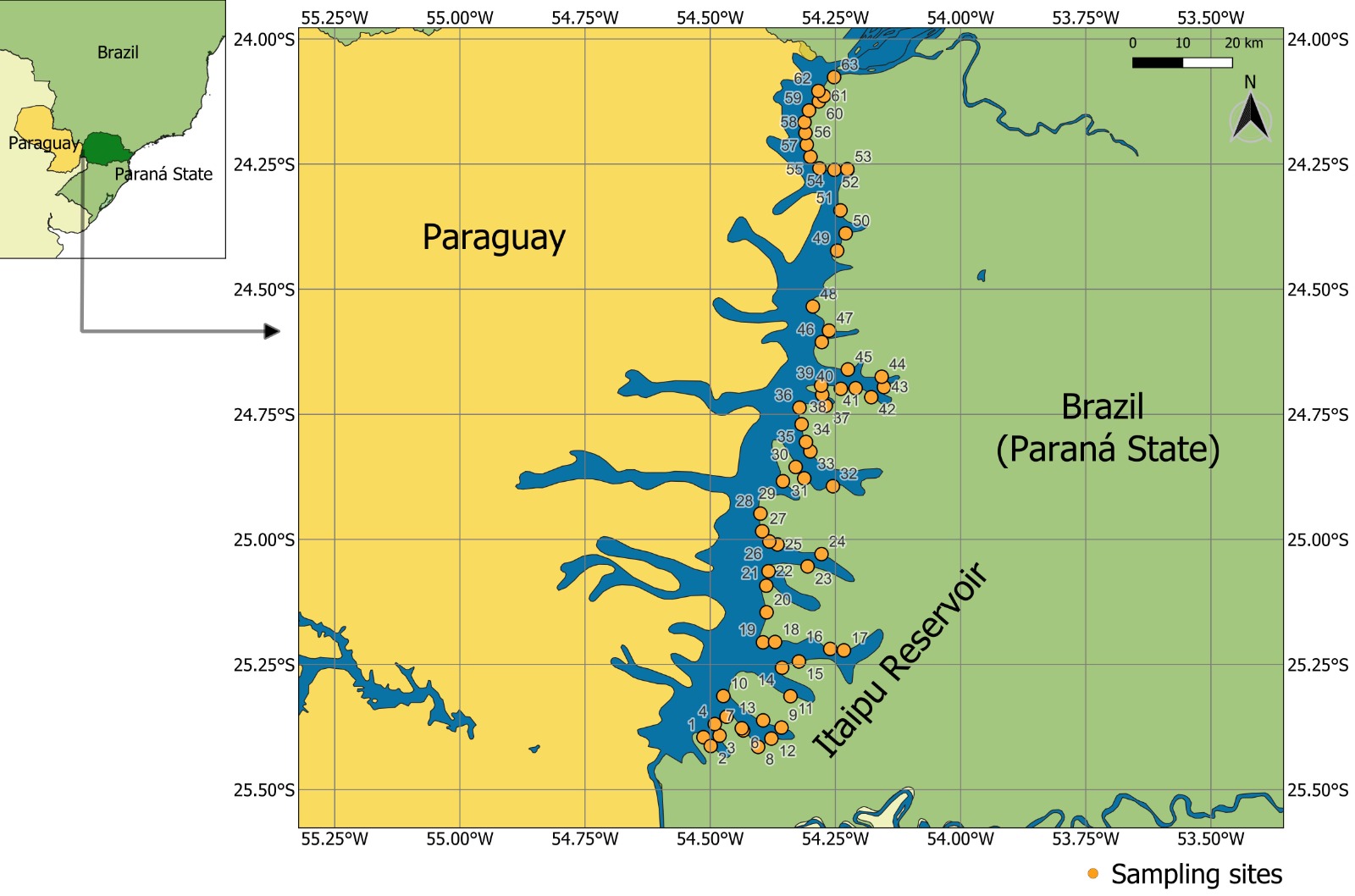
FIGURE 1| Distribution of the 63 sampling sites in the Itaipu Reservoir, Paraná River basin, Brazil (modified from Gubiani et al., 2025).
Fisheries data were collected monthly from March to October, between 1988 and 2024, at 15 fishing sites selected from a total of 63 professional fishing locations within the reservoir (Fig. 1; Tab. S1). Data for the remaining months were not collected because fishing is legally restricted during the “defeso” (also referred to as the “piracema” closed season), a reproductive protection period established to safeguard natural fish spawning. In the Paraná River basin, this closed season is defined annually from 1st November to 28 February under IBAMA (Instituto Brasileiro do Meio Ambiente e dos Recursos Naturais Renováveis) Normative Instruction No 25 from 2009 (IBAMA, 2009). Each month, a different set of 15 sites was sampled. Fish were caught with the assistance of one to seven local professional fishers at each site, using multiple gear types to maximize species and size diversity. Gillnets with mesh sizes ranging from 8 to 16 cm between opposite knots, with lengths of 20 to 100 m, and heights of 1 to 10 m were deployed for 24 h and checked the following morning. Longlines equipped with 40 to 1,500 hooks (sizes 2/0 to 7/0) were also used.
Following landing, the fish were analyzed in situ. Each specimen was taxonomically identified following CETESB (1981), Britski et al. (1999), Reis et al. (2003), Graça, Pavanelli (2007), and Pavanelli et al. (2023). For each individual, total length (TL) was measured to the nearest 0.1 cm, and sex and gonadal development stage were recorded. Gonadal stages were classified as immature, maturing, ripe, post-spawning, or regenerating based on macroscopic visual inspection, following Vazzoler (1996) and Brown-Peterson et al. (2011). Voucher specimens (Tab. S2) were preserved in 70% alcohol and deposited in the Ichthyological Collection of GERPEL (CIG) at the Universidade Estadual do Oeste do Paraná (Campus Toledo), and in the Ichthyological Collection of Nupelia (NUP) at the Universidade Estadual de Maringá.
Individuals were classified as reproductive when their gonads were in any stage other than immature. We then calculated, for each length class, the proportion of reproductive individuals and used this proportion as the response variable for the maturity ogive. Length at first maturity (L50) was estimated using a logistic model: fr = 1 – e-a(TL)b
Where fr is the frequency of reproductive individuals, TL is total length, and a and b are fitted model parameters (Santos, 1978). The model was linearized using a natural logarithm transformation:
ln[-In(1 – fr)] = Ina + bln(TL)
and fitted using linear regression with least-squares method (Zar, 1999). Scatterplots were used to inspect for outliers, and extreme outliers (standardized residuals ≥ |4|) were excluded prior to analysis. Model fit was assessed using the coefficient of determination (r2), and 95% confidence intervals (α = 0.05) were calculated for each L50 estimate.
An analysis of covariance (ANCOVA; Goldberg, Scheiner, 1993) was used to test whether parameter estimates differed between males and females. When the ANCOVA was significant, separate L50 values were estimated for each sex; otherwise, a pooled estimate was reported (denoted as ‘B’ in the table). To avoid overfitting and improve estimate stability and precision, we followed modelling practices recommended by Harrell Jr. (2015), modeling only species with sample sizes larger than 20 individuals. Logistic models and L50 estimates were generated using the sizeMat package (Torrejon-Magallanes, 2020).
After fitting the L50, we used the fitted limited model to estimate L99 as an approximation of L100, the length at which all individuals have reached sexual maturity, as follows:
L99 ͌100 = [-a + In (0.01)] / b
where a and b are the parameters estimated using the sizeMat package.
Finally, we examined the relationships between L50, L100 and Lmax. This approach is useful when logistic maturity ogives cannot be fitted to gonadal data. To this end, we fitted linear regression models using the least-squares method (Zar, 1999). All statistical analyses were conducted in R (R Development Core Team, 2024), with a significance threshold of p < 0.05. A comprehensive guide for all analyses is available at https://github.com/ICTES-UNIOESTE/Length-at-first-maturity-of-freshwater-fish-from-Itaipu-Reservoir/tree/main.
Results
A total of 167,960 individuals (raw counts) were caught over 35 years of samplings, representing 42 fish species distributed across six orders, 16 families, and 37 genera (Tab. S2). Sample size per species ranged from 26 for Brycon hilarii to 44,926 for Pterodoras granulosus (Tab. 1). Maximum total length ranged from 36.60 cm for Metynnis lippincottianus to 160.00 cm for females of Pseudoplatystoma corruscans (Tab. 1). New maximum total lengths were recorded for 28 fish species (Tab. 1, values in bold in Lmax column).
TABLE 1 | Estimated parameters of length at first maturity (L50) and length at which 100% of individuals are sexually mature (L100), calculated using the sizeMat package, along with the minimum (Lmin) and maximum (Lmax) total lengths recorded for fish species caught by professional fishers in the Itaipu Reservoir, Paraná River basin, Brazil, from March 1988 to October 2023. (B) both sexes; (M) males; (F) females; (N) total number of fish sampled; (a) intercept; (b) slope; (CI) confidence interval; (r2) coefficient of determination. Values in bold in the L50 column indicate estimates higher than those reported in FishBase; values in italics indicate lower estimates. Values in bold in the Lmax column represent newly recorded maximum total lengths for FishBase. Values marked with a question mark in the FishBase columns indicate new species records for the database.
Species | Sex | N | a | b | r2 | L50 | 95% CI of L50 | L100 | Lmin | Lmax | FishBase | ||
L50 FishBase | Range of L50 FishBase | Lmax FishBase | |||||||||||
Acestrorhynchus lacustris | B | 116 | -21.759 | 1.233 | 0.76 | 17.7 | 15.2-18.5 | 21.4 | 14.0 | 40.0 | 13.0 | 15-? | 31.8 |
Ageneiosus inermis | B | 1097 | -3.657 | 0.138 | 0.18 | 26.6 | 24.8-28.1 | 60.1 | 18.0 | 59.0 | ? | ?-? | 64.8 |
Ageneiosus ucayalensis | B | 890 | -10.964 | 0.653 | 0.21 | 16.8 | 8.9-18.9 | 23.9 | 13.6 | 44.0 | ? | ?-? | 35.2 |
Astronotus crassipinnis | B | 264 | -13.075 | 0.785 | 0.38 | 16.7 | 12.6-18.1 | 22.5 | 15.1 | 36.9 | ? | ?-? | 24.0 |
Auchenipterus osteomystax | B | 4724 | -11.242 | 0.678 | 0.48 | 16.6 | 16.2-17.0 | 23.4 | 12.0 | 47.6 | 15.3 | ?-? | 43.0 |
Brycon hilarii | B | 26 | -13.204 | 0.417 | 0.42 | 31.8 | 27.9-34.0 | 42.7 | 24.0 | 51.2 | ? | ?-? | 56.0 |
Brycon orbignyanus | B | 84 | -6.751 | 0.227 | 0.28 | 29.6 | 26.4-31.9 | 50.0 | 22.0 | 52.5 | 31.6 | ?-? | 79.5 |
Catathyridium jenynsii | B | 778 | -3.233 | 0.265 | 0.18 | 12.2 | 10.0-13.5 | 29.6 | 10.0 | 38.5 | 10.4 | ?-? | 23.7 |
Cichla kelberi | B | 785 | -7.269 | 0.337 | 0.30 | 21.6 | 20.1-22.7 | 35.2 | 17.0 | 51.0 | 20.7 | ?-? | 58.5 |
Cichla piquiti | B | 781 | -7.137 | 0.367 | 0.20 | 19.5 | 16.3-21.4 | 32.0 | 15.1 | 53.3 | ? | ?-? | 48.0 |
Geophagus sveni | B | 5858 | -6.662 | 0.568 | 0.17 | 11.7 | 10.8-12.4 | 19.8 | 10.3 | 33.3 | ? | ?-? | 16.7 |
Hemiodus orthonops | B | 1891 | -7.155 | 0.375 | 0.29 | 19.1 | 17.7-20.2 | 31.4 | 16.3 | 45.3 | ? | ?-? | 34.2 |
Hemisorubim platyrhynchos | B | 85 | -9.256 | 0.331 | 0.33 | 27.9 | 23.7-30.3 | 41.9 | 19.6 | 48.9 | 31.6 | ?-? | 61.0 |
Hoplias mbigua | B | 1649 | -5.327 | 0.260 | 0.20 | 20.5 | 16.9-22.7 | 38.2 | 17.0 | 52.0 | ? | ?-? | 29.3 |
Hypophthalmus oremaculatus | B | 19606 | -9.693 | 0.471 | 0.22 | 20.6 | 17.0-22.6 | 30.4 | 18.0 | 63.8 | ? | ?-? | ? |
Hypostomus ternetzi | B | 1372 | -3.606 | 0.245 | 0.15 | 14.7 | 10.3-17.6 | 33.6 | 13.0 | 53.0 | ? | ?-? | 34.3 |
Iheringichthys labrosus | B | 2718 | -8.492 | 0.536 | 0.29 | 15.8 | 13.8-17.1 | 24.5 | 12.0 | 39.0 | 12.3 | ?-? | 43.5 |
Leporinus friderici | B | 1895 | -7.158 | 0.411 | 0.25 | 17.4 | 14.6-19.0 | 28.6 | 16.0 | 46.0 | 18.1 | ?-? | 40.0 |
Megalancistrus parananus | B | 1608 | -4.678 | 0.231 | 0.22 | 20.3 | 17.8-22.2 | 40.2 | 20.0 | 77.0 | 17.5 | ?-? | 58.8 |
Megaleporinus macrocephalus | B | 677 | -5.689 | 0.227 | 0.36 | 25.1 | 22.8-26.6 | 45.3 | 18.0 | 70.1 | ? | ?-? | 68.4 |
Megaleporinus obtusidens | B | 409 | -4.752 | 0.189 | 0.19 | 25.1 | 22.2-26.8 | 49.6 | 20.0 | 68.0 | 21.6 | ?-? | 76.0 |
Metynnis lippincottianus | B | 2569 | -5.053 | 0.615 | 0.14 | 8.2 | 6.5-9.3 | 15.7 | 8.6 | 36.6 | ? | ?-? | 16.6 |
Piaractus mesopotamicus | B | 299 | -3.515 | 0.134 | 0.20 | 26.2 | 22.1-28.9 | 60.6 | 15.0 | 72.0 | ? | ?-? | 40.5 |
Pimelodus mysteriosus | B | 234 | -11.713 | 0.496 | 0.20 | 23.6 | 20.6-25.0 | 32.9 | 23.5 | 42.0 | ? | ?-? | 14.3 |
Pinirampus pirinampu | F | 3044 | -8.119 | 0.219 | 0.52 | 37.0 | 36.4-37.6 | 58.0 | 17.0 | 88.4 | ? | 45-? | 120.0 |
| M | 2804 | -8.715 | 0.228 | 0.51 | 38.3 | 37.9-38.8 | 58.5 | 16.0 | 83.0 |
|
|
|
Plagioscion squamosissimus | F | 18371 | -10.290 | 0.505 | 0.37 | 20.4 | 20.0-20.7 | 29.5 | 12.0 | 72.1 | 20.7 | ?-? | 80.0 |
| M | 17964 | -10.427 | 0.540 | 0.36 | 19.3 | 18.9-19.6 | 27.8 | 11.0 | 65.0 |
|
|
|
Potamotrygon amandae | B | 45 | -35.549 | 1.545 | 0.75 | 22.5 | 20.6-24.7 | 26.0 | 18.3 | 73.0 | ? | ?-? | 31.2 |
Potamotrygon falkneri | B | 68 | -14.893 | 0.730 | 0.50 | 20.4 | 17.8-22.1 | 26.7 | 16.2 | 78.0 | ? | ?-? | 60.0 |
Prochilodus lineatus | F | 3702 | -6.014 | 0.225 | 0.59 | 26.8 | 26.0-27.4 | 47.1 | 14.0 | 75.0 | 24.0 | ?-? | 80.0 |
| M | 2700 | -8.282 | 0.293 | 0.67 | 28.3 | 27.8-28.8 | 44.0 | 14.0 | 66.0 |
|
|
|
Pseudoplatystoma corruscans | F | 411 | -7.355 | 0.133 | 0.56 | 55.3 | 53.3-57.4 | 89.6 | 27.7 | 160.0 | 65.2 | ?-? | 182.0 |
| M | 184 | -8.077 | 0.133 | 0.48 | 60.7 | 58.1-63.6 | 95.0 | 28.0 | 83.4 |
|
|
|
Pterodoras granulosus | F | 24621 | -8.135 | 0.322 | 0.45 | 25.3 | 25.0-25.5 | 39.6 | 14.0 | 84.0 | 25.5 | 64-? | 90.1 |
| M | 20305 | -10.781 | 0.410 | 0.45 | 26.3 | 26.2-26.5 | 37.5 | 13.0 | 61.0 |
|
|
|
Pterygoplichthys ambrosettii | F | 1443 | -5.203 | 0.246 | 0.26 | 21.1 | 19.4-22.5 | 39.8 | 16.0 | 60.0 | 24.3 | ?-? | 55.0 |
| M | 854 | -8.066 | 0.332 | 0.45 | 24.3 | 23.2-25.2 | 38.1 | 15.0 | 57.3 |
|
|
|
Rhaphiodon vulpinus | B | 3523 | -6.104 | 0.223 | 0.26 | 27.4 | 24.5-29.4 | 48.0 | 14.1 | 83.7 | 31.5 | ?-? | 80.0 |
Rhinelepis aspera | B | 1315 | -6.185 | 0.294 | 0.26 | 21.0 | 17.2-23.3 | 36.7 | 18.0 | 50.0 | 28.8 | ?-? | 49.0 |
Salminus brasiliensis | B | 205 | -8.292 | 0.201 | 0.50 | 41.2 | 39.3-43.4 | 64.1 | 19.0 | 82.0 | 37.9 | ?-? | 100.0 |
Satanoperca setepele | B | 4365 | -6.524 | 0.650 | 0.27 | 10.0 | 7.6-11.6 | 17.1 | 9.1 | 37.0 | ? | ?-? | ? |
Schizodon borellii | B | 2748 | -26.186 | 1.230 | 0.43 | 21.3 | 20.1-22.1 | 25.0 | 20.0 | 49.0 | 17.8 | ?-? | 40.0 |
Serrasalmus maculatus | B | 3174 | -6.020 | 0.543 | 0.24 | 11.1 | 7.7-12.9 | 19.6 | 11.0 | 49.0 | 10.8 | ?-? | 34.5 |
Serrasalmus marginatus | B | 3573 | -4.620 | 0.471 | 0.15 | 9.8 | 7.4-11.3 | 19.6 | 11.4 | 49.0 | 12.2 | ?-? | 32.4 |
Sorubim lima | B | 278 | -8.148 | 0.316 | 0.34 | 25.9 | 15.4-31.2 | 40.4 | 28.0 | 62.8 | 23.2 | ?-? | 54.2 |
Trachelyopterus galeatus | B | 1754 | -38.568 | 2.710 | 0.58 | 14.2 | 13.6-14.5 | 15.9 | 13.6 | 42.0 | 10.8 | ?-? | 30.0 |
Zungaro jahu | F | 55 | -12.080 | 0.147 | 0.64 | 81.7 | 76.1-87.4 | 113.2 | 28.0 | 128.0 | ? | ?-? | 140.0 |
| M | 39 | -21.836 | 0.330 | 0.63 | 66.0 | 63.0-69.0 | 80.2 | 42.0 | 79.0 |
|
|
|
The minimum estimated L50 was 8.20 cm for Metynnis lippincottianus, whereas the maximum was 81.70 cm for females of Zungaro jahu (Tab. 1). New report L50 values for 19 fish species (Tab. 1, values indicated with a question mark in the L50Fishbase column), based on comparison with FishBase data (Froese, Pauly, 2025). For 10 species, our L50 estimates were lower than those reported in Fishbase (Tab. 1, values in italics in the L50 column), whereas for 15 species they were higher (values in bold in the L50 column).
Statistically clear sex-based differences in L50 were detected for seven species (ANCOVA, p < 0.05, Tab. 1), with males exhibiting higher L50 values than females in five species (Tab. 1). The coefficient of determination (r2) ranged from 0.14 for Metynnis lippincottianus to 0.76 for Acestrorhynchus lacustris (Tab. 1; Fig. S3). Confidence intervals were estimated for the L50 of all species, as this information is currently unavailable in FishBase (Tab. 1).
On average, species reached L50 at 46% of their recorded Lmax (Fig. 2A). We also estimated L99 (used here as an approximation of L100), with values ranging from 15.7 cm for Metynnis lippincottianus to 113.2 cm for Zungaro jahu. On average, species reached L100 at 137% of their L50 (Fig. 2B) and at 70% of their Lmax (Fig. 2C).

FIGURE 2| Relationships between (A) maximum total length (Lmax) and length at first maturity (L50), (B) length at first maturity (L50) and the length at which 100% of individuals are sexually mature (L100), and (C) maximum total length (Lmax) and L100, for fish species caught by professional fishers in the Itaipu Reservoir, Paraná River basin, Brazil, from March 1988 to October 2023.
Discussion
No statistically clear sex-based differences in length at first maturity (L50) were observed for 36 of the 42 species analyzed. When differences did occur, they were mostly observed in large-bodied species and those with large sample sizes. In such cases, sex-specific estimates may be appropriate; however, for most species, pooled estimates should be sufficient for management applications. This pattern is consistent with findings from other studies across diverse aquatic environments (Soares et al., 2020; Barbosa et al., 2022), particularly among small-bodied species (Soares et al., 2020; Froese, Binohlan, 2000). Variation in L50 between sexes has been associated with sampling effort, demographic structure, and phylogenetic differences (Orsi, 2017; Soares et al., 2020).
Our results provide updated estimates of L50 for 19 species and Lmax for 28 species, based on comparisons with FishBase data (Froese, Pauly, 2025). We emphasize that FishBase is used here as a widely consulted comparative baseline in fisheries science and management, not as a definitive reference for maturity parameters. Because compiled databases may draw on heterogeneous sources and may be incomplete or outdated for some taxa, agreements and discrepancies with FishBase should be interpreted cautiously, as they may reflect uncertainty, potential spatial variation, methodological differences, and data gaps. Importantly, our conclusions are grounded in a comprehensive long-term dataset of exploited fishes from the Itaipu Reservoir, which supports more robust estimation than short-term or opportunistic studies and provides uncertainty estimates that are often unavailable in compiled sources.
From a management perspective, L50 is a key life history metric for establishing minimum legal catch sizes and reducing juvenile harvest, helping to ensure recruitment and at least one reproductive event before capture (Froese et al., 2008). Accordingly, our L50 estimates provide a practical scientific basis for setting minimum catch sizes for exploited species, especially in the Itaipu Reservoir and for slow-growing and late-maturing taxa that are more vulnerable to depletion when harvested before maturity (Froese et al., 2008). These maturity benchmarks can inform the development of effective species management and conservation plans (Fontoura et al., 2009; Lima, 2022). However, minimum catch sizes alone are insufficient. Complementary measures, such as protection of spawning grounds and seasonal restrictions (Gogola et al., 2010), remain essential for maintaining reproductive output. In addition, L50 estimates can inform gillnet selectivity guidance, including mesh-size recommendations, reducing the likelihood of capturing immature individuals while maintaining feasible fishing practices (Hasan et al., 2021). For decision-makers, these results support a practical, tiered approach to regulation and monitoring in Itaipu. First, minimum-size regulations can prioritize species with the largest L50 values and/or wide confidence intervals, as these taxa are more likely to be harvested before first reproduction and may require more precautionary minimum sizes. Second, for the seven species with statistically clear sex-based differences in L50, regulations and selectivity guidance should be based on the more conservative estimate (i.e., the larger L50) to ensure adequate protection of the slower-maturing component of the stock. Third, because FishBase values differed from our local estimates in many cases, managers should avoid adopting external maturity values uncritically; instead, Itaipu-specific estimates and their confidence intervals provide a transparent basis for rulemaking and for documenting uncertainty. Finally, the consistent scaling relationships observed here (e.g., L50 ≈ 46% of Lmax; L100 ≈ 70% of Lmax) offer operational proxies for species or periods when maturity sampling is limited, enabling interim, precautionary updates while targeted reproductive monitoring is expanded.
It is important to emphasize that under overfishing, both the abundance and mean size of captured individuals tend to decline (Sparre, Venema, 1998). Consequently, minimum catch-size regulations may require medium- and long-term revisions as fishing pressure and stock structure change over time. Under intensive exploitation, shifts in maturation period may occur and can become difficult to reverse if adequate management measures are not adopted.
The relationships between L50 and Lmax, L50 and L100, and L100 and Lmax are also valuable for converting one metric into another, particularly when data are insufficient to fit a logistic model. Pauly (1984) observed that the ratio between L50 and Lmax can be relatively consistent across many fish families, supporting the use of size-based proxies in data-limited contexts. According to Suzuki et al. (2004), fish typically reach L50 at approximately 48% of Lmax, slightly higher than our estimate of 46%. Additionally, we recorded that fish reach L100 at approximately 70% of Lmax. Together, these associations provide operational alternatives for decision-making when direct reproductive information is limited.
In summary, this study provides the most comprehensive and up-to-date set of first maturity (L50) estimates for 42 freshwater fish species exploited by professional fishers in the Itaipu Reservoir, including the first published L50 values for 19 species and updated maximum lengths (Lmax) for 28 species, based on comparisons with the widely used FishBase database. These estimates are based on more than three decades of systematic monitoring and represent reservoir-specific benchmarks for understanding reproductive strategies and informing applied fisheries management. The strong associations observed between L50, Lmax, and L100 offer practical alternatives when reproductive data are limited, supporting the use of size-based proxies in data-limited assessments. Overall, our findings strengthen the scientific basis for defining minimum catch sizes, supporting gear selectivity guidance, and improving conservation planning and stock assessments in the Paraná River basin.
Acknowledgments
We thank the professional fishermen of Itaipu for providing the fish for our database. We also appreciate the support from Instituto Neotropical de Pesquisas Ambientais (INEO) and Grupo de Pesquisas em Recursos Pesqueiros e Limnologia (GERPEL).
References
Agostinho AA, Julio Jr. HF, Petrere Jr. M. Itaipu reservoir (Brazil): impacts of the impoundment on the fish fauna and fisheries. In: Cowx IG, editors. Rehabilitation of freshwater fisheries. London: Fishing News Books; 1994. p.171–84.
American Veterinary Medical Association (AVMA). 2000 Report of the AVMA Panel on Euthanasia. J Am Vet Med Assoc. 2001; 218(5):669–96. https://doi.org/10.2460/javma.2001.218.669
Barbosa LM, Costa RMR, Muniz CC, Mateus LAF. Tamanho da primeira maturação de duas espécies de interesse pesqueiro na bacia do alto rio Paraguai – Mato Grosso: subsídios para o estabelecimento do tamanho mínimo de captura. Rev Biodivers. 2022; 21(2):46–57.
Barzotto E, Mateus L. Reproductive biology of the migratory freshwater fish Salminus brasiliensis (Cuvier, 1816) in the Cuiabá River basin, Brazil. J Appl Ichthyol. 2017; 33(3):415–22. https://doi.org/10.1111/jai.13262
Britski HA, Silimon KZS, Lopes BS. Peixes do Pantanal: manual de identificação. Brasília: EMBRAPA; 1999.
Brown-Peterson NJ, Wyanski DM, Saborido-Rey F, Macewicz BJ, Lowerre-Barbieri SK. A standardized terminology for describing reproductive development in fishes. Mar Coast Fish. 2011; 3(1):52–70. https://doi.org/10.1080/19425120.2011.555724
Cardinale M, Modin J. Changes in size-at-maturity of Baltic cod (Gadus morhua) during a period of large variations in stock size and environmental conditions. Fish Res. 1999; 41(3):285–95. https://doi.org/10.1016/S0165-7836(99)00021-1
Companhia de Tecnologia de Saneamento Ambiental (CETESB). Itaipu Binacional: Ictiofauna – Complementação do Inventário Ictiofaunístico. São Paulo: CETESB; 1981.
Conselho Federal de Medicina Veterinária (CFMV). Resolução N° 714 de 20 de junho de 2002, atualizada do art. 16, alínea “f” da Lei n° 5.517/68, de 23 de outubro de 1968. Dispõe sobre procedimentos e métodos de eutanásia em animais e dá outras providências. [Internet]. Brasília: Conselho Federal de Medicina Veterinária; 2002. Available from: https://www.ibirapuera.br/wp-content/uploads/2021/01/Resolucao-CFMV-714-2002.pdf
Cox SP, Hinch SG. Changes in size at maturity of Fraser River sockeye salmon (Oncorhynchus nerka) (1952–1993) and associations with temperature. Can J Fish Aquat Sci. 1997; 54(5):1159–65. https://doi.org/10.1139/f97-009
Domínguez-Petit R, Anastasopoulou A, Cubillos L, Gerritsen HD, Gonçalves P, Hidalgo M et al. Maturity. In: Domínguez-Petit R, Murua H, Saborido-Rey F, Trippel E, editors. Handbook of applied fisheries reproductive biology for stock assessment and management. Vigo: Digital CSIC; 2017. p.4–47.
Fontoura NF, Braun AS, Milani PCC. Estimating size at first maturity (L50) from Gonadossomatic index (GSI) data. Neotrop Ichthyol. 2009; 7(2):217–22. https://doi.org/10.1590/S1679-62252009000200013
Froese R, Binohlan C. Empirical relationships to estimate asymptotic length, length at first maturity and length at maximum yield per recruit in fishes, with a simple method to evaluate length frequency data. J Fish Biol. 2000; 56(4):758–73. https://doi.org/10.1111/j.1095-8649.2000.tb00870.x
Froese R, Pauly D. FishBase. World Wide Web electronic publication. [Internet]. Stockholm: Swedish Museum of Natural History; 2025. Available from: www.fishbase.org
Froese R, Stern-Pirlot A, Winker H, Gascuel D. Size matters: how single species management can contribute to ecosystem-based fisheries management. Fish Res. 2008; 92(2–3):231–41. https://doi.org/10.1016/j.fishres.2008.01.005
Giarrizzo T, Bastos D, Andrade M. Length-weight relationships for selected fish species of Rio Trombetas Biological Reserve: a reference study for the Amazonian basin. J Appl Ichthyol. 2011; 27(6):1422–24. https://doi.org/10.1111/j.1439-0426.2011.01820.x
Gogola TM, Daga VS, Silva PRL, Sanches PV, Gubiani EA, Baumgartner G et al. Spatial and temporal distribution patterns of ichthyoplankton in a region affected by water regulation by dams. Neotrop Ichthyol. 2010; 8(2):341–49. https://doi.org/10.1590/S1679-62252010000200013
Goldberg DE, Scheiner SM. ANOVA and ANCOVA: field competition experiments. In: Scheiner SM, Gurevitch J, editors. Design and analysis of ecological experiments. New York: Chapman & Hall; 1993. p.69–93.
Graça WJ, Pavanelli CS. Peixes da planície de inundação do alto rio Paraná e áreas adjacentes. Maringá: EDUEM; 2007.
Harrell Jr. FE. Regression modeling strategies: with applications to linear models, logistic and ordinal regression, and survival analysis. Cham: Springer; 2015.
Hasan MDR, Hossain MY, Mawa Z, Tanjin S, Rahman MA, Sarkar UK et al. Evaluating the size at sexual maturity for 20 fish species (Actinopterygii) in wetland (Gajner Beel) ecosystem, north-western Bangladesh through multi-model approach: a key for sound management. Acta Ichthyol Piscat. 2021; 51(1):29–36. https://doi.org/10.3897/aiep.51.63339
Immonen E, Hämäläinen A, Schuett W, Tarka M. Evolution of sex-specific pace-of-life syndromes: genetic architecture and physiological mechanisms. Behav Ecol Sociobiol. 2018; 72:60. https://doi.org/10.1007/s00265-018-2462-1
Instituto Água e Terra (IAT). Portaria Nº 219, de 08 de julho de 2022 (Anexo I). Relação das espécies nativas e as respectivas dimensões mínimas e máximas para as espécies citadas de captura, com referência ao Comprimento Total* (Lt) em centímetros. [Internet]. Curitiba: Instituto Água e Terra; 2022. Available from: https://www.iat.pr.gov.br/sites/agua-terra/arquivos_restritos/files/documento/2022-07/PORT.%20219-2022_ANEXOS.pdf
Instituto Brasileiro do Meio Ambiente e dos Recursos Naturais Renováveis (IBAMA). Instrução Normativa nº 25, de 1º de setembro de 2009. [Internet]. Brasília: IBAMA; 2009. Available from: https://www.gov.br/ibama/pt-br/assuntos/biodiversidade/biodiversidade-aquatica/arquivos/defesos-continentais/2025-01-20_bacia_hidrografica_do_rio_parana_in_ibama_n-o-25_2009.pdf
Lappalainen A, Saks L, Šuštar M, Heikinheimo O, Jürgens K, Kokkonen E et al. Length at maturity as a potential indicator of fishing pressure effects on coastal pikeperch (Sander lucioperca) stocks in the northern Baltic Sea. Fish Res. 2016; 174:47–57. https://doi.org/10.1016/j.fishres.2015.08.013
Lima ML. Estratégia reprodutiva de Pyrrhulina capim Vieira & Netto-Ferreira, 2019 (Characiformes: Lebiasinidae) em riachos da Amazônia Oriental. [Undergraduate thesis]. Capitão Poço: Universidade Federal Rural da Amazônia; 2022.
Lourenço LS, Souza UP, Fernandes IM, Petrere Jr. M. Spatiotemporal variation in life history traits of three small fishes in streams of south-eastern Brazil. Fish Manag Ecol. 2015; 22(2):143–51. https://doi.org/10.1111/fme.12114
Mateus LAF, Penha JMF. Avaliação dos estoques pesqueiros de quatro espécies de grandes bagres (Siluriformes, Pimelodidae) na bacia do rio Cuiabá, Pantanal norte, Brasil, utilizando alguns Pontos de Referência Biológicos. Rev Bras Zool. 2007; 24(1):144–50. https://doi.org/10.1590/S0101-81752007000100017
Oliveira EF, Minte-Vera CV, Goulart E. Structure of fish assemblages along spatial gradients in a deep subtropical reservoir (Itaipu Reservoir, Brazil-Paraguay border). Environ Biol Fishes. 2005; 72(3):283–304. https://doi.org/10.1007/s10641-004-2582-5
Orsi ML. Estratégias reprodutivas de peixes: estratégias reprodutivas de peixes da região média-baixa do Rio Paranapanema, reservatório de Capivara. São Paulo: Editora Edgard Blucher; 2017.
Panfili J, Thior D, Ecoutin J-M, Ndiaye P, Albaret J-J. Influence of salinity on the size at maturity for fish species reproducing in contrasting West African estuaries. J Fish Biol. 2006; 69(1):95–113. https://doi.org/10.1111/j.1095-8649.2006.01069.x
Pauly D. A mechanism for the juvenile-to-adult transition in fishes. J Cons int Explor Mer. 1984; 41:280–84.
Pauly D. Why do fish reach first maturity when they do? J Fish Biol. 2022; 101(2):333–41. https://doi.org/10.1111/jfb.14902
Pavanelli CS, Graça WJ, Zawadzki CH, Suzuki HI, Fugi R, Bialetzki A et al. Peixes Comerciais do Reservatório de Itaipu. Maringá: EDUEM; 2023.
Petrere Jr. JM. Fisheries in large tropical reservoirs in South America. Lakes Reserv Res Manag. 1996; 2(1–2):111–33. https://doi.org/10.1111/j.1440-1770.1996.tb00054.x
Polovina JJ. Assessment and management of deep water bottom fishes in Hawaii and the Marianas. In: Polovina JJ, Ralston S, editors. Tropical snappers and groupers: Biology and fisheries management. Boulder: Westview Press; 1987. p.505–32.
R Development Core Team. R: A language and environment for statistical computing. Vienna, Austria: R Foundation for Statistical Computing; 2024. Available from: https://www.R-project.org
Reis RE, Kullander SO, Ferraris Jr. CJ. Checklist of the freshwater fishes of South and Central America. Porto Alegre: Edipucrs; 2003.
Ribas LGS, Piana PA, Henn C, Maciel AL, Cantanhêde G, Adames MS et al. Evaluating 36 years of fishing sustainability in a large reservoir. Sci Rep. 2025; 15:3748. https://doi.org/10.1038/s41598-025-88209-8
Sabbir W, Hossain MY, Rahman MA, Hasan MR, Mawa Z, Tanjin S et al. First report on reproductive features of the Hooghly croaker Panna heterolepis Trewavas, 1977 from the Bay of Bengal in relation to environmental factors. Environ Sci Pollut Res. 2021; 28:23152–59. https://doi.org/10.1007/s11356-020-12310-w
Sadovy YJ. Reproduction of reef fishery species. In: Polunin NVC, Roberts CM, editors. Reef fisheries. London: Chapman & Hall, 1996; p.15–59.
Santos EP. Dinâmica de populações aplicada à pesca e piscicultura. São Paulo: Edusp; 1978.
Sasaki M, Kingsbury KM, Booth DJ, Nagelkerken I. Body size mediates trophic interaction strength of novel fish assemblages under climate change. J Anim Ecol. 2024; 93(6):705–14. https://doi.org/10.1111/1365-2656.14079
Sharpe DMT, Hendry AP. Life history change in commercially exploited fish stocks: an analysis of trends across studies. Evol Appl. 2009; 2(3):260–75. https://doi.org/10.1111/j.1752-4571.2009.00080.x
Soares BE, Barros TF, Hashiguti DT, Pereira DC, Ferreira KCF, Caramaschi EP. Traditional approaches to estimate length at first maturity (L50) retrieve better results than alternative ones in a Neotropical heptapterid. J Fish Biol. 2020; 97:1393–400. https://doi.org/10.1111/jfb.14505
Souza ACV, Costa RS, Novaes JLC. Estimation of the length at first maturity of fish species of the Apodi/Mossoró River reservoirs in the Brazilian semi-arid region. Acta Ichthyol Piscat. 2019; 49(2):195–98. https://doi.org/10.3750/AIEP/02547
Sparre P, Venema SC. Introduction to tropical fish stock assessment. Part 1. Manual. Rome: FAO; 1998.
Suzuki HI, Vazzoler AEAM, Marques EE, Lizama MAP, Inada P. Reproductive ecology of the fish assemblages. In: Thomaz SM, Agostinho AA, Hahn NS, editors. The upper Paraná River and its floodplain: physical aspects, ecology and conservation. Leiden: Backhuys Publishers; 2004. p.271–91.
Tomasini JA, Laugier T. Male reproductive strategy and reserve allocation in sand smelt from brackish lagoons of southern France. J Fish Biol. 2005; 60(3):521–31. https://doi.org/10.1006/jfbi.2002.1868
Torrejon-Magallanes J. Package‘sizeMat’ estimate size at sexual maturity [Internet]. CRAN R-Project; 2020. Available from: https://cran.r-project.org/web/packages/sizeMat/sizeMat.pdf
Vazzoler AEAM. Biologia da reprodução de peixes teleósteos: teoria e prática. Maringá: EDUEM; 1996.
Wang HY, Höök TO. Eco-genetic model to explore fishing-induced ecological and evolutionary effects on growth and maturation schedules. Evol Appl. 2009; 2(3):438–55. https://doi.org/10.1111/j.1752-4571.2009.00088.x
Wootton RJ. Ecology of teleost fishes. London: Chapman and Hall; 1998.
Zar JH. Biostatistical analysis. New Jersey: Prentice Hall; 1999.
Authors

Éder André Gubiani1,2,3 , Anderson Luís Maciel2,3, Geuza Cantanhêde3, Luiz Guilherme dos Santos Ribas2,3, Pitágoras Augusto Piana1,2,3, Suelen Zontta Kiem3 and Caroline Henn4
[1] Programa de Pós-Graduação em Conservação e Manejo de Recursos Naturais, Centro de Ciências Biológicas e da Saúde, Universidade Estadual do Oeste do Paraná (UNIOESTE), Campus Cascavel, Rua Universitária, 2069, Bairro Universitário, 85819 110, Cascavel, PR, Brazil. (EAG) eder.gubiani@unioeste.br (corresponding author), (PAP) pitapiana@yahoo.com.br.
[2] Programa de Pós-Graduação em Recursos Pesqueiros e Engenharia de Pesca, Centro de Engenharias e Ciências Exatas, Universidade Estadual do Oeste do Paraná (UNIOESTE), Campus Toledo, Rua Guaíra, 3141, Jardim Santa Maria, 85903-220 Toledo, PR, Brazil. (ALM) maciel_ander@yahoo.com.br, (LGSR) lg_ribas@hotmail.com.
[3] Laboratório de Ictiologia e Estatística Pesqueira (ICTES), Instituto Neotropical de Pesquisas Ambientais (INEO), Grupo de Pesquisas em Recursos Pesqueiros e Limnologia (GERPEL), Universidade Estadual do Oeste do Paraná (UNIOESTE), Campus Toledo, Rua Guaíra, 3141, Jardim Santa Maria, 85903-220, Toledo, PR, Brazil. (GC) geuzac@yahoo.com.br, (SZK) suelen.zk@gmail.com.
[4] Itaipu Binacional, Av. Tancredo Neves, 6731, 85856-970, Foz do Iguaçu, PR, Brazil. (CH) chenn@itaipu.gov.br.
Authors’ Contribution 

Éder André Gubiani: Conceptualization, Data curation, Formal analysis, Investigation, Project administration, Writing-original draft, Writing-review and editing.
Anderson Luís Maciel: Data curation, Writing-review and editing.
Geuza Cantanhêde: Data curation, Writing-review and editing.
Luiz Guilherme dos Santos Ribas: Data curation, Formal analysis, Writing-review and editing.
Pitágoras Augusto Piana: Writing-review and editing.
Suelen Zontta Kiem: Writing-review and editing.
Caroline Henn: Data curation, Funding acquisition, Methodology, Writing-review and editing.
Ethical Statement
From 2002 onwards, when fish were landed alive, they were anesthetized and euthanized with an overdose of benzocaine solution (250 mg/L; AVMA, 2001), following procedures recommended by ethical guidelines (CFMV, 2002). Fish were collected under permanent licenses to collect zoological material issued by SISBIO (Sistema de Autorização e Informação em Biodiversidade), authorization numbers [24438–1], and in accordance with the approved procedure by the Ethics Committee on Animal Use of the Western Paraná State University (CEUA/UNIOESTE License number: protocol No 53/09 – CEEAAP/Unioeste). Before this period, the fish were rendered insensible on ice for subsequent analysis.
Competing Interests
The author declares no competing interests.
Data availability statement
Research data is only available upon request. The data supporting this study are available from Itaipu Binacional. Restrictions apply to the availability of these data, which were used under license for this study. Data are available from the authors upon reasonable request and with permission from Itaipu Binacional.
AI statement
During the preparation of this paper the authors used ChatGPT (Version 5) by OpenAI in order to review language. After using this tool/service, the authors reviewed and edited the content as needed and takes full responsibility for the content of the publication.
Funding
This study was partially funded by the Coordenação de Aperfeiçoamento de Pessoal de Nível Superior (CAPES) – Finance Code 001. In addition, this research was also fully financially supported by the Itaipu Binacional through project 4500070773/2023.
Supplementary Material
Supplementary material SUP
Peer Review
How to cite this article
Gubiani EA, Maciel AL, Cantanhêde G, Ribas LGS, Piana PA, Kiem SZ, Henn C. Length at first maturity of 42 freshwater fish species in the Itaipu Reservoir reveals strong reproductive-size relationships. Neotrop Ichthyol. 2026; 24(2):e250158. https://doi.org/10.1590/1982-0224-2025-0158
Copyright
This is an open access article under the terms of the Creative Commons Attribution License, which permits use, distribution and reproduction in any medium, provided the original work is properly cited.
Distributed under
Creative Commons CC-BY 4.0

© 2025 The Authors.
Diversity and Distributions Published by SBI
 Accepted January 21, 2026
Submitted September 4, 2025
Epub July 20, 2026