
 Viviana Márquez-Velásquez1,2
  , Ricardo S. Rosa3, Manoela Maria Ferreira Marinho4, João Paulo Capretz Batista da Silva3, Telton Pedro Anselmo Ramos5, Ana Carolina Figueiredo Lacerda6, Gabriel Beltrão3, André Castro3, Marcio Wanderson3, Danielle Cristina Gamba3, Laure Berti-Equille1,7 and Rafael L. G. Raimundo1,2,7
PDF: Download Here | Supplementary: Sup | Cite this article
Section Editor: Osmar Luiz
Editor-in-chief: José Birindelli
Abstract
A ictiofauna do estado da Paraíba (Nordeste do Brasil) abrange espécies de água doce, estuarinas e marinhas, fornecendo as comunidades humanas uma fonte de alimento, renda, e de valor cultural. Caracterizamos tendências da produção científica e os padrões de diversidade de peixes, evidenciando lacunas críticas no conhecimento e identificando prioridades de pesquisa para a conservação e o aproveitamento econômico das espécies. Uma ampla compilação de artigos e de dados de coleções zoológicas indica que os estudos taxonômicos e ecológicos são os principais responsáveis pelo crescimento exponencial do conhecimento sobre os peixes no estado da Paraíba. Nossa avaliação identificou 565 espécies válidas, em habitats marinhos, estuarinos, e de água doce. Esses números de espécies são conservadores, já que diversas questões taxonômicas ainda não foram resolvidas, e algumas áreas, como pequenas bacias costeiras e regiões marinhas profundas continuam pouco amostradas. Diversas pressões antrópicas têm ameaçado algumas dessas espécies. No ambiente marinho, 41 espécies são classificadas como ameaçadas, enquanto apenas duas espécies de água doce se enquadram nessa categoria. Apesar dos avanços substanciais no conhecimento, destacamos a necessidade de pesquisas taxonômicas adicionais, amostragens direcionadas em áreas pouco exploradas, e inventários em escala regional. Por fim, recomendamos a promoção da educação ambiental, bem como o fortalecimento e capacitação comunitária como elementos centrais na conservação e gestão das espécies de peixes no estado da Paraíba.
Palavras-chave: Cientometria, Elasmobrânquios, Nordeste do Brasil, Prioridades de pesquisa, Teleósteos.
Introduction
Aquatic ecosystems in the State of Paraíba, Brazil, hold over 560 fish species, a number resulting from the interplay of ecological gradients, biogeographical history, habitat heterogeneity, and anthropogenic processes (Márquez Velásquez et al., 2025). Freshwater fishes inhabit waters that drain two contrasting biomes: (i) the semiarid Caatinga, part of the Mid-Northeastern Caatinga Ecoregion (MNCE, sensu Rosa et al., 2003b), and (ii) the Atlantic Forest, being part of its highly threatened Pernambuco Endemism Centre (PEC; Silva, Casteleti, 2003), a global biodiversity hotspot (Myers et al., 2000). The Caatinga has a dense network of intermittent rivers that exhibit high fish endemism (Rosa et al., 2003b, 2004; Albert et al., 2011), and the Atlantic Forest includes PEC’s largest remaining forest fragments and small coastal streams flowing into the Atlantic. These biomes create unique conditions for faunal overlaps and transitions related to ecological and hydrological connectivity, which are intensified by anthropogenic processes.
Marine fishes of Paraíba occur in vast array of habitats, including tide pools, estuaries, shallow and deep reefs, and oceanic environments. Among these, coral reefs are particularly important, forming part of the richest coral reef system in the southwestern Atlantic (Leão et al., 2010), a biodiversity hotspot shaped by biogeographic and oceanographic processes. Locally, reefs are typically sandstone formations on the inner continental shelf (Leão et al., 2003), often forming long beachrock lines (Laborel, 1970). In these habitats, the ichthyofauna supports key socioeconomic activities, such as tourism and fishing (Costa et al., 2007; Paulo Júnior et al., 2012), with artisanal fishing comprising over 80% of the catches (IBAMA, 2008). The high fish diversity in this region is result of vicariance events, such as those associated with the final closure of the Isthmus of Panama (Coates, Obando, 1996); the presence of major dispersal barriers, such as the Amazon-Orinoco plume, which limits dispersal and contribute to the divergence between Brazilian and Caribbean assemblages (Rocha et al., 2005; Floeter et al., 2008). Additionally, the heavy sediment load in the Brazilian Northeastern Ecoregion of the Southwestern Atlantic (sensu Spalding et al., 2007) further isolates the northeastern and eastern portions of the coast (Leão et al., 2003).
Initial efforts to describe fish species in Northeastern Brazil began in the mid-17th century, with the publication of Historia Naturalis Brasiliae (Piso, Marcgrave, 1648), which documented the diversity of fishs from the São Francisco River to the state of Maranhão (Medeiros, Albuquerque, 2014; Alcantara-Rodriguez et al., 2019). This work presents detailed illustrations of marine and freshwater species (Willemsen, 2023). Later, at the end of the 19th century, the Geological Commission of the Empire conducted fish surveys in Paraíba, whose collected specimens are currently in the National Museum of Rio de Janeiro (Sanjad, 2004). Beaurepaire-Rohan (1911) compiled a list of Paraíba’s fishes by their common names and Miranda Ribeiro (1937, 1939) described several regional marine fish species in existing collections. Moreover, Starks (1913) surveyed the mouth of the Mamanguape River, while Fowler (1941, 1948, 1954) advanced systematic descriptions of freshwater species. Furthermore, the Technical Commission for Fish Farming in Northeast Brazil initiated its work in 1933, reinforcing pioneering studies of Paraíba fishes (Canan, 2011).
Over the last decades, ichthyology in the Paraíba State transitioned from a taxonomic focus to more multidisciplinary approaches, including ecology, reproduction, ethnobiology, parasitology, and fisheries management. This research has largely concentrated on major perennial and intermittent water courses, such as the Paraíba and Piranhas rivers, along with their respective coastal areas and basins (Rosa et al., 2003b; Honório et al., 2010; Xavier et al., 2012). However, other coastal rivers with ecological and socioeconomic relevance, such as the Jacu and Guaju rivers, remain poorly studied (Márquez Velásquez et al., 2025). In marine environments, research has focused mostly in coastal ecosystems, including estuaries and mangroves (e.g., Xavier et al., 2012; Medeiros et al., 2018, Ramos et al., 2019), intertidal zones (e.g., Rosa et al., 1997; Silva Nascimento, Ramos 2024), and coral reefs (e.g., Rocha et al., 1998; Souza et al., 2007).
Despite consistent growth of research in both freshwater (Lima et al., 2017; Oliveira-Silva et al., 2018, Ramos et al., 2018a,b, 2019; Marinho et al., 2023) and marine environments (Rosa et al., 1997; Honório et al., 2010; Silva et al., 2021; Marceniuk et al., 2023; Rosa et al., 2023), data remains uneven across time, space, habitats, and research fields, with most data available in grey literature. Scientometric methods can shed light on these imbalances and contribute with public policies and strategies that promote both basic and applied research. Although it is not biologically meaningful to use geopolitical borders to study biodiversity patterns, it is essential for policy-making to understand how knowledge trends vary across them (Beddington et al., 2007; Hortal et al., 2015). Data-driven strategies are critically lacking to guide policies promoting the conservation and sustainable use of aquatic biodiversity and ecosystems across spatial scales (Pullin, Stewart, 2006; Dallimer, Strange, 2015; Olawumi, Chan, 2018).
In this paper, we compiled data from published papers related to the ichthyofauna in the Paraíba State and data from specimens in relevant ichthyological collections. We combine these data with taxonomic and geographical analyses to suggest future directions for ichthyological research by (a) reviewing the development of ichthyological research over time in the Paraíba State, (b) exploring the temporal and disciplinary trends in research topics, (c) assessing gaps in current coverage of habitat types and geographical areas, and (d) describing trends and biases in the current coverage of taxonomic groups.
Material and methods
Data sources. We performed a literature search in Web of Science (WoS) (https://www.webofscience.com) and Google Scholar (www.google.com) including publications up to September 2024, using the search strings: ((fish* OR Ichth* OR pisces OR Osteichthyes OR Chondrichthyes OR Elasmobranchii) AND (Coast* OR Estuar* OR Marine OR Reef OR Freshwater OR Oceanic OR mangrove OR Freshwater* OR lake*) AND (Paraíba AND Northeast* AND Brazil*)). We performed searches in both English and Portuguese, encompassing titles, abstracts, keywords, and methods. We focused on indexed journal articles and scientific or technical books and excluded grey literature to benefit from the transparency and replicability ensured by peer-reviewed sources (Tab. S1).
We employed a snowball method (Wohlin, 2014) to identify additional publications from the reference lists that met our search criteria. After manually screening titles, abstracts, and methodologies, and excluding articles that did not report data from Paraíba State, we found 198 publication records. We used the open-source software Zotero (www.zotero.org) to organize all bibliographical information. From each selected publication, we extracted the following data: (i) title; (ii) year of publication; (iii) authors (iv) journal; (v) type of article (primary research or review); (vi) sampled locations; (vii) habitat (marine, estuarine, freshwater); (viii) river basin, for continental fishes, according to the Brazilian National Water Agency (ANA, 2015); (ix) research topics; and (x) species or taxonomic group(s). Here, freshwater encompasses lakes, streams, creeks, ponds, wetlands, marshes, and reservoirs, while estuaries are considered a separate category. Additionally, we compiled data from five Brazilian ichthyological collections that holds relevant material from the Paraíba State: Universidade Federal da Paraíba, João Pessoa (UFPB), Museu de Zoologia da Universidade de São Paulo, São Paulo (MZUSP), Universidade Federal de Rio Grande do Norte, Natal (UFRN), Museu Nacional, Rio de Janeiro (MNRJ), and Pontifícia Universidade Católica do Rio Grande do Sul, Porto Alegre (PUCRS), focusing only on voucher specimens that were georeferenced or clearly linked to Paraíba State. This data compilation is available at the DATAPB repository (Márquez Velásquez et al., 2025, https://datapb.ccae.ufpb.br/).
Temporal trends. We analysed scientific production by year and habitat, categorising the habitats into three types: (a) freshwater, (b) marine, and (c) estuarine. When a study encompassed multiple habitats, we included it in each relevant habitat. We classified the papers into research topics (see Tab. S1) based on titles and keywords, but verifying also the abstract if the theme remained unclear. If a study covered multiple topics, we counted each one separately. Our classification followed a controlled vocabulary developed to cover the diversity of ecological, taxonomic, and applied themes (Tab. 1). We used these categories to describe temporal trends and thematic focus in research efforts.
TABLE 1 | Research topic categories and their descriptions, used for classifying and assessing temporal trends of the compiled studies.
Topics | Description |
Taxonomy, systematics, evolution | Species lists, inventories, descriptions of new species, updates on systematics and taxonomy, evolutionary history, phylogenetic systematics, and genetics. |
Anatomy and morphology | Analysis and descriptions of anatomy and morphology. |
Distribution and biogeography | Geographical distributions, occurrence, new records, biogeographic and phylogeographic patterns. |
Trophic ecology | Diet, feeding habits, and trophic interactions. |
Ecology | Species interactions, effects of abiotic variables on populations or communities, pollution, ecomorphology, and migration. |
Ethnoecology | Local communities’ knowledge, management of natural resources, and cultural practices. |
Physiology | Mechanical, physical, and biochemical functions; ecotoxicological analyses. |
Reproduction | Reproductive biology, ontogeny, age and growth, weight-length and length-age relationships, demography. |
Parasitology | Parasites, their hosts, and the interactions between them. |
Fisheries | Landing data, description of catches, fishing effort, fishing gears, fish processing, marketing, and consumption. |
Conservation and management | Vulnerability assessment, demographic analysis, population decline, design of closed areas, invasive species, and ecotourism. |
Others | Papers not classified in any of the topics mentioned above, such as Palaeontology, and fish farming. |
Geographical trends. We gathered the geographical coordinates of the sampling sites from each relevant publication. When studies provided coordinates, we use them directly. For studies that did not provide coordinates, we inferred the locations from suitably georeferenced maps using WebPlotDigitizer (https://automeris.io/WebPlotDigitizer/). We then created a distribution map in QGIS software v. 2.18. Furthermore, we analysed the number of published papers, categorising them by the main hydrographic basins of Paraíba State (http://www.aesa.pb.gov.br/). This basin-level spatial resolution enabled us to identify sampling imbalances and underrepresented river systems.
Taxonomic trends. We classified species by family, order, and class, and verified their taxonomic status in Eschmeyer’s Catalogue of Fishes (Fricke et al., 2025). Whenever possible, we verified and reported fish habits using sampling locations from collections (Camargo, Isaac, 2001; Morais, 2016; Vendel et al., 2022). We broadly defined estuarine species as those that use estuarine habitats at any life-stage, regardless of whether they primarily inhabit freshwater or marine environments. For each species, we considered human uses: commercial, local consumption, medicinal, aquaculture, and recreational fishing (Pimentel Rocha et al., 2008; Almeida et al., 2014; Marceniuk et al., 2023). We also reported global conservation status based on the IUCN Red List (IUCN, 2025) and national status according to the Sistema de Avaliação do Risco de Extinção da Biodiversidade – SALVE (ICMBio, 2026). We classified extinction risk following IUCN categories: Critically Endangered (CR), Endangered (EN), Vulnerable (VU), Near Threatened (NT), Least Concern (LC), Data Deficient (DD), and Not Evaluated (NE).
We reported species endemic to the Northeastern Caatinga and Coastal Drainages ecoregion (NCCD) sensu Abell et al., 2008, and to the Northeastern Brazil Marine ecoregion (NBM) sensu Spalding et al., 2007. The NCCD encompasses all river basins located between the Parnaíba and São Francisco rivers. A large portion of this ecoregion is located within the Brazilian semi-arid region (Rosa et al., 2003b; Lima et al., 2017). Most of its tributaries, predominantly intermittent, drain areas of the Caatinga (Rosa et al., 2003b). In the easternmost portion of this ecoregion are small coastal rivers that lie entirely or largely under the influence of the Atlantic Forest and are distributed from southern Rio Grande do Norte to Alagoas (Rosa et al., 2003b; Lima et al., 2017). The NBM ecoregion, located between Piauí and Sergipe states, is nested within the Tropical South-western Atlantic Province (Northeastern and Eastern Brazil ecoregions) (Spalding et al., 2007). Additionally, we identified potentially undescribed or cryptic species in collections. For illustrative images of fish, we used figures from Phylopic.org (Keesey, 2024).
Results
Temporal trends. Our search identified 198 scientific publications (Tabs. S1, S2). Research articles comprised the majority (n = 184; 93%), while book or book sections accounted for only 14 (7%) of the total (Tabs. S1, S2). The first ichthyological study on Paraíba State documented the ichthyofauna of the estuarine waters in the Brazilian northeastern region during the 1970s (Oliveira, 1972). Advancements in taxonomy and ecology arose later, founded on investigations into shark fisheries biology (Lima, Ferreira, 1975) and preliminary surveys of marine fishes (Rosa, 1980a,b) (Fig. 1; Tab. S1).
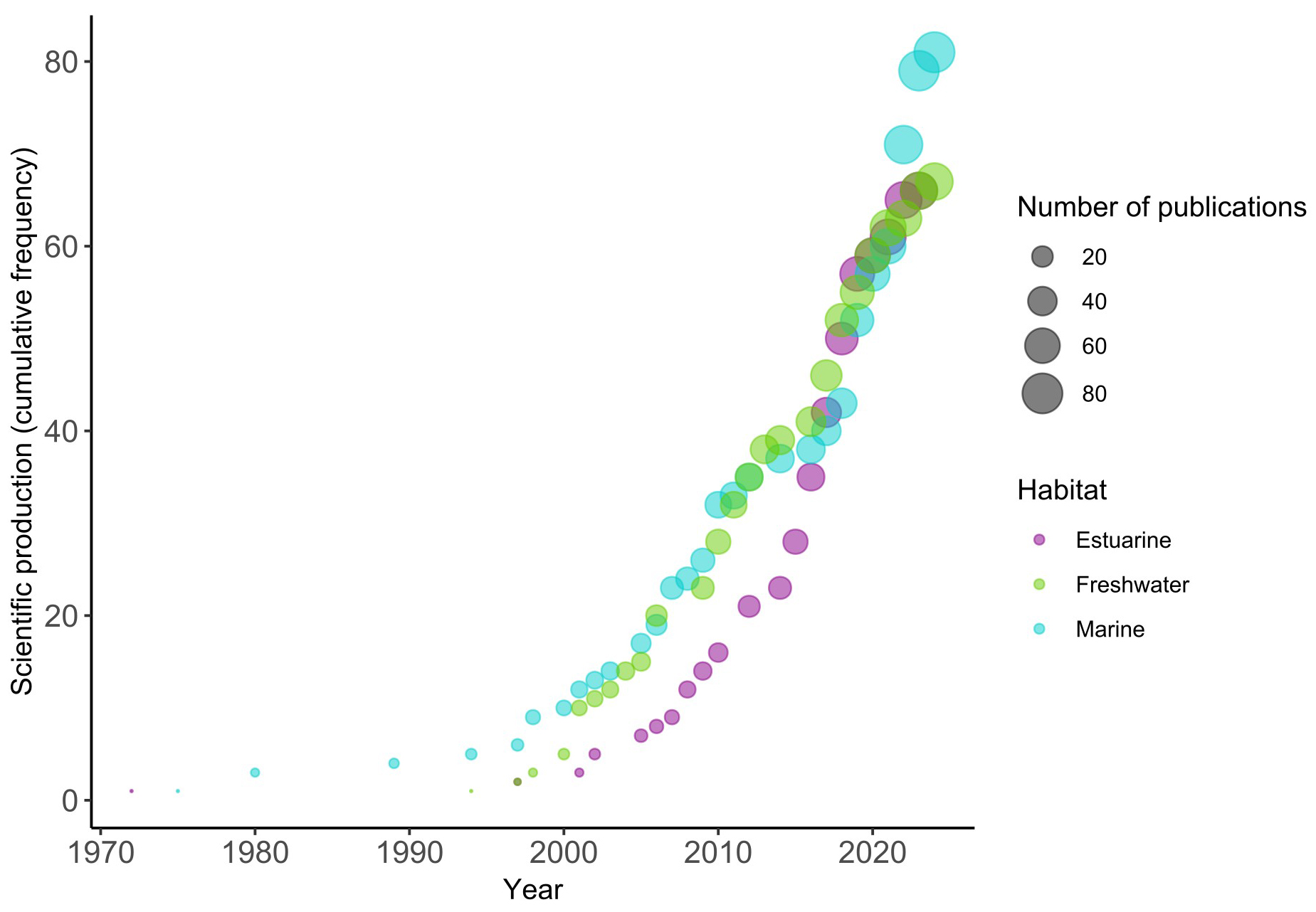
FIGURE 1| Temporal distribution of scientific publications for fish species of Paraíba State, Brazil, between 1972 and 2024, based on their habitats.
A temporal increase in the number of publications across research topics was detected over the studied period, with ecological studies rising sharply over the last 20 years, followed by Taxonomy and Systematics, Reproduction, Ethnoecology, and Fisheries research (Fig. 2A). The most common research topic in the dataset was Ecology (n = 57, 29%), followed by Taxonomy (45, 23%) and Trophic Ecology (28, 14.14%). Together, these categories comprised more than 50% of the dataset. Other areas included Reproduction (21, 10.60%), Distribution/Biogeography (20, 10.10%), Ethnoecology (19, 9.60%), and Fisheries (17, 8.60%). Studies on Parasitology and Anatomy appear in the dataset, though to a lesser extent (6, 3% each). Only 2% (n = 4) of these studies focused on Conservation and Management (Fig. 2A).

FIGURE 2| A. A network summarizing temporal research trends in the scientific knowledge of the ichthyofauna of Paraíba State, Brazil, from 1972 to 2024. B. Number of research production during the same period, categorized by habitat.
Overall, a clear upward trend in publications was evident over the last twenty years, particularly since 2000, driven by increases in Ecology, Taxonomy, and Trophic ecology research (Fig. 2B). In contrast, when considering habitat types, the predominant research topics in marine and estuarine environments, the most frequent research topics were Ecology, followed by Taxonomy/Systematics/Evolution and Trophic Ecology, respectively. In freshwater habitats, Taxonomy/Systematics/Evolution was the most prevalent topic, followed by Ecology and Reproduction (Fig. 2B). For freshwater habitats, Taxonomy/Systematics/Evolution emerged as the most common topic, followed by Ecology and Reproduction (Fig. 2B; Tab. S1).
Representation of habitats and locations in scientific production. The Paraíba River basin had the highest number of studies (n = 61; 42.10%), followed by the Mamanguape basin (49; 33.80%) and the Piranhas River basin (11; 7.60%). The Curimatau (3, 2.10%), Camaratuba (2; 1.40%) and Miriri River basins (1; 0.70%) had much fewer studies (Figs. 3A, B). Notably, there were no publications for the interstate basins of the Jacu, Guaju and Trairi Rivers, all located in northern Paraíba State along the border with Rio Grande do Norte State. Although studies exist for the Trairi River basin, they report exclusively on species recorded in the portion of the basin situated within the State of Rio Grande do Norte. The Tracunhaém River, part of the Goiana River basin (Pernambuco), lies between the states of Paraíba and Pernambuco, with no records available for this drainage in Paraíba. Of the total studies, 70 included the estuarine area, with the Mamanguape River estuary having most of the studies (n = 41, 58.6%), followed by the Paraíba River estuary (20, 28.60%), Abiaí (5, 7.14%), and the Gramame and Camaratuba River estuaries (2, 2.90%).

FIGURE 3| Distribution pattern of sampling and scientific knowledge on the ichthyofauna of Paraíba State, Brazil, from 1972 to 2024. A. The purple points on the map represent the sampling locations across the state. B. The data is categorized by the main river basins, showing an uneven distribution of research efforts among them.
In marine regions, the coastal area accounted for nearly 40% of the published studies (Fig. 3A). While estuaries and shallow coastal zones are well studied, deep-sea and shelf-edge areas remain largely underexplored. The distribution of lots within hydrographic basins exhibits a similar pattern, with the Paraíba River basin having the largest number of lots (n = 2,161), followed by Mamanguape (n = 1,458) and Piranhas Rivers (n = 700). Abiaí (478), Gramame (369), Miriri (97), Curimataú (71), and Camaratuba Rivers (33) are less represented. There are no recorded lots for the Jacu, Guaju, and Trairi River basins in Paraíba territory. Marine records dominate the dataset, comprising a total of 2,909 lots, highlighting the research emphasis along the coast.
Scientific production by taxa. This assessment includes 565 valid species, comprising teleost and elasmobranch fishes found in freshwater and marine/estuarine environments. These species belong to 39 orders and 132 families (Tab. 2; Fig. 4). To ensure the accuracy of the diversity patterns presented, we excluded questionable records that may have resulted from misidentifications.
TABLE 2 | Fish species found in Paraíba State, Northeastern Brazil, with non-native species indicated by asterisk. The symbol (?) denotes species whose occurrence is reported in biological collections but are possibly misidentifications. Endemic species to the Northeastern Caatinga and Coastal Drainagesecoregion (NCCD) are highlighted in bold. The IUCN status reflects the global assessment, and the BR status refers to the Sistema de Avaliação do Risco de Extinção da Biodiversidade – SALVE (ICMBio, 2026). NE: Not Evaluated, NA: Not Applicable. Species uses: Co: commercial, Or: ornamental in aquariums, F: food, Lc: local consumption, Me: medicinal, Aq: aquaculture, Rf: recreational fishing. Source: Li, Literature; ichthyological collections where the species is deposited (Tabs. S1, S2). a Endemic to the Mamanguape River, Paraíba, b Endemic to the Paraíba River, Paraíba, c Endemic to the Northeastern Brazil Marine ecoregion (NBM).
Class/Order | Family | Species | Habit | IUCN | BR | Use | Source |
Elasmobranchii |
|
|
|
|
|
|
|
Hexanchiformes | Hexanchidae | Hexanchus griseus (Bonnaterre, 1788) | Marine | NT | LC |
| Li |
Orectolobiformes | Rhincodontidae | Rhincodon typus Smith, 1828 | Marine | EN | VU |
| Li |
Orectolobiformes | Ginglymostomatidae | Ginglymostoma cirratum (Bonnaterre, 1788) | Marine | VU | VU | Lc | CIUFPB, Li |
Lamniformes | Lamnidae | Isurus oxyrinchus Rafinesque, 1810 | Marine | EN | CR |
| Li |
Carcharhiniformes | Scyliorhinidae | Scyliorhinus haeckelii (Miranda Ribeiro, 1907) | Marine | DD | LC |
| CIUFPB, Li |
Carcharhiniformes | Triakidae | Mustelus higmani Springer & Lowe, 1963 | Marine | EN | DD |
| CIUFPB, Li |
Carcharhiniformes | Triakidae | Pseudotriakis microdon Capello, 1868 | Marine | LC | LC |
| Li |
Carcharhiniformes | Carcharhinidae | Carcharhinus acronotus (Poey, 1860) | Marine | EN | VU |
| CIUFPB, Li |
Carcharhiniformes | Carcharhinidae | Carcharhinus plumbeus (Nardo, 1827) | Marine | EN | CR |
| CIUFPB, Li |
Carcharhiniformes | Carcharhinidae | Carcharhinus falciformis (Bibron, 1839) | Marine | VU | CR |
| Li |
Carcharhiniformes | Carcharhinidae | Carcharhinus leucas (Valenciennes, 1839) | Marine-Estuary | VU | VU |
| Li |
Carcharhiniformes | Carcharhinidae | Carcharhinus limbatus (Valenciennes, 1839) | Marine-Estuary | VU | NT |
| Li |
Carcharhiniformes | Carcharhinidae | Carcharhinus obscurus (Lesueur, 1818) | Marine-Estuary | EN | EN |
| Li |
Carcharhiniformes | Carcharhinidae | Carcharhinus perezi (Poey, 1876) | Marine | EN | VU |
| Li |
Carcharhiniformes | Carcharhinidae | Carcharhinus porosus (Ranzani, 1839) | Marine-Estuary | CR | CR | Lc | CIUFPB, Li |
Carcharhiniformes | Carcharhinidae | Prionace glauca (Linnaeus, 1758) | Marine | NT | NT |
| Li |
Carcharhiniformes | Carcharhinidae | Rhizoprionodon lalandii (Valenciennes, 1839) | Marine | VU | DD | Co, Lc | CIUFPB, Li |
Carcharhiniformes | Carcharhinidae | Rhizoprionodon porosus (Poey, 1861) | Marine-Estuary | VU | DD | Co | CIUFPB, Li |
Carcharhiniformes | Galeocerdonidae | Galeocerdo cuvier (Péron & Lesueur, 1822) | Marine | NT | NT |
| CIUFPB, Li |
Carcharhiniformes | Sphyrnidae | Sphyrna lewini (Griffith & Smith, 1834) | Marine-Estuary | CR | CR |
| CIUFPB, Li |
Carcharhiniformes | Sphyrnidae | Sphyrna mokarran (Rüppell, 1837) | Marine-Estuary | CR | CR |
| Li |
Carcharhiniformes | Sphyrnidae | Sphyrna aff. tiburo (Linnaeus, 1758) | Marine-Estuary | EN | CR |
| CIUFPB, Li |
Carcharhiniformes | Sphyrnidae | Sphyrna zygaena (Linnaeus, 1758) | Marine-Estuary | VU | CR |
| CIUFPB, Li |
Torpediniformes | Narcinidae | Narcine brasiliensis (Olfers, 1831) | Marine | NT | VU |
| CIUFPB, Li |
Rhinopristiformes | Rhinobatidae | Pseudobatos horkelii (Müller & Henle, 1841) | Marine | CR | CR |
| CIUFPB, Li |
Rhinopristiformes | Rhinobatidae | Pseudobatos percellens (Walbaum, 1792) | Marine | EN | VU | Co | CIUFPB, Li |
Myliobatiformes | Dasyatidae | Hypanus americanus (Hildebrand & Schroeder, 1928) | Marine | NT | VU |
| CIUFPB, Li |
Myliobatiformes | Dasyatidae | Hypanus berthalutzae Petean, Naylor & Lima, 2020 | Marine | VU | VU |
| Li |
Myliobatiformes | Dasyatidae | Hypanus guttatus (Bloch & Schneider, 1801) | Marine | NT | LC |
| CIUFPB, Li |
Myliobatiformes | Dasyatidae | Hypanus marianae (Gomes, Rosa & Gadig, 2000) | Marine | EN | VU |
| CIUFPB, Li |
Myliobatiformes | Urotrygonidae | Urotrygon microphthalmum Delsman, 1941 | Marine | CR | VU | Lc | CIUFPB, Li |
Myliobatiformes | Gymnuridae | Gymnura micrura (Bloch & Schneider, 1801) | Marine-Estuary | NT | DD |
| CIUFPB, Li |
Myliobatiformes | Aetobatidae | Aetobatus narinari (Euphrasen, 1790) | Marine | EN | DD | Lc, Me | CIUFPB, Li |
Myliobatiformes | Rhinopteridae | Rhinoptera bonasus (Mitchill, 1815) | Marine-Estuary | VU | DD |
| CIUFPB, Li |
Myliobatiformes | Mobulidae | Mobula birostris (Walbaum, 1792) | Marine | EN | VU |
| Li |
Actinopterygii |
|
|
|
|
|
|
|
Elopiformes | Elopidae | Elops smithi McBride, Rocha, Ruiz-Carus & Bowen, 2010 | Marine-Estuary | DD | LC |
| CIUFPB, Li |
Elopiformes | Megalopidae | Megalops atlanticus Valenciennes, 1847 | Marine-Estuary | VU | VU | Co, Lc, Me | CIUFPB, Li |
Albuliformes | Albulidae | Albula nemoptera (Fowler, 1911) | Marine | DD | DD |
| Li |
Albuliformes | Albulidae | Albula vulpes (Linnaeus, 1758) | Marine | NT | DD |
| CIUFPB, Li |
Anguilliformes | Chlopsidae | Chilorhinus suensonii Lütken, 1852 | Marine | LC | LC |
| CIUFPB, Li |
Anguilliformes | Moringuidae | Moringua edwardsi (Jordan & Bollman, 1889) | Marine-Estuary | LC | LC |
| Li |
Anguilliformes | Muraenesocidae | Cynoponticus savanna (Bancroft, 1831) | Marine | LC | LC |
| Li |
Anguilliformes | Muraenidae | Echidna catenata (Bloch, 1795) | Marine | LC | LC |
| Li |
Anguilliformes | Muraenidae | Enchelycore nigricans (Bonnaterre, 1788) | Marine | LC | LC |
| Li |
Anguilliformes | Muraenidae | Gymnothorax funebris Ranzani, 1839 | Marine-Estuary | LC | DD | Co | CIUFPB, Li |
Anguilliformes | Muraenidae | Gymnothorax miliaris (Kaup, 1856) | Marine | LC | LC |
| Li |
Anguilliformes | Muraenidae | Gymnothorax moringa (Cuvier, 1829) | Marine | LC | DD |
| CIUFPB, Li |
Anguilliformes | Muraenidae | Gymnothorax nigromarginatus (Girard, 1858) | Marine | LC | Ne |
| Li |
Anguilliformes | Muraenidae | Gymnothorax ocellatus Agassiz, 1828 | Marine | LC | DD |
| CIUFPB, Li |
Anguilliformes | Muraenidae | Gymnothorax vicinus (Castelnau, 1855) | Marine | LC | DD |
| CIUFPB, MZUSP, Li |
Anguilliformes | Muraenidae | Muraena pavonina Richardson, 1845 | Marine | LC | LC |
| Li |
Anguilliformes | Muraenidae | Uropterygius macularius (Lesueur, 1825) | Marine | LC | LC |
| CIUFPB, Li |
Anguilliformes | Ophichthidae | Ahlia egmontis (Jordan, 1884) | Marine | LC | LC |
| CIUFPB, Li |
Anguilliformes | Ophichthidae | Bascanichthys paulensis Storey, 1939 | Marine | LC | DD |
| CIUFPB, Li |
Anguilliformes | Ophichthidae | Callechelys bilinearis Kanazawa, 1952 | Marine | LC | LC |
| Li |
Anguilliformes | Ophichthidae | Myrichthys breviceps (Richardson, 1848) | Marine | LC | LC |
| CIUFPB, Li |
Anguilliformes | Ophichthidae | Myrichthys ocellatus (Lesueur, 1825) | Marine | LC | LC | Co(Or) | CIUFPB, Li |
Anguilliformes | Ophichthidae | Myrophis platyrhynchus Breder, 1927 | Marine-Estuary | LC | LC |
| CIUFPB, Li |
Anguilliformes | Ophichthidae | Myrophis punctatus Lütken, 1852 | Marine-Estuary | LC | LC |
| CIUFPB, Li |
Anguilliformes | Ophichthidae | Ophichthus cylindroideus (Ranzani, 1839) | Marine-Estuary | LC | LC |
| CIUFPB, Li |
Anguilliformes | Ophichthidae | Ophichthus ophis (Linnaeus, 1758) | Marine | LC | LC |
| CIUFPB, Li |
Anguilliformes | Congridae | Heteroconger camelopardalis (Lubbock, 1980) | Marine | LC | DD |
| Li |
Anguilliformes | Congridae | Heteroconger longissimus Günther, 1870 | Marine | LC | DD |
| Li |
Anguilliformes | Congridae | Paraconger caudilimbatus (Poey, 1867) | Marine | LC | Ne |
| CIUFPB, Li |
Clupeiformes | Engraulidae | Anchoviella vaillanti (Steindachner, 1908)* | Freshwater | LC | LC |
| Li |
Clupeiformes | Engraulidae | Anchoa filifera (Fowler, 1915) | Marine-Estuary | LC | LC |
| CIUFPB, Li |
Clupeiformes | Engraulidae | Anchoa hepsetus (Linnaeus, 1758) | Marine-Estuary | LC | LC |
| Li |
Clupeiformes | Engraulidae | Anchoa januaria (Steindachner, 1879) | Marine-Estuary | LC | LC |
| CIUFPB, Li |
Clupeiformes | Engraulidae | Anchoa lyolepis (Evermann & Marsh, 1900) | Marine | LC | LC |
| CIUFPB, Li |
Clupeiformes | Engraulidae | Anchoa spinifer (Valenciennes, 1848) | Marine-Estuary | LC | LC |
| CIUFPB, MNRJ, Li |
Clupeiformes | Engraulidae | Anchoa tricolor (Spix & Agassiz, 1829) | Marine-Estuary | LC | LC | Co | CIUFPB, Li |
Clupeiformes | Engraulidae | Anchovia clupeoides (Swainson, 1839) | Marine-Estuary | LC | LC |
| CIUFPB, Li |
Clupeiformes | Engraulidae | Anchoviella brevirostris (Günther, 1868) | Marine-Estuary | LC | LC |
| Li |
Clupeiformes | Engraulidae | Anchoviella lepidentostole (Fowler, 1911) | Marine-Estuary-Freshwater | LC | LC |
| CIUFPB, Li |
Clupeiformes | Engraulidae | Cetengraulis edentulus (Cuvier, 1829) | Marine-Estuary | LC | LC | Co | CIUFPB, Li |
Clupeiformes | Engraulidae | Engraulis anchoita Hubbs & Marini, 1935 | Marine | LC | LC |
| CIUFPB, Li |
Clupeiformes | Engraulidae | Lycengraulis grossidens (Spix & Agassiz, 1829) | Marine-Estuary | LC | LC | Lc | CIUFPB, Li |
Clupeiformes | Pristigasteridae | Chirocentrodon bleekerianus (Poey, 1867) | Marine-Estuary | LC | LC |
| CIUFPB, Li |
Clupeiformes | Pristigasteridae | Odontognathus mucronatus Lacepède, 1800 | Marine-Estuary-Freshwater | LC | LC |
| CIUFPB, Li |
Clupeiformes | Pristigasteridae | Pellona harroweri (Fowler, 1917) | Marine-Estuary | LC | LC |
| CIUFPB, Li |
Clupeiformes | Dorosomatidae | Harengula clupeola (Cuvier, 1829) | Marine-Estuary | LC | LC | Co | CIUFPB, Li |
Clupeiformes | Dorosomatidae | Lile piquitinga (Schreiner & Miranda Ribeiro, 1903) | Marine-Estuary | LC | LC |
| CIUFPB, Li |
Clupeiformes | Dorosomatidae | Opisthonema oglinum (Lesueur, 1818) | Marine-Estuary | LC | LC | Co, Lc | CIUFPB, UFRN, Li |
Clupeiformes | Dorosomatidae | Rhinosardinia amazonica (Steindachner, 1879) | Marine-Estuary-Freshwater | LC | LC |
| CIUFPB |
Clupeiformes | Dorosomatidae | Rhinosardinia bahiensis (Steindachner, 1879) | Marine-Estuary | LC | LC |
| CIUFPB, Li |
Clupeiformes | Dorosomatidae | Sardinella aurita Valenciennes, 1847 | Marine-Estuary | DD | DD | Co, Lc | CIUFPB, Li |
Cypriniformes | Cyprinidae | Cyprinus carpio Wu, Yang, Yue & Huang, 1963* | Freshwater-Estuary | LC | Ne | Co(Aq) | UFRN, Li |
Gymnotiformes | Gymnotidae | Gymnotus carapo Linnaeus, 1758 | Freshwater | LC | LC |
| CIUFPB, UFRN, Li |
Characiformes | Crenuchidae | Characidium bimaculatum Fowler, 1941 | Freshwater | LC | LC |
| CIUFPB, MZUSP, PUCRS, UFRN , Li |
Characiformes | Erythrinidae | Erythrinus erythrinus (Bloch & Schneider, 1801) | Freshwater | LC | LC |
| CIUFPB, PUCRS, UFRN, Li |
Characiformes | Erythrinidae | Hoplerythrinus unitaeniatus (Spix & Agassiz, 1829) | Freshwater | LC | LC |
| CIUFPB, Li |
Characiformes | Erythrinidae | Hoplias malabaricus (Bloch, 1794) | Freshwater | LC | LC | Co, Lc, Me | CIUFPB, PUCRS, UFRN, Li |
Characiformes | Parodontidae | Apareiodon davisi Fowler, 1941 | Freshwater | LC | LC |
| CIUFPB, UFRN, Li |
Characiformes | Serrasalmidae | Colossoma macropomum (Cuvier, 1816)* | Freshwater | NT | NT | Aq | CIUFPB, UFRN, Li |
Characiformes | Serrasalmidae | Metynnis lippincottianus (Cope, 1870) | Freshwater | LC | LC |
| CIUFPB, Li |
Characiformes | Serrasalmidae | Pygocentrus nattereri Kner, 1858 | Freshwater | LC | LC |
| UFRN |
Characiformes | Serrasalmidae | Serrasalmus cf. brandtii Lütken, 1875 | Freshwater | LC | LC |
| CIUFPB |
Characiformes | Serrasalmidae | Serrasalmus rhombeus (Linnaeus, 1766) | Freshwater | LC | LC |
| UFRN |
Characiformes | Anostomidae | Leporinus piau Fowler, 1941 | Freshwater | LC | LC | Co | CIUFPB, MZUSP, PUCRS, UFRN , Li |
Characiformes | Anostomidae | Arhinolemur elongatus (Valenciennes, 1850) | Freshwater | LC | Ne |
| CIUFPB |
Characiformes | Curimatidae | Curimatella lepidura (Eigenmann & Eigenmann, 1889) | Freshwater | LC | LC |
| UFRN |
Characiformes | Curimatidae | Psectrogaster rhomboides Eigenmann & Eigenmann, 1889 | Freshwater | LC | LC | Co, Lc | CIUFPB, PUCRS, UFRN, Li |
Characiformes | Curimatidae | Steindachnerina notonota (Miranda Ribeiro, 1937) | Freshwater | LC | LC |
| CIUFPB, MNRJ, PUCRS, UFRN, Li |
Characiformes | Prochilodontidae | Prochilodus brevis Steindachner, 1875 | Freshwater | LC | LC | Co, Lc, Me | CIUFPB, MNRJ, PUCRS, UFRN, Li |
Characiformes | Triportheidae | Triportheus signatus (Garman, 1890) | Freshwater | LC | LC | Co, Lc | CIUFPB, PUCRS, UFRN, Li |
Characiformes | Characidae | Cheirodon jaguaribensis Fowler, 1941 | Freshwater | DD | LC |
| CIUFPB, MZUSP, UFRN |
Characiformes | Characidae | Compsura heterura Eigenmann, 1915 | Freshwater | LC | LC |
| CIUFPB, PUCRS, UFRN, Li |
Characiformes | Characidae | Phenacogaster calverti (Fowler, 1941) | Freshwater | LC | LC |
| PUCRS, UFRN, MZUSP |
Characiformes | Characidae | Serrapinnus heterodon (Eigenmann, 1915) | Freshwater | LC | LC |
| CIUFPB, PUCRS, UFRN, Li |
Characiformes | Characidae | Serrapinnus piaba (Lütken, 1875) | Freshwater | LC | LC |
| CIUFPB, PUCRS, UFRN, Li |
Characiformes | Acestrorhamphidae | Astyanax bimaculatus (Linnaeus, 1758) | Freshwater | LC | LC | Lc | CIUFPB, MZUSP, PUCRS, UFRN , Li |
Characiformes | Acestrorhamphidae | Ctenobrycon kennedyi (Eigenmann, 1903) | Freshwater | LC | LC |
| CIUFPB, PUCRS, MZUSP |
Characiformes | Acestrorhamphidae | Ctenobrycon spilurus (Valenciennes, 1850) | Freshwater | LC | LC |
| UFRN |
Characiformes | Acestrorhamphidae | Hemigrammus marginatus Ellis, 1911 | Freshwater | LC | LC |
| CIUFPB, MZUSP, PUCRS, UFRN , Li |
Characiformes | Acestrorhamphidae | Hemigrammus rodwayi Durbin, 1909 | Freshwater | LC | Ne |
| CIUFPB, PUCRS, UFRN, Li |
Characiformes | Acestrorhamphidae | Hemigrammus unilineatus (Gill, 1858) | Freshwater | LC | LC |
| CIUFPB, PUCRS, UFRN, Li |
Characiformes | Acestrorhamphidae | Hyphessobrycon piabinhas Fowler, 1941 | Freshwater | DD | LC |
| CIUFPB |
Characiformes | Acestrorhamphidae | Moenkhausia costae (Steindachner, 1907)* | Freshwater | LC | LC |
| CIUFPB, UFRN, Li |
Characiformes | Acestrorhamphidae | Psalidodon fasciatus (Cuvier, 1819) | Freshwater | LC | LC |
| CIUFPB, UFRN, MZUSP, Li |
Siluriformes | Callichthyidae | Brochis cf. garbei (Ihering, 1911) | Freshwater | LC | LC |
| To be cataloged |
Siluriformes | Callichthyidae | Callichthys callichthys (Linnaeus, 1758) | Freshwater | LC | LC |
| CIUFPB, PUCRS |
Siluriformes | Callichthyidae | Hoplosternum littorale (Hancock, 1828) | Freshwater | LC | LC |
| To be cataloged |
Siluriformes | Callichthyidae | Megalechis thoracata (Valenciennes, 1840) | Freshwater | LC | LC |
| CIUFPB, Li |
Siluriformes | Loricariidae | Hypostomus pusarum Starks, 1913 | Freshwater | LC | LC | Co, Lc | CIUFPB, PUCRS, UFRN, Li |
Siluriformes | Loricariidae | Parotocinclus cearensis Garavello, 1977 | Freshwater | LC | LC |
| UFRN, PUCRS |
Siluriformes | Loricariidae | Parotocinclus jacksoni Ramos, Lustosa-Costa, Barros-Neto & Barbosa, 2021a | Freshwater | Ne | Ne |
| CIUFPB, MNRJ, Li |
Siluriformes | Loricariidae | Parotocinclus jumbo Britski & Garavello, 2002 | Freshwater | LC | LC |
| CIUFPB, MNRJ, MZUSP, PUCRS, UFRN, Li |
Siluriformes | Loricariidae | Parotocinclus seridoensis Ramos, Barros-Neto, Britski & Lima, 2013 | Freshwater | LC | EN |
| CIUFPB, PUCRS, UFRN, Li |
Siluriformes | Loricariidae | Parotocinclus spilosoma (Fowler, 1941)b | Freshwater | LC | EN |
| CIUFPB, PUCRS, UFRN, Li |
Siluriformes | Loricariidae | Pseudancistrus papariae Fowler, 1941 | Freshwater | Ne | Ne |
| UFRN |
Siluriformes | Loricariidae | Pseudancistrus genisetiger Fowler, 1941 | Freshwater | LC | LC |
| CIUFPB, PUCRS |
Siluriformes | Auchenipteridae | Trachelyopterus galeatus (Linnaeus, 1766) | Freshwater | LC | LC | Co | ANSP-Ichthyology, Li, UFRN |
Siluriformes | Heptapteridae | Pimelodella enochi Fowler, 1941 | Freshwater | LC | LC |
| ANSP-Ichthyology, UFRN, Li |
Siluriformes | Heptapteridae | Rhamdia quelen (Quoy & Gaimard, 1824) | Freshwater | LC | LC |
| CIUFPB, UFRN, Li |
Siluriformes | Ariidae | Bagre bagre (Linnaeus, 1766) | Marine-Estuary | LC | NT | Co | CIUFPB, Li |
Siluriformes | Ariidae | Bagre filamentosus (Swainson, 1839) | Marine | Ne | LC | Co | CIUFPB |
Siluriformes | Ariidae | Cathorops agassizii (Eigenmann & Eigenmann, 1888) | Marine-Estuary | LC | LC |
| CIUFPB, Li |
Siluriformes | Ariidae | Cathorops arenatus (Valenciennes, 1840) | Marine-Estuary | LC | LC |
| Li |
Siluriformes | Ariidae | Cathorops spixii (Agassiz, 1829) | Marine-Estuary | Ne | LC |
| CIUFPB, Li |
Siluriformes | Ariidae | Notarius luniscutis (Valenciennes, 1840) | Marine-Estuary | LC | LC |
| CIUFPB |
Siluriformes | Ariidae | Notarius parmocassis (Valenciennes, 1840) | Marine-Estuary | Ne | DD |
| Li |
Siluriformes | Ariidae | Sciades herzbergii Bloch, 1794 | Marine-Estuary | LC | LC |
| CIUFPB, Li |
Siluriformes | Ariidae | Sciades proops (Valenciennes, 1840) | Marine-Estuary | Ne | DD |
| CIUFPB, Li |
Stomiiformes | Gonostomatidae | Diplophos taenia Günther, 1873 | Marine | LC | LC |
| Li |
Stomiiformes | Gonostomatidae | Gonostoma atlanticum Norman, 1930 | Marine | LC | LC |
| Li |
Stomiiformes | Gonostomatidae | Sigmops elongatus (Günther, 1878) | Marine | LC | LC |
| Li |
Stomiiformes | Gonostomatidae | Zaphotias pedaliotus (Goode & Bean, 1896) | Marine | LC | Ne |
| Li |
Stomiiformes | Sternoptychidae | Argyropelecus aculeatus Valenciennes, 1850 | Marine | LC | LC |
| Li |
Stomiiformes | Sternoptychidae | Argyropelecus affinis Garman, 1899 | Marine | LC | LC |
| Li |
Stomiiformes | Sternoptychidae | Sternoptyx diaphana Hermann, 1781 | Marine | LC | LC |
| Li |
Stomiiformes | Sternoptychidae | Sternoptyx pseudobscura Baird, 1971 | Marine | LC | LC |
| Li |
Stomiiformes | Phosichthyidae | Ichthyococcus polli Blache, 1964 | Marine | LC | Ne |
| Li |
Stomiiformes | Phosichthyidae | Vinciguerria nimbaria (Jordan & Williams, 1895) | Marine | LC | LC |
| Li |
Stomiiformes | Stomiidae | Aristostomias tittmanni Welsh, 1923 | Marine | LC | Ne |
| Li |
Stomiiformes | Stomiidae | Astronesthes similus Parr, 1927 | Marine | LC | Ne |
| Li |
Stomiiformes | Stomiidae | Chauliodus sloani Bloch & Schneider, 1801 | Marine | LC | LC |
| Li |
Stomiiformes | Stomiidae | Melanostomias bartonbeani Parr, 1927 | Marine | LC | Ne |
| Li |
Stomiiformes | Stomiidae | Melanostomias tentaculatus (Regan & Trewavas, 1930) | Marine | LC | LC |
| Li |
Aulopiformes | Giganturidae | Gigantura indica Brauer, 1901 | Marine | LC | Ne |
| Li |
Stomiiformes | Stomiidae | Photonectes achirus Regan & Trewavas, 1930 | Marine | LC | Ne |
| Li |
Stomiiformes | Stomiidae | Stomias danae Ege, 1933 | Marine | LC | LC |
| Li |
Aulopiformes | Scopelarchidae | Rosenblattichthys hubbsi Johnson, 1974 | Marine | LC | LC |
| Li |
Aulopiformes | Scopelarchidae | Scopelarchus guentheri Alcock, 1896 | Marine | LC | LC |
| Li |
Aulopiformes | Synodontidae | Synodus bondi Fowler, 1939 | Marine | LC | LC |
| Li |
Aulopiformes | Synodontidae | Synodus foetens (Linnaeus, 1766) | Marine-Estuary | LC | LC |
| CIUFPB, Li |
Aulopiformes | Synodontidae | Synodus intermedius (Agassiz, 1829) | Marine | LC | LC |
| CIUFPB, Li |
Aulopiformes | Synodontidae | Synodus synodus (Linnaeus, 1758) | Marine | LC | LC |
| CIUFPB, Li |
Aulopiformes | Synodontidae | Trachinocephalus myops (Forster, 1801) | Marine | LC | LC |
| CIUFPB, Li |
Gadiformes | Stylephoridae | Stylephorus chordatus Shaw, 1791 | Marine | LC | Ne |
| Li |
Beryciformes | Holocentridae | Holocentrus adscensionis (Osbeck, 1765) | Marine | LC | LC | Lc | CIUFPB, MZUSP, Li |
Beryciformes | Holocentridae | Holocentrus rufus (Walbaum, 1792) | Marine | LC | LC |
| CIUFPB, Li |
Beryciformes | Holocentridae | Myripristis jacobus Cuvier, 1829 | Marine | LC | LC | Lc | CIUFPB, Li |
Beryciformes | Holocentridae | Plectrypops retrospinis (Guichenot, 1853) | Marine | LC | LC |
| CIUFPB, Li |
Ophidiiformes | Ophidiidae | Lepophidium brevibarbe (Cuvier, 1829) | Marine | LC | DD |
| Li |
Batrachoidiformes | Batrachoididae | Amphichthys cryptocentrus (Valenciennes, 1837) | Marine-Estuary | LC | LC |
| OBIS_BR, Li |
Batrachoidiformes | Batrachoididae | Batrachoides surinamensis (Bloch & Schneider, 1801) | Marine-Estuary | LC | LC |
| Li |
Batrachoidiformes | Batrachoididae | Porichthys kymosemeum Gilbert, 1968 | Marine | LC | LC |
| CIUFPB, Li |
Batrachoidiformes | Batrachoididae | Porichthys plectrodon Jordan & Gilbert, 1882 | Marine | LC | LC |
| Li |
Batrachoidiformes | Batrachoididae | Thalassophryne nattereri Steindachner, 1876 | Marine-Estuary | LC | LC |
| CIUFPB, Li |
Batrachoidiformes | Batrachoididae | Thalassophryne punctata Steindachner, 1936 | Marine-Estuary | LC | LC |
| CIUFPB, Li |
Gobiiformes | Apogonidae | Apogon americanus Castelnau, 1855 | Marine | LC | LC |
| CIUFPB, MZUSP, Li |
Gobiiformes | Apogonidae | Apogon pseudomaculatus Longley, 1932 | Marine | LC | LC |
| CIUFPB, Li |
Gobiiformes | Apogonidae | Apogon quadrisquamatus Longley, 1934 | Marine | LC | LC |
| CIUFPB, Li |
Gobiiformes | Apogonidae | Apogon robbyi Gilbert & Tyler, 1997 | Marine | LC | LC |
| CIUFPB, Li |
Gobiiformes | Apogonidae | Astrapogon puncticulatus (Poey, 1867) | Marine | LC | LC |
| CIUFPB, Li |
Gobiiformes | Apogonidae | Astrapogon stellatus (Cope, 1867) | Marine | DD | Ne |
| CIUFPB, Li |
Gobiiformes | Apogonidae | Phaeoptyx pigmentaria (Poey, 1860) | Marine | LC | LC |
| CIUFPB, Li |
Gobiiformes | Eleotridae | Eleotris pisonis (Gmelin, 1789) | Marine-Estuary-Freshwater | LC | LC |
| CIUFPB, MNRJ, PUCRS, UFRN, Li |
Gobiiformes | Eleotridae | Erotelis smaragdus (Valenciennes, 1837) | Marine-Estuary | LC | LC |
| CIUFPB, Li |
Gobiiformes | Eleotridae | Dormitator maculatus (Bloch, 1792) | Marine-Estuary-Freshwater | LC | LC |
| CIUFPB, Li |
Gobiiformes | Eleotridae | Guavina guavina (Valenciennes, 1837) | Marine-Estuary-Freshwater | LC | LC |
| CIUFPB, Li |
Gobiiformes | Oxudercidae | Awaous tajasica (Lichtenstein, 1822) | Freshwater-Estuary-Marine | LC | LC |
| CIUFPB, Li |
Gobiiformes | Oxudercidae | Ctenogobius apogonus Pezold, 2022 | Marine | Ne | Ne |
| Li |
Gobiiformes | Oxudercidae | Ctenogobius boleosoma (Jordan & Gilbert, 1882) | Marine-Estuary-Freshwater | LC | LC |
| CIUFPB, Li |
Gobiiformes | Oxudercidae | Ctenogobius saepepallens (Gilbert & Randall, 1968) | Marine | LC | LC |
| CIUFPB, Li |
Gobiiformes | Oxudercidae | Ctenogobius shufeldti (Jordan & Eigenmann, 1887) | Marine-Estuary-Freshwater | LC | LC |
| CIUFPB, Li |
Gobiiformes | Oxudercidae | Ctenogobius smaragdus (Valenciennes, 1837) | Marine-Estuary-Freshwater | LC | LC |
| CIUFPB, Li |
Gobiiformes | Oxudercidae | Ctenogobius stigmaticus (Poey, 1860) | Marine-Estuary | LC | LC |
| CIUFPB, Li |
Gobiiformes | Oxudercidae | Evorthodus lyricus (Girard, 1858) | Marine-Estuary-Freshwater | LC | LC |
| CIUFPB, Li |
Gobiiformes | Oxudercidae | Gnatholepis thompsoni Jordan, 1904 | Marine | LC | LC |
| CIUFPB, Li |
Gobiiformes | Oxudercidae | Gobioides broussonnetii Lacepède, 1800 | Marine-Estuary-Freshwater | LC | DD |
| CIUFPB, Li |
Gobiiformes | Oxudercidae | Gobionellus oceanicus (Pallas, 1770) | Marine-Estuary | LC | LC |
| CIUFPB, Li |
Gobiiformes | Oxudercidae | Gobionellus stomatus Starks, 1913 | Marine-Estuary | LC | LC |
| CIUFPB, Li |
Gobiiformes | Gobiidae | Barbulifer ceuthoecus (Jordan & Gilbert, 1884) | Marine | LC | LC |
| CIUFPB, Li |
Gobiiformes | Gobiidae | Barbulifer cf. enigmaticus Joyeux, Van Tassell & Macieira, 2009 | Marine | DD | LC |
| CIUFPB |
Gobiiformes | Gobiidae | Bathygobius geminatus Tornabene, Baldwin & Pezold, 2010 | Marine | DD | LC |
| Li |
Gobiiformes | Gobiidae | Bathygobius soporator (Valenciennes, 1837) | Marine-Estuary-Freshwater | LC | LC | Lc | CIUFPB, MNRJ, MZUSP, Li |
Gobiiformes | Gobiidae | Coryphopterus dicrus Böhlke & Robins, 1960 | Marine | LC | LC |
| CIUFPB, Li |
Gobiiformes | Gobiidae | Coryphopterus aff. eidolon Böhlke & Robins, 1960 | Marine | VU | Ne |
| CIUFPB |
Gobiiformes | Gobiidae | Coryphopterus glaucofraenum Gill, 1863 | Marine | LC | LC |
| CIUFPB, Li |
Gobiiformes | Gobiidae | Coryphopterus thrix Böhlke & Robins, 1960 | Marine | VU | LC |
| CIUFPB |
Gobiiformes | Gobiidae | Elacatinus figaro Sazima, Moura & Rosa, 1997 | Marine | VU | EN |
| CIUFPB, Li |
Gobiiformes | Gobiidae | Gobiosoma alfiei Joyeux & Macieira, 2015 | Marine | LC | LC |
| CIUFPB, Li |
Gobiiformes | Gobiidae | Gobiosoma spilotum? (Ginsburg, 1939) | Marine | EN | Ne |
| CIUFPB |
Gobiiformes | Gobiidae | Gobulus myersi Ginsburg, 1939 | Marine | LC | LC |
| CIUFPB, Li |
Gobiiformes | Gobiidae | Lythrypnus brasiliensis? Greenfield, 1988 | Marine | Ne | LC |
| CIUFPB |
Gobiiformes | Gobiidae | Microdesmus bahianus Dawson, 1973 | Marine | LC | LC |
| CIUFPB, Li |
Gobiiformes | Gobiidae | Microdesmus longipinnis (Weymouth, 1910) | Marine | LC | LC |
| CIUFPB, Li |
Gobiiformes | Gobiidae | Microgobius carri Fowler, 1945 | Marine | LC | LC |
| CIUFPB, Li |
Gobiiformes | Gobiidae | Microgobius meeki Evermann & Marsh, 1899 | Marine | LC | LC |
| CIUFPB, Li |
Gobiiformes | Gobiidae | Priolepis dawsoni Greenfield, 1989 | Marine | LC | LC |
| CIUFPB, Li |
Gobiiformes | Gobiidae | Psilotris cf. alepis Ginsburg, 1953 | Marine | LC | Ne |
| CIUFPB |
Gobiiformes | Gobiidae | Ptereleotris randalli Gasparini, Rocha & Floeter, 2001 | Marine | LC | LC |
| CIUFPB, Li |
Gobiiformes | Gobiidae | Risor ruber (Rosén, 1911) | Marine | LC | LC |
| CIUFPB, Li |
Syngnathiformes | Dactylopteridae | Dactylopterus volitans (Linnaeus, 1758) | Marine | LC | LC |
| CIUFPB, Li |
Syngnathiformes | Mullidae | Mulloidichthys martinicus (Cuvier, 1829) | Marine | LC | LC | Co | Li |
Syngnathiformes | Mullidae | Pseudupeneus maculatus (Bloch, 1793) | Marine | LC | LC | Co | CIUFPB, Li |
Syngnathiformes | Mullidae | Upeneus parvus (Cuvier, 1829) | Marine | LC | LC | Co | Li |
Syngnathiformes | Callionymidae | Callionymus bairdi Jordan, 1888 | Marine | LC | LC |
| CIUFPB, Li |
Syngnathiformes | Aulostomidae | Aulostomus strigosus Wheeler, 1955 | Marine | LC | LC | Co | Li |
Syngnathiformes | Fistulariidae | Fistularia petimba Lacépède, 1803 | Marine | LC | LC | Co | CIUFPB, Li |
Syngnathiformes | Fistulariidae | Fistularia tabacaria Linnaeus, 1758 | Marine | LC | LC | Co | CIUFPB, Li |
Syngnathiformes | Syngnathidae | Bryx dunckeri (Metzelaar, 1919) | Marine | LC | LC |
| CIUFPB, Li |
Syngnathiformes | Syngnathidae | Cosmocampus elucens (Poey, 1868) | Marine | LC | LC |
| CIUFPB, Li |
Syngnathiformes | Syngnathidae | Halicampus crinitus (Jenyns, 1842) | Marine | Ne | LC |
| CIUFPB, Li |
Syngnathiformes | Syngnathidae | Hippocampus aff. erectus Perry, 1810 | Marine | VU | VU | Co(Or) | OBIS_BR |
Syngnathiformes | Syngnathidae | Hippocampus reidi Ginsburg, 1933 | Marine | NT | VU | Co(Or), Me | CIUFPB, Li |
Syngnathiformes | Syngnathidae | Microphis lineatus (Kaup, 1856) | Marine-Estuary-Freshwater | Ne | Ne |
| CIUFPB, Li |
Syngnathiformes | Syngnathidae | Syngnathus folletti Herald, 1942 | Marine-Estuary | LC | LC |
| Li |
Syngnathiformes | Syngnathidae | Syngnathus pelagicus Linnaeus, 1758 | Marine | LC | LC |
| CIUFPB, Li |
Scombriformes | Stromateidae | Peprilus crenulatus Cuvier, 1829 | Marine-Estuary | LC | DD | Co | CIUFPB, Li |
Scombriformes | Pomatomidae | Pomatomus saltatrix (Linnaeus, 1766) | Marine-Estuary | VU | LC |
| Li |
Scombriformes | Nomeidae | Nomeus gronovii (Gmelin, 1789) | Marine | LC | LC |
| Li |
Scombriformes | Scombridae | Acanthocybium solandri (Cuvier, 1832) | Marine | LC | LC | Co | Li |
Scombriformes | Scombridae | Auxis thazard (Lacepède, 1800) | Marine | LC | LC | Co | Li |
Scombriformes | Scombridae | Euthynnus alletteratus (Rafinesque, 1810) | Marine | LC | LC | Co | Li |
Scombriformes | Scombridae | Scomberomorus brasiliensis Collette, Russo & Zavala-Camin, 1978 | Marine | LC | NT | Co | CIUFPB, Li |
Scombriformes | Scombridae | Scomberomorus cavalla (Cuvier, 1829) | Marine | LC | NT | Co | CIUFPB, Li |
Scombriformes | Scombridae | Scomberomorus regalis (Bloch, 1793) | Marine | LC | LC | Co | CIUFPB, Li |
Scombriformes | Scombridae | Thunnus albacares (Bonnaterre, 1788) | Marine | LC | LC | Co | Li |
Scombriformes | Scombridae | Thunnus atlanticus (Lesson, 1831) | Marine | LC | LC | Co | Li |
Scombriformes | Scombridae | Thunnus obesus (Lowe, 1839) | Marine | VU | LC | Co | CIUFPB, Li |
Scombriformes | Trichiuridae | Trichiurus lepturus Linnaeus, 1758 | Marine | LC | LC | Co | CIUFPB, Li |
Synbranchiformes | Synbranchidae | Synbranchus aff. marmoratus Bloch, 1795 | Freshwater | LC | LC |
| CIUFPB, UFRN, Li |
Carangiformes | Centropomidae | Centropomus ensiferus Poey, 1860 | Marine-Estuary | LC | DD | Co | CIUFPB, Li |
Carangiformes | Centropomidae | Centropomus parallelus Poey, 1860 | Marine-Estuary | LC | DD | Co | CIUFPB, Li |
Carangiformes | Centropomidae | Centropomus pectinatus Poey, 1860 | Marine-Estuary | LC | DD | Co | CIUFPB, Li |
Carangiformes | Centropomidae | Centropomus undecimalis (Bloch, 1792) | Marine-Estuary | LC | DD | Co | CIUFPB, Li |
Carangiformes | Sphyraenidae | Sphyraena barracuda (Edwards, 1771) | Marine-Estuary | LC | DD | Co | CIUFPB, Li |
Carangiformes | Sphyraenidae | Sphyraena borealis DeKay, 1842 | Marine | LC | Ne | Co | CIUFPB, Li |
Carangiformes | Sphyraenidae | Sphyraena guachancho Cuvier, 1829 | Marine-Estuary | LC | DD | Co | CIUFPB, Li |
Carangiformes | Polynemidae | Polydactylus oligodon (Günther, 1860) | Marine | LC | LC | Co | CIUFPB |
Carangiformes | Polynemidae | Polydactylus virginicus (Linnaeus, 1758) | Marine-Estuary | LC | LC | Lc | CIUFPB, Li |
Carangiformes | Cyclopsettidae | Citharichthys arenaceus Evermann & Marsh, 1900 | Marine-Estuary | LC | LC |
| CIUFPB, Li |
Carangiformes | Cyclopsettidae | Citharichthys cornutus (Günther, 1880) | Marine | LC | LC |
| Li |
Carangiformes | Cyclopsettidae | Citharichthys macrops Dresel, 1885 | Marine | LC | LC |
| CIUFPB, Li |
Carangiformes | Cyclopsettidae | Citharichthys spilopterus Günther, 1862 | Marine-Estuary-Freshwater | LC | LC |
| CIUFPB, Li |
Carangiformes | Cyclopsettidae | Cyclopsetta fimbriata (Goode & Bean, 1885) | Marine | LC | LC |
| Li |
Carangiformes | Cyclopsettidae | Etropus crossotus Jordan & Gilbert, 1882 | Marine-Estuary | LC | LC |
| CIUFPB, Li |
Carangiformes | Cyclopsettidae | Syacium micrurum Ranzani, 1842 | Marine-Estuary | LC | LC |
| CIUFPB, Li |
Carangiformes | Cyclopsettidae | Syacium papillosum (Linnaeus, 1758) | Marine | LC | LC |
| Li |
Carangiformes | Bothidae | Bothus lunatus (Linnaeus, 1758) | Marine | LC | LC |
| Li |
Carangiformes | Bothidae | Bothus ocellatus (Agassiz, 1831) | Marine | LC | LC |
| CIUFPB, Li |
Carangiformes | Bothidae | Bothus robinsi Topp & Hoff, 1972 | Marine | LC | LC |
| Li |
Carangiformes | Paralichthyidae | Paralichthys brasiliensis (Ranzani, 1842) | Marine-Estuary | LC | LC | Co | CIUFPB, Li |
Carangiformes | Achiridae | Achirus achirus (Linnaeus, 1758) | Marine-Estuary | LC | LC |
| CIUFPB, Li |
Carangiformes | Achiridae | Achirus declivis Chabanaud, 1940 | Marine-Estuary-Freshwater | LC | LC |
| CIUFPB, Li |
Carangiformes | Achiridae | Achirus lineatus (Linnaeus, 1758) | Marine-Estuary-Freshwater | LC | LC |
| CIUFPB, Li |
Carangiformes | Achiridae | Gymnachirus nudus Kaup, 1858 | Marine-Estuary | LC | LC |
| Li |
Carangiformes | Achiridae | Trinectes inscriptus (Gosse, 1851) | Marine-Estuary | LC | Ne |
| CIUFPB |
Carangiformes | Achiridae | Trinectes microphthalmus (Chabanaud, 1928) | Marine-Estuary-Freshwater | LC | LC |
| CIUFPB, Li |
Carangiformes | Achiridae | Trinectes paulistanus (Miranda Ribeiro, 1915) | Marine-Estuary-Freshwater | LC | LC |
| CIUFPB, Li |
Carangiformes | Cynoglossidae | Symphurus plagusia (Bloch & Schneider, 1801) | Marine-Estuary | LC | LC |
| CIUFPB, Li |
Carangiformes | Cynoglossidae | Symphurus rhytisma? Böhlke, 1961 | Marine | LC | LC |
| CIUFPB |
Carangiformes | Cynoglossidae | Symphurus tessellatus (Quoy & Gaimard, 1824) | Marine-Estuary | LC | LC |
| CIUFPB, Li |
Carangiformes | Carangidae | Alectis ciliaris (Bloch, 1787) | Marine | LC | LC | Co | Li |
Carangiformes | Carangidae | Caranx bartholomaei (Cuvier, 1833) | Marine | LC | LC | Co | CIUFPB, Li |
Carangiformes | Carangidae | Caranx crysos (Mitchill, 1815) | Marine | LC | LC | Co | CIUFPB, Li |
Carangiformes | Carangidae | Caranx hippos (Linnaeus, 1766) | Marine-Estuary-Freshwater | LC | LC | Co | CIUFPB, Li |
Carangiformes | Carangidae | Caranx latus Agassiz, 1831 | Marine-Estuary-Freshwater | LC | LC | Co | CIUFPB, Li |
Carangiformes | Carangidae | Caranx lugubris Poey, 1860 | Marine | LC | LC | Co | MNRJ, Li |
Carangiformes | Carangidae | Caranx ruber (Bloch, 1793) | Marine | LC | LC | Co | Li |
Carangiformes | Carangidae | Chloroscombrus chrysurus (Linnaeus, 1766) | Marine | LC | LC | Co | CIUFPB, Li |
Carangiformes | Carangidae | Decapterus macarellus (Cuvier, 1833) | Marine | LC | LC | Co | Li |
Carangiformes | Carangidae | Decapterus tabl Berry, 1968 | Marine | LC | LC | Co | Li |
Carangiformes | Carangidae | Elagatis bipinnulata (Quoy & Gaimard, 1825) | Marine | LC | LC | Co | Li |
Carangiformes | Carangidae | Hemicaranx amblyrhynchus (Cuvier, 1833) | Marine | LC | LC |
| CIUFPB |
Carangiformes | Carangidae | Naucrates ductor (Linnaeus, 1758) | Marine | LC | LC |
| Li |
Carangiformes | Carangidae | Oligoplites palometa (Cuvier, 1832) | Marine-Estuary-Freshwater | LC | LC | Co | CIUFPB, Li |
Carangiformes | Carangidae | Oligoplites saliens (Bloch, 1793) | Marine-Estuary | LC | LC | Co | CIUFPB, Li |
Carangiformes | Carangidae | Oligoplites saurus (Bloch & Schneider, 1801) | Marine-Estuary | LC | LC | Co | CIUFPB, Li |
Carangiformes | Carangidae | Selar crumenophthalmus (Bloch, 1793) | Marine | LC | LC | Co | CIUFPB, Li |
Carangiformes | Carangidae | Selene brownii (Cuvier, 1816) | Marine | LC | LC | Co | CIUFPB, Li |
Carangiformes | Carangidae | Selene setapinnis (Mitchill, 1815) | Marine | LC | LC | Co | CIUFPB, Li |
Carangiformes | Carangidae | Selene vomer (Linnaeus, 1758) | Marine-Estuary | LC | LC | Co, Lc | CIUFPB, Li |
Carangiformes | Carangidae | Seriola dumerili (Risso, 1810) | Marine | LC | LC | Co | Li |
Carangiformes | Carangidae | Seriola rivoliana Valenciennes, 1833 | Marine | LC | LC | Co | Li |
Carangiformes | Carangidae | Trachinotus carolinus (Linnaeus, 1766) | Marine-Estuary | LC | LC | Co | CIUFPB, Li |
Carangiformes | Carangidae | Trachinotus cayennensis Cuvier, 1832 | Marine | LC | LC |
| Li |
Carangiformes | Carangidae | Trachinotus falcatus (Linnaeus, 1758) | Marine | LC | LC | Co | CIUFPB, Li |
Carangiformes | Carangidae | Trachinotus goodei Jordan & Evermann, 1896 | Marine | LC | LC | Co | CIUFPB, Li |
Carangiformes | Carangidae | Trachurus lathami? Nichols, 1920 | Marine | LC | LC |
| CIUFPB |
Carangiformes | Carangidae | Uraspis secunda (Poey, 1860) | Marine | LC | LC |
| Li |
Carangiformes | Echeneidae | Echeneis naucrates Linnaeus, 1758 | Marine | LC | LC |
| CIUFPB, Li |
Carangiformes | Echeneidae | Remora remora (Linnaeus, 1758) | Marine | LC | LC |
| CIUFPB, Li |
Carangiformes | Rachycentridae | Rachycentron canadum (Linnaeus, 1766) | Marine | LC | LC | Co | CIUFPB, Li |
Carangiformes | Coryphaenidae | Coryphaena hippurus Linnaeus, 1758 | Marine | LC | LC | Co | Li |
Atheriniformes | Atherinopsidae | Atherinella blackburni (Schultz, 1949) | Marine-Estuary | LC | LC | Co | CIUFPB, Li |
Atheriniformes | Atherinopsidae | Atherinella brasiliensis (Quoy & Gaimard, 1825) | Marine-Estuary | LC | LC | Co | CIUFPB, Li |
Atheriniformes | Atherinopsidae | Membras dissimilis? (Carvalho, 1956) | Marine | Ne | NT |
| CIUFPB |
Beloniformes | Belonidae | Ablennes hians (Valenciennes, 1846) | Marine-Estuary-Freshwater | LC | LC |
| Li |
Beloniformes | Belonidae | Strongylura marina (Walbaum, 1792) | Marine-Estuary-Freshwater | LC | LC | Co | CIUFPB, Li |
Beloniformes | Belonidae | Strongylura timucu (Walbaum, 1792) | Marine-Estuary-Freshwater | LC | LC | Co | CIUFPB, Li |
Beloniformes | Belonidae | Tylosurus crocodilus (Péron & Lesueur, 1821) | Marine | LC | LC | Co | Li |
Beloniformes | Hemiramphidae | Hemiramphus brasiliensis (Linnaeus, 1758) | Marine-Estuary | LC | LC |
| CIUFPB, Li |
Beloniformes | Hemiramphidae | Hemiramphus balao Lesueur, 1821 | Marine | LC | DD | Co | Li |
Beloniformes | Hemiramphidae | Hyporhamphus roberti (Valenciennes, 1847) | Marine-Estuary | LC | LC |
| CIUFPB, Li |
Beloniformes | Hemiramphidae | Hyporhamphus unifasciatus (Ranzani, 1841) | Marine-Estuary | LC | DD | Co | CIUFPB, Li |
Beloniformes | Exocoetidae | Cheilopogon cyanopterus (Valenciennes, 1847) | Marine | LC | LC |
| Li |
Beloniformes | Exocoetidae | Cheilopogon melanurus (Valenciennes, 1847) | Marine | LC | LC |
| Li |
Beloniformes | Exocoetidae | Exocoetus volitans Linnaeus, 1758 | Marine | LC | LC |
| Li |
Beloniformes | Exocoetidae | Hirundichthys affinis (Günther, 1866) | Marine | LC | LC |
| Li |
Cyprinodontiformes | Rivulidae | Hypsolebias sp. | Freshwater | Na | Na |
| To be cataloged |
Cyprinodontiformes | Poeciliidae | Poecilia reticulata Peters, 1859* | Freshwater | LC | Ne |
| CIUFPB, PUCRS, UFRN, Li |
Cyprinodontiformes | Poeciliidae | Poecilia vivipara Bloch & Schneider, 1801 | Freshwater-Estuary | LC | LC | Co, Lc | CIUFPB, MNRJ, PUCRS, UFRN, Li |
Cyprinodontiformes | Poeciliidae | Xiphophorus maculatus (Günther, 1866)* | Freshwater | DD | Ne |
| CIUFPB, Li |
Cichliformes | Cichlidae | Astronotus ocellatus (Agassiz, 1831)* | Freshwater | LC | LC | Co, Lc | CIUFPB, Li |
Cichliformes | Cichlidae | Cichla ocellaris Bloch & Schneider, 1801* | Freshwater | LC | LC | Co, Lc | CIUFPB, Li |
Cichliformes | Cichlidae | Cichla monoculus Spix & Agassiz, 1831* | Freshwater | LC | LC | Co, Lc | CIUFPB, UFRN, Li |
Cichliformes | Cichlidae | Cichlasoma orientale Kullander, 1983 | Freshwater | LC | LC |
| CIUFPB, PUCRS, UFRN, Li |
Cichliformes | Cichlidae | Cichlasoma sanctifranciscense Kullander, 1983 | Freshwater | LC | LC |
| CIUFPB |
Cichliformes | Cichlidae | Coptodon rendalli (Boulenger, 1897)* | Freshwater | LC | Ne | Co(Aq), Lc | CIUFPB, PUCRS, Li |
Cichliformes | Cichlidae | Geophagus brasiliensis (Quoy & Gaimard, 1824) | Freshwater-Estuary | LC | LC |
| CIUFPB, PUCRS, UFRN, Li |
Cichliformes | Cichlidae | Oreochromis niloticus (Linnaeus, 1758)* | Freshwater | LC | Ne | Co(Aq), Me, Lc | CIUFPB, UFRN, Li |
Cichliformes | Cichlidae | Parachromis managuensis (Günther, 1867)* | Freshwater | LC | Ne |
| CIUFPB, UFRN, Li |
Cichliformes | Cichlidae | Saxatilia brasiliensis (Bloch, 1792) | Freshwater | LC | LC |
| CIUFPB, UFRN, PUCRS, Li |
Mugiliformes | Mugilidae | Mugil brevirostris Miranda Ribeiro, 1915 | Marine-Estuary | Ne | DD | Co | Li |
Mugiliformes | Mugilidae | Mugil curema Valenciennes, 1836 | Marine-Estuary | LC | DD | Co, Lc | CIUFPB, Li |
Mugiliformes | Mugilidae | Mugil curvidens Valenciennes, 1836 | Marine-Estuary | Ne | DD | Co | CIUFPB, Li |
Mugiliformes | Mugilidae | Mugil incilis Hancock, 1830 | Marine-Estuary | LC | DD | Co | CIUFPB, Li |
Mugiliformes | Mugilidae | Mugil liza Valenciennes, 1836 | Marine-Estuary | DD | NT | Co, Lc | CIUFPB, Li |
Mugiliformes | Mugilidae | Mugil rubrioculus Harrison, Nirchio, Oliveira, Ron & Gaviria, 2007 | Marine-Estuary | LC | DD | Co | Li |
Blenniiformes | Pomacentridae | Abudefduf saxatilis (Linnaeus, 1758) | Marine | LC | LC | LC | CIUFPB, Li |
Blenniiformes | Pomacentridae | Azurina multilineata (Guichenot, 1853) | Marine | LC | LC | Co(Or) | CIUFPB, Li |
Blenniiformes | Pomacentridae | Chromis flavicauda (Günther, 1880) | Marine | DD | LC | Co(Or) | CIUFPB, Li |
Blenniiformes | Pomacentridae | Chromis jubauna Moura, 1995 | Marine | LC | LC | Co(Or) | CIUFPB |
Blenniiformes | Pomacentridae | Microspathodon chrysurus (Cuvier, 1830) | Marine | LC | VU | Co(Or) | Li |
Blenniiformes | Pomacentridae | Stegastes fuscus (Cuvier, 1830) | Marine | LC | LC | Co(Or) | CIUFPB, MZUSP, Li |
Blenniiformes | Pomacentridae | Stegastes pictus (Castelnau, 1855) | Marine | LC | LC | Co(Or) | CIUFPB, MZUSP, Li |
Blenniiformes | Pomacentridae | Stegastes variabilis (Castelnau, 1855) | Marine | LC | LC | Co(Or) | CIUFPB, MZUSP, Li |
Blenniiformes | Grammatidae | Gramma brasiliensis Sazima, Gasparini & Moura, 1998 | Marine | LC | DD | Co(Or) | CIUFPB, Li |
Blenniiformes | Opistognathidae | Opistognathus aurifrons (Jordan & Thompson, 1905) | Marine | LC | LC |
| CIUFPB, Li |
Blenniiformes | Opistognathidae | Opistognathus cuvierii? Valenciennes, 1836 | Marine | LC | LC |
| CIUFPB |
Blenniiformes | Gobiesocidae | Gobiesox barbatulus Starks, 1913 | Marine | LC | LC |
| Li |
Blenniiformes | Gobiesocidae | Gobiesox strumosus? Cope, 1870 | Marine | LC | Ne |
| CIUFPB |
Blenniiformes | Gobiesocidae | Tomicodon fasciatus (Peters, 1859) | Marine | LC | Ne |
| CIUFPB, Li |
Blenniiformes | Tripterygiidae | Enneanectes altivelis Rosenblatt, 1960 | Marine | LC | LC |
| CIUFPB, Li |
Blenniiformes | Blenniidae | Entomacrodus vomerinus (Valenciennes, 1836) | Marine | LC | LC |
| CIUFPB, MZUSP, Li |
Blenniiformes | Blenniidae | Hypleurochilus fissicornis (Quoy & Gaimard, 1824) | Marine | LC | LC |
| Li |
Blenniiformes | Blenniidae | Hypleurochilus pseudoaequipinnis Bath, 1994 | Marine | LC | LC |
| CIUFPB, Li |
Blenniiformes | Blenniidae | Ophioblennius atlanticus? (Valenciennes, 1836) | Marine | LC | Ne |
| CIUFPB |
Blenniiformes | Blenniidae | Ophioblennius trinitatis Miranda Ribeiro, 1919 | Marine | LC | LC |
| Li |
Blenniiformes | Blenniidae | Parablennius marmoreus (Poey, 1876) | Marine | LC | LC | LC | Li |
Blenniiformes | Blenniidae | Parablennius pilicornis (Cuvier, 1829) | Marine | LC | LC |
| CIUFPB, Li |
Blenniiformes | Blenniidae | Scartella cristata (Linnaeus, 1758) | Marine | LC | LC |
| CIUFPB, MZUSP, Li |
Blenniiformes | Labrisomidae | Gobioclinus kalisherae (Jordan, 1904) | Marine | LC | LC |
| CIUFPB, Li |
Blenniiformes | Labrisomidae | Labrisomus cricota Sazima, Gasparini & Moura, 2002 | Marine | LC | LC |
| Li |
Blenniiformes | Labrisomidae | Labrisomus nuchipinnis (Quoy & Gaimard, 1824) | Marine | LC | LC |
| CIUFPB, MNRJ, MZUSP, Li |
Blenniiformes | Labrisomidae | Malacoctenus delalandii (Valenciennes, 1836) | Marine | LC | LC |
| CIUFPB, Li |
Blenniiformes | Labrisomidae | Malacoctenus triangulatus? Springer, 1959 | Marine | LC | LC |
| CIUFPB |
Blenniiformes | Labrisomidae | Malacoctenus zaluari Carvalho-Filho, Gasparini & Sazima, 2020 | Marine | LC | Ne |
| Li |
Blenniiformes | Labrisomidae | Paraclinus arcanus Guimarães & Bacellar, 2002 | Marine | LC | LC |
| CIUFPB, Li |
Blenniiformes | Labrisomidae | Paraclinus rubicundus (Starks, 1913) | Marine | LC | LC |
| CIUFPB, Li |
Blenniiformes | Labrisomidae | Starksia brasiliensis (Gilbert, 1900) | Marine | LC | LC |
| CIUFPB, Li |
Blenniiformes | Chaenopsidae | Emblemaria australis Ramos, Rocha & Rocha, 2003c | Marine | LC | DD |
| CIUFPB, Li |
Blenniiformes | Chaenopsidae | Emblemariopsis signifer (Ginsburg, 1942) | Marine | LC | LC |
| CIUFPB, Li |
Blenniiformes | Dactyloscopidae | Dactyloscopus crossotus Kanazawa, 1952 | Marine | LC | LC |
| CIUFPB, Li |
Blenniiformes | Dactyloscopidae | Dactyloscopus tridigitatus Böhlke, 1968 | Marine | LC | LC |
| CIUFPB, Li |
Perciformes | Serranidae | Diplectrum formosum (Linnaeus, 1766) | Marine | LC | LC | Co | CIUFPB, Li |
Perciformes | Serranidae | Diplectrum radiale (Quoy & Gaimard, 1824) | Marine | LC | LC | Co | Li |
Perciformes | Serranidae | Serranus annularis (Günther, 1880) | Marine | LC | LC |
| CIUFPB, Li |
Perciformes | Serranidae | Serranus baldwini (Evermann & Marsh, 1899) | Marine | LC | LC |
| CIUFPB, Li |
Perciformes | Serranidae | Serranus flaviventris (Cuvier, 1829) | Marine | LC | LC |
| CIUFPB, Li |
Perciformes | Serranidae | Serranus phoebe Poey, 1851 | Marine | LC | LC |
| CIUFPB, Li |
Perciformes | Epinephelidae | Alphestes afer (Bloch, 1793) | Marine | LC | DD | Co | CIUFPB, Li |
Perciformes | Epinephelidae | Cephalopholis fulva (Linnaeus, 1758) | Marine | LC | NT | Co | CIUFPB, MZUSP, Li |
Perciformes | Epinephelidae | Dermatolepis inermis (Valenciennes, 1833) | Marine | DD | DD | Co | Li |
Perciformes | Epinephelidae | Epinephelus adscensionis (Osbeck, 1765) | Marine | LC | DD | Co | CIUFPB, Li |
Perciformes | Epinephelidae | Epinephelus guttatus (Linnaeus, 1758) | Marine | LC | Ne |
| Li |
Perciformes | Epinephelidae | Epinephelus itajara (Lichtenstein, 1822) | marine | VU | CR | Co | CIUFPB, Li |
Perciformes | Epinephelidae | Epinephelus morio (Valenciennes, 1828) | Marine | VU | EN | Co | Li |
Perciformes | Epinephelidae | Hyporthodus niveatus (Valenciennes, 1828) | Marine | VU | VU | Co | Li |
Perciformes | Epinephelidae | Mycteroperca bonaci (Poey, 1860) | Marine | NT | EN | Co | CIUFPB, Li |
Perciformes | Epinephelidae | Mycteroperca interstitialis (Poey, 1860) | Marine | VU | VU | Co | Li |
Perciformes | Epinephelidae | Paranthias furcifer (Valenciennes, 1828) | Marine | LC | Ne | Co | CIUFPB, Li |
Perciformes | Grammistidae | Rypticus bistrispinus (Mitchill, 1818) | Marine | LC | LC |
| CIUFPB, Li |
Perciformes | Grammistidae | Rypticus randalli Courtenay, 1967 | Marine | LC | LC |
| CIUFPB, Li |
Perciformes | Grammistidae | Rypticus saponaceus (Bloch & Schneider, 1801) | Marine | LC | LC |
| CIUFPB, Li |
Perciformes | Grammistidae | Rypticus subbifrenatus Gill, 1861 | Marine | LC | LC |
| CIUFPB |
Perciformes | Triglidae | Prionotus cf. nudigula Ginsburg, 1950 | Marine | LC | LC |
| CIUFPB, Li |
Perciformes | Triglidae | Prionotus punctatus (Bloch, 1793) | Marine | LC | LC |
| CIUFPB, Li |
Perciformes | Liopropomatidae | Liopropoma carmabi (Randall, 1963) | Marine | LC | LC |
| Li |
Perciformes | Scorpaenidae | Pterois volitans (Linnaeus, 1758)* | Marine | LC | Ne |
| CIUFPB, Li |
Perciformes | Scorpaenidae | Scorpaena bergii Evermann & Marsh, 1900 | Marine | LC | LC |
| CIUFPB, Li |
Perciformes | Scorpaenidae | Scorpaena brasiliensis Cuvier, 1829 | Marine | LC | LC |
| CIUFPB, Li |
Perciformes | Scorpaenidae | Scorpaena inermis Cuvier, 1829 | Marine | LC | LC |
| Li |
Perciformes | Scorpaenidae | Scorpaena isthmensis Meek & Hildebrand, 1928 | Marine | LC | LC |
| CIUFPB, Li |
Perciformes | Scorpaenidae | Scorpaena melasma Eschmeyer, 1965 | Marine | DD | LC |
| CIUFPB |
Perciformes | Scorpaenidae | Scorpaena plumieri Bloch, 1789 | Marine-Estuary | LC | LC |
| CIUFPB, Li |
Perciformes | Scorpaenidae | Scorpaenodes caribbaeus Meek & Hildebrand, 1928 | Marine | LC | LC |
| Li |
Perciformes | Scorpaenidae | Scorpaenodes tredecimspinosus (Metzelaar, 1919) | Marine | LC | LC |
| CIUFPB, Li |
Labriformes | Labridae | Bodianus brasiliensis (Heiser, Moura & Robertson, 2000) | Marine | LC | Ne |
| Li |
Labriformes | Labridae | Bodianus pulchellus (Poey, 1860) | Marine | LC | LC | Co(Or) | Li |
Labriformes | Labridae | Bodianus rufus (Linnaeus, 1758) | Marine | LC | LC | Co(Or) | CIUFPB, Li |
Labriformes | Labridae | Clepticus brasiliensis Heiser, Moura & Robertson, 2000 | Marine | LC | LC |
| Li |
Labriformes | Labridae | Cryptotomus roseus Cope, 1871 | Marine | LC | LC |
| CIUFPB, Li |
Labriformes | Labridae | Doratonotus megalepis Günther, 1862 | Marine | LC | LC |
| CIUFPB, Li |
Labriformes | Labridae | Halichoeres bivittatus (Bloch, 1791) | Marine | LC | LC |
| CIUFPB, Li |
Labriformes | Labridae | Halichoeres brasiliensis (Bloch, 1791) | Marine | DD | DD |
| CIUFPB, Li |
Labriformes | Labridae | Halichoeres dimidiatus (Agassiz, 1831) | Marine | LC | LC | Co(Or) | CIUFPB, Li |
Labriformes | Labridae | Halichoeres penrosei Starks, 1913 | Marine | LC | LC |
| CIUFPB, Li |
Labriformes | Labridae | Halichoeres poeyi (Steindachner, 1867) | Marine | LC | LC |
| CIUFPB, Li |
Labriformes | Labridae | Halichoeres radiatus (Linnaeus, 1758) | Marine | LC | LC |
| CIUFPB, Li |
Labriformes | Labridae | Nicholsina usta (Valenciennes, 1840) | Marine | LC | LC |
| CIUFPB, Li |
Labriformes | Labridae | Scarus trispinosus Valenciennes, 1840 | Marine | EN | CR |
| CIUFPB, Li |
Labriformes | Labridae | Scarus zelindae Moura, Figueiredo & Sazima, 2001 | Marine | DD | EN |
| CIUFPB, Li |
Labriformes | Labridae | Sparisoma amplum (Ranzani, 1841) | Marine | LC | VU |
| Li |
Labriformes | Labridae | Sparisoma axillare (Steindachner, 1878) | Marine | DD | VU |
| CIUFPB, Li |
Labriformes | Labridae | Sparisoma frondosum (Agassiz, 1831) | Marine | DD | VU |
| Li |
Labriformes | Labridae | Sparisoma radians (Valenciennes, 1840) | Marine | LC | LC |
| CIUFPB, Li |
Labriformes | Labridae | Thalassoma noronhanum (Boulenger, 1890) | Marine | LC | LC |
| CIUFPB, Li |
Labriformes | Labridae | Xyrichtys martinicensis Valenciennes, 1840 | Marine | LC | Ne |
| Li |
Labriformes | Labridae | Xyrichtys novacula (Linnaeus, 1758) | Marine | LC | LC |
| CIUFPB, Li |
Labriformes | Labridae | Xyrichtys splendens Castelnau, 1855 | Marine | LC | LC |
| CIUFPB, Li |
Labriformes | Uranoscopidae | Astroscopus y-graecum (Cuvier, 1829) | Marine | LC | Ne |
| HVASF |
Centrarchiformes | Kyphosidae | Kyphosus sectatrix (Linnaeus, 1758) | Marine | LC | LC | Co | CIUFPB, Li |
Centrarchiformes | Cirrhitidae | Amblycirrhitus pinos (Mowbray, 1927) | Marine | LC | DD |
| Li |
Acropomatiformes | Pempheridae | Pempheris schomburgki Müller & Troschel, 1848 | Marine | LC | LC |
| CIUFPB, Li |
Acanthuriformes | Gerreidae | Diapterus auratus Ranzani, 1842 | Marine-Estuary | LC | LC | Co | CIUFPB, Li |
Acanthuriformes | Gerreidae | Diapterus rhombeus (Cuvier, 1829) | Marine-Estuary | LC | LC | Co | CIUFPB, Li |
Acanthuriformes | Gerreidae | Eucinostomus argenteus Baird & Girard, 1855 | Marine-Estuary | LC | LC | Co | CIUFPB, Li |
Acanthuriformes | Gerreidae | Eucinostomus gula (Quoy & Gaimard, 1824) | Marine-Estuary | LC | LC | Co | CIUFPB, Li |
Acanthuriformes | Gerreidae | Eucinostomus havana (Nichols, 1912) | Marine-Estuary | LC | LC | Co | CIUFPB, Li |
Acanthuriformes | Gerreidae | Eucinostomus lefroyi (Goode, 1874) | Marine | LC | LC |
| CIUFPB, Li |
Acanthuriformes | Gerreidae | Eucinostomus melanopterus (Bleeker, 1863) | Marine-Estuary-Freshwater | LC | LC | Co | CIUFPB, MNRJ, Li |
Acanthuriformes | Gerreidae | Eugerres brasilianus (Cuvier, 1830) | Marine-Estuary | LC | LC | Co | CIUFPB, Li |
Acanthuriformes | Gerreidae | Genyatremus luteus (Bloch, 1790) | Marine-Estuary | DD | LC | Co | CIUFPB, Li |
Acanthuriformes | Gerreidae | Gerres cinereus (Walbaum, 1792) | Marine-Estuary | LC | LC | Co | CIUFPB, Li |
Acanthuriformes | Gerreidae | Eucinostomus jonesii (Günther, 1879) | Marine | LC | LC |
| Li |
Acanthuriformes | Ephippidae | Chaetodipterus faber (Broussonet, 1782) | Marine-Estuary | LC | LC | Co, Lc | CIUFPB, Li |
Acanthuriformes | Sciaenidae | Bairdiella goeldi Marceniuk, Molina, Caires, Rotundo, Wosiacki & Oliveira, 2019 | Marine-Estuary | LC | LC | Co | CIUFPB, Li |
Acanthuriformes | Sciaenidae | Ctenosciaena gracilicirrhus (Metzelaar, 1919) | Marine | LC | LC |
| CIUFPB |
Acanthuriformes | Sciaenidae | Cynoscion acoupa (Lacepède, 1801) | Marine-Estuary | VU | DD | Co | CIUFPB, Li |
Acanthuriformes | Sciaenidae | Cynoscion jamaicensis (Vaillant & Bocourt, 1883) | Marine-Estuary | LC | LC | Co | CIUFPB, Li |
Acanthuriformes | Sciaenidae | Cynoscion leiarchus (Cuvier, 1830) | Marine-Estuary | LC | LC | Co | CIUFPB, Li |
Acanthuriformes | Sciaenidae | Cynoscion microlepidotus (Cuvier, 1830) | Marine-Estuary | LC | LC | Co | CIUFPB, Li |
Acanthuriformes | Sciaenidae | Cynoscion virescens (Cuvier, 1830) | Marine-Estuary | LC | DD | Co | CIUFPB, Li |
Acanthuriformes | Sciaenidae | Eques lanceolatus (Linnaeus, 1758) | Marine | Ne | LC | Co | Li |
Acanthuriformes | Sciaenidae | Isopisthus parvipinnis (Cuvier, 1830) | Marine-Estuary | LC | LC | Co | CIUFPB, Li |
Acanthuriformes | Sciaenidae | Larimus breviceps Cuvier, 1830 | Marine | LC | LC | Co | CIUFPB, MNRJ, Li |
Acanthuriformes | Sciaenidae | Macrodon ancylodon (Bloch & Schneider, 1801) | Marine-Estuary | LC | LC | Co | CIUFPB, Li |
Acanthuriformes | Sciaenidae | Menticirrhus cuiaranensis Marceniuk, Caires, Rotundo, Cerqueira, Siccha-Ramirez, Wosiacki & Oliveira, 2020 | Marine-Estuary | LC | LC | Co | CIUFPB, Li |
Acanthuriformes | Sciaenidae | Menticirrhus martinicensis (Cuvier, 1830) | Marine-Estuary | LC | LC | Co | CIUFPB |
Acanthuriformes | Sciaenidae | Micropogonias furnieri (Desmarest, 1823) | Marine-Estuary | LC | VU | Co | CIUFPB, Li |
Acanthuriformes | Sciaenidae | Nebris microps Cuvier, 1830 | Marine-Estuary | LC | LC | Co | CIUFPB, Li |
Acanthuriformes | Sciaenidae | Odontoscion aff. dentex (Cuvier, 1830) | Marine | LC | LC | Co | CIUFPB, Li |
Acanthuriformes | Sciaenidae | Paralonchurus brasiliensis (Steindachner, 1875) | Marine-Estuary | LC | LC | Co | CIUFPB, Li |
Acanthuriformes | Sciaenidae | Pareques lineatus (Cuvier, 1830) | Marine | LC | Ne | Co | CIUFPB, Li |
Acanthuriformes | Sciaenidae | Plagioscion squamosissimus (Heckel, 1840)* | Freshwater | LC | LC | Co, Lc | CIUFPB, Li |
Acanthuriformes | Sciaenidae | Stellifer brasiliensis (Schultz, 1945) | Marine-Estuary | LC | LC |
| CIUFPB, Li |
Acanthuriformes | Sciaenidae | Stellifer collettei Chao, Carvalho-Filho & Andrade Santos, 2021 | Marine-Estuary | LC | LC |
| CIUFPB, Li |
Acanthuriformes | Sciaenidae | Stellifer gomezi (Cervigón, 2011) | Marine | Ne | LC |
| CIUFPB |
Acanthuriformes | Sciaenidae | Stellifer menezesi Chao, Carvalho-Filho & Andrade Santos, 2021 | Marine-Estuary | LC | LC |
| CIUFPB |
Acanthuriformes | Sciaenidae | Stellifer musicki Chao, Carvalho-Filho & Andrade Santos, 2021 | Marine | LC | LC |
| CIUFPB, Li |
Acanthuriformes | Sciaenidae | Stellifer microps (Steindachner, 1864) | Marine-Estuary | LC | LC |
| CIUFPB, Li |
Acanthuriformes | Sciaenidae | Stellifer naso (Jordan, 1889) | Marine-Estuary | LC | LC |
| CIUFPB, Li |
Acanthuriformes | Sciaenidae | Stellifer punctatissimus (Meek & Hildebrand, 1925) | Marine-Estuary | LC | LC |
| CIUFPB, Li |
Acanthuriformes | Sciaenidae | Stellifer rastrifer (Jordan, 1889) | Marine-Estuary | LC | LC |
| CIUFPB, Li |
Acanthuriformes | Sciaenidae | Stellifer stellifer (Bloch, 1790) | Marine-Estuary | DD | LC |
| CIUFPB, MNRJ, Li |
Acanthuriformes | Sciaenidae | Umbrina coroides Cuvier, 1830 | Marine-Estuary | LC | LC | Co | CIUFPB, Li |
Acanthuriformes | Haemulidae | Anisotremus surinamensis (Bloch, 1791) | Marine | DD | DD | Co | CIUFPB, Li |
Acanthuriformes | Haemulidae | Anisotremus virginicus (Linnaeus, 1758) | Marine | LC | LC | Co | CIUFPB, Li |
Acanthuriformes | Haemulidae | Conodon nobilis (Linnaeus, 1758) | Marine-Estuary | LC | LC | Co | CIUFPB, Li |
Acanthuriformes | Haemulidae | Haemulon atlanticus Carvalho, Marceniuk, Oliveira & Wosiacki, 2021 | Marine | LC | LC | Co | CIUFPB, MNRJ, Li |
Acanthuriformes | Haemulidae | Haemulon aurolineatum Cuvier, 1830 | Marine | LC | LC | Co | CIUFPB, Li |
Acanthuriformes | Haemulidae | Haemulon bonariense Cuvier, 1830 | Marine | LC | Ne |
| Li |
Acanthuriformes | Haemulidae | Haemulon melanurum (Linnaeus, 1758) | Marine | LC | LC | Co | Li |
Acanthuriformes | Haemulidae | Haemulon parra (Desmarest, 1823) | Marine | LC | LC | Co | CIUFPB, Li |
Acanthuriformes | Haemulidae | Haemulon plumierii (Lacepède, 1801) | Marine | LC | DD | Co | CIUFPB, Li |
Acanthuriformes | Haemulidae | Haemulon squamipinna Rocha & Rosa, 1999 | Marine | LC | LC | Co | CIUFPB, MZUSP, Li |
Acanthuriformes | Haemulidae | Haemulon striatum (Linnaeus, 1758) | Marine | LC | LC |
| Li |
Acanthuriformes | Haemulidae | Haemulopsis corvinaeformis (Steindachner, 1868) | Marine-Estuary | LC | LC | Co | CIUFPB, Li |
Acanthuriformes | Haemulidae | Orthopristis rubra? (Cuvier, 1830) | Marine-Estuary | LC | LC | Co | CIUFPB, MNRJ |
Acanthuriformes | Haemulidae | Orthopristis scapularis Fowler, 1915 | Marine | LC | LC | Co | CIUFPB, Li |
Acanthuriformes | Haemulidae | Paranisotremus moricandi (Ranzani, 1842) | Marine | LC | LC |
| CIUFPB, Li |
Acanthuriformes | Haemulidae | Pomadasys ramosus (Poey, 1860) | Marine-Estuary | Ne | LC |
| CIUFPB |
Acanthuriformes | Haemulidae | Rhonciscus approximans (Bean & Dresel, 1884) | Marine-Estuary-Freshwater | Ne | Ne |
| Li |
Acanthuriformes | Haemulidae | Rhonciscus crocro (Cuvier, 1830) | Marine-Estuary | DD | LC | Co | CIUFPB |
Acanthuriformes | Lobotidae | Lobotes surinamensis (Bloch, 1790) | Marine-Estuary | LC | LC | Co(Rf) | CIUFPB, Li |
Acanthuriformes | Lutjanidae | Lutjanus alexandrei Moura & Lindeman, 2007 | Marine | Ne | DD | Co | CIUFPB, Li |
Acanthuriformes | Lutjanidae | Lutjanus analis (Cuvier, 1828) | Marine-Estuary | NT | NT | Co | CIUFPB, MNRJ, Li |
Acanthuriformes | Lutjanidae | Lutjanus buccanella (Cuvier, 1828) | Marine | DD | DD | Co | CIUFPB, Li |
Acanthuriformes | Lutjanidae | Lutjanus cyanopterus (Cuvier, 1828) | Marine-Estuary | VU | VU | Co | CIUFPB, MNRJ, Li |
Acanthuriformes | Lutjanidae | Lutjanus jocu (Bloch & Schneider, 1801) | Marine-Estuary | DD | NT | Co | OBIS_BR |
Acanthuriformes | Lutjanidae | Lutjanus campechanus (Poey, 1860) | Marine | VU | EN | Co | Li |
Acanthuriformes | Lutjanidae | Lutjanus synagris (Linnaeus, 1758) | Marine-Estuary | NT | DD | Co | CIUFPB, Li |
Acanthuriformes | Lutjanidae | Lutjanus vivanus (Cuvier, 1828) | Marine | LC | DD | Co | CIUFPB, Li |
Acanthuriformes | Lutjanidae | Ocyurus chrysurus (Bloch, 1791) | Marine | DD | DD | Co | CIUFPB, Li |
Acanthuriformes | Lutjanidae | Rhomboplites aurorubens (Cuvier, 1829) | Marine | VU | DD | Co | CIUFPB, Li |
Acanthuriformes | Malacanthidae | Malacanthus plumieri (Bloch, 1786) | Marine | LC | LC | Co | CIUFPB, Li |
Acanthuriformes | Pomacanthidae | Centropyge aurantonotus Burgess, 1974 | Marine | LC | DD | Co(Or) | CIUFPB, Li |
Acanthuriformes | Pomacanthidae | Holacanthus ciliaris (Linnaeus, 1758) | Marine | LC | DD | Co(Or) | CIUFPB, Li |
Acanthuriformes | Pomacanthidae | Holacanthus tricolor (Bloch, 1795) | Marine | LC | DD | Co(Or) | CIUFPB, Li |
Acanthuriformes | Pomacanthidae | Pomacanthus arcuatus (Linnaeus, 1758) | Marine | LC | DD | Co(Or) | Li |
Acanthuriformes | Pomacanthidae | Pomacanthus paru (Bloch, 1787) | Marine | LC | DD | Co(Or) | CIUFPB, Li |
Acanthuriformes | Chaetodontidae | Chaetodon ocellatus Bloch, 1787 | Marine | LC | DD | Co(Or) | CIUFPB, Li |
Acanthuriformes | Chaetodontidae | Chaetodon sedentarius Poey, 1860 | Marine | LC | LC | Co(Or) | Li |
Acanthuriformes | Chaetodontidae | Chaetodon striatus Linnaeus, 1758 | Marine | LC | LC | Co(Or) | CIUFPB, Li |
Acanthuriformes | Acanthuridae | Acanthurus bahianus Castelnau, 1855 | Marine | LC | LC |
| CIUFPB, Li |
Acanthuriformes | Acanthuridae | Acanthurus chirurgus (Bloch, 1787) | Marine | LC | LC |
| CIUFPB, Li |
Acanthuriformes | Acanthuridae | Acanthurus coeruleus Bloch & Schneider, 1801 | Marine | LC | LC | Co(Or) | CIUFPB, Li |
Acanthuriformes | Sparidae | Archosargus probatocephalus (Walbaum, 1792) | Marine-Estuary | LC | LC | Co | OBIS_BR, Li |
Acanthuriformes | Sparidae | Archosargus rhomboidalis (Linnaeus, 1758) | Marine-Estuary | LC | LC | Co | CIUFPB, Li |
Acanthuriformes | Sparidae | Calamus calamus (Valenciennes, 1830) | Marine | LC | DD | Co | Li |
Acanthuriformes | Sparidae | Calamus penna (Valenciennes, 1830) | Marine | LC | LC |
| CIUFPB, Li |
Acanthuriformes | Sparidae | Calamus pennatula Guichenot, 1868 | Marine | LC | LC | Co | CIUFPB, Li |
Acanthuriformes | Priacanthidae | Heteropriacanthus cruentatus (Lacepède, 1801) | Marine | LC | LC | Co | Li |
Acanthuriformes | Priacanthidae | Priacanthus arenatus Cuvier, 1829 | Marine | LC | LC | Co | CIUFPB, Li |
Acanthuriformes | Antigoniidae | Antigonia capros? Lowe, 1843 | Marine | LC | LC |
| CIUFPB |
Lophiiformes | Ogcocephalidae | Ogcocephalus parvus Longley & Hildebrand, 1940 | Marine | LC | DD |
| Li |
Lophiiformes | Ogcocephalidae | Ogcocephalus vespertilio (Linnaeus, 1758) | Marine-Estuary | LC | LC |
| CIUFPB, MZUSP, Li |
Lophiiformes | Antennariidae | Antennarius multiocellatus (Valenciennes, 1837) | Marine | LC | LC |
| CIUFPB, Li |
Lophiiformes | Antennariidae | Antennarius scaber (Cuvier, 1817) | Marine | LC | Ne |
| Li |
Lophiiformes | Antennariidae | Antennarius striatus (Shaw, 1794) | Marine | LC | LC |
| CIUFPB, Li |
Lophiiformes | Antennariidae | Histrio histrio (Linnaeus, 1758) | Marine | LC | LC |
| Li |
Tetraodontiformes | Molidae | Mola mola (Linnaeus, 1758) | Marine | VU | LC |
| CIUFPB, Li |
Tetraodontiformes | Diodontidae | Chilomycterus antennatus (Cuvier, 1816) | Marine | LC | Ne |
| Li |
Tetraodontiformes | Diodontidae | Chilomycterus antillarum (Jordan & Rutter, 1897) | Marine | LC | LC |
| CIUFPB, Li |
Tetraodontiformes | Diodontidae | Chilomycterus spinosus (Linnaeus, 1758) | Marine-Estuary | LC | LC |
| CIUFPB, Li |
Tetraodontiformes | Diodontidae | Diodon holocanthus (Linnaeus, 1758) | Marine-Estuary | LC | LC |
| CIUFPB, Li |
Tetraodontiformes | Diodontidae | Diodon hystrix (Linnaeus, 1758) | Marine-Estuary | LC | LC |
| CIUFPB, Li |
Tetraodontiformes | Tetraodontidae | Canthigaster figueiredoi (Moura & Castro, 2002) | Marine | LC | LC |
| Li |
Tetraodontiformes | Tetraodontidae | Sphoeroides psittacus (Bloch & Schneider, 1801) | Marine-Estuary | LC | LC | Co, Lc | Li |
Tetraodontiformes | Tetraodontidae | Lagocephalus laevigatus (Linnaeus, 1766) | Marine-Estuary | LC | LC | Co, Lc | CIUFPB, Li |
Tetraodontiformes | Tetraodontidae | Sphoeroides camila Carvalho-Filho, Rotundo, Pitassy & Sazima, 2023 | Marine | Ne | Ne |
| Li |
Tetraodontiformes | Tetraodontidae | Sphoeroides greeleyi Gilbert, 1900 | Marine-Estuary | LC | LC |
| CIUFPB, Li |
Tetraodontiformes | Tetraodontidae | Sphoeroides pachygaster (Muller & Troschel, 1848) | Marine | LC | LC |
| CIUFPB, Li |
Tetraodontiformes | Tetraodontidae | Sphoeroides spengleri (Bloch, 1785) | Marine-Estuary | LC | LC |
| CIUFPB, Li |
Tetraodontiformes | Tetraodontidae | Sphoeroides testudineus (Linnaeus, 1758) | Marine-Estuary | LC | LC | Lc | CIUFPB, Li |
Tetraodontiformes | Tetraodontidae | Sphoeroides tyleri (Shipp, 1972) | Marine | LC | LC |
| Li |
Tetraodontiformes | Ostraciidae | Acanthostracion polygonius (Poey, 1876) | Marine | LC | LC |
| Li |
Tetraodontiformes | Ostraciidae | Acanthostracion quadricornis (Linnaeus, 1758) | Marine | LC | LC |
| CIUFPB, Li |
Tetraodontiformes | Ostraciidae | Lactophrys trigonus (Linnaeus, 1758) | Marine | LC | LC |
| Li |
Tetraodontiformes | Monacanthidae | Aluterus heudelotii (Hollard, 1855) | Marine | LC | LC |
| CIUFPB, Li |
Tetraodontiformes | Monacanthidae | Aluterus monoceros (Linnaeus, 1758) | Marine | LC | DD |
| CIUFPB, Li |
Tetraodontiformes | Monacanthidae | Aluterus schoepfi (Walbaum, 1792) | Marine | LC | LC |
| CIUFPB, Li |
Tetraodontiformes | Monacanthidae | Aluterus scriptus (Osbeck, 1765) | Marine | LC | LC |
| Li |
Tetraodontiformes | Monacanthidae | Cantherhines macrocerus (Hollard, 1853) | Marine | LC | LC |
| CIUFPB, Li |
Tetraodontiformes | Monacanthidae | Cantherhines pullus (Ranzani, 1842) | Marine | LC | LC |
| CIUFPB, Li |
Tetraodontiformes | Monacanthidae | Monacanthus ciliatus (Mitchill, 1818) | Marine | LC | LC |
| CIUFPB, Li |
Tetraodontiformes | Monacanthidae | Stephanolepis hispida (Linnaeus, 1766) | Marine | LC | LC |
| CIUFPB, Li |
Tetraodontiformes | Monacanthidae | Stephanolepis setifer (Bennett, 1831) | Marine | LC | LC |
| Li |
Tetraodontiformes | Balistidae | Balistes capriscus (Gmelin, 1789) | Marine | VU | EN | Co, Me | CIUFPB, Li |
Tetraodontiformes | Balistidae | Balistes vetula (Linnaeus, 1758) | Marine | NT | DD | Co | CIUFPB, MZUSP, Li |
Tetraodontiformes | Balistidae | Canthidermis sufflamen (Mitchill, 1815) | Marine | LC | DD |
| Li |
Tetraodontiformes | Balistidae | Melichthys niger (Bloch, 1786) | Marine | LC | LC |
| CIUFPB, Li |
Tetraodontiformes | Balistidae | Xanthichthys ringens (Linnaeus, 1758) | Marine | LC | LC |
| CIUFPB, Li |
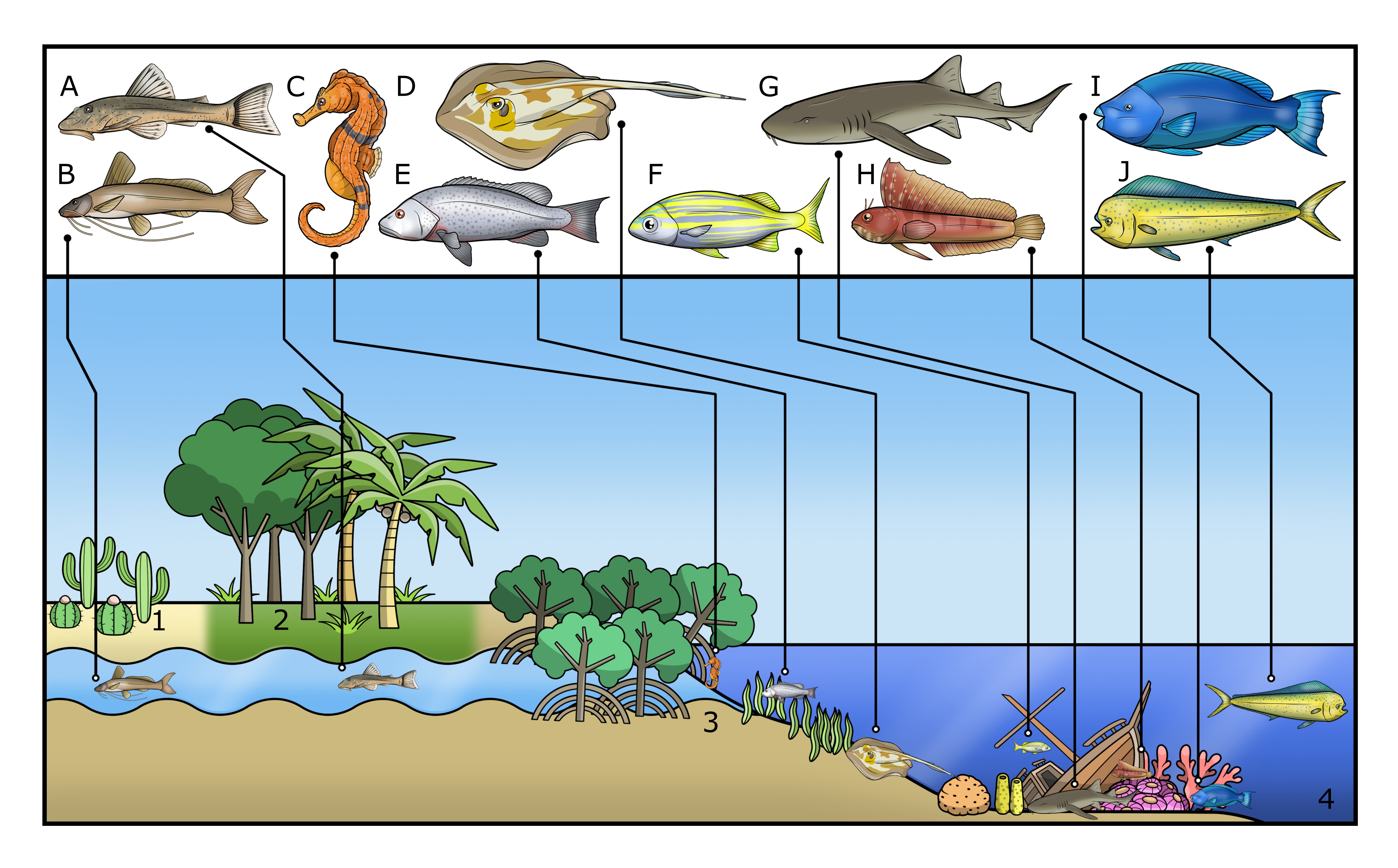
FIGURE 4| Schematic overview of the ichthyofauna of Paraíba State and their associated habitats: Freshwater (1–2), estuarine (3) and marine (4). A. Parotocinclus jacksoni; B. Pimelodella enochi; C. Hippocampus reidi; D. Hypanus marianae; E. Lutjanus cyanopterus; F. Haemulon squamipinna; G. Ginglymostoma cirratum; H. Emblemaria australis; I. Scarus trispinosus; J. Coryphaena hippurus. The number indicate the biome and realms: 1. Caatinga, 2. Atlantic Forest, 3. Mangrove Forest, and 4. Marine region. Illustration by Lukas M. Silva.
We identified 467 marine and estuarine teleosts, distributed across 26 orders and 96 families. The most representative orders are Acanthuriformes (87 spp., 18.67%), Carangiformes (61, 13.09%), and Gobiiformes (42, 9.01%). The most speciose families are Sciaenidae (29, 6.12%), Carangidae (27, 5.70%), and Labridae (23, 4.85%) (Tab. 2; Fig. 5A). Only one species is non-native, the lionfish Pterois volitans, an invasive species from the family Scorpaenidae (Tab. 2; Fig. 6F).

FIGURE 5| Absolute frequency of A. Marine-estuarine teleost species; B. Freshwater teleost species; and C. Elasmobranch species in the Paraíba State, Brazil. Marine teleost fishes are further categorized by their most representative orders, families and species.
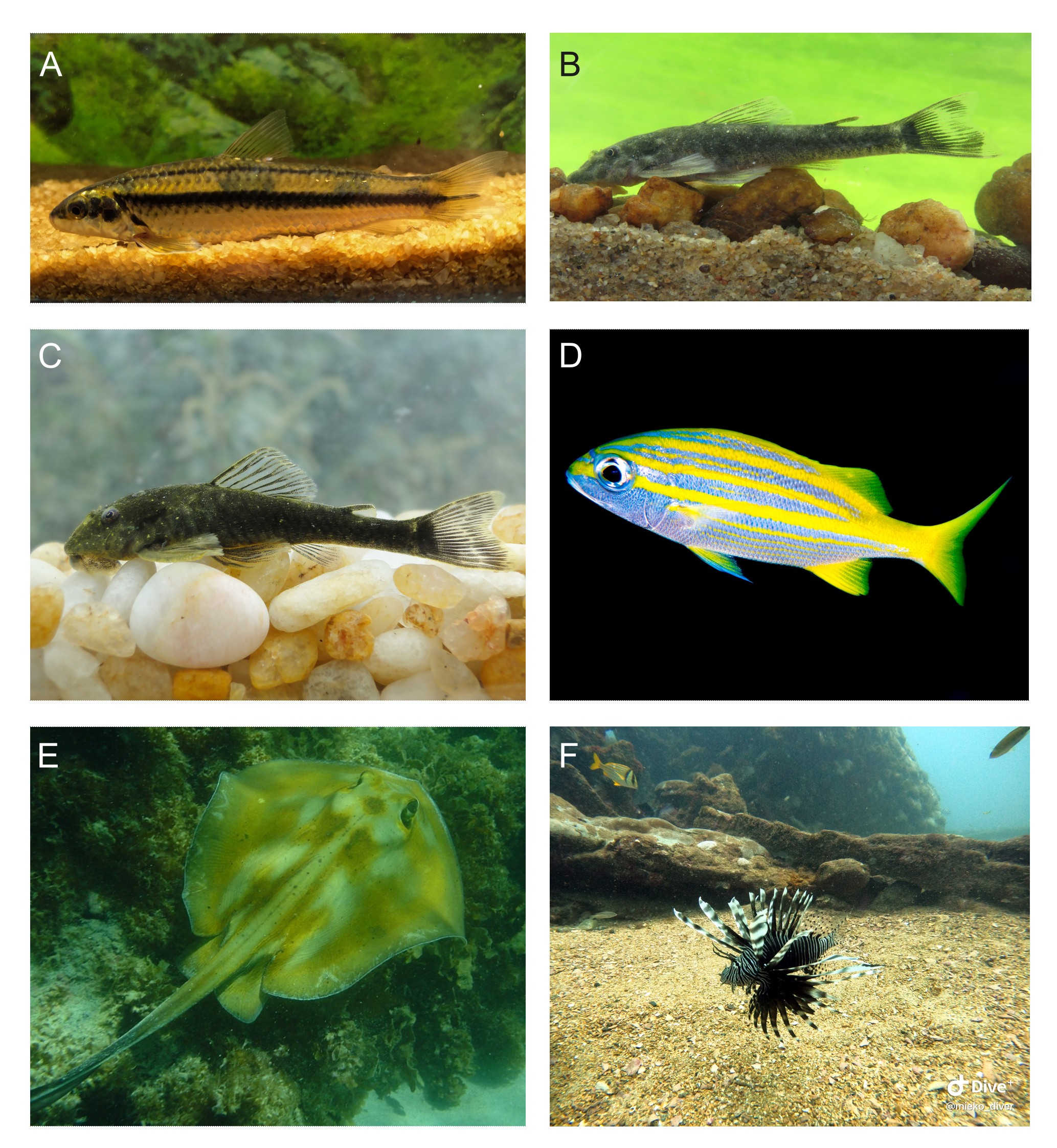
FIGURE 6| Fish species of Paraíba State. A. Apareiodon davisi; B. Parotocinclus jacksoni, endemic to the Mamanguape River; C. Parotocinclus spilosoma, endemic to the Paraíba River(Photos by Telton Ramos); D. Haemulon squamipinna, endemic to the Tropical Southwestern Atlantic province(Photo by Luis A. Rocha), and E. Hypanus marianae,endemic to Tropical Southwestern Atlanticprovince(Photo by Tiego Costa). F. The invasive marine species Pterois volitans (Photo by Vannesa Mieko).
For elasmobranch fishes, we identified 35 species across 7 orders and 17 families, all inhabiting marine environments, with some occasionally visiting estuaries. The most representative elasmobranchs fish orders are Carcharhiniformes (19 species, 54.30%) and Myliobatiformes (9 species, 25.71%), together accounting for 80% of all species. The families with the highest diversity are Carcharhinidae (11 species, 31.43%) and both Sphyrnidae and Dasyatidae (4 species each, 11.43%, see Tab. 2; Fig. 5C).
In freshwater environments, we identified a total of 63 teleost fish species, including exclusively freshwater species and some that may occasionally enter marine waters. These species belong to nine orders and 22 families (Tab. 2). Additionally, one species, the rivulid fish Hypsolebias sp., is currently being described (in prep.). The most speciose orders are Characiformes (30 spp., 47.69%), Siluriformes (15 spp., 23.08%), and Cichliformes (10 spp., 15.38%), collectively accounting for 80% of all freshwater species. The most speciose families are Cichlidae (10, 15.40%), Acestrorhamphidae (9, 13.84%), and Loricariidae (7, 12.31%) (Tab. 2; Fig. 5B). Of the 63 species, 13 are non-native, belonging to six families: Cichlidae (6 species), Serrasalmidae (1), Poeciliidae (2), and Acestrorhamphidae, Engraulidae, Cyprinidae, and Sciaenidae (1 each). Regarding species richness per basin, the Paraíba River is the most diverse, holding 47 species, followed by the Piranhas River (45 species), Mamanguape River (31), Abiaí River (29), Gramame River (29), Curimataú River (21), Camaratuba River (18), and Miriri River (12) (see Tab. 2; Fig. 3A).
Endemism and threat status. A total of nine freshwater fish species is endemic to the NCCD ecoregion, encompassing two orders and three families (Tab. 2). To date, no species have been reported exclusively as endemic to the Atlantic Forest biome in Paraíba. The family Loricariidae exhibits the highest richness of endemic species. Parotocinclus cearensis, P. seridoensis, and P. jacksoni; are endemic to the NCCD. Additionally, P. jacksoni is endemic to Mamanguape River basin and P. spilosoma is endemic to the Paraíba River basin. In marine environments, one marine species is endemic to the Northeastern Brazil Marine ecoregion (NBM): the teleost fish Emblemaria australis. The species Thalassophryne punctata; Haemulon squamipinna, and the stingray Hypanus marianae are endemic to the Tropical Southwestern Atlantic province and are restricted to the coastal zone (Tab. 2; Fig. 6).
In this study, we report that 44 species are threatened according to the IUCN, comprising 5 Critically Endangered (CR) species, 13 Endangered (EN) species, and 26 Vulnerable (VU) species, all of which inhabit marine and estuarine environments. According to the Sistema de Avaliação do Risco de Extinção da Biodiversidade (SALVE), Paraíba State is home to 43 threatened species, including 11 CR species, such as the Atlantic goliath grouper, Epinephelus itajara. Nine EN species occur in the state, including the red grouper, Epinephelus morio, and only two species from freshwater environments, the loricariids Parotocinclus seridoensis and P. spilosoma. Additionally, Paraíba has 23 VU species, including the large-eye marine stingray, Hypanus marianae, endemic to the Tropical Southwestern Atlantic province (Tab. 2; Fig. 7). Of the total number of threatened fish species in Paraíba, 51.20% are elasmobranch species, including 14 sharks (e.g., the great hammerhead Sphyrna mokarran) and eight rays (e.g., the Brazilian guitarfish Pseudobatos horkelii), both classified as CR species (Tab. 2). Among the data-deficient species (DD), 38 (61%) are marine and 24 (39%) are estuarine. Additionally, 28 (82%) marine and 3 (9%) estuarine and freshwater species remain non-evaluated (NE) (Tab. 2; Fig. 7).
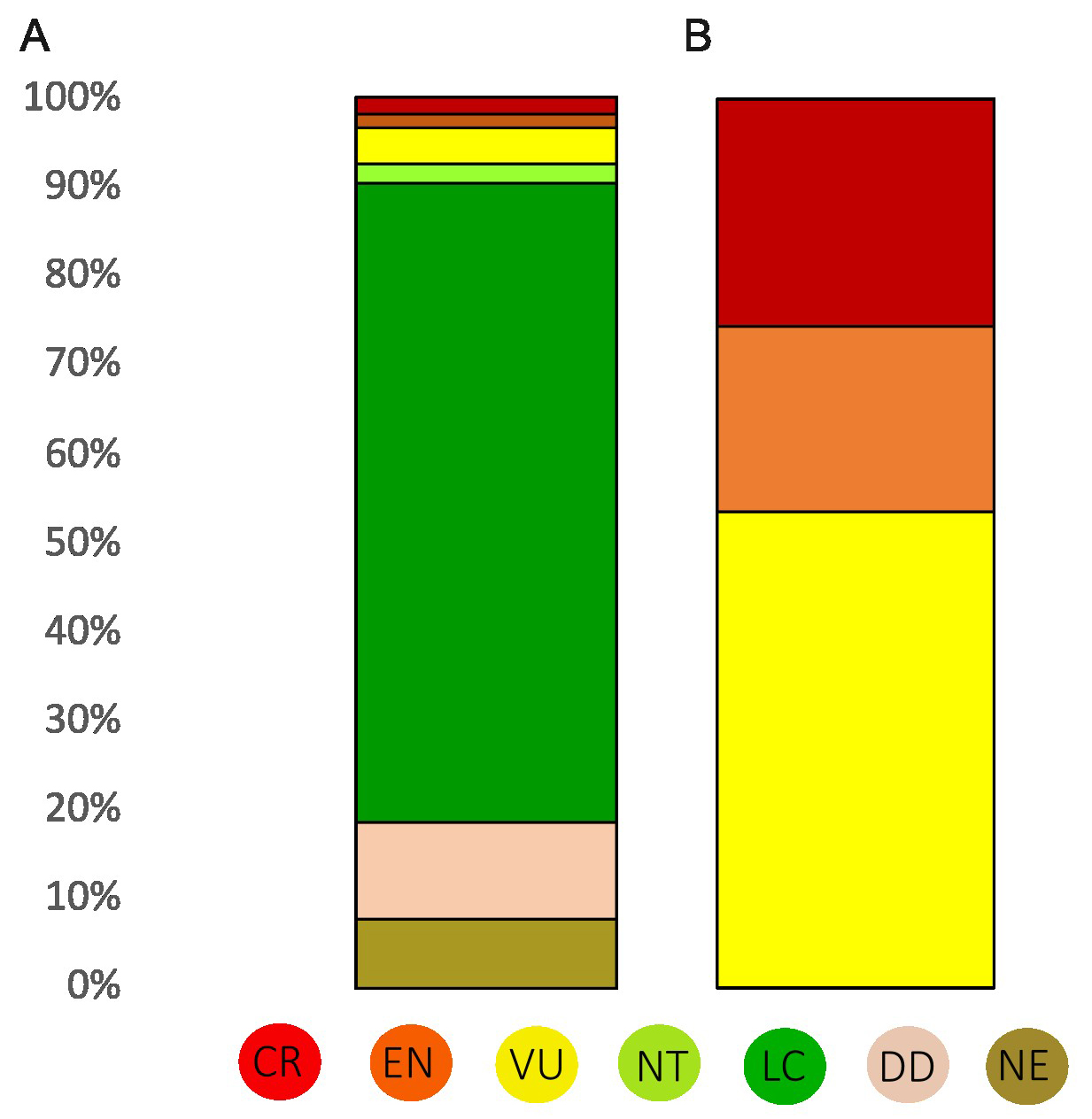
FIGURE 7| A. Extinction risk categories of fish species of the Paraíba State, according to national assessment lists; and B. The threatened species. CR: Critically Endangered; EN: Endangered; VU: Vulnerable; NT: Near Threatened; LC: Least Concern; DD: Data Deficient; NE: Not Evaluated.
Human use. Around 200 species are used by humans for trade (including ornamental purpose), local consumption, and traditional medicine (Tab. 2). In marine environments, commercially valuable species include the “camurin” Centropomus undecimalis, the “pescada” Cynoscion acoupa,the “vermelhos” Lutjanus spp., the “serras” Scomberomorus cavalla and S. brasiliensis, and the “dourado” Coryphaena hippurus. Some elasmobranch species are also caught and consumed locally, such as “cação rabo seco” Rhizoprionodon porosus and other species of “cação”(e.g., Carcharhinus spp.). Among the species captured, some are classified as threatened, including Lutjanus cyanopterus and L. campechanus, as well as some shark and ray species such as Carcharhinus porosus and Urotrygon microphthalmum, which are incidentally captured and consumed by local communities. In freshwater environments, around 14 species are used by local communities, including the native “curimatã” Prochilodus brevis and the “piau” Leporinus piau, which are important food and income sources (Tab. 2). Additionally, several exotic cichlid species, such as “tilápia do Nilo” Oreochromis niloticus, “tucunaré” Cichla monoculus and C. ocellaris are also relevant food sources.
Discussion
Multiple anthropogenic pressures threaten tropical fish biodiversity, ecosystem resilience, and the sustainability of resource use (Floeter et al., 2006; Costa, Barletta, 2016; Torremorell et al., 2021). Despite significant progress in studying Paraíba’s ichthyofauna, research efforts remain spatially biased, thematically concentrated, and insufficient to face conservation and management demands. Addressing these gaps is crucial for protecting fish diversity and supporting food security and local economies (Floeter et al., 2006; Ribeiro et al., 2009, 2015; Leão et al., 2016; Dala-Corte et al., 2020; Pelicice et al., 2021).
Although research on Paraíba’s fish dates back to the 17th century, contemporary efforts have notably expanded since the 1990s, reflecting broader national trends in ichthyology (e.g., Ramos et al., 2019; Vendel et al., 2022; Villarins et al., 2022; Marceniuk et al., 2023) including reef fishes in the Southwestern Atlantic (Rocha, Sampaio, 2022), stream-dwelling fishes (Lima et al., 2021) and elasmobranchs (Coelho et al., 2021; Viana et al., 2024). This growth results from the expansion of graduate programs, the consolidation of research groups, and the establishment of biological collections such as CIUFPB, now the largest ichthyological collection in Brazil’s Northeast (Azevedo et al., 2010; Viana et al., 2019; Rosa et al., 2023; Márquez Velásquez et al., 2025). However, institutional consolidation contrasts with knowledge asymmetries, such as certain basins and taxonomic groups that remain poorly studied due to inconsistent funding and the lack of a long-term research policy (Crouzeilles et al., 2017; Oliveira et al., 2020).
The increasing number of publications has not led to proportional advances in understanding the life histories and ecological roles of the studied species, some of which are commercially exploited. Although the application of molecular tools and integrative taxonomy (e.g., Berbel-Filho et al., 2016, 2018; Lustosa-Costa et al., 2024) is starting to uncover cryptic diversity and enhancing taxonomical work (e.g., Medeiros, Maltchik, 2001); and comparative anatomical studies have recently begun to be applied to phylogenetic analyses (Medeiros et al., 2025),such studies are still emerging and should be stimulated by funding agencies. Ethnobiological studies increasingly focus on the importance of traditional ecological knowledge in understanding fish ecology (e.g., Rosa et al., 2005; Mourão, Nordi, 2006; Almeida et al., 2014) and supporting participatory governance and management practices at the local level (Müller, Guimbo, 2011; Brasil, 2025). In the future, collaborative governance models that integrate academic, governmental, and community actors will be essential. Long-term funding for underrepresented regions and species groups, and integrating local knowledge into research agendas can help align biodiversity science with conservation and social equity.
Geographical distribution of research
Continental environments. Ichthyological surveys in Paraíba over recent decades produced valuable data for major basins, including the Paraíba (e.g., Rosa, Groth, 2004; Ramos et al., 2018a,b), Piranhas-Açu (Silva et al., 2014), Mamanguape (e.g., Rosa, Groth, 2004; Xavier et al., 2012, Oliveira-Silva et al., 2018), Gramame (Gomes-Filho, Rosa, 2001; Suruagy, Crispim, 2023), Curimataú rivers (Ramos et al., 2005) and smaller coastal basins, such as Jaguaribe river (Ramos et al., 2017). The small coastal rivers within the Tambaba Environmentally Protected Area, including Graú, Mucatú, Bucatú, and Gurugi rivers (Ramos et al., 2019), have also been well sampled. However, research efforts are spatially biased, with more than half of all studies focused on the Paraíba and Mamanguape River basins.
This asymmetry results from biogeographical, logistical, and institutional factors. The Borborema Plateau shapes Paraíba’s hydrography, which encompasses both the Caatinga (northwest-flowing) and Atlantic Forest (eastward-draining) domains (Rosa et al., 2003b). However, the proximity of the Paraíba and Mamanguape River basins to the capital João Pessoa, where research infrastructure, graduate programs, and funding are concentrated, has led to their overrepresentation in the literature. Furthermore, the Mamanguape River flows through the municipality of Rio Tinto, where one of the campuses of the Universidade Federal da Paraíba (UFPB) is located, and its estuary lies within the federal Environmental Protected Area Barra de Mamanguape, thereby enhancing the visibility and research appeal in the river basin (CERHPB, 2004; Azevedo et al., 2010; Junqueira et al., 2020). Systematic inventories covering all of the state’s eleven drainage systems are still lacking.
Smaller basins, such as Gramame and Abiaí Rivers, are relatively well-represented in collections and publications, while others remain poorly known. The Curimataú basin, covering 5% of the state’s area, and the Miriri basin, both under strong degradation pressure, received insufficient attention (CERHPB, 2004; AESA, 2022). Similarly, the interstate river basins of Jacu, Guaju, and Trairi, despite covering only small portions of Paraíba, face intense anthropogenic pressures, including sugarcane expansion, sewage input, and overgrazing (Hunka et al., 2007; Araújo et al., 2019; Marinho et al., 2023). The lack of surveys in these basins, even when they overlap adjacent inventoried areas (e.g., Trairi River in RN; Medeiros et al., 2019), reveals not only logistical and institutional asymmetries but also a misalignment between conservation priorities and research programs.
In addition, ichthyofaunal surveys within Conservation Units (CUs) in Paraíba State have been published. However, these data remain scattered and often scarce for several CUs, hindering a comprehensive assessment of the species distribution and management effectiveness. Of the 34 CUs established, 12 classified as strictly protected and 22 as sustainable use, 14 is entirely covered by Atlantic Forest, 12 by Caatinga, and only the Guaribas Biological Reserve encompasses both biomes (da Costa & da Silva, 2025). Five UCs included terrestrial and coastal marine environments. The freshwater ichthyofaunal data are restricted to some units, including the Environmental Protected Area (APA) of Tambaba (Ramos et al., 2019); the Biological Reserves (REBIO) Guaribas in Camaratuba River (Gouveia et al., 2017); the Private Natural Heritage Reserve (RPPN) Fazenda Pacatuba (Furtado etal., 2018); the State Park Mata do Xem-Xém (Ramos etal., 2018a,b), both in Paraíba River; and the Mata do Buraquinho Wildlife Refuge, crossed by the smaller coastal basin of the Jaguaribe River (Ramos et al., 2017). Overall, these fragmented records highlight the need for broader and more systematic surveys within these units to better inform management and conservation planning.
Marine environments. Marine ichthyological research in Paraíba State has predominantly centered on shallow coastal zones, particularly natural reefs (e.g., Souza et al., 2007; Honório et al., 2010) and artificial structures, such as shipwrecks (e.g., Cardoso et al., 2020; Medeiros et al., 2022), largely due to the logistical ease of sampling nearshore habitats. Initial efforts began in the 1970s with estuarine surveys (Oliveira, 1972), followed by studies on shark fisheries (Lima, Ferreira, 1975) and broader inventories in the 1980s (Rosa 1980a, b). From the late 1990s, taxonomic efforts (e.g., Rosa et al., 1997; Rocha et al., 1998, 2000) expanded knowledge of the coastal ichthyofauna and compilations validated new records of species (Marceniuk et al., 2023; Silva Nascimento, Ramos, 2024).
Despite their ecological and socioeconomic significance, providing food, income, and tourism services (Costa et al., 2007; Ilarri et al., 2008), coastal reef systems are increasingly threatened by pollution, mass tourism, and unregulated coastal development (Ilarri et al., 2008; Queiroz Pereira, 2020). In contrast, deeper marine zones remain markedly understudied as a consequence of cost and access constraints. Once considered buffered from anthropogenic impacts (Pulido Mantas et al., 2024), these environments are subject to overfishing, sedimentation, debris, and invasive species (Rocha et al., 2018; Soares et al., 2019). Existing data for deeper areas result from oceanographic surveys (Ramos, 1994; Rincon et al., 2017; Mincarone et al., 2022; Villarins et al., 2022) and technical SCUBA dives (Rocha et al., 2000; Feitoza et al., 2005). Only recently, advanced methods, such as trimix diving, remotely operated vehicles (ROVs), baited remote underwater video systems (BRUVS), and sidescan sonar, begun to reveal mesophotic reef biodiversity (e.g., Medeiros et al., 2021; Silva et al., 2021). Scaling up the use of these tools is essential to minimize depth-related sampling gaps and inform conservation strategies across the full marine gradient.
Some of these marine environments in Paraíba State are currently under the protection of CUs, and some ichthyofaunal surveys have been carried out within and around these protected areas. Most of the five federal protected areas designated for sustainable use have ichthyofaunal studiesdocumented in the literature: the Restinga de Cabedelo National Forest (FLONA), the only federally protected area in the Paraíba River estuary (e.g., Vendel et al., 2022); the Acaú-Goiana Extractive Reserve (RESEX), located along the coastal boundary between Paraíba and Pernambuco States (e.g., Barleta, Costa 2009); the Area of Relevant Ecological Interest (AREI) of the Mamanguape River Mangroves, the Environmental Protection Area (APA) of the Mamanguape River (e.g., Xavier et al., 2012; Oliveira-Silva et al., 2018), and the most recently established Queimado Shipwreck Marine Protected Area (Medeiros et al., 2022). Additionally, the state hosts the strictly protected Areia Vermelha Marine State Park, a CU for which an ichthyofaunal survey exists but remains unpublished (Querino, 2011). Given that these CUs play a key role in conserving marine biodiversity and mitigating anthropogenic pressures, systematic surveys are crucial to support effective monitoring and adaptive management.
Species richness and taxonomy trends
Freshwater ecosystems. Paraíba’s freshwater fish fauna comprises about 8% of the species recorded in Northeastern Brazil, 52% of which occur in the Northeastern Caatinga and Coastal Drainagesecoregion (Carvalho-Rocha 2023), 73% in the Mid-Northeastern Caatinga Ecoregion (MNCE) (Lima et al., 2017; Silva et al., 2020), and only 5% of species endemic to the Pernambuco Endemism Centre in the Northern Atlantic Forest, which hosts approximately 58 species (Marinho et al., 2023). These patterns suggest that Paraíba’s ichthyofauna has a strong biogeographic alignment with the Caatinga, despite comprising only a small portion of the MNCE (56,467.24 km²; IBGE, 2022). The MNCE remains one of Brazil’s least studied regions for freshwater fishes, primarily due to its intermittent flows (Lévêque et al., 2008; Lima et al., 2017; Berbel‐Filho et al., 2018), and Northeast Brazil remains underrepresented in global ichthyofaunal databases (Tedesco et al., 2017).
Fish diversity in Paraíba is influenced by historical marine transgressions, aridification, and drainage reorganization (Ab’Sáber, 1957; Lundberg et al., 1998), as well as by human-induced introductions and extinctions (Rosa et al., 2003b; Ribeiro 2006). As is typical in most Neotropical basins (Buckup et al., 2007; Lima et al., 2017; Menezes et al., 2007), Paraíba’s fish fauna is dominated by Characiformes and Siluriformes with Acestrorhamphidae, Cichlidae, and Loricariidae being the most speciose families. Among the 62 recorded species, 13 are non-native (21%), mostly cichlids. Such cichlid dominance represents 73% of all exotic species reported for the Caatinga (Lima et al., 2017), raising concerns about biotic homogenization, competitive displacement, and long-term impacts on the structure of ecological communities.
The absence of Rivulidae records in Paraíba State is notable, given their endemism in the MNCE and commonness in Caatinga habitats (Myers, 1952; Lima et al., 2017; Berbel‐Filho et al., 2018; Abrantes et al., 2020). As annual fish species adapted to ephemeral ponds, rivulids survive through diapause and are typically active only during the rainy season (Berois et al., 2016). Their detectability is sensitive to sampling season, a factor that likely explains their omission from most dry-season surveys (Rosa et al., 2023). More than 50 annual fish species have been described from the Caatinga (Lima et al., 2017), but Paraíba has only one known record of a Rivulid (TPAR, 2025, pers. obs.). This points to the importance of seasonal sampling in temporary aquatic habitats, which may contain endemic lineages relevant for systematics, biogeography, and conservation planning. Eight of the 49 Caatinga endemics occur in Paraíba, including the “cascudinho” Parotocinclus jacksoni, whose distribution is restricted to the Caatinga (upper) section of the Mamanguape River basin (Oliveira-Silva et al., 2018; Ramos et al., 2021a). Another “cascudinho”, Parotocinclus spilosoma, is endemic to the Paraíba River basin. These narrow-range endemics contribute to the state’s ecological and evolutionary distinctiveness in freshwater fish assemblages and suggest the presence of microendemism shaped by isolation.
The full extent of freshwater fish diversity in Paraíba State remains unknown. Underestimation of species richness is the most likely scenario for most taxonomic groups, as supported by: (i) undescribed species in collections (e.g., Hypsolebias sp.; (ii) unresolved taxonomy of widespread complexes (e.g., Astyanax bimaculatus, Hoplias malabaricus, Synbranchus marmoratus); iii) limited digitization and few recent revisions (Lima et al., 2017; Marinho et al., 2023), and iv) under-sampled sub-basins.
Marine ecosystems. Despite its relative small coastline (138 km, Ab’Saber, 2001), Paraíba’s fish diversity comprises ~83% of species known from tropical northeastern Brazil (Rosa et al., 2023), and 14% of South American marine fishes (Reis et al., 2016). Forty of them are Brazilian endemics and three are restricted to the northeastern coast. Recent estimates suggest the existence of 418–427 coastal teleost species (Marceniuk et al., 2023; Rosa et al., 2023), and surveys in mesophotic zones and other under-sampled habitats continue to reveal additional diversity (e.g., Silva et al., 2021).
Elasmobranch fishes recorded in Paraíba account for about 19% of Brazil’s elasmobranch diversity (Kotas et al., 2023) with the stingray Hypanus marianae representing a coastal Tropical Southwestern Atlantic endemic. In Paraíba, sharks are the most common group in elasmobranch records, particularly Carcharhiniformes, as in other Brazilian regions (e.g., Rosa, Gadig, 2014; Bezerra et al., 2021) and worldwide (Compagno, 2003; Ebert et al., 2021). Myliobatiformes is the most species-rich order among batoids (Fricke et al., 2025). Within Myliobatiformes, records of Mobula birostris reported in the literature for Paraíba likely refer to Mobula yarae Bucair & Marshall, 2025. The regional pattern of more shark than ray species, which diverges from global patterns (Fricke et al., 2025), may result from research focus, greater catchability, and higher intrinsic diversity of sharks within Brazil’s elasmobranch fauna (e.g., Meneses et al., 2005; Rosa, Gadig, 2014; Bezerra et al., 2021). It may also be partly explained by the exclusion of grey literature in this study, which includes theses and undergraduate monographs that hold unpublished information on the elasmobranch fish fauna of Paraíba and the Brazilian Northeast.
Paraíba’s marine fish assemblages reflect a complex interplay of biogeographic processes that shape patterns of endemism and species turnover. Situated within the north-northeastern subprovince of the Brazilian Province (Briggs, 1974; Pinheiro et al., 2018), the state lies at a transitional biogeographic zone. The intersection of ecological processes and historical events that have shaped Paraíba’s marine biota includes dispersal capacity (Floeter et al., 2008; Cowman, Bellwood, 2013), environmental conditions and local adaptation (Robertson and Cramer 2014), oceanographic currents (Spalding et al., 2007), habitat discontinuities (Riginos, Nachman, 2001), isolation-by-distance and gene flow (Rocha et al., 2008), and vicariance events (Joyeux et al., 2001).
Conservation concerns
Aquatic ecosystems in Paraíba State hold numerous endangered species whose ecological functions are tightly linked with ecosystem resilience. In marine habitats, threatened taxa include teleosts of the families Epinephelidae, Labridae, Lutjanidae, Carangidae, and Ariidae, and elasmobranchs of the families Sphyrnidae, Carcharhinidae, and Rhinobatidae. These species play diverse ecological roles. For example, parrotfishes (Labridae) promote reef diversity through grazing and bioerosion (Bonaldo et al., 2014) and sharks control prey dynamics (Heithaus et al., 2008). The critically endangered endemic parrotfish Scarus trispinosus (ICMBio, 2026) experienced population declines over the past three decades due to overexploitation by small-scale fisheries (Roos et al., 2016). Additionally, the demographic decline of the critically threatened mesopredator Epinephelus itajara (Epinephelidae) affects epibenthic and demersal food webs of marine rocky shores (Artero et al., 2015; Freitas et al., 2015). This is a widespread effect as the species ranks among the most endangered taxa in the whole Atlantic Ocean (IUCN, 2025).
Chondrichthyans, which play key ecological roles (Heithaus et al., 2012; Dedman et al., 2024), rank among the most threatened vertebrate groups worldwide (Dulvy et al., 2021; Pacoureau et al., 2021). Paraíba State is no exception, as more than 40% of local chondrichthyan species face severe extinction risks (ICMBio, 2026). Widespread ecological impact derived from disruption of size-structured predation and nutrient flow chains arise from population declines of top predators, such as the great hammerhead shark Sphyrna mokarran, the smalltail shark Carcharhinus porosus and the Brazilian guitarfish Pseudobatos horkelii.
Major anthropogenic processes that may be driving marine population declines in Paraíba include habitat degradation, pollution, coastal development, climate change (Hillebrand et al., 2018; Prates et al., 2010), overfishing (Pinheiro et al., 2010; Bender et al., 2014), and biological invasions, particularly by the lionfish Pterois volitans (Luiz et al., 2021; Soares et al., 2022, Maggioni et al., 2023). The spread of lionfish in a variety of habitats, from mangroves to deep reefs and in marine protected areas, raises concerns as this invasive species imposes strong predation on juvenile reef fishes, which is likely to erode the biotic architecture of local food webs (Albins, Hixon, 2008; Soares et al., 2022, 2023). It is important to note that many of the introduced species documented in the Southwestern Atlantic and along the Brazilian coast since the mid-2000s (Schwindt et al., 2020) exhibit cryptobenthic behavior (Ferreira et al., 2009), which may hinder earlier detection and facilitate unnoticed establishment, highlighting the potential occurrence of cryptic invasive species in Paraíba State.
Despite their ecological and economic importance, estuaries are among the most threatened ecosystems (Whitfield et al., 2022). Estuaries are critical habitats for many fish species, playing a key role as nurseries by providing juveniles with favorable conditions, such as high temperatures, prey availability, and refuge from predators, enhancing growth and survival (Potter et al., 2015; Xavier et al., 2022). Anthropogenic pressures, including human occupation and economic activities, resulting in sewage discharges (Cortez et al., 2023), sugarcane plantations, and intensive shrimp aquaculture in the surrounding area (Marcelino et al., 2005; Barletta et al., 2010) are among the main threats, further compounded by impacts related to climate change. More than 160 species have been recorded in the estuaries of Paraíba State (mainly in Mamanguape and Paraiba Rivers) including threatened species such as Lutjanus cyanopterus and the Atlantic tarpon Megalops atlanticus Valenciennes, 1847, which occurs in both estuarine and reef areas (Xavier et al., 2012; Vendel et al., 2022), highlighting ecosystem connectivity. The Critically Endangered Carcharhinus porosus was reported in the Paraiba estuary and at Tambaú and Bessa beaches, but it has not been captured there or elsewhere in Paraíba State since the 1980s, emphasizing the need for continuous monitoring of fish populations. The diversity and structural complexity of these habitats highlight the importance of the Mangrove-Reef System as a priority area for conservation and research.
Regarding freshwater environments, the conservation status of many species remains unclear as substantial knowledge gaps persist. To date, only two species, the loricariids Parotocinclus seridoensis and P. spilosoma,are listed as endangered, with population declines linked to habitat loss and fragmentation (ICMBio, 2026). Three native species have not been evaluated, including Hemigrammus rodwayi, Pseudancistrus papariae and the endemic Parotocinclus jacksoni (Ramos et al., 2021a). Missing data constraints extinction risk assessments and conservation planning, reinforcing the need for substantial investments supporting systematic surveys in freshwater systems.
Freshwater ecosystems and their fishes are also among the most threatened habitats and species worldwide (Dudgeon et al., 2006; Sayer et al., 2025). Paraíba mirrors these global trends, which are driven by the interplay of diverse regional processes, such as: i) hydrologic changes caused by dams, weirs and channels (Brito et al., 2020; Carvalho et al., 2023); ii) habitat destruction from intensive agriculture, especially sugarcane plantations, along with removal of riparian vegetation, livestock and shrimp farming (Sousa et al., 2020; Marinho et al., 2023); iii) pollution and eutrophication of water bodies (Correia et al., 2015); and iv) introductions of invasive species (Leão et al., 2011).
To date, 13 non-native freshwater fish species have been reported in Paraíba (21%) (Latini et al., 2016), indicating a strong trend of biotic homogenization. This results from accidental or deliberate introductions via aquaculture, aquarium trade (Leão et al., 2011), biological control (Leão et al., 2011; Latini et al., 2016), and interbasin water transfer (Ramos et al., 2021b). The “tucunaré” (Cichla ocellaris) and tilapias (Oreochromis niloticus and Coptodon rendalli) were introduced for food safety by government programs or for sport fishing (Rosa, Groth, 2004; Leão et al., 2011). Aquarium species were accidentally released in the wild, such as Xiphophorus maculatus, Astronotus ocellatus, and Parachromis managuensis (Ramos et al., 2020; Marinho et al., 2023). Species used for mosquito control, such as the“barrigudinho” Poecilia reticulata, used against the dengue vector, Aedes aegypti (Levis et al., 2013; Azevedo-Santos et al., 2016). Biotic homogenization is expected to increase due to large-scale interbasin water transfer, such as illustrated by “tetra-fortuna” Moenkhausia costae, the first record of an allochthonous species in the Paraíba river arising from its novel connections with the São Francisco River since 2018 (Ramos et al., 2021b).
Introductions correlate with habitat degradation, which amplifies the impacts of invasive species (Poff et al., 2007), leading to the regional extinction of native species (Rosa, Groth, 2004; Charvet et al., 2021); biotic homogenization (Latini, Petrere, 2004; Rosa, Groth, 2004; Orlandi Neto et al., 2024); food web changes arising from novel predation and competition pressures (Zaret, Paine, 1973; Pyke, 2008); hybridization (Oliveira et al., 2006), and the spillover of parasites and diseases (Dobson, May, 1987; Williams et al., 2013). Emerging host-parasite dynamics under strong anthropogenic changes deserve particular attention (Chalkowski et al., 2018; De Lima et al., 2025; Moraes et al., 2025). For example, it is still unclear whether nematodes parasitizing M. costae in the Paraíba river are also exotic species (Sousa et al., 2025), with potential to reaching the native fauna and leading to community changes (Lacerda et al., 2013).
Despite the importance of protected areas for biodiversity conservation, they also face threats and challenges. Exotic species have already been recorded within their area. For example, in APAs of Tambaba (Ramos etal., 2019) the “tucunaré C. monoculus and the “barrigudinho” P. reticulata were recorded, the latter also documented in REBIO Guaribas (Gouveia etal., 2017); the RPPN Fazenda Pacatuba (Furtado etal., 2018) and State Park Mata do Xem-Xém (Ramos etal., 2018a,b). Additionally, the “tilápia do Nilo” O. niloticus has been recorded in the REBIO Guaribas and the State Park Mata do Xem-Xém, within the Paraíba River basin (Gouveia et al., 2017; Ramos et al., 2018a). As previously mentioned, these species pose a threat to the native ichthyofauna, and their populations should be monitored. On the other hand, the need to effectively implement management plans persists. These plans have been established in only eight of the 34 protected areas in the state, although in some cases their preparation is underway, including the holding of public hearings (da Costa, da Silva, 2025). This panorama is consistent with that observed in other regions of Brazil, where the implementation of management plans remains limited: 84% of protected areas established more than five years ago still lack this critical management tool (Riva et al., 2014). Moreover, the establishment of management councils, currently present in 14 of these areas, is critical to ensure effective governance and promote participatory decision-making. Therefore, ichthyological surveys, proper design and management plans, and the establishment of management councils in UCs in Paraiba State are essential to guide the biodiversity conservation actions and an effective management.
Economic perspectives. The freshwater and marine ichthyofauna of Paraíba support local communities through commercial and sport fishing (e.g., Nascimento et al., 2016; Santos et al., 2023) and ecotourism (Costa et al., 2007; Souza, 2007). Particularly, small-scale fisheries and aquaculture are vital for local economies in terms of livelihoods and food security (Paulo Júnior et al., 2012). Key resources include “tilapia”, “traíra”, “tucunaré”, “curimatã”, and “pescada do Piauí”(IBAMA, 2008). Artisanal marine fishing targets mostly Scombridae (e.g., Euthynnus alletteratus, Scomberomorus brasiliensis, S. cavalla) and Carangidae (e.g., Caranx bartholomaei), Lutjanidade and Centropomidae (Centropomus undecimalis) (IBAMA, 2008), with eventual captures of elasmobranchs in the family Carcharhinidae (Rhizoprionodon porosus, Carcharhinus spp.), Sphyrnidae (Sphyrna spp.) (Mariano, Rosa, 2010; Morais, 2016), and rays, including Urotrygon microphthalmum, Rhinoptera bonasus, Aetobatus narinari and Hypanus guttatus (RSR, 2025, pers. comm.; JPCB, 2023, pers. comm.). In general, these elasmobranchs are caught incidentally in artisanal beach seines and gillnets. Catches have strongly declined, for example, with artisanal fishing dropping to half between 2002–2004 (IBAMA, 2007). As a consequence, regulation is urgently needed for both marine and freshwater environments as fish stocks approach collapse (MPA, 2013).
Other income-generating activities involve ornamental species, such as seahorses (Hippocampus spp.),a rare fish species threatened in Brazil, not only by the trade and habitat degradation (Borges et al., 2025a) but also by its biological characteristics as high site fidelity and low reproduction rate (Foster, Vincent, 2004). In this context, over the past decades, researchers at UFPB developed conservation projects investigating biological, ecological, and bioeconomic aspects of the seahorse Hippocampus reidi (e.g., Rosa et al., 2005). Currently, researchers at the Universidade Estadual da Paraíba (UEPB) are conducting studies to fill knowledge gaps regarding seahorse species and determine their conservation priorities in Brazil, using a multidisciplinary approach that integrates biogeographical, ecological, and ethnobiological knowledge (Borges et al., 2025b).
The conservation and management of species and fishery resources are essential not only to preserve biodiversity but also to ensure the continuity of economic activities, social well-being and food security (Tickner et al., 2020; Oguh et al., 2021). Multidisciplinary efforts and participatory management, to improve decision-making and socio-ecological management (Pomeroy, Rivera-Guieb, 2006), as well as in the identification of potential resources. Additionally, empowering local communities through human resource development can support management and productive activities by strengthening local capacities in fisheries management, monitoring and enforcement, civic education, and communication. Such initiatives, typically implemented through training courses or workshops, also contribute to the development of sustainable economic alternatives, such as ecotourism, as observed in other regions of Brazil (WCS-Brasil, https://amazoniacienciaciudadana.org/) and other South American countries (https://www.wwf.org.co).
Some examples that advance in this direction may involve training fishermen in the cultivation and processing techniques of native freshwater fish species, as a means to diversify local livelihoods, reduce pressure on wild stocks, and offer products with greater added value and acceptance in different markets, for example, boneless fillets (Kubitza et al., 2007). Additionally, strengthening the fisheries value chain via training in fish processing and marketing are complementary strategies. Encouraging responsible fish consumption can improve food security while increasing community income. Finally, transforming discarded fishing nets into handcrafted products can also contribute to the mitigation of marine pollution.
Finally, it is relevant to discuss with local communities how the sustainable management of fish populations contributes to biodiversity conservation and long-term profitability for the fishing and tourism activities. This could include practices such as: i) the identification, establishment and control of key areas for reproduction of freshwater species and of marine protected areas, ii) catch limits, iii) the promotion of conservation of native species, and iii) the control of invasive species. Thus, it is essential to utilize traditional knowledge and empower local people through the development of human capital, science, and technological innovation to create sustainable solutions that meet the needs of communities (Alcalá Moya, 2011; Nishi, Subramanian, 2023).
Integrative overview and perspective. This study presents significant advances in the research on the ichthyofauna of freshwater, estuarine and marine environments in Paraíba State; however, there is still much to be done. Our review found biases related to research topics and the spatial distribution of studies and species. Although much of the river basins have already been inventoried, some areas are under-sampled, such as the small coastal rivers. Thus, future sampling efforts should be directed to these under-sampled localities to address these gaps, in addition to the inventories performed at the regional scale to support public conservation policies (Rosa et al., 2003a; Tedesco et al., 2017). Reducing these gaps will require an intensive and joint effort of a diverse team of professionals and institutions. Interdisciplinary and inter-institutional efforts are also applied to biodiversity research and social development. Additionally, infrastructure, equipment, new technologies, and investments in human resources are essential to optimize research and promote projects and initiatives that involve local communities, biodiversity conservation, and social welfare.
To address most of the knowledge gaps of the fish fauna of Paraíba State, and promoting its conservation and sustainable use, we recommend the following actions: i) fish surveys to fill local gaps, mainly in: under-sampled drainages such as Miriri, Curimatau and Camaratuba Rivers as well as the small coastal and interstate basins; headwater areas of drainage, which are more difficult to access; deep reefs, estuaries and in the UCs; ii) to prioritize the monitoring of basins and their estuaries, mainly those harboring the highest number of endemic and threatened species, such as the Paraíba and Mamanguape River basins; iii) to strengthen the control mechanisms of conservation units (CUs); to implement and update management plans in order to improve oversight and enforcement; and to expand existing conservation units to encompass potential key areas for species conservation; iv) to develop projects to recover degraded aquatic habitats, through restoration of riparian forests programs, particularly in estuarine areas such as the Mamanguape and Paraíba River estuaries, as well as the protection and recovery of river headwaters; and coastal reef restoration programs; v) promotion of environmental education projects for the conservation of freshwater and marine ecosystems and their species in schools and communities; vi) restriction and control of introduction of exotic species in natural aquatic environments; and vii) digitalization, curation and availability of biological collection data. It is essential to acknowledge that a substantial amount of unpublished research, stemming from undergraduate and graduate theses from universities in the Northeast, remains unexplored and has yet to be published. This represents valuable sources for research on the ichthyofauna of Paraíba State. The following table (Tab. 3) presents topics and questions that we consider relevant to future research. Advancing these actions will be crucial for strengthening research and conservation of the fish fauna of Paraíba State.
TABLE 3 | Future research on the fish fauna of Paraíba State.
Research area | Future perspectives |
Biology and Population Ecology | Studies on the biological aspects and population status of data-deficient and near-threatened species. |
Explore the age and growth, as well as the life history parameters, of fisheries resources, which are key to effective fisheries management. | |
Ecology | Effects of climate change on demography, physiology, and biological processes, as well as on the distribution patterns of species. |
Ecotoxicology | Assessing the effects of pollution in fish populations and the effect of human consumption of the polluted species; screening of contaminants in tissues. |
Biogeography-Phylogeography | How species responded to past changes may help to predict how they might cope with the ongoing climatic changes. Evaluation of processes that generated and maintained the diversity of fish fauna of the Caatinga and the Atlantic Forest. |
Biological invasions | To assess the degree of invasibility of this species in the basin, the ecological impacts (on the ecosystems and on the native species) are considered. For marine species, to assess the distribution, biology, reproduction, and trophic ecology aspects, and to propose control and management measures. |
Genetic-eDNA | DNA collected from environmental samples, such as water, can be used to analyse genetic data and detect the presence of species in the area. |
Parasitology | Parasite diversity, parasite-host relationships, effects of parasitism on the host`s condition and how environmental changes and biological invasions may affect these associations. |
Fisheries | Monitoring of landing data, description of catches and fishing effort. |
Conservation | Delineation of habitat use and critical areas for endangered, endemic species; evaluation of the effectiveness of existing MPAs for the species. |
Bioeconomy | Explore ways to sustainably use and manage fish, in a manner that ensures the long-term health of aquatic ecosystems and maximises the benefits for local communities. |
Taxonomy and Systematics | Ichthyofaunal surveys at poorly sampled areas; use of integrative taxonomy to better understand widespread species complexes; digitise scientific data from collections and make them available; improve data quality of scientific collections by providing reliable species identification. |
Acknowledgments
We gratefully acknowledge the Fundação de Apoio à Pesquisa do Estado da Paraíba (FAPESQ) and Conselho Nacional de Desenvolvimento Científico e Tecnológico – CNPq for the postdoctoral fellowship to VMV (2413/2023). We thank the curators and technicians of the institutions who kindly sent us their records (UFPB, UFRN, MZUSP, MNRJ, PUCRS). We thank all collaborators of the Ichthyological collections of UFPB, and to all the ichthyologists who contributed in any way with their comments. We are grateful to the collaboration and support of PRONEX/FAPESQ-PB (027–2023), specially to Alexandre Vasconcellos (UFPB). We thank the Instituto Nacional de Ciência e Tecnologia da Biodiversidade e uso Sustentável de Peixes Neotropicais (INCT-Peixes) (MCTIC/CNPq (#405706/2022–7) for funding technician work at CIUFPB. TPAR thanks the Conselho Nacional de Desenvolvimento Científico e Tecnológico (CNPq) for the the Senior Postdoctoral Fellowship (PDS) (102654/2024–7).
References
Abell R, Thieme ML, Revenga C, Bryer M, Kottelat M, Bogustskay N et al. Freshwater ecoregions of the World: a new map of biogeographic units for freshwater biodiversity conservation. BioScience. 2008; 58(5):403–14. https://doi.org/10.1641/B580507
Abrantes YG, Medeiros LS, Bennemann ABA, Bento DM, Teixeira FK, Rezende CF et al. Geographic distribution and conservation of seasonal killifishes (Cyprinodontiformes, Rivulidae) from the Mid-Northeastern Caatinga ecoregion, northeastern Brazil. Neotrop Biol Conserv. 2020; 15(3):301–15. https://doi.org/10.3897/neotropical.15.e51738
Ab’Sáber NA. Significado geomorfológico da rede hidrográfica do Nordeste oriental brasileiro. Bol Geogr. 1957.
Ab’Sáber NA. Litoral do Brasil. São Paulo: Metalivros; 2001.
AESA. Plano Estadual de Recursos Hídricos do Estado da Paraíba. 2022. Available from: www.aesa.pb.gov.br
Albert JS, Petry P, Reis RE. Major biogeographic and phylogenetic patterns. In: Albert J, Reis R, editors. Historical biogeography of Neotropical freshwater fishes. London: University of California Press; 2011.
Albins MA, Hixon MA. Invasive Indo-Pacific lionfish Pterois volitans reduce recruitment of Atlantic coral-reef fishes. Mar Ecol Prog Ser. 2008; 367:233–38. https://doi.org/10.3354/meps07620
Alcalá Moya MG. Pescadores en América Latina y El Caribe: espacio, población, producción y política. v2. México: Facultad de Ciencias de la Universidad Nacional Autónoma de México; 2011.
Alcantara-Rodriguez M, Françozo M, Van Andel T. Plant knowledge in the Historia Naturalis Brasiliae (1648): retentions of seventeenth-century plant use in Brazil. Econ Bot. 2019; 73:390–404. https://doi.org/10.1007/s12231-019-09469-w
Almeida DM, Silva-Oliveira EC, Alves RRN. Ethnoichthyology of fishermen community from the Praia da Penha, in João Pessoa City, Paraíba, Brazil. Braz J Biol Sci. 2014; 1(2):39–49. N TEM
Alvares CA, Stape JL, Sentelhas PC, Gonçalves JLM, Sparovek G. Köppen’s climate classification map for Brazil. Meteorol Z. 2013; 22(6):711–28. https://doi.org/10.1127/0941-2948/2013/0507
Agência Nacional de Águas (ANA). Conjuntura dos recursos hídricos no Brasil: regiões hidrográficas brasileiras. Edição Especial. Brasília, DF: Agência Nacional de Águas e Saneamento Básico-ANA; 2015.
Araújo NHL, Batista IS, Terto ML, Anjos RS. Impactos ambientais dentro da microbacia do rio Jacu: um estudo de caso da área em torno do rio principal – Jacu, no município de Goianinha-RN. Rev Casa Geogr Sobral. 2019; 21(2):1070–90. https://doi.org/10.35701/rcgs.v21n2.597
Artero C, Koenig C, Richard P, Berzins R, Guillou G, Bouchon C et al. Ontogenetic dietary and habitat shifts in goliath grouper Epinephelus itajara from French Guiana. Endanger Species Res. 2015; 27:155–68. https://doi.org/10.3354/esr00661
Azevedo PG, Mesquita FO, Young RJ. Fishing for gaps in science: a bibliographic analysis of Brazilian freshwater ichthyology from 1986 to 2005. J Fish Biol. 2010; 76(9):2177–93. https://doi.org/10.1111/j.1095-8649.2010.02668.x
Azevedo-Santos VM, Vitule JRS, García-Berthou E, Pelicice FM, Simberloff D. Misguided strategy for mosquito control. Science. 2016; 351(6274):675. https://doi.org/10.1126/science.351.6274.675
Barletta M, Costa MF. Living and non-living resources exploitation in a tropical semi-arid estuary. J Coast Res. 2009; 56:371–75.
Barletta M, Jaureguizar AJ, Baigun C, Fontoura NF, Agostinho AA, Almeida-Val VMF et al. Fish and aquatic habitat conservation in South America: a continental overview with emphasis on neotropical systems. J Fish Biol. 2010; 76(9):2118–76. https://doi.org/10.1111/j.1095-8649.2010.02684.x
Beddington JR, Agnew DJ, Clark CW. Current problems in the management of marine fisheries. Science. 2007; 316(5832):1713–16. https://doi.org/10.1126/science.1137362
Bender MG, Machado GR, Silva PJA, Floeter SR, Monteiro-Netto C, Luiz OJ, Ferreira CE. Local ecological knowledge and scientific data reveal overexploitation by multigear artisanal fisheries in the Southwestern Atlantic. PLoS ONE. 2014; 9(10):e110332. https://doi.org/10.1371/journal.pone.0110332
Berbel-Filho WM, Martinez PA, Ramos TPA, Torres RA, Lima SM. Inter- and intra-basin phenotypic variation in two riverine cichlids from northeastern Brazil: potential eco-evolutionary damages of Sao Francisco interbasin water transfer. Hydrobiologia. 2016; 766:43–56. https://doi.org/10.1007/s10750-015-2440-9
Berbel-Filho WM, Ramos TPA, Jacobina UP, Maia DJ, Torres RA, Lima SM. Updated checklist and DNA barcode-based species delimitations reveal taxonomic uncertainties among freshwater fishes from the mid-north-eastern Caatinga ecoregion, north-eastern Brazil. J Fish Biol. 2018; 93(2):311–23. https://doi.org/10.1111/jfb.13758
Berois N, Arezo MJ, Papa NG, Chalar C. Life cycle, reproduction, and development in annual fishes. In: Berois N, García C, Sá R, editors. Annual fishes: life history strategy, diversity and evolution. Boca Raton: CRC Press/Taylor and Francis Group; 2016. p.33–45.
Bezerra NA, Palmeira Nunes AR, Viana DDL, Nunes ISLB, Rêgo MGD, Roque PCG et al. Elasmobrânquios marinhos do Nordeste Brasileiro. In: Viana D, Oliveira JE, Hazin FH, Souza MA, editors. Ciências do Mar: dos oceanos do mundo ao Nordeste do Brasil. Olinda: Via Design Publicações; 2021. p.205–35.
Bonaldo RM, Hoey AS, Bellwood DR. The ecosystem roles of parrotfishes on tropical reefs. In: Hughes RN, Hughes DJ, Smith IP, editors. Oceanography and Marine Biology. Boca Raton: CRC Press; 2014. p.81–132.
Borges AKM, Adams VM, Alves RRN, Oliveira TPR. Seahorse ecology and conservation in Brazil: a systematic review. Ethnobiol Conserv. 2025a; 14:12. https://doi.org/10.15451/ec2025-02-14.12-1-24
Borges AKM, Adams VM, Alves RRN, Oliveira TPR. Assessing conservation priorities for seahorses in Brazil reveals gaps in current protected areas. Conserv Sci Pract. 2025b; 7(6):e70062. https://doi.org/10.1111/csp2.70062
Brasil. Livro Violeta: ciência, tecnologia e inovação para um Brasil justo, sustentável e desenvolvido. Brasília: Ministério da Ciência, Tecnologia e Inovação/Centro de Gestão e Estudos Estratégicos; 2025.
Briggs JC. Marine zoogeography. New York: McGraw-Hill; 1974.
Brito MFG, Daga VS, Vitule JRS. Fisheries and biotic homogenization of freshwater fish in the Brazilian semiarid region. Hydrobiologia. 2020; 847:3877–95. https://doi.org/10.1007/s10750-020-04236-8
Buckup PA, Menezes NA, Ghazzi MS. Catálogo das espécies de peixes de água doce do Brasil. Rio de Janeiro: Museu Nacional; 2007.
Camargo M, Isaac V. Os peixes estuarinos da região norte do Brasil: lista de espécies e considerações sobre sua distribuição geográfica. Bol Mus Para Emílio Goeldi Zool. 2001; 17(2):133–57. Available from: https://repositorio.museu-goeldi.br/handle/mgoeldi/723
Canan B. Primeira contribuição à história da ictiologia no estado do Rio Grande do Norte. Carpe Diem Rev Cult Cient UNIFACEX. 2011; 9(1):1–17. Available from: https://periodicos.unifacex.com.br/Revista/article/view/107
Cardoso APLR, Matos MRSBC, Rosa RS, Alvarado F, Medeiros APM, Santos BA. Increased fish diversity over day and night in structurally complex habitats of artificial reefs. J Exp Mar Biol Ecol. 2020; 522:151244. https://doi.org/10.1016/j.jembe.2019.151244
Carvalho AAD, Silva MJG, Batista FRC, Araújo JS, Montenegro AAA, Silva TGF et al. Spatio-temporal dynamics and physico-hydrological trends in rainfall, runoff and land use in Paraíba Watershed. Geographies. 2023; 3(4):714–27. https://doi.org/10.3390/geographies3040038
Carvalho-Rocha Y. Biogeografia cladística da ictiofauna do nordeste brasileiro. [PhD Dissertation]. João Pessoa: Universidade Federal da Paraíba; 2023.
Chalkowski K, Lepczyk CA, Zohdy S. Parasite ecology of invasive species: conceptual framework and new hypotheses. Trends Parasitol. 2018; 34(8):655–63. https://doi.org/10.1016/j.pt.2018.05.008
Charvet P, Occhi TVT, Faria L, Carvalho B, Pedroso CR, Carneiro L et al. Tilapia farming threatens Brazil’s waters. Science. 2021; 371(6527):371–56. https://doi.org/10.1126/science.abg1346
Coates AG, Obando JA. The geologic evolution of the Central American isthmus. In: Jackson JBC, Budd AF, Coates AG, editors. Evolution and environments in tropical America. Chicago: University of Chicago Press; 1996. p.21–56.
Coelho KKF, Lima FS, Wosnick N, Nunes AROP, Silva APC, Gava TT et al. Research trends on elasmobranchs from the Brazilian Amazon Coast: a four-decade review. Biota Neotrop. 2021; 21(4):e20211218. https://doi.org/10.1590/1676-0611-BN-2021-1218
Compagno LJ. Sharks of the order Carcharhiniformes. Caldwell: The Blackburn Press; 2003.
Conselho Estadual de Recursos Hídricos da Paraíba (CERHPB). Proposta de instituição do Comitê das Bacias Hidrográficas do Litoral Norte. AESA, João Pessoa-PB; 2004. Available from: http://www.aesa.pb.gov.br/comites/litoral_norte/proposta.pdf
Correia LJH, Fernandes AJD, Lúcio MMLM, Tomaz JKO, Honorato MB, Carneiro EN. Monitoramento da qualidade físico-química da água do estuário do rio Paraíba – Cabedelo, PB. Principia. 2015; 1(27):47–54. https://doi.org/10.18265/1517-03062015v1n27p47-54
Cortez CS, Ribeiro R, Moreira-Santos M. Ecological risk assessment of the Paraíba River estuary (Brazil): plan for a tier 1 screening phase for the ecotoxicological line of evidence. Chemosphere. 2023; 335:139039. https://doi.org/10.1016/j.chemosphere.2023.139039
Costa BG, Silva Júnior WR. Caracterização das unidades de conservação da Paraíba, Nordeste do Brasil. Principia. 2025; 62. https://doi.org/10.18265/2447-9187a2022id7877
Costa CF, Sassi R, Costa MA, Brito AC. Recifes costeiros da Paraíba, Brasil: usos, impactos e necessidades de manejo no contexto da sustentabilidade. Gaia Sci. 2007; 1(1).
Costa MF, Barletta M. Special challenges in the conservation of fishes and aquatic environments of South America. J Fish Biol. 2016; 89(1):4–11. https://doi.org/10.1111/jfb.12970
Cowman PF, Bellwood DR. The historical biogeography of coral reef fishes: global patterns of origination and dispersal. J Biogeogr. 2013; 40(2):209–24. https://doi.org/10.1111/jbi.12003
Crouzeilles R, Feltran-Barbieri R, Ferreira MS, Strassburg BBN. Hard times for the Brazilian environment. Nat Ecol Evol. 2017; 1:1213. https://doi.org/10.1038/s41559-017-0303-7
Dala-Corte RB, Melo AS, Siqueira T, Bini LM, Martins RT, Cunico AM et al. Thresholds of freshwater biodiversity in response to riparian vegetation loss in the Neotropical region. J Appl Ecol. 2020; 57(7):1391–402. https://doi.org/10.1111/1365-2664.13657
Dallimer M, Strange N. Why socio-political borders and boundaries matter in conservation. Trends Ecol Evol. 2015; 30(3):132–39. https://doi.org/10.1016/j.tree.2014.12.004
Dedman S, Moxley JH, Papastamatiou YP, Braccini M, Caselle JE, Chapman DD et al. Ecological roles and importance of sharks in the Anthropocene Ocean. Science. 2024; 385(6708):adl2362. https://doi.org/10.1126/science.adl2362
Dobson AP, May RM. The effects of parasites on fish populations – theoretical aspects. Int J Parasitol. 1987; 17(2):363–70. https://doi.org/10.1016/0020-7519(87)90111-1
Dudgeon D, Arthington AH, Gessner MO, Kawabata ZI, Knowler DJ, Leveque C et al. Freshwater biodiversity: importance, threats, status and conservation challenges. Biol Rev. 2006; 81(2):163–82. https://doi.org/10.1017/S1464793105006950
Dulvy NK, Pacoureau N, Rigby CL, Pollom RA, Jabado RW, Ebert DA et al. Overfishing drives over one-third of all sharks and rays toward a global extinction crisis. Curr Biol. 2021; 31(21):4773–87. https://doi.org/10.1016/j.cub.2021.08.062
Ebert DA, Dando M, Fowler SA. A pocket guide to sharks of the world. Princeton: Princeton University Press; 2021.
Feitoza BM, Rosa RS, Rocha LA. Ecology and zoogeography of deep reef fishes in northeastern Brazil. Bull Mar Sci. 2005; 76(3):725–42.
Ferreira CEL, Junqueira AOR, Villac MC, Lopes RM. Marine bioinvasions in the Brazilian coast: brief report on history of events, vectors, ecology, impacts and management of non-indigenous species. In: Rilov G, Crooks JA, editors. Biological invasions in marine ecosystems. Berlin: Springer; 2009. p.459–77. https://doi.org/10.1007/978-3-540-79236-9_27
Figueiredo GGAA, Pessanha ALM. Comparative study of trophic organization of juvenile fish assemblages of three tidal creeks in a tropical semi-arid estuary. J Fish Biol. 2016; 89(1):680–95. https://doi.org/10.1111/jfb.12844
Floeter SR, Halpern BS, Ferreira CEL. Effects of fishing and protection on Brazilian reef fishes. Biol Conserv. 2006; 128(3):391–402. https://doi.org/10.1016/j.biocon.2005.10.005
Floeter SR, Rocha LA, Robertson DR, Joyeux JC, Smith-Vaniz WF, Wirtz P et al. Atlantic reef fish biogeography and evolution. J Biogeogr. 2008; 35(1):22–47. https://doi.org/10.1111/j.1365-2699.2007.01790.x
Foster SA, Vincent AC. Life history and ecology of seahorses: implications for conservation and management. J Fish Biol. 2004; 65(1):1–61. https://doi.org/10.1111/j.0022-1112.2004.00429.x
Fowler HW. A collection of fresh-water fishes obtained in eastern Brazil by Dr. Rodolpho von Ihering. PNAS. 1941; 93:123–336.
Fowler HW. Os peixes de água doce do Brasil. Arq Zool. 1948; 6:1–204.
Fowler HW. Os peixes de água doce do Brasil. Arq Zool. 1954; 9:1–400.
Freitas MO, Abilhoa V, Giglio VJ, Hostim-Silva M, Moura RL, Francini-Filho RB et al. Diet and reproduction of the goliath grouper, Epinephelus itajara (Actinopterygii: Perciformes: Serranidae), in eastern Brazil. Acta Ichthyol Piscat. 2015; 45(1):1–11. https://doi.org/10.3750/AIP2015.45.1.01
Fricke R, Eschmeyer WN, Van der Laan R. Eschmeyer’s catalog of fishes: genera, species, references [Internet]. San Francisco: California Academy of Science; 2025. Available from: http://researcharchive.calacademy.org/research/ichthyology/catalog/fishcatmain.asp
Gomes-Filho HP, Rosa RS. Inventário da Ictiofauna da bacia do rio Gramame, Paraíba, Brasil. In: Barbosa JE, Watanabe T, Paz RJ, editors. A bacia do rio Gramame: biodiversidade, uso e conservação. Campina Grande: EDUEPB; 2001. p.167–73.
Heithaus MR, Wirsing AJ, Dill LM. The ecological importance of intact top-predator populations: a synthesis of 15 years of research in a seagrass ecosystem. Mar Freshw Res. 2012; 63(11):1039. https://doi.org/10.1071/MF12024
Heithaus MR, Frid A, Wirsing AJ, Worm B. Predicting ecological consequences of marine top predator declines. Trends Ecol Evol. 2008; 23(4):202–10. https://doi.org/10.1016/j.tree.2008.01.003
Hillebrand H, Brey T, Gutt J, Hagen W, Metfies K, Meyer B et al. Climate change: warming impacts on marine biodiversity. In: Salomon M, Markus T, editors. Handbook on marine environment protection. Cham: Springer; 2018. p.353–73.
Honório PPF, Ramos RTC, Feitoza BM. Composition and structure of reef fish communities in Paraíba State, north-eastern Brazil. J Fish Biol. 2010; 77(4):907–26. https://doi.org/10.1111/j.1095-8649.2010.02728.x
Hortal J, Bello F, Diniz-Filho JAF, Lewinsohn TM, Lobo JM, Ladle RJ et al. Seven shortfalls that beset large-scale knowledge of biodiversity. Annu Rev Ecol Evol Syst. 2015; 46:523–49. https://doi.org/10.1146/annurev-ecolsys-112414-054400
Hunka PG, Alonso SF, Vianna PCG. Pesquisa de campo: uma experiência na bacia do rio Guajú – PB/RN. Rev Campo-Territ. 2007; 2:98–106. https://doi.org/10.14393/RCT2411821
Instituto Brasileiro do Meio Ambiente e dos Recursos Naturais Renováveis (IBAMA). Estatística da pesca 2006 – Brasil – Grandes regiões e unidades da federação. Brasília: IBAMA; 2008.
Instituto Brasileiro do Meio Ambiente e dos Recursos Naturais Renováveis (IBAMA). A estatística da pesca 2007 Brasil: grandes regiões e unidades da federação. Brasília: IBAMA; 2007.
Instituto Brasileiro de Geografia e Estatística (IBGE). Área territorial brasileira: atualização 2022 [Internet]. 2022. Available from: https://www.ibge.gov.br
Instituto Chico Mendes de Conservação da Biodiversidade (ICMBio). Sistema de Avaliação do Risco de Extinção da Biodiversidade – SALVE. 2026. Available from: https://salve.icmbio.gov.br/
Ilarri MI, Souza AT, Medeiros PR, Grempel RG, Rosa IMDL. Effects of tourist visitation and supplementary feeding on fish assemblage composition on a tropical reef in the Southwestern Atlantic. Neotrop Ichthyol. 2008; 6(4):651–56. https://doi.org/10.1590/S1679-62252008000400014
International Union for Conservation of Nature (IUCN). The IUCN red list of threatened species, version 2025-1 [Internet]. 2025. Available from: https://www.iucnredlist.org
Joyeux JC, Floeter SR, Ferreira CEL, Gasparini JL. Biogeography of tropical reef fishes: the South Atlantic puzzle. J Biogeogr. 2001; 28(7):831–41. https://doi.org/10.1046/j.1365-2699.2001.00602.x
Junqueira NT, Magnago LF, Pompeu PS. Assessing fish sampling effort in studies of Brazilian streams. Scientometrics. 2020; 123:841–60. https://doi.org/10.1007/s11192-020-03418-4
Keesey TM. PhyloPic. 2024. Available from: https://www.phylopic.org
Kotas JE, Barreto R, Santos RA, Lessa R, Rosa RS, Vizuete EP et al.Plano de Ação Nacional para Conservação dos Tubarões e Raias Marinhos Ameaçados de Extinção. In: Kotas JE, Vizuete EP, Santos RA, Baggio MR, Salge PG, Barreto R, editors. Primeiro Ciclo do Plano de Ação Nacional para a Conservação dos Tubarões e Raias Marinhos Ameaçados de Extinção. Brasília-DF: ICMBio/CEPSUL; 2023. p.8–319.
Kubitza F, Ono E, Campos JL. Os caminhos da produção de peixes nativos no Brasil: uma análise da produção e obstáculos da piscicultura. Panor Aquicultura. 2007; 17(102):14–23.
Laborel J. Les peuplements de madréporaires des côtes tropicales du Brésil [PhD Dissertation]. Abidjan: Université d’Abidjan; 1970.
Lacerda ACF, Yamada FH, Antonucci AM, Dias MT. Peixes introduzidos e seus parasitos. In: Pavanelli GC, Takemoto RM, Eiras JC, editors. Parasitologia de peixes de água doce do Brasil. Maringá: Eduem; 2013. p.169–93.
Latini AO, Petrere Jr. M. Reduction of a native fish fauna by alien species: an example from Brazilian freshwater tropical lakes. Fish Manag Ecol. 2004; 11(2):71–79. https://doi.org/10.1046/j.1365-2400.2003.00372.x
Latini AO, Resende DC, Pombo VB, Coradin L. Espécies exóticas invasoras de águas continentais no Brasil. Brasília: Ministério do Meio Ambiente – MMA, Série Biodiversidade, 39; 2016.
Leão TCC, Almeida WR, Dechoum M, Ziller SR. Espécies exóticas invasoras no Nordeste do Brasil: contextualização, manejo e políticas públicas. Recife: Cepan; 2011.
Leão Z, Kikuchi R, Oliveira M, Vasconcellos V. Status of Eastern Brazilian coral reefs in time of climate changes. Pan-Am J Aquat Sci. 2010; 5(2):224–35.
Leão ZMAN, Kikuchi RKP, Ferreira BP, Neves EG, Sovierzoski HH, Oliveira MDM et al. Brazilian coral reefs in a period of global change: a synthesis. Braz J Oceanogr. 2016; 64(2):97–116. https://doi.org/10.1590/S1679-875920160916064sp2
Leão ZMAN, Kikuchi RKP, Testa V. Corals and coral reefs of Brazil. In: Cortés J, editor. Latin American Coral Reefs. Amsterdam: Elsevier; 2003. p.9–52.
Lévêque C, Oberdorff T, Paugy D, Stiassny MLJ, Tedesco PA. Global diversity of fish (Pisces) in freshwater. Hydrobiologia. 2008; 595(1):545–67. https://doi.org/10.1007/s10750-007-9034-0
Levis C, Ramos TPA, Lima S. A disputa desigual entre peixes nativos e exóticos do semiárido. Natal: EDUFRN; 2013.
Lima AM, Ferreira MV. Informes sobre a biologia pesqueira dos tubarões do Estado da Paraíba. In: Pesca e aproveitamento econômico dos tubarões do nordeste brasileiro. Recife: SUDENE, Ministério do Interior; 1975.
Lima LB, Marco Júnior P, Lima-Junior DP. Trends and gaps in studies of stream-dwelling fish in Brazil. Hydrobiologia. 2021; 848(17):3955–68. https://doi.org/10.1007/s10750-021-04616-8
Lima VMM, Mendonça-Filho JCG, Lima MDO, Honório LCB, Falkenberg JM, Yamada FH et al. Unveiling new data on fish parasite diversity in reservoirs of the Brazilian semi-arid. J Helminthol. 2025; 99:e56. https://doi.org/10.1017/S0022149X25000288
Lima SMQ, Ramos TPA, Silva MJ, Rosa RS. Diversity, distribution, and conservation of the Caatinga fishes: advances and challenges. In: da Silva JMC, Leal IR, Tabarelli M, editors. Caatinga: the largest tropical dry forest region in South America. Springer; 2017; p.97–131.
Luiz OJ, Santos WCR, Marceniuk AP, Rocha LA, Floeter SR, Buck CE et al. Multiple lionfish (Pterois spp.) new occurrences along the Brazilian coast confirm the invasion pathway into the Southwestern Atlantic. Biol Invasions. 2021; 23:3013–19. https://doi.org/10.1007/s10530-021-02575-8
Lundberg JG, Marshall LG, Guerrero J, Horton B, Malabarba MCSL, Wesselingh F. The stage for Neotropical fish diversification: a history of tropical South American rivers. In: Malabarba LR, Reis RE, Vari RP, Lucena ZMS, Lucena CAS, editors. Phylogeny and classification of Neotropical fishes. Porto Alegre: Edipucrs; 1998. p.13–48.
Lustosa-Costa SY, Ramos TPA, Zawadzki CH, Jacobina UP, Lima SMQ. Integrative taxonomy clarifies the armoured catfish Hypostomus pusarum (Starks) species complex (Siluriformes: Loricariidae) and reveals a new species in the drainages of Northeastern Brazil. Zool J Linn Soc. 2024; 201(3):zlae059. https://doi.org/10.1093/zoolinnean/zlae059
Maggioni R, Rocha RS, Viana JT, Giarrizzo T, Rabelo EF, Ferreira CEL et al. Genetic diversity patterns of lionfish in the Southwestern Atlantic Ocean reveal a rapidly expanding stepping-stone bioinvasion process. Sci Rep. 2023; 13:13469. https://doi.org/10.1038/s41598-023-40407-y
Marcelino RL, Sassi R, Cordeiro TA, Costa CF. Uma abordagem sócio-econômica e sócio-ambiental dos pescadores artesanais e outros usuários ribeirinhos do estuário do rio Paraíba do Norte, Estado da Paraíba, Brasil. Trop Oceanogr. 2005; 33(2):179–92. https://doi.org/10.5914/tropocean.v33i2.5061
Marceniuk AP, Vendel AL, Carvalho Filho A, Rosa RS. Peixes marinhos da Paraíba. Campina Grande: EDUEPB; 2023.
Mariano EF, Rosa RS. Caracterização da pesca artesanal no litoral da Paraíba: embarcações, procedimentos e capturas da pesca embarcada. Bol Téc Cient CEPENE. 2010; 18.
Marinho MMF, Lima SMQ, Paiva REC, Ramos TPA. Fishes from the Northern Atlantic Forest and their conservation. In: Pereira Filho GA, França FGR, Alves RRN, Vasconcellos A, editors. Animal Biodiversity and Conservation in Brazil’s Northern Atlantic Forest. Switzerland, Cham: Springer; 2023. p.133–46.
Márquez Velásquez V, André LCC, Monteiro MWV, Gamba DC, Marinho MMF, Rosa RS et al.Coleção Ictiológica da Universidade Federal da Paraíba – CIUFPB. Repositório DATAPB. 2025. https://doi.org/10.48472/DATAPB/QL6VGJ
Medeiros APM, Ferreira BP, Alvarado F, Betancur-R R, Soares MO, Santos BA. Deep reefs are not refugium for shallow-water fish communities in the southwestern Atlantic. Ecol Evol. 2021; 11(9):4413–27. https://doi.org/10.1002/ece3.7336
Medeiros APM, Ferreira BP, Betancur-R R, Cardoso APLR, Matos MRSBC, Santos BA. Centenary shipwrecks reveal the limits of artificial habitats in protecting regional reef fish diversity. J Appl Ecol. 2022; 59(1):286–99. https://doi.org/10.1111/1365-2664.14053
Medeiros APM, Xavier JHA, Silva MB, Aires-Souza L, Rosa IML. Distribution patterns of the fish assemblage in the Mamanguape River Estuary, North-eastern Brazil. Mar Biol Res. 2018; 14(5):524–36. https://doi.org/10.1080/17451000.2018.1459724
Medeiros APM, Xavier JHA, Rosa IML. Diet and trophic organization of the fish assemblage from the Mamanguape River Estuary, Brazil. Lat Am J Aquat Res. 2017; 45(5):879–90. http://dx.doi.org/10.3856/vol45-issue5-fulltext-2
Medeiros ES, Maltchik L. Diversity and stability of fishes (Teleostei) in a temporary river of the Brazilian semiarid region. Iheringia Sér Zool. 2001; (90):157–66. https://doi.org/10.1590/S0073-47212001000100016
Medeiros IS, Santos SS, Rebelo VA, Almeida IC, Veloso TMG, Almeida NV et al. Effectiveness of federal protected areas in the preservation of mangrove forests on the coast of the state of Paraíba, Brazil. An Acad Bras Ciênc. 2023; 95(1):e20211079. https://doi.org/10.1590/0001-3765202320211079
Medeiros J, Vaz DF, Araújo MV, Lima A, Silva JPC. Morphology and phylogenetic implications of the inclinatores dorsales for the galeomorph sharks (Chondrichthyes: Elasmobranchii). J Anat. 2025; 246(4):544–57. https://doi.org/10.1111/joa.14162
Medeiros LS, Ramos TPA, Silva MJ, Paiva REC, Lira MGS, Lima SMQ. Ichthyofauna of Trairi River basin, Rio Grande do Norte State, northeastern Brazil: a century after the study of the naturalist Edwin Starks in the Papari lagoon. Pap Avulsos Zool. 2019; 59:e20195901. https://doi.org/10.11606/1807-0205/2019.59.01
Medeiros MFT, Albuquerque UP. Food flora in 17th century northeast region of Brazil in Historia Naturalis Brasiliae. J Ethnobiol Ethnomed. 2014; 10(1):50. https://doi.org/10.1186/1746-4269-10-50
Meneses TS, Santos FN, Pereira CW. Fauna de Elasmobrânquios do litoral do estado de Sergipe, Brasil. Arq Ciênc Mar. 2005; 38(1–2):79–93.
Menezes NA, Weitzman SH, Oyakawa OT, Lima FCT, Castro RMC, Weitzman MJ. Peixes de água doce da Mata Atlântica: lista preliminar das espécies e comentários sobre conservação de peixes de água doce neotropicais. São Paulo: Museu de Zoologia – USP; 2007.
Mincarone MM, Eduardo LN, Di Dario F, Frédou T, Bertrand A, Lucena-Frédou F. New records of rare deep-sea fishes (Teleostei) collected from off north-eastern Brazil, including seamounts and islands of the Fernando de Noronha Ridge. J Fish Biol. 2022; 101(4):945–59. https://doi.org/10.1111/jfb.15155
Miranda-Ribeiro AD. Sobre uma collecção de vertebrados do nordeste brasileiro. Primeira parte: peixes e batrachios. O Campo. 1937; 54–56.
Moraes LSC, Cavalcanti LD, Padial AA. On the invasion of fish parasites in freshwater environments: an overview. Biol Invasions. 2025; 27:105. https://doi.org/10.1007/s10530-025-03555-y
Morais DMD. Composição de desembarque, conhecimento tradicional e risco de extinção: a captura de elasmobrânquios do estado da Paraíba, Brasil [Master Thesis]. Universidade de Lisboa; 2016.
Mourão JS, Nordi N. Pescadores, peixes, espaço e tempo: uma abordagem etnoecológica. Interciencia. 2006; 31:358–63.
Ministério da Pesca e Aquicultura (MPA). Boletim estatístico da pesca e aquicultura – Brasil 2013. Brasília: MPA; 2013.
Müller J, Guimbo ID. Letting wood rot: a case study on local perceptions of global conservation initiatives (Boumba, Niger). Ethnobiol Lett. 2011; 1:40–50.
Myers GS. Annual fishes. Aquar J. 1952; 23:125–41.
Nascimento GCC, Córdula EBL, Lucena RFP, Rosa RS, Mourão JS. Characterization of artisanal fishing in fishweirs, the north coast of Paraiba, Brazil. Arq Ciênc Mar. 2016; 49(2):92–103. Available from: http://www.repositorio.ufc.br/handle/riufc/26652
Nishi M, Subramanian SM. Ecosystem restoration through managing socio-ecological production landscapes and seascapes. Tokyo: Springer Nature; 2023.
Oguh CE, Obiwulu ENO, Umezinwa OJ, Ameh SE, Ugwu CV, Sheshi IM. Ecosystem and ecological services; need for biodiversity conservation – a critical review. Asian J Biol. 2021; 11(4):1–14. https://doi.org/10.9734/AJOB/2021/v11i430146
Olawumi TO, Chan DWM. A scientometric review of global research on sustainability and sustainable development. J Clean Prod. 2018; 183:231–50. https://doi.org/10.1016/j.jclepro.2018.02.162
Oliveira AMED. Peixes estuarinos do Nordeste Oriental brasileiro. Arq Ciênc Mar. 1972.
Oliveira AV, Prioli AJ, Prioli SMAP, Bignotto TS, Júlio Jr. HF, Carrer H et al. Genetic diversity of invasive and native Cichla (Pisces: Perciformes) populations in Brazil with evidence of interspecific hybridization. J Fish Biol. 2006; 69:260–77. https://doi.org/10.1111/j.1095-8649.2006.01291.x
Oliveira CDL, Ladle RJ, Batista VS. Patterns and trends in scientific production on marine elasmobranchs: research hotspots and emerging themes for conservation. J Coast Conserv. 2023; 27(1):6. https://doi.org/10.1007/s11852-023-00937-z
Oliveira EA, Martelli H, Silva ACS, Oliveira MC. Science funding crisis in Brazil and COVID-19: deleterious impact on scientific output. An Acad Bras Ciênc. 2020; 92(4):e20200700. https://doi.org/10.1590/0001-3765202020200700
Oliveira-Silva L, Ramos TPA, Carvalho-Rocha YGP, Viana KMP, Avellar RC, Ramos RTC. Ichthyofauna of the Mamanguape river basin, Northeastern, Brazil. Biota Neotrop. 2018; 18(3):e20170452. https://doi.org/10.1590/1676-0611-BN-2017-0452
Oliveira-Silva L, Lustosa-Costa SY, Ramos RTC, Santos BA, Ramos TPA. Fish metacommunity dynamics in an intermittent river of Northeast Brazil: ecological drivers and conservation implications. J Nat Conserv. 2025; 89:127112. https://doi.org/10.1016/j.jnc.2025.127112
Orlandi Neto A, Caneppele D, Marques H, Dias JHP, Balbuena JA, Oliveira C et al. Long-term impact of an invasive predator on the diversity of fish assemblages in a neotropical reservoir. Biol Invasions. 2024; 26(4):1255–67. https://doi.org/10.1007/s10530-023-03243-9
Pacoureau N, Rigby CL, Kyne PM, Sherley RB, Winker H, Carlson JK et al. Half a century of global decline in oceanic sharks and rays. Nature. 2021; 589(7843):567–71. https://doi.org/10.1038/s41586-020-03173-9
Paulo Júnior EPN, Xavier JHA, Sassi R, Rosa RS. Gestão da pesca artesanal na Costa da Paraíba, Brasil: uma abordagem utilizando o Processo Analítico Hierárquico. Rev Gest Costeira Integr. 2012; 12(4):509–20.
Pelicice FM, Bialetzki A, Camelier P, Carvalho FR, García-Berthou E, Pompeu PS et al. Human impacts and the loss of Neotropical freshwater fish diversity. Neotrop Ichthyol. 2021; 19(3):e210134. https://doi.org/10.1590/1982-0224-2021-0134
Pinheiro HT, Joyeux JC, Martins AS. Reef fisheries and underwater surveys indicate overfishing of a Brazilian coastal island. Nat Conserv. 2010; 8(2):151–59. https://doi.org/10.4322/natcon.00802008
Pinheiro HT, Rocha LA, Macieira RM, Carvalho-Filho A, Anderson AB, Bender MG et al. South-western Atlantic reef fishes: zoogeographical patterns and ecological drivers reveal a secondary biodiversity centre in the Atlantic Ocean. Divers Distrib. 2018; 24(7):951–65. https://doi.org/10.1111/ddi.12729
Piso W, Marcgrave G. Historia naturalis Brasiliae. Amsterdam: Franciscus Hack/Ludovicus Elzevier; 1648.
Pomeroy RS, Rivera-Guieb R. Fishery co-management: a practical handbook. Ottawa: CABI/International Development Research Centre; 2006.
Potter IC, Tweedley JR, Elliott M, Whitfield AK. The ways in which fish use estuaries: a refinement and expansion of the guild approach. Fish Fisher. 2015; 16(2):230–39. https://doi.org/10.1111/faf.12050
Prates APL, Gonçalves MA, Rosa MR. Panorama da conservação dos ecossistemas costeiros e marinhos no Brasil. Brasília: MMA/SBF/GBA; 2010.
Pulido Mantas T, Roveta C, Calcinai B, Campanini C, Coppari M, Falco P et al. Mesophotic zone as buffer for biodiversity protection: a promising opportunity to enhance MPA effectiveness. Mar Environ Res. 2024; 201:106676. https://doi.org/10.1016/j.marenvres.2024.106676
Pullin AS, Stewart GB. Guidelines for systematic review in conservation and environmental management. Conserv Biol. 2006; 20(6):1647–56. https://doi.org/10.1111/j.1523-1739.2006.00485.x
Pyke G. Plague minnow or mosquito fish? A review of the biology and impacts of introduced Gambusia species. Annu Rev Ecol Evol Syst. 2008; 39(1):171–91. https://doi.org/10.1146/annurev.ecolsys.39.110707.173451
Querino LAC. Composição e estrutura da comunidade de peixes recifais do parque estadual marinho areia vermelha, Cabedelo, PB [Master Thesis]. João Pessoa: UFPB; 2011.
Queiroz Pereira A. Coastal resorts and urbanization in Northeast Brazil. Cham: Springer; 2020.
Ramos RTC. Análise da composição e distribuição da fauna de peixes demersais da plataforma continental da Paraíba e estados vizinhos. Rev Nord Biol. 1994; 1–30.
Ramos RTC, Ramos TPA, Rosa RS, Beltrão GBM, Groth F. Diversidade de peixes (Ictiofauna) da bacia do rio Curimataú, Paraíba. In: Araújo FS, Rodal MJ, Barbosa MR, editors. Análise das variações da biodiversidade do Bioma Caatinga: suporte a estratégias regionais de conservação. Brasília: MMA; 2005. p.291–317.
Ramos TPA, Costa SYL, Silva LO. Ictiofauna do Parque Estadual Mata do Xem-Xém, bacia do rio Paraíba do Norte, Paraíba, Brasil. Rev Nordest Biol. 2018a; 26(1):70–83.
Ramos TPA, Lima JAS, Lustosa-Costa SY, Silva MJ, Avellar RC, Oliveira-Silva L. Continental ichthyofauna from the Paraíba do Norte River basin pre-transposition of the São Francisco River, Northeastern Brazil. Biota Neotrop. 2018b; 18(4):e20170471. https://doi.org/10.1590/1676-0611-BN-2017-0471
Ramos TPA, Carvalho Rocha YGP, Costa SYL, Barbosa JEL. First record of non-native platyfish, Xiphophorus maculatus (Gunther, 1866) (Cyprinodontiformes, Poeciliidae), in the Jaguaribe River basin, northeastern Brazil. Check List. 2020; 16(5):1159–64. https://doi.org/10.15560/16.5.1159
Ramos TPA, Carvalho-Rocha YGP, Oliveira-Silva L, Lustosa-Costa SY, Ferreira PHP. Continental fishes from the Tambaba Environmentally Protected Area, Paraíba State, Brazil. Pap Avulsos Zool. 2019; 59:e20195950. https://doi.org/10.11606/1807-0205/2019.59.50
Ramos TPA, Lustosa-Costa SY, Barros-Neto LF, Barbosa JEL. Parotocinclus jacksoni, a new hypoptopomatine catfish (Siluriformes: Loricariidae) from the rio Mamanguape basin, north-eastern Brazil. J Fish Biol. 2021a; 99(4):1467–75. https://doi.org/10.1111/jfb.14855
Ramos TPA, Lustosa-Costa SY, Lima RMO, Barbosa JEL, Menezes RF. First record of Moenkhausia costae (Steindachner 1907) in the Paraíba do Norte basin after the São Francisco River diversion. Biota Neotrop. 2021b; 21(2):e20201049. https://doi.org/10.1590/1676-0611-BN-2020-1049
Ramos TPA, Carvalho-Rocha YGP, Silva MJ, Rosa RS, Gomes Filho G, Sá Neto AA. Ictiofauna do rio Jaguaribe, uma microbacia sob domínio da Mata Atlântica, Paraíba, Nordeste do Brasil. Rev Nord Biol. 2017; 25(1):63–79. https://doi.org/10.22478/ufpb.2236-1480.2017v25n1.46056
Reis RE, Albert JS, Di Dario F, Mincarone MM, Petry P, Rocha LA. Fish biodiversity and conservation in South America. J Fish Biol. 2016; 89(1):12–47. https://doi.org/10.1111/jfb.13016
Ribeiro EMS, Arroyo-Rodríguez V, Santos BA, Tabarelli M, Leal IR. Chronic anthropogenic disturbance drives the biological impoverishment of the Brazilian Caatinga vegetation. J Appl Ecol. 2015; 52(3):611–20. https://doi.org/10.1111/1365-2664.12420
Ribeiro MC, Metzger JP, Martensen AC, Ponzoni FJ, Hirota MM. The Brazilian Atlantic Forest: how much is left, and how is the remaining forest distributed? Implications for conservation. Biol Conserv. 2009; 142(6):1141–53. https://doi.org/10.1016/j.biocon.2009.02.021
Riginos C, Nachman MW. Population subdivision in marine environments: the contributions of biogeography, geographical distance and discontinuous habitat to genetic differentiation in a blennioid fish, Axoclinus nigricaudus. Mol Ecol. 2001; 10(6):1439–53. https://doi.org/10.1046/j.1365-294X.2001.01294.x
Rincon G, Mazzoleni RC, Palmeira ARO, Lessa R. Deep-water sharks, rays, and chimaeras of Brazil. In: Rodrigues Filho LF, Sales JB, editors. Chondrichthyes – Multidisciplinary approach. London: IntechOpen; 2017. p.83–112. https://doi.org/10.5772/intechopen.69471
Riva AL, Aidar F, Toledo C, Pages M, Laes M, Dutra V. Unidades de conservação no Brasil: a contribuição do uso público para o desenvolvimento socioeconômico. São Paulo: Semeia; 2014.
Robertson DR, Cramer KL. Defining and dividing the greater Caribbean: insights from the biogeography of shorefishes. PLoS ONE. 2014; 9(7):e102918. https://doi.org/10.1371/journal.pone.0102918
Rocha CMC, Sampaio CLS. A review of the knowledge of reef fish in the Southwest Atlantic. Mar Environ Res. 2022; 182:105769. https://doi.org/10.1016/j.marenvres.2022.105769
Rocha LA, Rosa IL, Feitoza BM. Sponge-dwelling fishes of northeastern Brazil. Environ Biol Fishes. 2000; 59(4):453–58. https://doi.org/10.1023/A:1026584708092
Rocha LA, Pinheiro HT, Shepherd B, Papastamatiou YP, Luiz OJ, Pyle RL et al. Mesophotic coral ecosystems are threatened and ecologically distinct from shallow water reefs. Science. 2018; 361(6399):281–84. https://doi.org/10.1126/science.aaq1614
Rocha LA, Robertson DR, Roman J, Bowen BW. Ecological speciation in tropical reef fishes. Proc R Soc B. 2005; 272(1563):573–79. https://doi.org/10.1098/2004.3005
Rocha LA, Rocha CR, Robertson DR, Bowen BW. Comparative phylogeography of Atlantic reef fishes indicates both origin and accumulation of diversity in the Caribbean. BMC Evol Biol. 2008; 8(1):157. https://doi.org/10.1186/1471-2148-8-157
Rocha LA, Rosa IL, Rosa RS. Peixes recifais da costa da Paraíba, Brasil. Rev Bras Zool. 1998; 15(2):553–66.
Rocha MDSP, Mourão JS, Souto W, Barboza RRD, Alves RRN. Use of fishing resources in the Mamanguape River estuary, Paraíba State, Brazil. Interciencia. 2008; 33(12):903–10.
Roos NC, Pennino MG, Lopes PFM, Carvalho AR. Multiple management strategies to control selectivity on parrotfishes harvesting. Ocean Coast Manag. 2016; 134:20–29. https://doi.org/10.1016/j.ocecoaman.2016.09.029
Rosa IML, Alves RRN, Bonifácio KM, Mourão JS, Osório FM, Oliveira TPR et al. Fishers’ knowledge and seahorse conservation in Brazil. J Ethnobiol Ethnomed. 2005; 1(1):12. https://doi.org/10.1186/1746-4269-1-12
Rosa RS. Levantamento preliminar de espécies de peixes marinhos na Paraíba. Rev Nord Biol. 1980a.
Rosa RS. Lista sistemática de peixes marinhos da Paraíba (Brasil). Rev Nord Biol. 1980b; 3(2):205–26.
Rosa RS, Gadig OBF. Conhecimento da diversidade dos Chondrichthyes marinhos no Brasil: a contribuição de José Lima de Figueiredo. Arq Zool. 2014; 45:89–104. https://doi.org/10.11606/issn.2176-7793.v45iespp89-104
Rosa RS, Gomes-Filho G, Menezes NA, Shibatta OA, Costa WJEM. Biota aquática: áreas e ações prioritárias para a conservação da Caatinga. In: da Silva JMC, Tabarelli M, Fonseca MT, Lins LV, editors. Biodiversidade da Caatinga: áreas e ações prioritárias para a conservação. Brasília, DF: Ministério do Meio Ambiente-MMA/UFPE; 2003a. p.163–71.
Rosa RS, Groth F. Ictiofauna dos ecossistemas de brejos de altitude de Pernambuco e Paraíba. In: Pôrto KC, Cabral JJ, Tabarelli M, editors. Brejos de altitude em Pernambuco e Paraíba: história natural, ecologia e conservação.Brasília, DF: Ministério do Meio Ambiente; 2004. p.201–10.
Rosa RS, Medeiros APM, Felinto A, Brito C, Santana EFC, Albuquerque FV et al. Marine teleost fishes of the northeastern Brazilian coast: 166 years of compiled data. Syst Biodivers. 2023; 21(1):2228314. https://doi.org/10.1080/14772000.2023.2228314
Rosa RS, Menezes NA, Costa WJEM, Britski HA, Groth F. Diversidade, padrões de distribuição e conservação dos peixes da Caatinga. In: Leal IR, Tabarelli M, Silva JMC, editors. Ecologia e Conservação da Caatinga. Recife: Edufpe; 2003b. p.135–81.
Rosa RS, Rosa IL, Rocha LA. Diversidade da ictiofauna de poças de maré da praia do Cabo Branco, João Pessoa, Paraíba, Brasil. Rev Bras Zool. 1997; 14(1):201–12. https://doi.org/10.1590/S0101-81751997000100019
Sanjad N. Charles Frederick Hartt e a institucionalização das ciências naturais no Brasil. Hist cienc saude-Manguinhos; 2004; 11(2):449–55. https://doi.org/10.1590/S0104-59702004000200016
Santos L, Vasconcelos-Filho J, Eduardo LN, Lira A, Craveiro C, Silva EF et al. Stock assessment of Larimus breviceps, a bycatch species exploited by artisanal beach seining in Northeast Brazil. Fish Manag Ecol. 2023; 31(1):e12647. https://doi.org/10.1111/fme.12647
Sayer CA, Fernando E, Jimenez RR, Macfarlane NBW, Rapacciuolo G, Böhm M et al. One-quarter of freshwater fauna threatened with extinction. Nature. 2025; 638(8049):138–45. https://doi.org/10.1038/s41586-024-08375-z
Schwindt E, Carlton JT, Orensanz JM, Scarabino F, Bortolus A. Past and future of the marine bioinvasions along the Southwestern Atlantic. Aquat Invasions. 2020; 15(1):11–29. https://doi.org/10.3391/ai.2020.15.1.02
Silva JMCD, Casteleti CHM. The Atlantic Forest of South America: biodiversity status, threats, and outlook. In: Galindo-Leal C, Câmara IG, editors. Status of the biodiversity of the Atlantic Forest of Brazil. Washington: Island Press; 2003. p.43–59.
Silva MB, Rosa RS, Menezes R, Francini-Filho RB. Changes in reef fish assemblages in a cross-shelf euphotic-mesophotic gradient in tropical SW Atlantic. Estuar Coast Shelf Sci. 2021; 259:107465. https://doi.org/10.1016/j.ecss.2021.107465
Silva MJ, Ramos TPA, Carvalho FR, Brito MFG, Ramos RTC, Rosa RS et al. Freshwater fish richness baseline from the Sao Francisco Interbasin Water Transfer Project in the Brazilian Semiarid. Neotrop Ichthyol. 2020; 18(4):e200063. https://doi.org/10.1590/1982-0224-2020-0063
Silva MJ, Ramos TPA, Diniz VD, Ramos RTC, Medeiros ESF. Ichthyofauna of Serido/Borborema: a semi-arid region of Brazil. Biota Neotrop. 2014; 14(3):e20130077. https://doi.org/10.1590/1676-06032014007713
Silva Nascimento CMD, Ramos JAA. Peixes da zona de arrebentação do litoral de Cabedelo e Lucena: um guia ilustrado. João Pessoa: Editora IFPB; 2024.
Soares MO, Tavares TCL, Carneiro PBM. Mesophotic ecosystems: distribution, impacts and conservation in the South Atlantic. Divers Distrib. 2019; 25(2):255–68. https://doi.org/10.1111/ddi.12846
Soares MO, Feitosa CV, Garcia TM, Cottens KF, Vinicius B, Paiva SV et al. Lionfish on the loose: Pterois invade shallow habitats in the tropical southwestern Atlantic. Front Mar Sci. 2022; 9:956848. https://doi.org/10.3389/fmars.2022.956848
Soares MO, Pereira PHC, Feitosa CV, Maggioni R, Rocha RS, Bezerra LEA et al. Lessons from the invasion front: integration of research and management of the lionfish invasion in Brazil. J Environ Manage. 2023; 340:117954. https://doi.org/10.1016/j.jenvman.2023.117954
Sousa JYB, Velozo ALS, Pereira JR, Santos GF, Araújo SRD, Araújo SNR. Detecção temporal de impactos em áreas conflitantes e uso dos recursos hídricos no semiárido da Paraíba. Rev Geociênc Nordeste. 2020; 6(2):24–31. https://doi.org/10.21680/2447-3359.2020v6n2ID20553
Sousa JWG, Falkenberg JM, Lima VMM, Winkeler IE, Ramos TPA, Lustosa-Costa SY et al. Revealing the first records of endoparasitic interactions in the non-native fish Moenkhausia costae within a reservoir in Northeastern Brazil. An Acad Bras Ciênc. 2025; 97(1):e20240651. https://doi.org/10.1590/0001-3765202520240651
Souza A. Recife de Picãozinho: um aquário natural ameaçado. Ciênc Hoje. 2007; 41:71–72.
Souza AT, Ilarri M, Medeiros PR, Grempel RG, Rosa RS, Sampaio CLS. Fishes (Elasmobranchii and Actinopterygii) of Picaozinho Reef, Northeastern Brazil, with notes on their conservation status. Zootaxa. 2007; 1608(1):11–19. https://doi.org/10.11646/zootaxa.1608.1.2
Spalding MD, Fox HE, Allen GR, Davidson N, Ferdaña ZA, Finlayson M et al. Marine ecoregions of the World: a bioregionalization of coastal and shelf areas. BioScience. 2007; 57(7):573–83. https://doi.org/10.1641/B570707
Starks EC. The fishes of the Stanford Expedition to Brazil. Foley Press; 1913.
Suruagy M, Crispim MC. Diversidade e distribuição da população ictiofaunística da bacia do rio Gramame, Paraíba: um relato das espécies de maior relevância ambiental, econômica e social. In: Paula DP, Oliveira EC, Dias JA, Fonseca LC, Rodrigues MAC, Albuquerque MG et al, editors. Gestão das zonas costeiras: a influência continental na qualidade ambiental. Tomo XII da Rede BRASPOR. Rio de Janeiro, UFRJ; 2023. p.241–65.
Tedesco PA, Beauchard O, Bigorne R, Blanchet S, Buisson L, Conti L et al. A global database on freshwater fish species occurrence in drainage basins. Sci Data. 2017; 4(1):170141. https://doi.org/10.1038/sdata.2017.141
Tickner D, Opperman JJ, Abell R, Acreman M, Arthington AH, Bunn SE et al. Bending the curve of global freshwater biodiversity loss: an emergency recovery plan. BioScience. 2020; 70(4):330–42. https://doi.org/10.1093/biosci/biaa002
Torremorell A, Hegoburu C, Brandimarte AL, Rodrigues EHC, Pompêo M, Silva SC et al. Current and future threats for ecological quality management of South American freshwater ecosystems. Inland Waters. 2021; 11(2):125–40. https://doi.org/10.1080/20442041.2019.1608115
Vendel AL, Macêdo AKS, Silva JRP, Santos JA, Alves VEN, Rosa RS. Espécies de peixes do estuário do rio Paraíba, nordeste do Brasil. Biota Neotrop. 2022; 22(3):e20211293. https://doi.org/10.1590/1676-0611-BN-2022-1293
Viana S, Petean FF, Soares K. Chondrichthyan systematics in Brazil depicted: historical overview, research trends and future perspectives. Neotrop Ichthyol. 2024; 22(3):e240011. https://doi.org/10.1590/1982-0224-2024-0011
Viana S, Lima DP, Viana K, Felinto A, Rosa RS. Cartilaginous fishes (Class Chondrichthyes) from the Ichthyological Collection at the Federal University of Paraíba, Brazil. Rev Nord Biol. 2019; 27(1):25–58. https://doi.org/10.22478/ufpb.2236-1480.2019v27n1.46558
Villarins BT, Di Dario F, Eduardo LN, Lucena-Frédou F, Bertrand A, Prokofiev AM et al. Deep-sea dragonfishes (Teleostei: Stomiiformes) collected from off northeastern Brazil, with a review of the species reported from the Brazilian Exclusive Economic Zone. Neotrop Ichthyol. 2022; 20(2):e220004. https://doi.org/10.1590/1982-0224-2022-0004
Whitfield AK, Able KW, Blaber SJ, Elliott M. Fish and fisheries in estuaries: a global perspective. Nova Jersey, EUA: John Wiley & Sons; 2022.
Willemsen A. An imaginary Brazilian zoo: traditions and innovations in the portrayal of animals in the Historia Naturalis Brasiliae. In: Françozo M, editor. Toward an Intercultural Natural History of Brazil. New Yor-London: Routledge; 2023. p.105–21.
Williams CF, Britton JR, Turnbull JF. A risk assessment for managing non-native parasite. Biol Invasions. 2013; 15(6):1273–86. https://doi.org/10.1007/s10530-012-0364-0
Wohlin C. Guidelines for snowballing in systematic literature studies and a replication in software engineering. In: Silva FQ, editor. Proceedings of the 18th International Conference on Evaluation and Assessment in Software Engineering. London: ACM; 2014; p.1–10.
Xavier JHA, Cordeiro CAMM, Tenório GD, Diniz AF, Paulo Júnior EPN, Rosa RS et al. Fish assemblage of the Mamanguape Environmental Protection Area, NE Brazil: abundance, composition and microhabitat availability along the mangrove-reef gradient. Neotrop Ichthyol. 2012; 10(1):109–22. https://doi.org/10.1590/S1679-62252012000100011
Zaret TM, Paine RT. Species introduction in a tropical lake. Science. 1973; 182(411):449–55. https://doi.org/10.1126/science.182.4111.449
Authors

Viviana Márquez-Velásquez1,2 , Ricardo S. Rosa3, Manoela Maria Ferreira Marinho4, João Paulo Capretz Batista da Silva3, Telton Pedro Anselmo Ramos5, Ana Carolina Figueiredo Lacerda6, Gabriel Beltrão3, André Castro3, Marcio Wanderson3, Danielle Cristina Gamba3, Laure Berti-Equille1,7 and Rafael L. G. Raimundo1,2,7
[1] IDEAL International Joint Lab, Universidade Federal da Paraíba, Campus IV, 58297-000, Rio Tinto, PB, Brazil. (VMV) vmarquez@squalus.org (corresponding author), (RLGR) rafael.raimundo@academico.ufpb.br, (LBE) laure.berti@ird.fr.
[2] Departamento de Engenharia e Meio Ambiente and Programa de Pós-Graduação em Ecologia e Monitoramento Ambiental (PPGEMA), Universidade Federal da Paraíba, Campus IV, 58297-000, Rio Tinto, PB, Brazil.
[3] Laboratório de Ictiologia, Centro de Ciências Exatas e da Natureza, Universidade Federal da Paraíba, 58051-900, João Pessoa, PB, Brazil. (RSR) rsrosa@dse.ufpb.br, (JPCB) jpzoologia@dse.ufpb.br, (GB) gabrielbeltraoictio@gmail.com, (AC) andre.castro@academico.ufpb.br, (MW) mwvm22@gmail.com, (DCG) danielle.gamba@academico.ufpb.br.
[4] Instituto de Biologia, Universidade Federal de Mato Grosso do Sul, 79070-900, Campo Grande, MS, Brazil. (MMFM) manoela.marinho@gmail.com.
[5] Laboratório de Ictiologia Sistemática e Evolutiva, Departamento de Botânica e Zoologia, Programa de Pós-Graduação em Sistemática e Evolução, Centro de Biociências, Universidade Federal do Rio Grande do Norte, Av. Senador Salgado Filho, 3000, Lagoa Nova, 59978-970, Natal, RN, Brazil. (TPAR) telton@gmail.com.
[6] Programa de Pós-Graduação em Ciências Biológicas (Zoologia), Departamento de Sistemática e Ecologia, Laboratório de Hidrologia, Microbiologia e Parasitologia, Universidade Federal da Paraíba, Cidade Universitária, s/n, 58051-900, João Pessoa, PB, Brazil. (ACFL) acflacerda@dse.ufpb.br.
[7] Institut de Recherche pour le Développement (IRD), UMR ESPACE-DEV, Montpellier, France.
Authors’ Contribution 

Viviana Márquez-Velásquez: Conceptualization, Data curation, Formal analysis, Funding acquisition, Investigation, Methodology, Project administration, Resources, Supervision, Validation, Visualization, Writing-original draft.
Ricardo S. Rosa: Conceptualization, Data curation, Formal analysis, Investigation, Methodology, Supervision, Validation, Writing-original draft, Writing-review and editing.
Manoela Maria Ferreira Marinho: Data curation, Validation, Writing-original draft, Writing-review and editing.
João Paulo Capretz Batista da Silva: Data curation, Writing-original draft, Writing-review and editing.
Telton Pedro Anselmo Ramos: Data curation, Writing-original draft, Writing-review and editing.
Ana Carolina Figueiredo Lacerda: Writing-original draft, Writing-review and editing.
Gabriel Beltrão: Data curation, Writing-review and editing.
André Castro: Data curation, Writing-review and editing.
Marcio Wanderson: Data curation, Digitization of collection data
Danielle Cristina Gamba: Data curation, Digitization of collection data
Laure Berti-Equille: Writing-original draft, Writing-review and editing.
Rafael L. G. Raimundo: Conceptualization, Funding acquisition, Investigation, Project administration, Validation, Writing-original
Ethical Statement
Not applicable.
Competing Interests
The author declares no competing interests.
Data availability statement
The data supporting the findings of this study are included in the supplementary material of this article. The datasets generated during the current study are also available in the DATAPB repository (DOI: https://doi.org/10.48472/DATAPB/QL6VGJ) upon request.
AI statement
The authors used the AI tool Claude Sonnet 4.6for a final review of the reference list, specifically to check formatting consistency and ensure compliance with the journal’s guidelines. No AI tools were used for data analysis, interpretation of results, or generation of scientific content.
Funding
This work was supported by FAPESQ-CNPq (postdoctoral fellowship 77/2022 to VMV), DATAPB Universal Project FAPESQ 3087–21 and the French Institute for Research on Sustainable Development – IRD via the International Joint Laboratory on Sustainability IDEAL.
Supplementary Material
Supplementary material SUP
Peer Review
How to cite this article
Márquez-Velásquez V, Rosa RS, Marinho MMF, da Silva JPCB, Ramos TPA, Lacerda ACF, Beltrão G, Castro A, Wanderson M, Gamba DC, Berti-Equille L, Raimundo RLG. Ichthyofauna of Paraíba State, Brazil: diversity patterns, knowledge gaps, and challenges for fish conservation and sustainable use. Neotrop Ichthyol. 2026; 24(2):e250176. https://doi.org/10.1590/1982-0224-2025-0176
Copyright
This is an open access article under the terms of the Creative Commons Attribution License, which permits use, distribution and reproduction in any medium, provided the original work is properly cited.
Distributed under
Creative Commons CC-BY 4.0

© 2025 The Authors.
Diversity and Distributions Published by SBI
 Accepted March 5, 2026
Submitted October 12, 2025
Epub July 20, 2026