
 Bruno Silva de Alcântara1, Silvia Yasmin Lustosa-Costa2,3, Telton Pedro Anselmo Ramos3,4 and Rosemberg F. Menezes1,5
PDF: Download Here | Supplementary: Sup | Cite this article
Associate Editor: Franco Teixeira de Mello
Section Editor: Fernando Pelicice
Editor-in-chief: José Birindelli
Abstract
Avaliar com acurácia a estrutura de comunidades de peixes em ecossistemas de água doce ainda é um desafio, especialmente em ambientes lênticos, onde métodos tradicionais podem não capturar bem a riqueza de espécies. Neste estudo, comparamos estimativas de abundância (em número e peso fresco), riqueza e composição de espécies (diversidade beta) usando três métodos de amostragem: dois ativos (redes de arrasto manual e tarrafa) e um passivo (rede de espera), em 14 reservatórios amostrados nas estações seca e chuvosa no Nordeste do Brasil. Também particionamos a diversidade beta para entender se as diferenças na composição entre métodos e estações foram causadas por substituição de espécies ou aninhamento. Identificamos 23 espécies de peixes, distribuídas em nove famílias e quatro ordens. O arrasto manual registrou o maior número de espécies e indivíduos em ambas as estações. Ao analisar diferenças sazonais dentro de cada método, apenas a tarrafa apresentou variação significativa, com maior captura na estação seca. As redes de espera tenderam a ser mais seletivas para a captura de indivíduos maiores. A dissimilaridade entre métodos foi explicada tanto por substituição quanto por aninhamento, enquanto que o efeito sazonal foi pequeno. Esses resultados reforçam a importância de combinar métodos para uma avaliação mais acurada e abrangente das comunidades de peixes em ecossistemas lênticos.
Palavras-chave: Diversidade beta, Ecossistemas lênticos, Riqueza, Técnicas de amostragem, Terras secas.
Introduction
By using an appropriate sampling strategy applied to the intrinsic characteristics of the target ecosystems (Olin, Malinen, 2003; Medeiros et al., 2010; Kubečka et al., 2012; Oliveira et al., 2014; Merz et al., 2021), it is possible to obtain valuable information and better understand how environmental changes affect freshwater fish communities (Menezes et al., 2013; Tessier et al., 2016; Vasconcelos Filho et al., 2019). This information can help in the management of resources and conservation of fish biodiversity, including threatened or endangered species (Vasconcelos Filho et al., 2019; Pelicice et al., 2021). Therefore, identifying sampling methods suitable for different spatial and temporal scales in freshwater ecosystems remains a key challenge (Cao et al., 2001; Vasconcelos Filho et al., 2019).
The sampling methods used to study fish communities vary in terms of their effectiveness and specificity, as well as the effort and costs required (Kubečka et al., 2012). Some common techniques used in freshwaters include the use of side-scan sonars, manual trawl nets, cast nets, gill nets, longlines, electrofishing (Portt et al., 2006; Ribeiro, Zuanon, 2006; Kubečka et al., 2012; Menezes et al., 2013; Yu et al., 2022; Millar et al., 2023; Rodrigues Carneiro et al., 2024), and more recently, environmental DNA (eDNA) metabarcoding (Gehri et al., 2021; Euclide et al., 2021; Curto et al., 2025).These common techniques are divided into active and passive methods, which differ in their mode of operation, selectivity, and ecological impact (Uieda, Castro, 1999; Millar et al., 2023).
Passive collection involves obtaining samples of organisms without actively pursuing or disturbing them, that is, the method is stationary, and organisms typically move toward the gear on their own (Mehdi et al., 2021). However, passive collection tends to be highly selective with regard to the species and size of the fish captured (Ribeiro, Zuanon, 2006; Mehdi et al., 2021). On the other hand, active collection, such as in the case of manual trawl nets and electrofishing, tends to capture a larger quantity of fish and a greater number of species (Lapointe et al., 2006; Medeiros et al., 2010; Menezes et al., 2013; Oliveira et al., 2014; Mehdi et al., 2021). However, active techniques may cause greater disturbances in the physical environment and the benthic communities, due to overfishing, the movement of the collectors, and changes in the structure of microhabitats (e.g., submerged litter beds and logs) (Jennings, Kaiser, 1998; Auster, Langton, 1999). Additionally, captures made using this method can depend considerably on the skill of the collector (Portt et al., 2006; Ribeiro, Zuanon, 2006). Due to these different characteristics between passive and active methods, it is up to researchers to choose the methods that best meet their research objectives (Portt et al., 2006; Medeiros et al., 2010; Mehdi et al., 2021).
Among freshwater ecosystems, reservoirs present particular challenges for fish sampling. In reservoirs, the choice of sampling methods is further constrained by high habitat heterogeneity, fluctuating water levels, turbidity, and complex shoreline structures (Beltrão et al., 2009; Beghelli et al., 2014), which can differentially affect the performance of each technique. Gill nets, cast nets, and manual trawl nets are among the most widely used methods in these systems (Beltrão et al., 2009; Medeiros et al., 2010; Ramos et al., 2021), due to their logistical feasibility, relatively low cost, and adaptability to a broad range of reservoir sizes and morphologies. Nevertheless, these methods can differ substantially in their selectivity, efficiency across habitats, and sensitivity to seasonal hydrological changes, potentially leading to biased estimates of richness, abundance, and community composition.
In addition to these traditional methods, techniques such as electrofishing (Junqueira et al., 2020; Rodrigues Carneiro et al., 2024) and eDNA metabarcoding have gained prominence in ichthyofaunal surveys in Neotropical regions (Milan et al., 2020). Electrofishing is recognized for its high efficiency in shallow and structured environments and its ability to sample cryptic or benthic species (Penczak et al., 2003; Menezes et al., 2013; Oliveira et al., 2014; Rodrigues Carneiro et al., 2024); however, its application in neotropical reservoirs is often limited by deep water zones, high conductivity (common in the Brazilian semiarid region), safety concerns, and logistical constraints. Similarly, eDNA metabarcoding offers a non-invasive and sensitive approach for detecting species presence, including rare or elusive taxa (Gehri et al., 2021), but still faces challenges related to quantitative inference, DNA persistence, reference database completeness, and the interpretation of spatial signals in lentic systems (Euclide et al., 2021). Consequently, traditional capture-based methods remain essential for assessing abundance, biomass, size structure, and population dynamics in Neotropical freshwater ecosystems. Nevertheless, regardless of the technique employed, the characterization of fish assemblages depends not only on sampling methodology but also on environmental conditions that influence species distribution and detectability (Latini, Petrere, 2004; Jurajda et al., 2009; Silva et al., 2025)
Natural drivers include seasonal variations in temperature, nutrients, and dissolved oxygen; extreme drought or rainfall events; climate change; and variability in resource availability and biological interactions. Anthropogenic drivers include water pollution, overfishing, habitat fragmentation and the introduction of exotic species (Agostinho et al., 2004; Latini, Petrere, 2004; Menezes et al., 2012; Menezes et al., 2015). These environmental and anthropogenic drivers act as environmental filters that regulate fish community structure by selectively excluding species with narrow physiological tolerances while favoring more tolerant and opportunistic taxa (Jeppesen et al., 2000). In lentic ecosystems, changes in oxygen availability, temperature, and nutrient concentrations often reduce habitat suitability for sensitive species, resulting in declines in species richness and shifts in relative abundance patterns toward tolerant generalists (Jeppesen et al., 2000; Menezes et al., 2015). Consequently, these processes alter community composition, functional structure, and ecological interactions, ultimately reshaping fish assemblages across environmental gradients. In tropical freshwater ecosystems, seasonal hydrological fluctuations strongly influence fish assemblages by altering habitat availability, resource distribution, and environmental conditions (Orsi et al., 2018; Duarte et al., 2022). Periods of increased water levels expand habitat connectivity, enabling dispersal among lentic and lotic systems and access to feeding and spawning areas, which can enhance species richness and facilitate coexistence (Kong et al., 2017). Conversely, low-water periods restrict habitats, concentrate individuals, and intensify biotic interactions, often resulting in shifts in dominance and relative abundance (Röpke et al., 2016). Seasonal dynamics also regulate migration, growth, and reproductive cycles, leading to predictable temporal restructuring of assemblages (Fernandes, 1997). Consequently, Neotropical fish communities frequently exhibit marked seasonal changes driven by hydrological variability.
Understanding how environmental variability and sampling methods influence fish assemblages is essential for guiding scientific data collection efforts, as well as to guide decision-making when the focus is the conservation of certain species and environmental protection (Oliveira et al., 2014; Silva et al., 2024). Additionally, it is important for implementing management programs aimed at controlling or reducing the fishing of endangered species and optimizing the capture of commercially valuable species (Gomiero, 2010), thereby aligning fishing activities with the reproductive seasonality of fish and ensuring the sustainability of both populations and fisheries (Agostinho et al., 2004).
Given these methodological and ecological challenges, the analysis of sampling approaches can help optimize the time and resources needed to collect ichthyofauna data. Therefore, this study can offer more confidence in the description of fish communities in lakes and reservoirs. Given this need, this study aims to evaluate how three different sampling methods (gill nets, cast nets, and manual trawl nets) can interfere with the description of patterns of richness, abundance, and species composition of fish in 14 reservoirs located in the Borborema Plateau, in Northeastern Brazil. For this, we tested: (i) which method would be most effective in capturing individuals and the number of fish species; (ii) which season would be most conducive to capturing individuals and a greater variety of fish species; and (iii) whether the species abundance (based on numbers and weight) and composition of fish would differ between sampling methods and between the dry and rainy seasons.
Material and methods
Study area. The Borborema Plateau is the main relief unit in the eastern sector of Northeastern Brazil (Corrêa et al., 2010). In the state of Paraíba, the Borborema Plateau region is located between 06° and 08° S latitude and between 35° and 36° W longitude and is drained by the Curimataú, Mamanguape, and Paraíba rivers basins, which together cover an area of approximately 26,908.1 km². This region contains 40 public reservoirs monitored by the Agência Executiva de Gestão de Águas da Paraíba (AESA), reflecting the strategic importance of surface water storage in this region (IBGE, 2010).
The region’s climate is predominantly semi-arid (BSh’ according to the Köppen classification), with marked spatial variability driven by topography. The eastern eastern (windward) slope of the Borborema Plateaureceives higher orographic rainfall (~1,200 mm/year) and exhibits milder temperatures, while western (leeward) slope is characterized by lower annual precipitation (~500 mm/year) and higher temperatures (Mayo, Fevereiro, 1982; IBGE, 1985). These climatic gradients strongly influence hydrological regimes, reservoir water levels, and seasonal connectivity among aquatic habitats(Velloso et al., 2002). Meanwhile, the northwestern slope is characterized by shallower soils, xerophytic vegetation, and a hot semi-arid tropical climate with a rainy season occurring form February to May (Velloso et al., 2002).
Regarding water resources, the significant role of the “Brejos de Altitude” as major water dispersers is evident, where a large part of the drainage of the states of Paraíba and Pernambuco originates (Rosa, Groth, 2004). The Borborema Plateau ecoregion consists of rivers with low flow (Paraíba, Ipojuca, among others), as well as small and large reservoirs frequently used for public supply and irrigation. However, the above-average rainfall in the “Brejos de Altitude”, compared to the surrounding regions, makes these areas highly suitable for activities such as agriculture and urban supply, which increase susceptibility to severe and chronic anthropogenic changes (Rosa, Groth, 2004), such as the reduction of riparian forests, eutrophication, and salinization of water bodies.
Sampling. Fish samples were collected from 14 reservoirs located in the Borborema Plateau Paraíba State (Tab. 1; Fig. 1). The selection of sampling points was based on information provided by the AESA and according to the WorldClim 2 database (Fick, Hijmans, 2017). The reservoirs were sampled four times: twice at the end of the dry season (February 2019 and January 2020) and twice at the end of the rainy season (May and July of 2018 and May and July of 2022). They are located along the watersheds of the upper and middle courses of the Paraíba, Curimataú, and Mamanguape rivers (Fig. 1; Tab. 1).
TABLE 1 | Location of reservoirs with their respective coordinates and data on altitude, temperature, and average annual precipitation. The climatic variables of temperature and precipitation were obtained from the WorldClim2 database (Fick, Hijmans, 2017). 1Upper Course of the Paraíba River, 2Middle Course of the Paraíba River.
City | Reservoir | Basin | Latitude | Longitude | Altitude (m) | Precipitation (mm/year) |
Alagoa Nova | Camará | Mamanguape | 07°01’59.6"S | 35°45’50.1"W | 457 | 1,240 |
Serra Redonda | Chupadouro II | Mamanguape | 07°11’32.8"S | 35°40’49.7"W | 340 | 992 |
Massaranduba | Massaranduba | Mamanguape | 07°10’56.9"S | 35°47’50.6"W | 426 | 894 |
Bananeiras | Lagoa do Matias | Mamanguape | 06°44’7.56"S | 35°34’46.3"W | 426 | 1,002 |
Remigio | Lagoa do Remígio | Mamanguape | 06°59’27.3”S | 35°47’18.8”W | 468 | 1,114 |
Areia | Saulo Maia | Mamanguape | 06°55’32.2"S | 35°40’31.8"W | 420 | 1,300 |
Alagoa grande | Pitombeira | Mamanguape | 06°59’27.3"S | 35°33’54.3”W | 510 | 1,037 |
Sumé | Sumé | Paraíba1 | 07°40’13.0"S | 36°54’32.0°W | 532 | 553 |
Camalaú | Camalaú | Paraíba1 | 07°53’19.0"S | 36°50’30.0"W | 533 | 545 |
Monteiro | Poções | Paraíba1 | 07°53’40.0"S | 37°00’33.0"W | 568 | 598 |
Fagundes | Gavião | Paraíba2 | 07°21’34.2"S | 35°46’51.8"W | 481 | 757 |
Puxinanã | Milhã | Paraíba2 | 07°08’54.7"S | 35°57’45.1"W | 654 | 635 |
Algodão de Jandaíra | Algodão | Curimataú | 06°54’36.0"S | 36°00’17.0"W | 459 | 451 |
Galante | José Rodrigues (Galante) | Paraíba2 | 07°31’75.49"S | 35°78’52.85" | 487 | 872 |

FIGURE 1| Study area highlighting the state of Paraíba and fourteen reservoirs located on the Borborema Plateau, Paraíba, Brazil. Filled colored circles indicate the river basins in which the reservoirs are located. Reservoirs: A. José Rodrigues (Galante), B. Algodão, C. Milhã, and D. Sumé.
Three sampling methods were used to capture fish: (i) one set of manual trawls (one 10 m long trawl with a 15 mm mesh and another 4 m long with a 5 mm mesh size; both 1.5 m in height); (ii) a set of cast nets with 20 mm mesh size and 2.5 m of diameter; and (iii) two sets of gill nets, each 30 m long and 1.5 m high, with meshes of 20, 40, 50, 60, 100, and 120 mm, respectively (Fig. S1). In each reservoir, sampling effort was standardized: 2 hauls with the 4 m and 10 m nets and 6 cast net throws were conducted. The hauls and casts were conducted in three different littoral zones of each reservoir. The two sets of gill nets were set in the littoral zone (near aquatic macrophyte beds, when present) at approximately 3 m depth. Each deployment lasted four hours during the day (08:00–16:00). Thus, all reservoirs were sampled with the same fishing gear, effort, and exposure time, irrespective of reservoir size, so that each reservoir was represented by a standardized sample; although this design does not scale effort to area, it ensures that comparisons of fish assemblage structure among reservoirs are not confounded by differences in sampling effort.
Sampled specimens were anesthetized in a solution of eugenol, measured and weighed, and then fixed in 10% formalin. The specimens were treated according to scientific curation standards, which consisted of fixing in formalin for a minimum of eight days, transferring to a 70% ethanol solution, sorting into batches of specimens, and individually labeling each batch, following Malabarba, Reis (1987). Fish species were identified to the lowest possible taxonomic level using the identification keys provided in the recent articles by Ramos et al. (2018, 2019).
Statistical analyses. We employed generalized linear models (GLMs) to assess the effectiveness of each sampling method (cast, gill and manual trawl nets) on richness and fish abundance (based on both individual counts and fresh weight) between and within the seasons. For count data (fish richness and individual counts), we initially fitted Poisson models and then evaluated overdispersion; in cases where overdispersion was detected, we refitted the models using the quasi-Poisson family to obtain robust standard errors and significance tests, while retaining the log-link structure of the Poisson model. Overdispersion in Poisson models was evaluated using the ratios of residual deviance and of squared Pearson residuals to the residual degrees of freedom. Ratios substantially greater than 1.5 indicated overdispersion, in which case a quasi-Poisson error distribution was used to obtain more reliable standard errors and significance tests. For normally distributed response variables, we used the Gaussian family with an identity link. The significance level used was 0.05 (5%). These analyses were conducted using the stats package in R, employing the glm function (R Development Core Team, 2025).
The categorical predictors included two (Season: rainy and dry) or three levels (Sampling methods: cast, gill and manual trawl nets) and were modeled as a factor, with one level automatically set as the reference category. No significant interaction effects were detected in the tested models, so interactions were removed and a reduced model with additive effects were used for inference (for models including interaction terms, see Tab. S2). Coefficients for the non-reference levels represent the change in the response variable relative to the baseline. For Poisson and quasi-Poisson models, these represent changes on the log-transformed scale. To facilitate interpretation, we used the emmeans package (Lenth, 2025) to estimate marginal means for each factor level. These estimates are presented on the response scale (e.g., expected counts or means), along with standard errors and 95% confidence intervals. Where relevant, pairwise comparisons between levels were conducted, and multiple testing was addressed using appropriate adjustments.
To test whether species composition varied between collection methods and between dry and rainy seasons, we used a permutational multivariate analysis of variance (PERMANOVA) with 1,000 randomizations using Jaccard (for presence-absence data) and Bray-Curtis (for counting and weight data) as the dissimilarity measure (Anderson, 2001). To test whether variability in species composition was driven by species replacement or nestedness, we performed a beta diversity partitioning using the R package betapart (Baselga et al., 2023). The significance level used for the PERMANOVA analyses was 0.05 (5%). Graphical representation was performed using non-metric multidimensional scaling (nMDS) (Clarke, 1993). PERMANOVA was performed using the vegan package with the adonis2 function (Oksanen et al., 2019). All graphs were performed using the ggplot2 package in R software (Wickham, 2009; R Development Core Team, 2025). A flowchart summarizing all the methods used is also available in the supplementary materials (Fig. S3).
Results
We identified 23 fish species across ten families and five orders. The most representative families in terms of the number of specimens were Cichlidae (N = 1,204), Acestrorhamphidae (N = 594), and Curimatidae (N = 209), which together accounted for 88.6% of all individuals captured. In contrast, Erythrinidae (N = 62), Loricariidae (N = 91), Poeciliidae (N = 42), Prochilodontidae (N = 37), Anostomidae (N = 25), and Sciaenidae (N = 1) collectively represented the remaining 11.4% (Tab. S4).
The most frequently captured species during the study were Geophagus brasiliensis (551 individuals, 24.3%), Oreochromis niloticus (547 individuals, 24.1%), and Astyanax aff. bimaculatus (495 individuals, 21.8%). Collectively, these three species represented 70.2% of all individuals captured (Fig. 2). However, when considering fresh weight, O. niloticus was the most dominant species, accounting for 31.5% of the total weight, followed by Hoplias malabaricus (17.5%), G. brasiliensis (15.4%), and A. aff. bimaculatus (10.2%) (Fig. S5). Collectively, these four species represented 74.6% of the total weight of all individuals captured.

FIGURE 2| Relative frequency based on the number of individuals collected using the combined methods (all methods) and separately by cast nets, gill nets and trawl nets in the fourteen sampled reservoirs in the Borborema Plateau.
Manual trawl nets stood out among the methods for capturing a greater number of individuals and species. However, in terms of fresh weight, gill nets captured twice as much fish biomass (fresh weight) as trawl nets and three times as much as cast nets (Fig. S6). Trawls captured a total of 1,332 individuals (58.7% of the total), while gill nets and cast nets captured 566 and 371 individuals, respectively (Fig. S5). The manual trawl nets caught 22 species, the cast nets 16, and the gill nets 15 (Tab. S4). In terms of numbers, G. brasiliensis, O. niloticus, and A. aff. bimaculatus were among the four most frequently captured species with cast and manual trawl nets (Fig. 2). For gill nets, however, A. aff. bimaculatus, S. notonota, and Moenkhausia costae were the three most frequently captured species (Fig. 2). In terms of weight, O. niloticus and G. brasiliensis comprised more than 56% of the total weight of fish caught with both cast and manual trawl nets, whereas for gill nets, O. niloticus and H. malabaricus accounted for nearly 60% of the total weight (Fig. S5).
Overall, there was a tendency to capture more species and individuals during the dry season, although this pattern was not reflected in significant seasonal differences when richness, total number of individuals, and total fresh weight were considered across all methods combined (Figs. 3A–C; Tab. 2). Cast nets, however, captured significantly more individuals in the dry season (Fig. 4B; Tab. 2). Seasonal analyses also showed that, in both dry and rainy seasons, manual trawl nets consistently captured more individuals than the other methods (Fig. 5; Tab. 3), and during the rainy season they also captured more species. Fresh weight tended to be higher with gill nets, but differences among methods were not statistically significant (Figs. 3, 5).
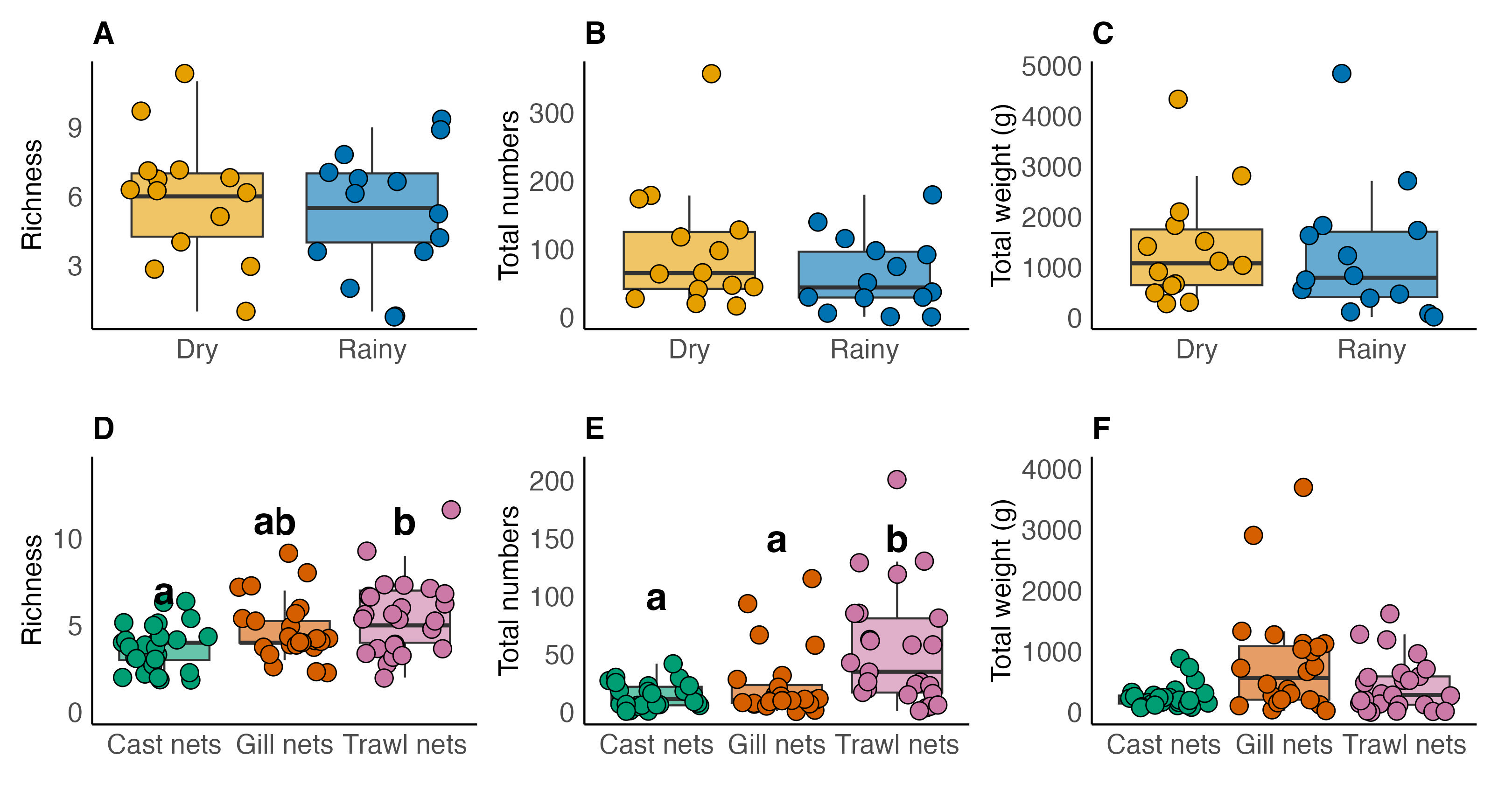
FIGURE 3| Species richness, total numbers, and total weight of fish were compared between seasons (dry and rainy; A–C) and among capture methods (cast nets, gill nets, and trawling nets; D–F). Different letters above the boxes indicate significant differences between groups based on pairwise comparisons from GLM analyses. Boxplots show the interquartile range (25th–75th percentile, boxes) and the 10th–90th percentiles (whiskers) for each response variable.
TABLE 2 | Results of generalized linear models (GLMs) testing the effects of sampling method (cast nets, gill nets, and trawl nets) on three fish community metrics: species richness, total number of individuals, and total fresh weight. Estimates are shown for each method relative to the reference level and with standard errors. Significant results are indicated (p < 0.05) in bold. + p < 0.1, *p < 0.05, **p < 0.01, ***p < 0.001.
Predictors | Intercept | Season | F | Num. Obs. | Distribution | ||
estimate | std.error | estimate | std.error | ||||
Between seasons | |||||||
All data | |||||||
Richness | 1.78*** | 0.126 | -0.115 | 0.183 | 0.394 | 28 | Quasi-Poisson |
Numbers | 4.593*** | 0.22 | -0.445 | 0.352 | 1.603 | 28 | Quasi-Poisson |
Weight | 10.04*** | 0.464 | -0.783 | 0.657 | 1.423 | 28 | Gaussian |
Cast nets | |||||||
Richness | 1.075*** | 0.156 | -0.227 | 0.245 | 0.859 | 26 | Poisson |
Numbers | 2.937*** | 0.151 | -0.749*** | 0.281 | 7.117 | 26 | Quasi-Poisson |
Weight | 5.244*** | 0.167 | 0.195 | 0.245 | 0.63 | 26 | Gaussian |
Gill nets | |||||||
Richness | 1.312*** | 0.139 | -0.031 | 0.217 | 0.021 | 24 | Poisson |
Numbers | 3.244*** | 0.326 | -0.214 | 0.538 | 0.158 | 24 | Quasi-Poisson |
Weight | 6.084*** | 0.337 | 0.027 | 0.522 | 0.003 | 24 | Gaussian |
Trawl nets | |||||||
Richness | 1.442*** | -0.135 | 0.116 | -0.189 | 0.375 | 25 | Poisson |
Numbers | 4.068*** | -0.249 | -0.204 | -0.38 | 0.289 | 25 | Quasi-Poisson |
Weight | 5.45*** | -0.461 | -0.299 | -0.666 | 0.202 | 25 | Gaussian |

FIGURE 4| Species richness, total numbers, and total fresh weight of fish were compared between seasons (dry and rainy; A–I) within each capture method. Different letters above the boxes indicate significant differences between groups based on pairwise comparisons from GLM analyses. Boxplots represent the interquartile range (25th–75th percentile, boxes) and the 10th–90th percentiles (whiskers) for each response variable.

FIGURE 5| Comparison of species richness, total numbers, and total weight of fish among capture methods during the dry (A–C) and rainy (D–F) seasons, using cast nets, gill nets, and trawling nets. Different letters above the boxes indicate significant differences between groups based on pairwise comparisons from GLM analyses. Boxplots show the interquartile range (25th–75th percentile, boxes) and the 10th–90th percentiles (whiskers) for each response variable.
TABLE 3 | Results of generalized linear models (GLMs) assessing the effects of sampling method (cast nets, gill nets, and trawl nets) on three fish community metrics: species richness, total number of individuals, and total fresh weight. Estimates are presented relative to the reference level, with standard errors in parentheses. Analyses were conducted using combined data from both seasons (dry + rainy) as well as separately for each season. Significant results (p < 0.05) are indicated in bold. + p < 0.1, *p < 0.05, **p < 0.01, ***p < 0.001.
Predictors | Intercept | Gill nets | Trawl nets | F | Num. Obs. | Distribution | |||
estimate | std.error | estimate | std.error | estimate | std.error | ||||
Among methods | |||||||||
Dry + Rainy | |||||||||
Richness | 1.296*** | 0.103 | 0.245 | 0.139 | 0.405** | 0.134 | 4.609 | 75 | Poisson |
Numbers | 2.658*** | 0.286 | 0.502 | 0.368 | 1.317*** | 0.323 | 10.258 | 75 | Quasi-Poisson |
Weight | 7.687*** | 0.357 | 1.099 | 0.515 | -0.076 | 0.51 | 3.192 | 75 | Gaussian |
Dry | |||||||||
Richness | 1.075*** | 0.156 | 0.238 | 0.209 | 0.368+ | 0.206 | 1.602 | 41 | Poisson |
Numbers | 2.937*** | 0.368 | 0.307 | 0.485 | 1.131*** | 0.427 | 4.563 | 41 | Quasi-Poisson |
Weight | 5.244*** | 0.309 | 0.840+ | 0.438 | 0.206 | 0.446 | 1.994 | 41 | Gaussian |
Rainy | |||||||||
Richness | 0.847*** | 0.189 | 0.434+ | 0.252 | 0.711*** | 0.231 | 6.767 | 34 | Poisson |
Numbers | 2.188*** | 0.461 | 0.842 | 0.567 | 1.676*** | 0.502 | 6.713 | 34 | Quasi-Poisson |
Weight | 5.439*** | 0.391 | 0.672 | 0.581 | -0.288 | 0.554 | 1.413 | 34 | Gaussian |
Fish species composition varied little across sampling methods, with both turnover and nestedness components contributing to the observed beta diversity (Tab. 4; Fig. 6); however, the nestedness component was only observed for the presence-absence data. Plagioscion squamosissimus, Poecilia vivipara, and Serrapinnus heterodon were captured only by manual trawl nets, Cichla temensis only by cast nets, and Psectrogaster sp. only by gill nets (Fig. S7). No seasonal effect was detected on total beta diversity or on its turnover and nestedness components for the presence-absence, numbers, and weight data (Tab. 4; Fig. 6).
TABLE 4 | Results of the permutational multivariate analysis of variance (PERMANOVA) testing the effects of seasonal variation and sampling methods on total beta diversity and the turnover and nestedness components. Df: degrees of freedom associated with each factor or term; SS: sum of squares, representing the amount of variation explained; R²: proportion of total variance explained by each factor; F: pseudo-F statistic from the PERMANOVA, indicating the ratio of explained to unexplained variation; P: p-value obtained by permutation tests, used to assess statistical significance. Significant results (p < 0.05) are indicated in bold.
Predictors | Beta diversity | Df | SS | R2 | F | P | |
Season (p/a) | Total | Model | 1 | 0.25 | 0.03 | 1.05 | 0.37 |
|
| Residual | 26 | 6.32 | 0.97 |
|
|
| Turnover | Model | 1 | 0.21 | 0.06 | 1.55 | 0.24 |
|
| Residual | 26 | 3.55 | 0.94 |
|
|
| Nestedness | Model | 1 | 0.07 | 0.04 | 1.01 | 0.44 |
|
| Residual | 26 | 1.83 | 0.96 |
|
|
Season (numbers) | Total | Model | 1 | 0.21 | 0.02 | 0.66 | 0.77 |
|
| Residual | 26 | 8.45 | 0.98 |
|
|
| Turnover | Model | 1 | 0.18 | 0.03 | 0.96 | 0.48 |
|
| Residual | 26 | 4.86 | 0.97 |
|
|
| Nestedness | Model | 1 | 0.02 | 0.01 | 0.39 | 0.65 |
|
| Residual | 26 | 1.94 | 0.99 |
|
|
Season (weight) | Total | Model | 1 | 0.27 | 0.03 | 0.83 | 0.58 |
|
| Residual | 26 | 8.51 | 0.96 |
|
|
| Turnover | Model | 1 | 0.14 | 0.02 | 0.69 | 0.57 |
|
| Residual | 26 | 5.28 | 0.98 |
|
|
| Nestedness | Model | 1 | 0.19 | 0.09 | 2.87 | 0.17 |
|
| Residual | 26 | 1.73 | 0.91 |
|
|
Method (p/a) | Total | Model | 2 | 1.66 | 0.07 | 2.96 | 0.001*** |
|
| Residual | 72 | 20.23 | 0.93 |
|
|
| Turnover | Model | 2 | 1.19 | 0.07 | 2.81 | 0.013** |
|
| Residual | 72 | 15.23 | 0.93 |
|
|
| Nestedness | Model | 2 | 0.35 | 0.11 | 4.45 | 0.048* |
|
| Residual | 72 | 2.88 | 0.88 |
|
|
Method (numbers) | Total | Model | 2 | 2.12 | 0.08 | 3.13 | 0.001*** |
|
| Residual | 72 | 24.42 | 0.92 |
|
|
| Turnover | Model | 2 | 1.63 | 0.09 | 3.60 | 0.004** |
|
| Residual | 72 | 16.51 | 0.91 |
|
|
| Nestedness | Model | 2 | 0.22 | 0.05 | 2.05 | 0.25 |
|
| Residual | 72 | 3.89 | 0.95 |
|
|
Method (weight) | Total | Model | 2 | 2.42 | 0.08 | 3.44 | 0.001*** |
|
| Residual | 72 | 25.31 | 0.92 |
|
|
| Turnover | Model | 2 | 2.69 | 0.13 | 5.54 | 0.001*** |
|
| Residual | 72 | 17.49 | 0.86 |
|
|
| Nestedness | Model | 2 | -0.24 | -0.07 | -2.35 | 0.97 |
|
| Residual | 72 | 3.81 | 1.07 |
|
|
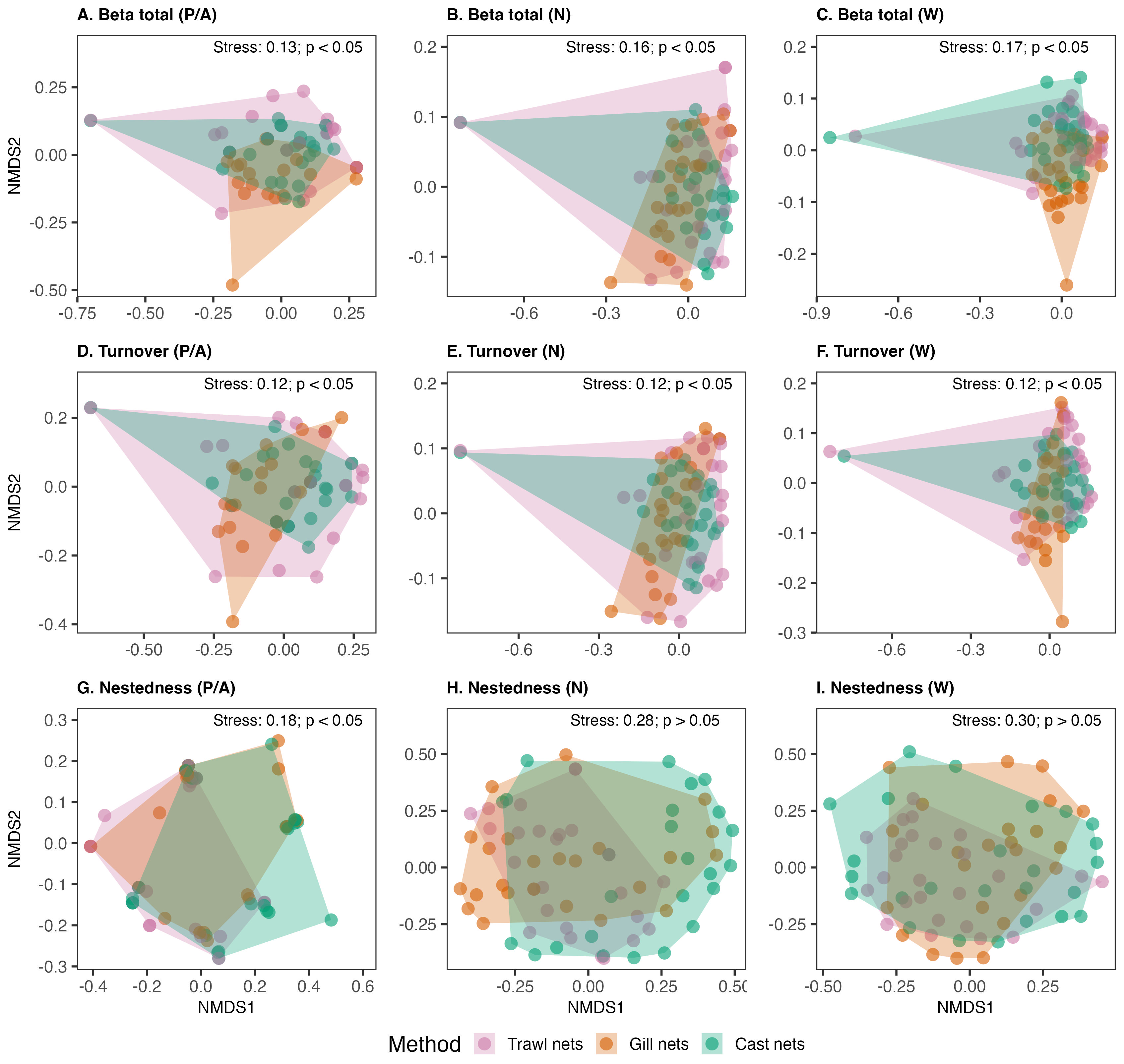
FIGURE 6| NMDS graphs illustrating fish species composition across different sampling methods (trawl nets, gill nets, and cast nets). The polygons separate the method types, while the filled circles represent the sampling units (reservoirs). Panels (A, B, C) display total fish beta diversity, while panels (D, E, F) and (G, H, I) show the beta diversity components of turnover and nestedness based on presence/absence (P/A), numbers (N), and weight (W) data, respectively. The p-values refer to the significance levels from the PERMANOVA.
Discussion
This study highlights the superior performance of trawl nets in sampling fish communities in reservoirs, as they consistently yielded higher individual counts and greater species richness than cast and gill nets in both dry and rainy seasons. This pattern is consistent with previous work showing that active gears tend to capture more individuals and species in lentic systems (Ribeiro, Zuanon, 2006; Gomiero, 2010; Medeiros et al., 2010; Kubečka et al., 2012; Vasconcelos Filho et al., 2019). The greater efficiency of manual trawl nets is likely related to their active nature and the larger area swept by two operators, which increases encounter probability and reduces the chance of escape compared to cast nets, which are operated by a single person and cover a smaller area per throw.
Beyond their higher efficiency, trawl nets alone did not fully capture the diversity and composition of fish assemblages. Our multivariate analyses showed that both species turnover and nestedness contributed to differences among methods, indicating that each gear samples a particular subset of the community. Gill nets, for example, were less efficient in terms of numbers and richness, but captured larger individuals and accounted for most of the total fresh weight (Fig. S5), reflecting their selectivity for larger-bodied fish in slightly deeper littoral and pelagic habitats (Miranda et al., 2000; Altuntaş et al., 2024). Cast nets, although active, covered smaller areas and thus captured fewer individuals and species than manual trawl nets. Some species were only detected by specific methods in our study (e.g., Cichla temensis by cast nets and Psectrogaster sp. by gill nets, Tab. S4; Fig. S7), reinforcing that combining methods increases taxonomic coverage and improves detection of rare or behaviorally distinct taxa (Gomiero, 2010; Merz et al., 2021). Additionally, regardless of the sampling method employed, Oreochromis niloticus was consistently the most dominant species, highlighting its strong establishment and ecological prominence in northeastern Brazilian reservoirs, where it is recognized as a successful invasive species with potential implications for native communities and fisheries (Attayde et al., 2011).
These method-specific differences have practical consequences for costs and logistics. Trawl nets require more personnel and physical effort but produce high numbers of individuals and species per unit time, increasing cost-effectiveness in long-term monitoring. Gill nets demand less active effort during deployment but require longer exposure times and may cause higher mortality of large individuals, which can be problematic in conservation settings (Ribeiro, Zuanon, 2006). They may also be problematic for some trophic ecology studies, as captured fish can die and remain in the net for extended periods, during which gut contents are metabolized and important information may be lost. Cast nets are inexpensive and easy to operate but provide more limited spatial coverage. Consequently, for large monitoring networks or restricted budgets, manual trawl nets can serve as a core, efficient method, with cast and/or gill nets added strategically when particular size classes, habitats, or rare species are of interest.
Seasonality is often considered a key driver of fish detectability and community structure in freshwater systems (Contente, Del Bianco Rossi-Wongtschowski, 2017; Orsi et al., 2018; Duarte et al., 2022; Espínola et al., 2025), and semiarid reservoirs typically show higher catches during the dry season as water levels fall. In our study, however, seasonal effects were modest: only cast nets captured more individuals in the dry season, whereas manual trawl and gill nets showed no significant differences in richness or abundance between seasons (Fig. 4), and species composition varied more among methods than between seasons (Tab. 4; Fig. 6). These results indicate that, within the hydrological range sampled here, method choice has a stronger influence on observed assemblages than the timing of sampling.
From a monitoring perspective, our study gives clear guidelines for the design of long-term monitoring programs in semiarid reservoirs. When the objective is to track broad trends in richness, abundance, and overall assemblage structure, manual trawl nets can be adopted as the primary method, with surveys conducted at least once per year, preferably in a hydrologically representative period. In systems with strong interannual variability or where management decisions depend on short-term responses (e.g., stocking, drawdown, or drought), biannual sampling that includes both dry and rainy seasons may be desirable, especially for methods such as cast nets that showed some seasonal signal. Under strong logistical or budgetary constraints, monitoring can prioritize trawl-based sampling in a subset of sentinel reservoirs, while occasional campaigns incorporating cast and gill nets can be used to reassess method representativeness, detect rare or large-bodied species, and refine management actions (e.g., harvest regulation, stocking strategies, or habitat restoration).
In addition to traditional sampling gears, contemporary freshwater fish ecology in the Neotropics increasingly employs methods such as electrofishing (Junqueira et al., 2020) and DNA metabarcoding (Milan et al., 2020), which can provide higher taxonomic resolution and allow detection of cryptic or rare species. However, in semiarid reservoirs, practical and logistical constraints, such as shallow water areas, limited accessibility, and intermittent hydrology, can restrict the applicability of these approaches. Nonetheless, these complementary techniques hold great potential for future monitoring programs, either as targeted surveys in specific habitats or as non-invasive tools to enhance long-term datasets. Integrating electrofishing and environmental DNA approaches alongside conventional nets could improve detection of elusive species, refine community assessments, and ultimately support more informed management and conservation decisions.
Overall, our results support three central conclusions: (i) manual trawl nets are the most efficient method for sampling fish assemblages in semiarid reservoirs, (ii) combining complementary gears increases taxonomic coverage and improves detection of rare or behaviorally distinct species, and (iii) seasonality has a relatively low influence on richness, abundance, and composition compared to method choice. These findings provide actionable guidance for monitoring and management, particularly in long-term programs where efficiency, cost, and logistics must be balanced against the need to represent the full diversity of fish communities.
Acknowledgments
We thank the Universidade Federal da Paraíba (UFPB) and the Programa de Pós-Graduação em Biodiversidade (PPGBio) for providing the facilities necessary to carry out the laboratory work. We also thank José L. Attayde, Ana C. F. Lacerda and three anonymous reviewers for their suggestions to improve the manuscript. We further thank Joneany Margylla, Érica L. F. Álvaro, Yuri G. P. C. Rocha, Alysson Felix, Marcos Chaves, João V. S. Barbosa, Regina W. G. C. Lima, and Laryssa Cândido for their invaluable assistance during fieldwork.
References
Agostinho AA, Gomes LC, Latini JD. Fisheries management in Brazilian reservoirs: lessons from/for South America. Interciencia. 2004; 29(6):334–38.
Altuntaş C, Tokaç A, Herrmann B, Mısır DS, Dağtekin M, Cerbule K. Effect of mesh size in monofilament and multifilament gillnets on catch efficiency in the Black Sea whiting (Merlangius merlangus) fishery. Estuar Coast Shelf Sci. 2024; 299:108695. https://doi.org/10.1016/j.ecss.2024.108695
Anderson MJ. A new method for non-parametric multivariate analysis of variance. Austral Ecol. 2001; 26(1):32–46. https://doi.org/10.1111/j.1442-9993.2001.01070.pp.x
Attayde JL, Brasil J, Menescal RA. Impacts of introducing Nile tilapia on the fisheries of a tropical reservoir in North-eastern Brazil. Fish Manag Ecol. 2011; 18(6):437–43. https://doi.org/10.1111/j.1365-2400.2011.00796.x
Auster P, Langton R. The effects of fishing on fish habitat. Am Fish Soc Symp. 1999; 22:150–87.
Baselga A, Orme D, Villeger S, Bortoli JD, Leprieur F, Logez M. Package ‘betapart’: partitioning beta diversity into turnover and nestedness components. 2023; R package version 1.6. Available from: https://CRAN.R-project.org
Beghelli FGS, Santos ACA, Urso-Guimarães MV, Calijuri MC. Spatial and temporal heterogeneity in a subtropical reservoir and their effects over the benthic macroinvertebrate community. Acta Limnol Bras. 2014; 26(3):306–17. https://doi.org/10.1590/S2179-975X2014000300010
Beltrão GBM, Medeiros ESF, Ramos RTC. Effects of riparian vegetation on the structure of the marginal aquatic habitat and the associated fish assemblage in a tropical Brazilian reservoir. Biota Neotrop. 2009; 9(4):37–43. https://doi.org/10.1590/S1676-06032009000400003
Cao Y, Larsen DP, Hughes RM. Evaluating sampling sufficiency in fish assemblage surveys: a similarity-based approach. Can J Fish Aquat Sci. 2001; 58(9):1782–93. https://doi.org/10.1139/cjfas-58-9-1782
Clarke KR. Nonparametric multivariate analyses of changes in community structure. Aust J Ecol. 1993; 18(1):117–43. https://doi.org/10.1111/j.1442-9993.1993.tb00438.x
Contente RF, Del Bianco Rossi-Wongtschowski CL. Improving the characterization of fish assemblage structure through the use of multiple sampling methods: a case study in a subtropical tidal flat ecosystem. Environ Monit Assess. 2017; 189(6):251. https://doi.org/10.1007/s10661-017-5954-y
Corrêa ACB, Tavares BAC, Monteiro KA, Cavalcanti LCS, Lira DR. Megageomorfologia e morfoestrutura do planalto da Borborema. Rev Inst Geol. 2010; 31(1–2):35–52. https://doi.org/10.5935/0100-929X.20100003
Fernandes CC. Lateral migration of fishes in Amazon floodplains. Ecol Freshw Fish. 1997; 6(1):36–44. https://doi.org/10.1111/j.1600-0633.1997.tb00140.x
Curto M, Batista S, Santos CD, Ribeiro F, Nogueira S, Ribeiro D et al.Freshwater fish community assessment using eDNA metabarcoding vs. capture-based methods: differences in efficiency and resolution coupled to habitat and ecology. Environ Res. 2025; 274:1–28. https://doi.org/10.1016/j.envres.2025.121238
Duarte C, Antão LH, Magurran AE, Deus CP. Shifts in fish community composition and structure linked to seasonality in a tropical river. Freshw Biol. 2022; 67(10):1789–800. https://doi.org/10.1111/fwb.13975
Espínola LA, Simōes NR, Rabuffetti AP, Contreras FI, Saucedo GI, Abrial E et al. Impact of extreme droughts on fish assemblages in a large South American floodplain river. Ecohydrology. 2025; 18(5):e70062. https://doi.org/10.1002/eco.70062
Euclide PT, Lor Y, Spear MJ, Tajjioui T, Vander Zanden J, Larson WA et al. Environmental DNA metabarcoding as a tool for biodiversity assessment and monitoring: reconstructing established fish communities of north-temperate lakes and rivers. Divers Distrib. 2021; 27(10):1966–80. https://doi.org/10.1111/ddi.13253
Fick SE, Hijmans RJ. WorldClim 2: new 1-km spatial resolution climate surfaces for global land areas. Int J Climatol. 2017; 37(12):4302–15. https://doi.org/10.1002/joc.5086
Gehri RR, Larson WA, Gruenthal K, Sard NM, Shi Y. eDNA metabarcoding outperforms traditional fisheries sampling and reveals fine-scale heterogeneity in a temperate freshwater lake. Environ DNA. 2021; 3(5):912–29. https://doi.org/10.1002/edn3.197
Gomiero LM. Métodos de coleta utilizados na captura de Tucunaré (Cichla spp.) para fins científicos. Rev Bras Eng Pesca. 2010; 5(1):1–13. https://doi.org/10.18817/repesca.v5i1.155
Instituto Brasileiro de Geografia e Estatística (IBGE). Atlas Nacional do Brasil: Região Nordeste. 1985. Available from: www.ibge.gov.br
Instituto Brasileiro de Geografia e Estatística (IBGE). Censo demográfico. 2010. Available from: www.ibge.gov.br
Jennings S, Kaiser MJ. The effects of fishing on marine ecosystems. Adv Mar Biol. 1998; 34:201–212. https://doi.org/10.1016/s0065-2881(08)60212-6
Jeppesen E, Peder Jensen J, Søndergaard M, Lauridsen T, Landkildehus F. Trophic structure, species richness and biodiversity in Danish lakes: changes along a phosphorus gradient. Freshw Biol. 2000; 45(2):201–18. https://doi.org/10.1046/j.1365-2427.2000.00675.x
Junqueira NT, Magnago LF, Pompeu PS. Assessing fish sampling effort in studies of Brazilian streams. Scientometrics. 2020; 123:841–60. https://doi.org/10.1007/s11192-020-03418-4
Jurajda P, Janáč M, White SM, Ondračková M. Small – but not easy: evaluation of sampling methods in floodplain lakes including whole-lake sampling. Fish Res. 2009; 96(1):102–08. https://doi.org/10.1016/j.fishres.2008.09.005
Kong H, Chevalier M, Laffaille P, Lek S. Spatio-temporal variation of fish taxonomic composition in a South-East Asian flood-pulse system. PLoS ONE. 2017; 12(3):e0174582. https://doi.org/10.1371/journal.pone.0174582
Kubečka J, Godø OR, Hickley P, Prchalová M, Říha M, Rudstam L et al. Fish sampling with active methods. Fish Res. 2012; 123–124:1–03. https://doi.org/10.1016/j.fishres.2011.11.013
Lapointe NWR, Corkum LD, Mandrak NE. A comparison of methods for sampling fish diversity in shallow offshore waters of large rivers. N Am Fish Manag. 2006; 26(3):503–13. https://doi.org/10.1577/m05-091.1
Latini AO, Petrere M. Reduction of a native fish fauna by alien species: an example from Brazilian freshwater tropical lakes. Fish Manag Ecol. 2004; 11(2):71–79. https://doi.org/10.1046/j.1365-2400.2003.00372.x
Lenth R. emmeans: estimated marginal means, aka least-squares means. 2025; R package version 1.11.1. Available from: https://cran.r-project.o
Malabarba LR, Reis RE. Peixes – Manual de técnicas para a preparação de coleções zoológicas. Campinas: Soc Bras Zool; 1987; 1–14.
Mayo SJ, Fevereiro VPB. Mata do Pau-Ferro: a pilot study of the brejo forest. London: Royal Botanic Gardens; 1982.
Medeiros ESF, Silva MJ, Figueiredo BRS, Ramos TPA, Ramos RTC. Effects of fishing technique on assessing species composition in aquatic systems in semi-arid Brazil. Braz J Biol. 2010; 70(2):255–62. https://doi.org/10.1590/s1519-69842010000200004
Mehdi H, Lau SC, Synyshyn C, Salena MG, Morphet ME, Hamilton J et al. A comparison of passive and active gear in fish community assessments in summer versus winter. Fish Res. 2021; 242:106016. https://doi.org/10.1016/j.fishres.2021.106016
Menezes RF, Attayde JL, Lacerot G, Kosten S, Coimbra e Souza L, Costa LS et al. Lower biodiversity of native fish but only marginally altered plankton biomass in tropical lakes hosting introduced piscivorous Cichla cf. ocellaris. Biol Invasions. 2012; 14(7):1353–63. https://doi.org/10.1007/s10530-011-0159-8
Menezes RF, Borchsenius F, Svenning J-C, Davidson TA, Søndergaard M, Lauridsen TL et al.Homogenization of fish assemblages in different lake depth strata at local and regional scales. Freshw Biol. 2015; 60(4):745–57. https://doi.org/10.1111/fwb.12526
Menezes RF, Borchsenius F, Svenning J-C, Søndergaard M, Lauridsen TL, Landkildehus F et al. Variation in fish community structure, richness, and diversity in 56 Danish lakes with contrasting depth, size, and trophic state: does the method matter? Hydrobiologia. 2013; 710(1):47–59. https://doi.org/10.1007/s10750-012-1025-0
Merz JE, Anderson JT, Wiesenfeld J, Zeug SC. Comparison of three sampling methods for small-bodied fish in lentic nearshore and open water habitats. Environ Monit Assess. 2021; 193(5):1–20. https://doi.org/10.1007/s10661-021-09027-9
Milan DT, Mendes IS, Damasceno JS, Teixeira DF, Sales NG, Carvalho DC. New 12S metabarcoding primers for enhanced Neotropical freshwater fish biodiversity assessment. Sci Rep. 2020; 10:17966. https://doi.org/10.1038/s41598-020-74902-3
Millar EN, Reid SM, Jones NE. Methods for sampling fishes and their habitats in flowing waters: 2005-2022 update. Ontario: King’s Printer for Ontario; 2023.
Miranda LE, Agostinho AA, Gomes LC. Appraisal of the selective properties of gill nets and implications for yield and value of the fisheries at the Itaipu Reservoir, Brazil-Paraguay. Fish Res. 2000; 45(2):105–16. https://doi.org/10.1016/S0165-7836(99)00114-9
Oksanen J, Blanchet FG, Michael F, Roeland K, Legendre P, McGlinn D et al. vegan: Community Ecology Package. 2019; R package version 2.4-4. Available from: https://CRAN.R-project.org
Olin M, Malinen T. Comparison of gillnet and trawl in diurnal fish community sampling. Hydrobiologia. 2003; 506:443–49. https://doi.org/10.1023/B:HYDR.0000008545.33035.c4
Oliveira AG, Gomes LC, Latini JD, Agostinho AA. Implications of using a variety of fishing strategies and sampling techniques across different biotopes to determine fish species composition and diversity. Nat Conserv. 2014; 12(2):112–17. https://doi.org/10.1016/j.ncon.2014.08.004
Orsi CH, Message HJ, Debona T, Baumgartner D, Baumgartner G. Hydrological seasonality dictates fish fauna of the lower Araguaia River, Tocantins-Araguaia basin. Environ Biol Fish. 2018; 101(6):881–97. https://doi.org/10.1007/s10641-018-0744-0
Pelicice FM, Bialetzki A, Camelier P, Carvalho FR, García-Berthou E, Pompeu PS et al. Human impacts and the loss of Neotropical freshwater fish diversity. Neotrop Ichthyol. 2021; 19(3):e210134. https://doi.org/10.1590/1982-0224-2021-0134
Penczak T, Agostinho AA, Latini JD. Rotenone calibration of fish density and biomass in a tropical stream sampled by two removal methods. Hydrobiologia. 2003; 510(1–3):23–38. https://doi.org/10.1023/B:HYDR.0000008499.03601.56
Portt CB, Coker GA, Ming DL, Randall RG. A review of fish sampling methods commonly used in Canadian freshwater habitats. Can Tech Rep Fish Aquat Sci. 2006; (2604):51.
R Development Core Team. R: a language and environment for statistical computing. 2025; R Foundation for Statistical Computing. Available from: https://www.R-project.org/
Ramos TPA, Carvalho-Rocha YGPD, Oliveira-Silva L, Lustosa-Costa SY, Ferreira PHP. Continental fishes from the Tambaba Environmentally Protected Area, Paraíba State, Brazil. Pap Avulsos Zool. 2019; 59:e20195950. https://doi.org/10.11606/1807-0205/2019.59.50
Ramos TPA, Lima JAS, Costa SYL, Silva MJ, Avellar RC, Oliveira-Silva L. Continental ichthyofauna from the Paraíba do Norte River basin pre-transposition of the São Francisco River, Northeastern Brazil. Biota Neotrop. 2018; 18(4):e20170471. https://doi.org/10.1590/1676-0611-bn-2017-0471
Ramos TPA, Lustosa-Costa SY, Lima RMO, Barbosa JEL, Menezes RF. First record of Moenkhausia costae (Steindachner, 1907) in the Paraíba do Norte basin after the São Francisco River diversion. Biota Neotrop. 2021; 21(2):e20201049. https://doi.org/10.1590/1676-0611-bn-2020-1049
Ribeiro OM, Zuanon J. Comparação da eficiência de dois métodos de coleta de peixes em igarapés de terra firme da Amazônia Central. Acta Amaz. 2006; 36(3):389–94. https://doi.org/10.1590/s0044-59672006000300017
Rodrigues Carneiro C, Juncá FA, Souza FB, Santos ACA. Assessing the efficiency of active sampling methods for fishes in neotropical streams of the Caatinga Biome, Northeast Brazil. Stud Neotrop Fauna Environ. 2024; 60(1):34–45. https://doi.org/10.1080/01650521.2024.2380168
Röpke CP, Amadio SA, Winemiller KO, Zuanon J. Seasonal dynamics of the fish assemblage in a floodplain lake at the confluence of the Negro and Amazon Rivers. J Fish Biol. 2016; 89(1):194–212. https://doi.org/10.1111/jfb.12791
Rosa RS, Groth F. Ictiofauna dos ecossistemas de Brejos de Altitude de Pernambuco e Paraíba. In: Porto KC, Cabral JJP, Tabarelli M, editors. Brejos de Altitude em Pernambuco e Paraíba: história natural, ecologia e conservação. Brasília: Ministério do Meio Ambiente; 2004. p.201–28.
Silva RS, Oliveira LP, Damasceno MYM, Noruega MF, Jardim Junior AA, Ferreira GT GT et al. Daily cycle and environmental factors influence fish assemblage structure in an Amazonian conservation unit. Braz J Biol. 2024; 84:e279923. https://doi.org/10.1590/1519-6984.279923
Silva RS, Oliveira LP, Damasceno MYM, Noruega MF, Jardim Junior AA, Ferreira GT et al.Daily cycle and environmental factors influence fish assemblage structure in an Amazonian conservation unit. Braz J Biol. 2025; 84:e279923. https://doi.org/10.1590/1519-6984.279923
Tessier A, Descloux S, Lae R, Cottet M, Guedant P, Guillard J. Fish assemblages in large tropical reservoirs: overview of fish population monitoring methods. Rev Fish Sci Aquac. 2016; 24(2):160–77. https://doi.org/10.1080/23308249.2015.1112766
Uieda VS, Castro RMC. Coleta e fixação de peixes de riachos. In: Caramaschi EP, Mazzoni R, Peres-Neto PR, editors. Ecologia de peixes de riachos. Rio de Janeiro: Oecologia Brasiliensis. 1999; 6(1):1–22.
Vasconcelos Filho JIF, Maia RC, Salles R. Desempenho dos diferentes métodos de amostragem na caracterização da ictiofauna associada ao manguezal da praia de Arpoeiras em Acaraú, Ceará. Arq Ciênc Mar. 2019; 52(1):81–98. https://doi.org/10.32360/acmar.v52i1.40386
Velloso AL, Sampaio EVSB, Pareyn FGC. Ecorregiões: propostas para o bioma Caatinga. Recife: PNE Associação Plantas do Nordeste; 2002.
Wickham H. ggplot2: Elegant Graphics for Data Analysis. 2009.
Yu T-S, Ji CW, Park Y-S, Han K-H, Kwak I-S. Characterization of fish assemblages and standard length distributions among different sampling gears using an artificial neural network. Fishes. 2022; 7(5):275. https://doi.org/10.3390/fishes7050275
Authors

Bruno Silva de Alcântara1, Silvia Yasmin Lustosa-Costa2,3, Telton Pedro Anselmo Ramos3,4 and Rosemberg F. Menezes1,5
[1] Programa de Pós-Graduação em Biodiversidade, Centro de Ciências Agrárias (CCA), Universidade Federal da Paraíba (UFPB), 58397-000, Areia, PB, Brazil. (BSA) brunoalcantara1006@gmail.com.
[2] Universidade Estadual da Paraíba, Laboratório de Ecologia Aquática, Departamento de Biologia, Campus Universitário, 58109 753, Campina Grande, PB, Brazil. (SYLC) silviayasminlcosta@gmail.com.
[3] Instituto Peixes da Caatinga, Rua Doutor Antonio Massa, 73, 58015-410, João Pessoa, PB, Brazil. (TPAR) telton@gmail.com.
[4] Programa de Pós-Graduação em Sistemática e Evolução, Departamento de Botânica e Zoologia, Centro de Biociências, Universidade Federal do Rio Grande do Norte, Av. Senador Salgado Filho, 3000, Lagoa Nova, 59978-970, Natal, RN, Brazil.
[5] Departamento de Fitotecnia e Ciências Ambientais, Universidade Federal da Paraíba (UFPB), Campus II, 58397-000, Areia, PB, Brazil. (RFM) rosembergmenezes@gmail.com (corresponding author).
Authors’ Contribution 

Bruno Silva de Alcântara: Conceptualization, Data curation, Formal analysis, Investigation, Methodology, Visualization, Writing-original draft, Writing-review and editing.
Silvia Yasmin Lustosa-Costa: Conceptualization, Data curation, Investigation, Methodology, Supervision, Validation, Visualization, Writing-original draft, Writing-review and editing.
Telton Pedro Anselmo Ramos: Conceptualization, Data curation, Investigation, Methodology, Supervision, Validation, Visualization, Writing-original draft, Writing-review and editing.
Rosemberg F. Menezes: Conceptualization, Data curation, Formal analysis, Funding acquisition, Investigation, Methodology, Project administration, Resources, Supervision, Validation, Visualization, Writing-original draft, Writing-review and editing.
Ethical Statement
Specimens were collected under collection permit number 56416–1/2016, issued by the Instituto Chico Mendes de Conservação da Biodiversidade (ICMBio), updated in 2022.
Competing Interests
The author declares no competing interests.
Data availability statement
The data supporting the findings of this study are available from the corresponding author upon reasonable request.
AI statement
An AI language model (ChatGPT, OpenAI) was used solely for English grammar and language refinement. No AI was used for data analysis, interpretation, or generation of scientific conclusions. All translated text was carefully reviewed and approved by the authors.
Funding
Coordenação de Aperfeiçoamento de Pessoal de Nível Superior (CAPES) for awarding a Master’s scholarship to BSA during the execution of this project, and to the Conselho Nacional de Desenvolvimento Científico e Tecnológico (CNPq, process 421997/2018–4) and the PELD RIPA project (Process 445968/2024–9) for financial support.
Supplementary Material
Supplementary material SUP
Peer Review
How to cite this article
Alcântara BS, Lustosa-Costa SY, Ramos TPA, Menezes RF. Evaluating sampling methods for fish diversity and composition across seasons in Northeastern Brazil’s reservoirs. Neotrop Ichthyol. 2026; 24(2):e250130. https://doi.org/10.1590/1982-0224-2025-0130
Copyright
This is an open access article under the terms of the Creative Commons Attribution License, which permits use, distribution and reproduction in any medium, provided the original work is properly cited.
Distributed under
Creative Commons CC-BY 4.0

© 2025 The Authors.
Diversity and Distributions Published by SBI
 Accepted March 22, 2026
Submitted July 18, 2025
Epub July 20, 2026