
 Junior Chuctaya1,2
  , Cristina Bührnheim3,4 and Luiz R. Malabarba2
PDF: Download Here | Supplementary: Sup | Cite this article
Associate Editor: Priscila Camelier
Section Editor: Bruno Melo
Editor-in-chief: José Birindelli
Abstract
O gênero Odontostilbe (Characiformes: Characidae) compreende pequenos caracídeos neotropicais amplamente distribuídos em bacias hidrográficas da América do Sul. Espécimes previamente identificados como Odontostilbe paraguayensis são revisados e uma nova espécie é descrita para a bacia do alto rio Paraná. A delimitação das espécies baseia-se na análise de caracteres morfológicos, merísticos e morfométricos. A nova espécie difere da maioria dos congêneres pela combinação de linha lateral incompleta, presença de dentes mesopterigóides organizados em dois grupos distintos e presença de ganchos em todos os raios não ramificados da nadadeira anal em machos maduros. Odontostilbe paraguayensis distingue-se de todas as congêneres pela presença de supraneurais parcialmente fusionados formando uma estrutura predorsal distinta. A distribuição de O. paraguayensis está restrita à bacia do rio Paraguai, enquanto a nova espécie ocorre na bacia do alto rio Paraná. Esses resultados refinam os limites taxonômicos dentro de Odontostilbe e contribuem para uma melhor compreensão da diversidade de espécies e dos padrões de distribuição na drenagem do rio da Prata. Uma chave para a identificação das espécies de Odontostilbe da bacia do Paraná-Paraguai é fornecida.
Palavras-chave: Caracteres merísticos, Chave de identificação, Drenagem do rio da Prata, Morfologia dos supraneurais, Taxonomia integrativa.
Introduction
The subfamily Cheirodontinae (Characiformes: Characidae) represents a diverse group of small Neotropical characids widely distributed throughout Central and South American freshwater systems. Members of the subfamily are typically associated with streams, floodplains, and marginal habitats of large river basins, where they play important ecological roles in trophic dynamics and community structure. Cheirodontine species are traditionally diagnosed by a combination of morphological characters, including specialized dentition (e.g., number and shape of tooth cusps), the condition of the lateral line (complete or incomplete), characteristics of the ventral precurrent caudal-fin rays, features of the infraorbital series, and the presence of modified scales at the base of the caudal peduncle (Malabarba, 1998). Currently, the subfamily comprises approximately 63 valid species distributed among 18 genera (Fricke et al., 2026), reflecting a complex evolutionary history and considerable morphological diversity within the group.
Within Cheirodontinae, the genus Odontostilbe Cope, 1870 is one of the most widely distributed taxa in southern and central South America and currently includes 17 valid species occurring in major river basins such as the Amazon, Orinoco, and La Plata systems (Toledo-Piza et al., 2024). Species of Odontostilbe are typically small-bodied fishes inhabiting lowland rivers, floodplains, and associated wetlands. The Paraná-Paraguay drainage represents one of the principal centers of diversity for cheirodontine fishes, harboring approximately 15 species of the subfamily. Within this basin, four species of Odontostilbe have been recorded: O. microcephala Eigenmann, 1907, O. paraguayensis Eigenmann & Kennedy, 1903, O. avanhandava Chuctaya, Bührnheim & Malabarba, 2018, and O. weitzmani Chuctaya, Bührnheim & Malabarba, 2018 (Chuctaya et al., 2018; Toledo-Piza et al., 2024).
Over the past decades, knowledge of the taxonomy, diversity, and ecology of Odontostilbe has increased considerably (Burns et al., 1997; Malabarba, 1998; Bührnheim, Malabarba, 2006, 2007; Oliveira et al., 2012; Tondato et al., 2014; Chuctaya et al., 2018, 2020; Toledo-Piza et al., 2024). Nevertheless, several species remain poorly defined and are still known mainly from their original descriptions. Diagnostic characters often overlap among species, particularly in taxa such as O. euspilurus (Fowler, 1945), O. dierythrura Fowler, 1940, O. roloffi Géry, 1972, and O. paraguayensis, which has resulted in recurrent misidentifications in museum collections and field surveys. These taxonomic uncertainties highlight the need for detailed reassessments of morphological variation and species limits within the genus.
In addition, the phylogenetic relationships within the genus remain under discussion (Malabarba, 1998; Mariguela et al., 2013; Jerep, Malabarba, 2014). Malabarba (1998) diagnosed Odontostilbe based on two characters: an elongate second unbranched dorsal-fin ray and an elongate unbranched pelvic-fin ray. However, Malabarba, Jerep (2014) described Serrapinnus tocantinensis, a species exhibiting elongation of the unbranched dorsal- and pelvic-fin rays into filaments in mature males. This discovery demonstrated that these characters have evolved more than once and that more taxon and character inclusive analyses are necessary to recognize when diagnostic features among cheirodontine genera correspond to homologous or homoplastic characters.
In this context, we provide a redescription of Odontostilbe paraguayensis in order to refine its diagnosis and clarify its taxonomic identity. Additionally, we describe a new species of Odontostilbe from major tributaries of the upper rio Paraná basin in Brazil.
Material and methods
Counts and measurements follow Fink, Weitzman (1974) unless otherwise specified. Counts and measurements were taken from the left side of the specimens whenever possible. Measurements were taken as projected point-to-point distances using digital calipers to the nearest 0.1 mm. Measurements are expressed as percentages of standard length (SL), except for subunits of the head, which are expressed as percentages of head length (HL). Precaudal, caudal, and total vertebral counts include the four vertebrae of the Weberian apparatus and the terminal “half centrum” as outlined by Malabarba, Weitzman (1999). The gill raker located at the junction between the ceratobranchial and epibranchial is counted together with the rakers of the lower limb of the first branchial arch following Bührnheim, Malabarba (2006). In counts of anal-fin rays, the last two rays are recorded as a single element because they are supported by the same pterygiophore.
Secondary sexual characters, particularly the presence of hooks on the fins, follow the terminology and criteria proposed by Chuctaya et al. (2018). Specimens were cleared and stained (c&s) according to Taylor, Van Dyke (1985) and were used to examine and count vertebrae, teeth, gill rakers, denticulation of gill rakers, supraneurals, and proximal radials. In the description, counts are followed by their frequency in parentheses, and holotype values are marked with an asterisk.
Radiographs of the type specimens of Odontostilbe paraguayensis were provided by the Ichthyology Section of the California Academy of Sciences and were used to determine vertebral and fin-ray counts of the types. Scanning electron microscope (SEM) images were obtained to examine tooth morphology and the denticulation of the gill rakers. Images of supraneurals were taken from cleared and stained specimens using a Nikon AZ100M camera attached to a stereomicroscope. Osteological nomenclature follows Weitzman (1962).
Specimens examined were obtained from the following institutions: ANSP, Academy of Natural Sciences of Drexel University, Philadelphia; CAS, California Academy of Sciences, San Francisco; FMNH, Field Museum of Natural History, Chicago; INPA, Instituto Nacional de Pesquisas da Amazônia, Manaus; INHS, Illinois Natural History Survey, Illinois; LIRP, Laboratório de Ictiologia de Ribeirão Preto, Universidade de São Paulo, Ribeirão Preto; MCP, Museu de Ciências e Tecnologia da Pontifícia Universidade Católica do Rio Grande do Sul, Porto Alegre; MZUSP, Museu de Zoologia da Universidade de São Paulo, São Paulo; UFRGS, Universidade Federal do Rio Grande do Sul, Porto Alegre; and USNM, Smithsonian Institution, National Museum of Natural History (NMNH), Washington D. C.
Statistical analysis. A total of 19 morphometric variables (M1–M19) were obtained for each specimen. Standard length (SL) corresponded to variable M1 and was used as the size proxy in all subsequent analyses. The complete morphometric matrix also included specimen identification and species designation.
Because linear morphometric variables are strongly influenced by overall body size, a size-correction procedure was applied prior to multivariate analyses in order to focus on shape variation. Variables M2–M19 were considered potentially size-dependent and were corrected using an allometric residual approach. For each variable, both the morphometric measurement and SL were log10-transformed, and a linear regression of the form log10(Mi) ~ log10(SL) was fitted. Residuals from these regressions were extracted and used as size-corrected variables. These residuals represent deviations from the expected value of each measurement for a given body size and therefore reflect shape variation independent of overall size.
Principal Component Analysis (PCA) was performed on the matrix of size-corrected variables (M2–M19) in order to evaluate morphometric variation among species. The PCA was based on centered and scaled data, using a correlation matrix. Because the effect of size had been removed prior to ordination, the morphospace was interpreted mainly using the first two principal components (PC1 and PC2), which summarize the major axes of shape variation among specimens.
To visualize the morphometric space occupied by each species, individual scores were plotted on the PC1–PC2 plane. The extent of variation within each species was illustrated using convex hull polygons encompassing the outermost specimens in the ordination space.
All analyses were carried out in R. Morphometric data were imported from Microsoft Excel files using the package readxl. Data cleaning and organization were performed with dplyr, tidyr, and stringr. Principal Component Analysis was carried out using the base R function prcomp. Graphical visualization of the PCA results was produced with ggplot2, and specimen labels were added, when necessary, with ggrepel. The geographic distribution map was produced using QGIS v. 2.8 (Quantum GIS Development Team 2016).
Results
Odontostilbe britskii, new species
urn:lsid:zoobank.org:act:6B944AB1-F64A-4C0A-9E9D-52D305B07C54
(Figs. 1–4; Tab. 1)
Holotype. MCP 12111, 24.9 mm SL, male, Brazil, São Paulo State, marginal pools of the rio Corumbataí, rio Tietê basin, 22.241489°S 47.608446°W, 23 Feb 1963, H. A. Britski.
Paratypes. All from Brazil, upper rio Paraná basin. São Paulo State: MCP 12109, 2, 23.4–24.7 mm SL, marginal pools of the rio Corumbataí, rio Tietê basin, 22.241489°S 47.608446°W, 25 Jan 1963, H. A. Britski & M. Vander. MCP 12110, 1 c&s, 24.0 mm SL, marginal pools of the rio Corumbataí, rio Tietê basin, 22.241489°S 47.608446°W, 25 Jan 1963, H. A. Britski. MCP 53154, 5, 17.2–25.4 mm SL, marginal pools of the rio Corumbataí, rio Tietê basin, 22.241489°S 47.608446°W, 23 Feb 1963, H. A. Britski. MZUSP 42803, 20, 23.0–26.4 mm SL, Lagoa da Ponta Seca, Corumbataí, 22.233334°S 47.616665°W, 20 Apr 1964, H. A. Britski & N. A. Menezes. MZUSP 123332, 1, 23.9 mm SL, marginal pools of the rio Corumbataí, rio Tietê basin, 22.241489°S 47.608446°W, 25 Jan 1963, H. A. Britski & V. M. Britski. UFRGS 22870, 20 (4 c&s), 22.6–26.6 mm SL, Lagoa da Ponta Seca, Corumbataí, 22.233334°S 47.616665°W, 20 Apr 1964, H. A. Britski & N. A. Menezes.
Diagnosis. Odontostilbe britskii differs from all congeners by the presence of an incomplete lateral line (vs. lateral line complete in all other species of Odontostilbe). It further differs from all congeners by the presence of mesopterygoid teeth arranged in two distinct patches on the median portion of the bone (vs. mesopterygoid teeth arranged in a single patch in O. weitzmani and O. avanhandava, or absent in all remaining species of the genus). The new species also differs from O. paraguayensis by having five separate supraneurals (vs. supraneurals 2–4 fused), and from O. microcephala and O. avanhandava by having a terminal mouth (vs. subterminal). Additionally, males of O. britskii possess hooks on the first to fifteenth branched anal-fin rays (vs. hooks on the first to seventh rays in O. weitzmani and O. paraguayensis, and on the first to eighth rays in O. microcephala).
Description. Morphometric data are presented in Tab. 1. Body moderately short and laterally compressed. Greatest body depth immediately anterior to dorsal-fin origin. Dorsal profile of head convex from snout to distal tip of supraoccipital bone. Predorsal profile slightly convex from posterior end of supraoccipital to dorsal-fin origin, located approximately at vertical through midlength of standard length; dorsal-fin base straight. Dorsal profile of body between last dorsal-fin ray and adipose-fin origin slightly convex, becoming slightly concave from that point to caudal-fin origin. Caudal peduncle longer than deep.
TABLE 1 | Odontostilbe britskii, lateral view: (A) holotype, MCP 12111, male, 24.9 mm SL, marginal pools of the rio Corumbataí, rio Tietê basin, São Paulo, Brazil; (B) paratype, MCP 53154, female, 25.2 mm SL, marginal pools of the rio Corumbataí, rio Tietê basin, São Paulo, Brazil.
| Holotype | Females | Males | ||||||||
N | Min | Max | Mean | SD | N | Min | Max | Mean | SD | ||
Standard length (mm) | 24.9 | 19 | 17.6 | 26.5 | 24.3 | – | 12 | 22.6 | 25.3 | 23.9 | – |
Percents of standard length | |||||||||||
Snout to anal-fin origin | 62.4 | 19 | 62.6 | 65.7 | 64.2 | 1.1 | 12 | 60.8 | 64.2 | 62.5 | 1.1 |
Snout to dorsal-fin origin | 47.8 | 19 | 47.6 | 51.5 | 49.8 | 1.0 | 12 | 46.0 | 50.4 | 48.1 | 1.4 |
Snout to pelvic-fin origin | 44.9 | 19 | 43.8 | 47.5 | 45.9 | 1.0 | 12 | 42.9 | 47.1 | 45.2 | 1.1 |
Snout to pectoral-fin origin | 25.7 | 19 | 24.1 | 28.8 | 26.1 | 1.3 | 12 | 23.4 | 26.8 | 25.2 | 1.1 |
Dorsal to caudal-fin origin | 51.8 | 19 | 47.6 | 52.9 | 50.3 | 1.5 | 12 | 48.8 | 54.8 | 51.8 | 1.5 |
Orbit to dorsal-fin origin | 31.8 | 19 | 32.5 | 37.0 | 35.2 | 1.3 | 12 | 31.2 | 35.3 | 32.2 | 1.2 |
Anal fin base length | 24.8 | 19 | 20.6 | 24.7 | 23.0 | 1.1 | 12 | 19.4 | 25.9 | 23.3 | 1.9 |
Peduncle length | 14.7 | 19 | 11.6 | 15.3 | 13.3 | 0.9 | 12 | 11.5 | 16.8 | 15.1 | 1.4 |
Peduncle depth | 13.6 | 19 | 10.9 | 12.6 | 11.9 | 0.5 | 12 | 12.1 | 14.4 | 13.0 | 0.6 |
Body depth at dorsal fin | 32.2 | 19 | 31.7 | 37.4 | 34.1 | 1.6 | 12 | 30.5 | 34.4 | 32.3 | 1.1 |
Dorsal fin length | 34.6 | 19 | 25.4 | 31.3 | 29.3 | 1.3 | 12 | 28.3 | 36.9 | 31.9 | 2.6 |
Pelvic fin length | 30.3 | 19 | 17.2 | 20.4 | 18.6 | 0.9 | 12 | 18.4 | 30.3 | 22.6 | 4.7 |
Pectoral fin length | 26.2 | 19 | 19.6 | 25.8 | 21.7 | 1.5 | 12 | 23.2 | 26.2 | 24.7 | 1.1 |
Head length | 25.8 | 19 | 25.8 | 30.0 | 28.0 | 1.1 | 12 | 25.7 | 28.8 | 27.2 | 0.9 |
Percents of head length | |||||||||||
Snout length | 23.6 | 19 | 21.4 | 26.8 | 23.8 | 1.4 | 12 | 23.0 | 27.0 | 24.7 | 1.3 |
Upper Jaw length | 28.4 | 19 | 26.1 | 33.9 | 29.8 | 2.3 | 12 | 28.2 | 34.1 | 30.3 | 1.8 |
Horizontal orbit diameter | 36.0 | 19 | 33.1 | 40.6 | 36.7 | 2.2 | 12 | 35.5 | 39.2 | 36.8 | 1.0 |
Interorbital width | 35.4 | 19 | 29.6 | 36.6 | 33.1 | 2.2 | 12 | 31.6 | 36.8 | 34.9 | 1.4 |
Ventral profile of head gently convex from mouth to pelvic-fin origin. Ventral body profile approximately straight from pelvic-fin origin to anal-fin origin. Anal-fin base straight to slightly concave. Ventral profile of caudal peduncle straight to slightly convex.
Head relatively small, 25.7–30.0% SL (mean = 27.7). Snout short and slightly rounded. Mouth terminal, opening at anterior tip of head. Maxilla short, positioned obliquely at approximately 45° relative to longitudinal axis of body; posterior tip reaching vertical through anterior margin of eye and extending ventrally beyond horizontal through ventral margin of eye.
Premaxilla with four or five teeth arranged in single row, each tooth bearing seven cusps, with larger central cusp wider than lateral cusps. Maxilla with two broad teeth, each bearing seven cusps, similar in shape to those of premaxillary teeth. Dentary with seven teeth, gradually decreasing in size posteriorly; anterior five to six teeth larger, each bearing five cusps, followed posteriorly by one to two smaller teeth bearing fewer cusps (Fig. 2). Mesopterygoid with unicuspid teeth arranged in two distinct patches on dorsolateral surface of median portion of mesopterygoid (Fig. 3).
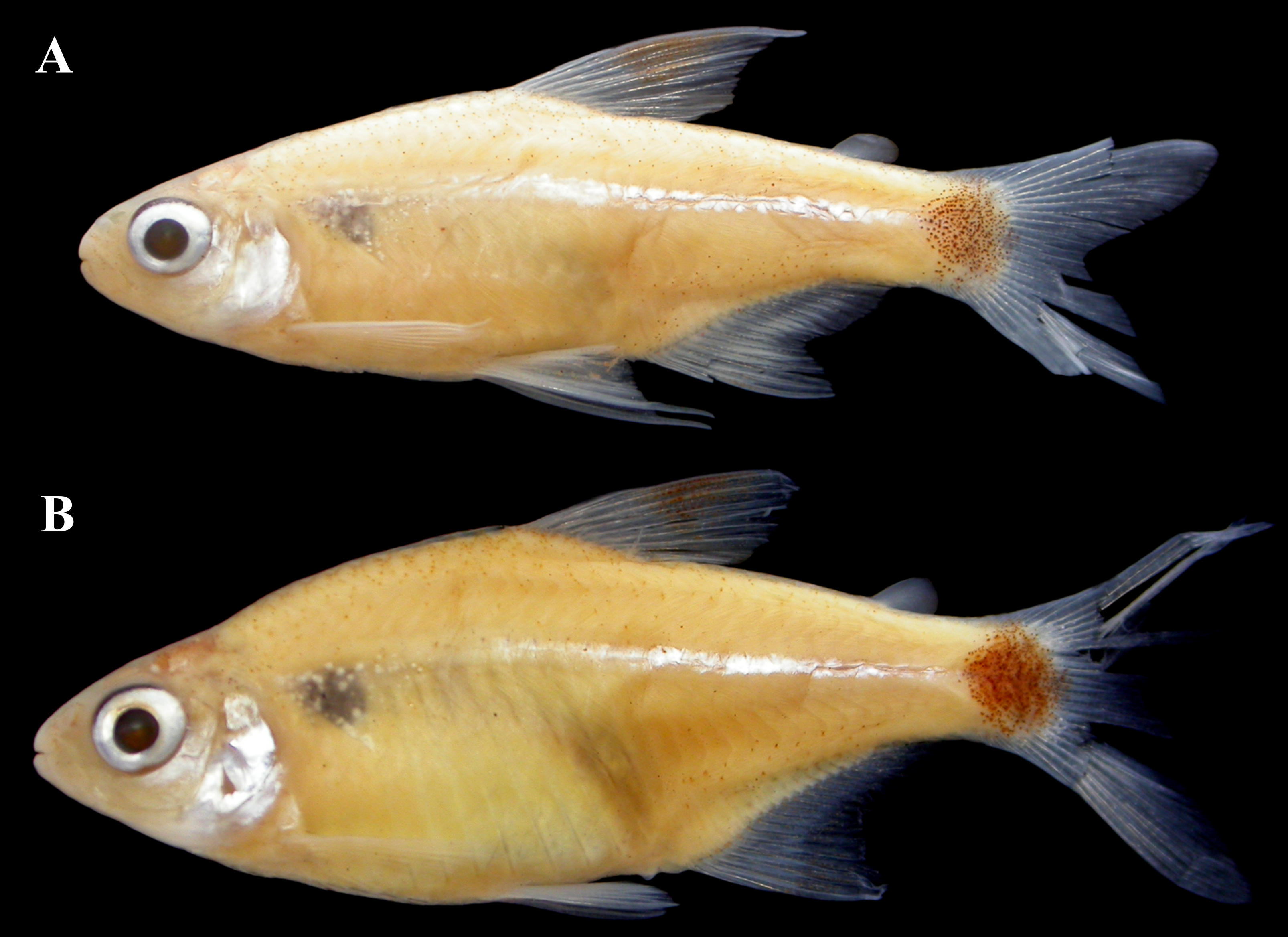
FIGURE 1 | Odontostilbe britskii, lateral view: (A) holotype, MCP 12111, male, 24.9 mm SL, marginal pools of the rio Corumbataí, rio Tietê basin, São Paulo, Brazil; (B) paratype, MCP 53154, female, 25.2 mm SL, marginal pools of the rio Corumbataí, rio Tietê basin, São Paulo, Brazil.

FIGURE 2 | Dentition of Odontostilbe britskii, paratype, MCP 12110: (A) left premaxilla, (B) maxilla, and (C) left dentary, lateral view. Scanning electron micrographs (SEM).

FIGURE 3 | Mesopterygoid of Odontostilbe britskii, paratype, MCP 12110, ventral view: (A) mesopterygoid showing teeth arranged in two groups; (B) detail of unicuspid mesopterygoid teeth. SEM images.

FIGURE 4 | Anal-fin of Odontostilbe britskii, male paratype, UFRGS 22870, cleared and stained specimen, showing two pairs of retrorse bony hooks per segment, symmetrically arranged, each with a robust base and curved or straight tip. Hooks present from last unbranched ray to the 12th–15th branched anal-fin rays. Abbreviations: AF, anal fin; AH, anal-fin hooks; BR, branched ray; UR, unbranched ray; Pt, pterygiophore; Ptdr, pterygiophore portion distal radial; Ptmr, pterygiophore portion medial radial; Ptpr, pterygiophore portion proximal radial; PLR, pleural rib.
Dorsal-fin rays ii,9(35)*. First unbranched dorsal-fin ray approximately half length of second unbranched ray; subsequent branched rays gradually decreasing in size posteriorly. Dorsal-fin origin located slightly anterior to midlength of standard length. Unbranched dorsal-fin rays inserted in first pterygiophore and last two branched rays inserted in tenth pterygiophore. Proximal radial of first pterygiophore in contact with neural spine of ninth precaudal vertebra. Dorsal fin with medial radials fused with distal radials from first to fourth pterygiophores and visible from fifth to tenth pterygiophores. All proximal radial pterygiophores with lateral projections. Adipose-fin origin located approximately at vertical through base of last anal-fin rays.
Anal-fin rays iv(35)* unbranched and 15(11)*, 16(19), or 17(5) branched. Anal-fin profile concave. Anal-fin origin posterior to vertical through base of last dorsal-fin ray. Anal fin supported by 17 pterygiophores. All unbranched rays associated with first pterygiophore. Medial radials fused with distal radials in first to fifth pterygiophores and visible from sixth to last pterygiophore. Proximal radial of first pterygiophore in contact with hemal spine of first caudal vertebra.
Pectoral-fin rays i(35)*, 11(19), 12(10)*, or 13(2). Tip of pectoral fin reaching pelvic-fin origin. Pelvic-fin rays i,7(35)*; pelvic-fin origin located slightly anterior to vertical through dorsal-fin origin. Principal caudal-fin rays 19(35)*. Procurrent caudal-fin rays: dorsal 9(2), 10(13), 11(19)*, or 13(1); ventral 8(2), 9 (3), 10(13)*, 11(14), or 12(3).
Cycloid scales; lateral line incomplete with 6(1), 7(5), 8(11), 9(8)*, 10(4), 11(1), or 12(1) pored scales. Total number of scales on longitudinal series 30(1), 31(5), 32(10)*, 33(12), or 34(1). Predorsal scales 10(21)*, 11(1), or 12(1). Scale rows between lateral line and dorsal-fin origin 5(35)*. Scale rows between lateral line and anal-fin origin 4(35)*. Scales around caudal peduncle 14(35)*. One scales row present at base of first unbranched to fifth branched anal-fin rays.
Gill rakers; upper limb 6, lower limb 9 (including two on hypobranchial) (1). Upper gill rakers with three to four denticles on anterolateral margin and three denticles on posterolateral margin. Lower gill rakers with four denticles on anterolateral margin and one to two denticles on posterolateral margin. Denticulation mainly concentrated on basal portion of gill rakers. Olfactory rosette slightly oval, composed of eight (2) lamellae on each side of median raphe in males and five (1) or six (1) lamellae in females. Precaudal vertebrae 15(4); caudal vertebrae 17(4); total vertebrae 33(1), 34(3), or 35(1). Supraneurals 4(3) or 5(1), lacking lateral projections.
Coloration in alcohol. Overall body coloration pale yellowish. Dorsal surface of head from snout to anterior margin of frontal bones yellowish, and light brown in parietal and supraoccipital regions. Opercular apparatus silvery. Dorsal midline from supraoccipital to caudal peduncle slightly darker, with sparsely distributed chromatophores on scales. Ventral region between pectoral- and pelvic-fin origins lighter. Humeral region with slightly darkened triangular area associated with muscular hiatus of pseudotympanum. Lateral surface of body with silvery band extending from pseudotympanum to caudal peduncle. Conspicuous black caudal spot at posterior termination of caudal peduncle and base of caudal-fin rays, usually reaching both dorsal and ventral margins of caudal peduncle. Dorsal fin with black spot covering half distal length of second unbranched ray and all branched rays, becoming less conspicuous posteriorly. Pectoral and pelvic fins hyaline. Anal fin hyaline with sparse chromatophores along median portion of rays. Adipose and caudal fins hyaline (Fig. 1).
Sexual dimorphism. Sexual dimorphism is evident in the relative length of the second unbranched dorsal-fin ray, which is longer in males than in females, and in the number of lamellae on each side of the median raphe olfactory rosette (eight in males and five or six in females). Sexually mature males also possess small bony hooks on the anal and pelvic fins.
Pelvic-fin rays with hooks along all branched rays, located on the median and distal portions of the segments; some vestigial hooks may be found on the distal margin of the proximal portion of the rays. One hook per segment of the lepidotrichia on the posterolateral border, forming retrorse hooks with a robust base and a curved tip reaching the proximal margin of the segment where they are inserted.
Anal-fin rays (Fig. 4) with two pairs of retrorse bony hooks per segment, symmetrically arranged, with a robust base and curved or straight tips. Hooks present from the last unbranched ray to the 12th to 15th branched rays, decreasing in number posteriorly until disappearing. Distal tip of each hook does not reach the proximal margin of the lepidotrichial segment where it is inserted. No sexual dimorphism was observed in body coloration.
Geographical distribution. Odontostilbe britskii is the species of the genus Odontostilbe with the most restricted geographic range, known only from marginal pools of the rio Corumbataí, rio Tietê basin, upper rio Paraná drainage, São Paulo State, Brazil (Fig. 5).

FIGURE 5 | Map of southern South America showing the distribution of Odontostilbe britskii (pink triangles) and O. paraguayensis (orange pentagons). Stars indicate the type localities. Major river basins indicated.
Conservation status. Odontostilbe britskii appears to be locally abundant where it occurs; however, reliable information on its population size, distribution, and ecological requirements is still lacking. Therefore, the species is provisionally categorized as Data Deficient (DD) according to the IUCN Red List Categories and Criteria (International Union for Conservation of Nature, 2024).
Etymology. The specific epithet britskii honors Heraldo A. Britski, in recognition of his outstanding contributions to the systematics of Neotropical Characiformes, which included collecting the type specimens of this new species.
Odontostilbe paraguayensis Eigenmann & Kennedy, 1903
(Figs. 6–11; Tab. 2)
Odontostilbe paraguayensis Eigenmann, Kennedy, 1903:512–13 (original description; type material; type locality: Asunción, Paraguay). —Eigenmann et al., 1907:125 (listed; Corumbá). —Eigenmann, 1910:429 (listed; geographic distribution, Paraguay). —Bertoni, 1914:11 (listed; geographic distribution, Paraguay). —Eigenmann, 1915:12 (distribution), 90 (diagnostic key), 96 (description), pl. XVI (figure). —Pearson, 1924:34 (listed; headwaters of the Beni River, Bolivia). —Pearson, 1937:108 (listed; geographic distribution, Bolivia). —Fowler, 1940:99 (listed; geographic distribution, Bolivia). —Fowler, 1941:183 (comparative material in description of Odontostilbe iheringi Fowler, 1941; species currently recognized as Serrapinnus heterodon (Eigenmann, 1915)). —Fowler, 1948:198–99 (listed; including figure reproduced from Eigenmann (1915)). —Ringuelet et al., 1967:94–95 (diagnostic key), 95–97 (description based on specimens collected by Ringuelet & Aramburu (1962)), 97 (distribution: Bermejo basin in Salta and Formosa, Argentina). —Ringuelet, 1975:65 (listed; upper Paraná and Paraguay rivers), 75 (listed; Bermejo and Paraná basins), 78 (listed; Paraguay River downstream of Bahía Negra). —Géry, 1977:554 (figure from Eigenmann (1915)), 558 (diagnostic key). —Arratia et al., 1983:80 (listed; Bermejo and Juramento rivers, Argentina). —Uj, 1987:132 (diagnostic key), 136–38 (description; erroneously referred to type locality stream Tramantina, Paraguay), 153–54 (osteological description of skull and fins; generic placement), 160 (distribution). —Ibarra, Stewart, 1987:61 (listed; paratype from Arroyo Trementina). —Casciotta et al., 1992:10–13 (comparative material in description of Odontostilbe yatai Casciotta, Miquelarena & Protogino, 1992, currently recognized as Heterocheirodon yatai), 14 (diagnostic key). —Britski et al., 1999:47 (diagnostic key; brief description). —Toledo-Piza et al., 2001:73–79 (records, distribution and ecology for upper and lower rio Paraguay basin and rio Apa sub-basin, Paraguay). —Malabarba, 2003:218 (listed; distribution in Paraguay and lower Paraná basins). —López et al., 2003:31 (listed; Paraná River basin, Corrientes Province, Argentina). —Liotta, 2005:222 (listed; notes on geographic distribution in Argentina). —López et al., 2005:226 (listed; Paraná River), 236 (listed; tributaries of Paraná River). —Bührnheim, Malabarba, 2006:172 (comparative material in redescription of Odontostilbe fugitiva Cope, 1870), 188 (ecological notes; review of Aquarap Expedition material and correction of identifications; description of Odontostilbe nareuda Bührnheim & Malabarba, 2006). —Bührnheim, Malabarba, 2007:5 (comparative material in redescription of Odontostilbe pulchra Gill, 1858). —Miquelarena et al., 2008:57–58 (diagnostic key for Cheirodontinae species of Argentina), 83–85 (description and distribution). —Mirande, 2010 (comparative material in phylogenetic analysis of Characidae). —Mariguela et al., 2013 (molecular phylogeny of Cheirodontinae). —Almirón et al., 2015:125 (brief description; distribution in Paraná delta). —Mirande, Koerber, 2015:19 (listed; geographic distribution in Argentina). —Koerber et al., 2017:30 (listed; geographic distribution in Paraguay). —Toledo-Piza et al., 2024:241 (listed; geographic distribution in South America).
Diagnosis. Odontostilbe paraguayensis (Fig. 6) differs from all congeners by the presence of partially fused supraneurals, sometimes forming a spine projected anterodorsally above the musculature and beneath skin (vs. four to six separate supraneurals in all other species of the genus). The species is further distinguished by the following combination of characters: mouth terminal, with mouth opening located approximately at the horizontal through the middle of the eye (vs. mouth subterminal in O. avanhandava, and O. microcephala); hooks present on the first to seventh branched anal-fin rays in males (vs. hooks on the first to fifteenth in O. britskii); maxilla bearing two teeth (vs. four teeth in O. pao); mesopterygoid teeth absent (vs. present and arranged in a continuous row in O. weitzmani and O. avanhandava, or arranged in two groups in O. britskii).

FIGURE 6 | Odontostilbe paraguayensis, holotype, CAS 59785, female, 30.5 mm SL, Asunción, Paraguay: (A) left lateral view; (B) dorsal (upper) and ventral (lower) views; (C) radiograph of the holotype in left lateral view. Photographs provided by the California Academy of Sciences, Ichthyology Section. Scale bar = 10 mm.
Description. Morphometric data presented in Tab. 2. Body moderately short and laterally compressed. Predorsal profile of body irregular, with small anteriorly directed spine located beneath skin in dorsal midline between second and fourth predorsal scales, supported by fusion of second to fourth supraneurals. Dorsal profile of head straight; profile from distal tip of supraoccipital to supraneural spine distinctly concave, becoming straight and generally parallel to body axis from that point to dorsal-fin origin. Greatest body depth variable, occurring between projection of supraneural spine and dorsal-fin origin. Dorsal profile between base of last dorsal-fin ray and adipose fin straight or slightly concave, and slightly concave from that point to caudal-fin base. Prepelvic region flattened, with well-marked lateral angles. Ventral profile of snout convex from mouth to pelvic-fin origin, more pronounced in females, and slightly convex from that point to anal-fin origin. Anal-fin base straight. Ventral profile of caudal peduncle slightly concave (Fig. 7).
TABLE 2 | Morphometric data for Odontostilbe paraguayensis. Males range, females range, number of individuals (N), mean, min, max, and standard deviation (SD) include values of the paratype CAS 59786 and SL of holotype CAS 59785.
| Holotype | Paratype | Females | Males | ||||||||
N | Min | Max | Mean | SD | N | Min | Max | Mean | SD | |||
Standard length (mm) | 30.5 | 31.5 | 33 | 25.8 | 37.56 | 30.85 | – | 12 | 29.3 | 33.87 | 31.67 | – |
Percents of standard length | ||||||||||||
Snout to anal-fin origin | 66.2 | 29 | 63.2 | 68.7 | 65.7 | 1.4 | 11 | 61.7 | 66.2 | 64.1 | 1.3 | |
Snout to dorsal-fin origin | 46.7 | 29 | 44.1 | 49.4 | 46.8 | 1.2 | 11 | 44.8 | 49.4 | 46.8 | 1.6 | |
Snout to pelvic-fin origin | 47.3 | 29 | 44.8 | 48.9 | 46.9 | 0.9 | 11 | 44.8 | 48.0 | 46.3 | 1.0 | |
Snout to pectoral-fin origin | 22.8 | 29 | 19.8 | 26.1 | 23.1 | 1.4 | 11 | 23.4 | 25.9 | 24.5 | 0.9 | |
Dorsal to caudal-fin origin | 54.8 | 29 | 50.1 | 55.0 | 52.4 | 1.5 | 11 | 49.5 | 55.2 | 52.1 | 1.6 | |
Orbit to dorsal-fin origin | 32.1 | 29 | 29.5 | 35.5 | 32.1 | 1.6 | 11 | 28.5 | 33.2 | 29.9 | 1.4 | |
Anal fin base length |
| 24.4 | 29 | 23.1 | 26.5 | 24.4 | 0.9 | 11 | 23.8 | 26.7 | 25.7 | 0.8 |
Peduncle length |
| 14.2 | 29 | 9.7 | 14.3 | 11.0 | 0.9 | 11 | 10.1 | 12.4 | 11.5 | 0.7 |
Peduncle depth |
| 10.7 | 29 | 9.9 | 12.3 | 11.0 | 0.5 | 11 | 10.3 | 11.6 | 10.8 | 0.4 |
Body depth at dorsal fin | 34.0 | 29 | 30.1 | 39.1 | 34.8 | 2.6 | 11 | 29.1 | 35.1 | 31.7 | 1.8 | |
Dorsal fin length |
| – | 29 | 23.6 | 30.4 | 27.7 | 1.6 | 11 | 29.6 | 35.0 | 32.9 | 1.6 |
Pelvic fin length |
| 15.5 | 29 | 12.7 | 18.1 | 15.5 | 1.1 | 11 | 16.5 | 23.6 | 20.7 | 1.9 |
Pectoral fin length |
| – | 29 | 17.1 | 23.3 | 20.5 | 1.2 | 11 | 19.2 | 25.5 | 23.4 | 1.7 |
Head length |
| 25.0 | 29 | 21.1 | 28.1 | 24.4 | 1.4 | 11 | 23.6 | 26.9 | 25.3 | 0.9 |
Percents of head length | ||||||||||||
Snout length |
| – | 29 | 19.1 | 26.4 | 22.3 | 1.5 | 11 | 23.1 | 29.0 | 25.5 | 1.8 |
Upper Jaw length |
| – | 29 | 25.3 | 36.8 | 30.1 | 2.6 | 11 | 27.9 | 33.9 | 30.2 | 1.6 |
Horizontal orbit diameter | 32.9 | 29 | 32.2 | 41.5 | 36.9 | 2.4 | 11 | 34.7 | 39.2 | 36.4 | 1.3 | |
Interorbital width |
| 34.1 | 29 | 31.2 | 39.5 | 34.8 | 1.9 | 11 | 34.1 | 39.5 | 36.4 | 1.5 |

FIGURE 7 | Odontostilbe paraguayensis: (A) MZUSP 90666, male, 30.8 mm SL, rio Sepotuba, rio Paraguay basin, Cáceres, Mato Grosso, Brazil; (B) UFRGS 13019, female, 32.3 mm SL, Córrego Pinheiros, rio Paraguay basin, Brazil; (C) live specimen, not preserved, Pre-Delta National Park, Paraná River basin, Argentina (photograph by Liliana Ciotek and Pablo Giorgis).
Head small, 21.1–28.1% SL. Snout short and slightly rounded. Mouth terminal, opening at anterior tip of head; upper and lower jaws approximately equal in length. Maxilla short, positioned obliquely at approximately 45° relative to longitudinal axis of body, posterior tip reaching vertical through anterior margin of eye. Dentition based on five c&s specimens. Premaxilla with five teeth (occasionally six) arranged in a single row, each bearing 9–11 cusps, with a prominent central cusp wider than lateral cusps. Maxilla with two broad teeth bearing seven cusps, similar in shape to cusps of premaxillary teeth. Dentary with 7–10 teeth gradually decreasing in size posteriorly; anterior 5–6 teeth larger, bearing 7–9 cusps, followed posteriorly by 1–2 teeth bearing 3–5 cusps and two smaller conical teeth. Teeth generally asymmetric, with lateral cups differing in size between both sides of central cusp; central cusp slightly longer and wider than lateral cusps and slightly inclined toward interior of mouth. Dentary teeth inclined anteriorly and slightly outward (Fig. 8).
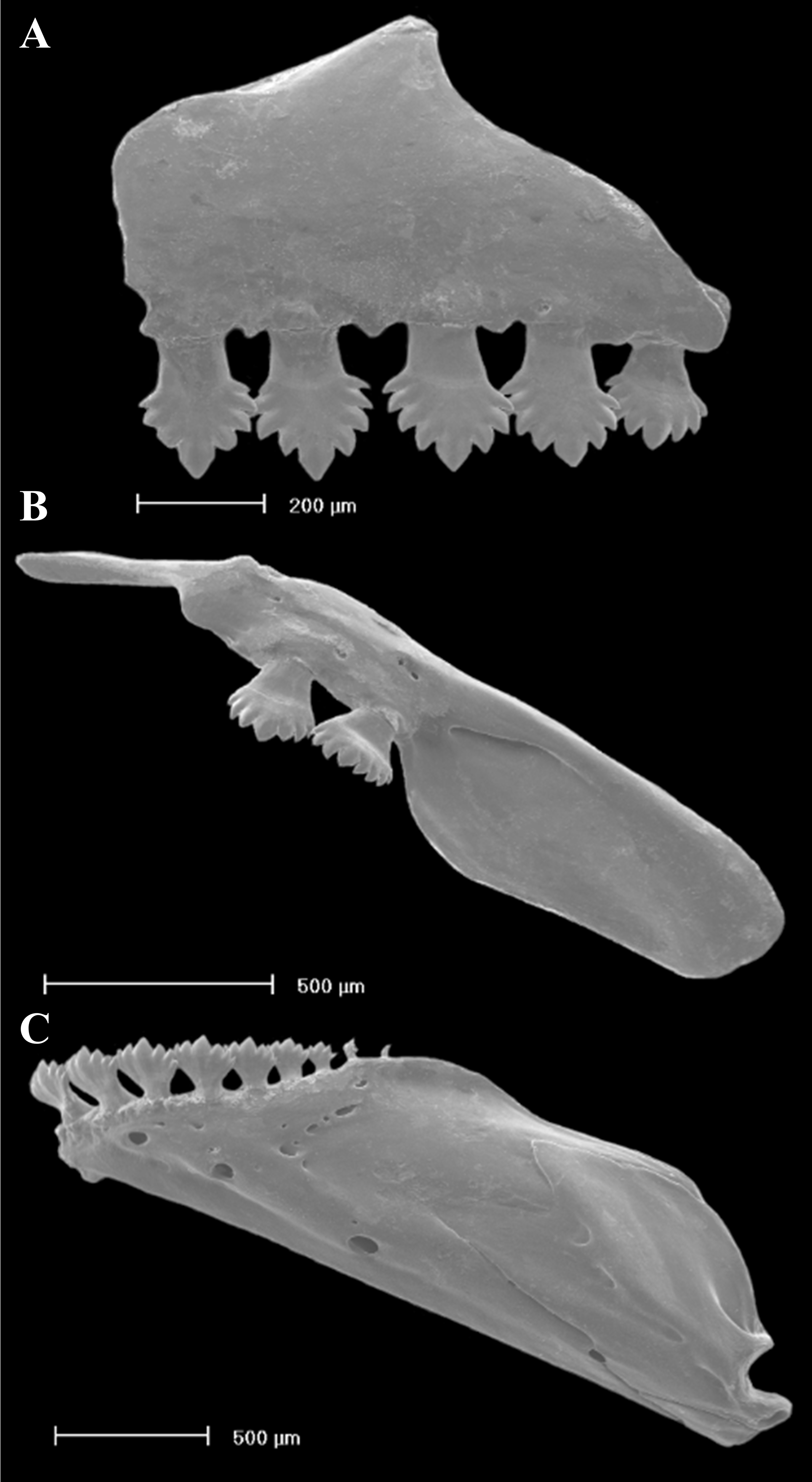
FIGURE 8 | Dentition of Odontostilbe paraguayensis, MCP 12032: (A) premaxilla, (B) maxilla, and (C) dentary, left lateral view. Scanning electron micrographs (SEM).
Dorsal-fin rays ii,9(32). First unbranched dorsal-fin ray approximately half length of second unbranched ray; subsequent branched rays gradually decreasing in size posteriorly. Dorsal-fin origin located slightly anterior to midpoint of standard length. Unbranched dorsal-fin rays inserted on first pterygiophore, and last two branched rays inserted on tenth pterygiophore. Proximal radial of first dorsal-fin pterygiophore in contact with neural spine of ninth precaudal vertebra. Medial radials fused with distal radials from first to fifth pterygiophore and visible from sixth to tenth pterygiophore. Proximal radials of first to eighth pterygiophores with lateral projections, absent in ninth and tenth. Adipose-fin origin located approximately at a vertical through base of last anal-fin rays.
Anal-fin rays iii(3), iv(22), or v(5) unbranched; branched rays 18(1), 19(9), 20(17), or 21(3). Anal-fin profile concave. Anal-fin origin posterior to vertical through base of last dorsal-fin rays. Anal fin supported by 21–23 pterygiophores. Unbranched anal-fin rays associated with first pterygiophore. Medial radials fused with distal radials in first to fifth pterygiophores and visible from sixth to last pterygiophore. Proximal radial of first pterygiophore in contact with hemal spine of first caudal vertebra. Pectoral-fin rays i,11(3), 12(17), or 13(2). Tip of extended pectoral fin reaching anterior margin of pelvic bone. Pelvic-fin rays i,7(33); pelvic-fin origin located approximately below vertical through dorsal-fin origin. Principal caudal-fin rays 19(27), exceptionally 20(2). Procurrent caudal-fin rays: dorsal 8(3), 9(1), 10(5), 11(4), or 12(5); ventral 8(5), 9(10), 10(3), or 11(1).
Cycloid scales; lateral line complete, with 34(7), 35(9), or 36(3) pored scales. Predorsal scales usually not arranged in regular series. Scale rows between lateral line and dorsal-fin origin 6(27); scale rows between lateral line and anal-fin origin 4(27); scales around caudal peduncle 14(27). Scales at base of anal fin 3–5, covering base of unbranched rays and first to sixth branched rays.
Supraneurals. Four supraneurals present. First supraneural lamellar and independent; second to fourth supraneurals lamellar and partially fused, forming a continuous plate bearing an anteriorly directed spinous process. This structure produces a conspicuous predorsal protuberance visible externally along dorsal midline between second and fourth predorsal scales (Fig. 9A). Precaudal vertebrae 15(1), 16(3), or 17(1); caudal vertebrae 18(5); total vertebrae 33(1), 34(3), or 35(1).

FIGURE 9 | Supraneurals of Odontostilbe species, left lateral view: (A) fused supraneurals of O. paraguayensis, MCP 35618; (B) separate supraneurals of O. britskii, UFRGS 22870, paratype. Cleared and stained specimens. Abbreviations: DF, dorsal fin; FSN, fused supraneurals; SN, separate supraneural; SO, supraoccipital; V, vertebra; WA, Weberian apparatus; NS, neural spine; EN, epineural; Ptpr, pterygiophore portion proximal radial.
Gill rakers based on two specimens. First gill arch with 6 gill rakers on upper limb and 10–11 on lower limb (2). Gill rakers short, not elongate, with robust basal denticles. Upper gill rakers slender, bearing 0–2 denticles on anterolateral margin and 2–3 denticles on posterolateral margin (2). Lower gill rakers more robust, bearing 4–6 denticles on anterolateral margin and a single well-developed denticle on posterolateral margin (2). Denticles of lower gill rakers markedly more developed than those of upper limb. Denticles mainly concentrated on basal portion of gill rakers, forming a series of strong, recurved projections (Fig. 10). Olfactory rosette slightly oval, composed of twenty (1) or twenty-one (1) lamellae on each side of median raphe in males and eleven (1) or twelve (1) lamellae in females.

FIGURE 10 | Gill rakers of Odontostilbe paraguayensis, MCP 12032. (A) First gill arch, left lateral view; (B) detail of gill rakers on the upper limb of the first gill arch; (C) detail of gill rakers on the lower limb of the first gill arch. Scanning electron micrographs (SEM).
Coloration in alcohol. Overall body coloration yellowish. Dorsal surface of head from snout to posterior margin of frontal with sparsely scattered chromatophores; region of parietal and supraoccipital darker, with more concentrated dark-yellow chromatophores. Opercular apparatus, infraorbital region, and branchiostegal rays silvery white, with patches of golden chromatophores on opercle. Ventral region between pectoral and pelvic fins paler. Humeral region with a slightly darkened triangular area corresponding to muscular hiatus of pseudotympanum.
Lateral region with a silvery lateral band extending from pseudotympanum to caudal peduncle; dorsal margin of band marked by a line of dark chromatophores forming a narrow dark stripe. Scales above and below lateral band with scattered dark chromatophores. Dorsal region from supraoccipital to caudal peduncle with small dark chromatophores dispersed on scales. Conspicuous rounded black caudal spot present on caudal peduncle and extending onto base of median caudal-fin rays, usually reaching upper margin of caudal peduncle.
Dorsal fin with dark-gray chromatophores along first and second unbranched rays and sparsely scattered on branched rays. Pectoral fin with dark chromatophores mainly along first unbranched ray. Pelvic and anal fins with dark chromatophores scattered along rays. Adipose fin hyaline with a few small dark chromatophores. Caudal fin with scattered dark-gray chromatophores on posterior portion and along edges of fin rays; basal portions of caudal-fin lobes with pale chromatophores immediately posterior to caudal peduncle spot.
Coloration in life. Body yellowish, with scattered dark chromatophores on scales and fins. Lateral region with a conspicuous silvery band covered with bluish iridescent chromatophores, extending posteriorly to anterior margin of caudal spot. Head laterally and ventrally silvery. Distinct black caudal spot present on caudal peduncle, reaching upper margin of peduncle and extending onto base of median caudal-fin rays. Each lobe of caudal fin with yellow pigmentation immediately posterior to caudal spot. Basal and medial portions of dorsal and anal fins yellow (Fig. 7C). In life, body coloration more translucent and lateral band more iridescent than in preserved specimens.
Sexual dimorphism. Sexually mature males are easily recognized by the presence of secondary sexual characters, including bony hooks on the pelvic and anal fins (Fig. 11), and in the number of lamellae on each side of the median raphe olfactory rosette (twenty or twenty-one in males and five or six in females).

FIGURE 11 | Secondary sexual characters of Odontostilbe paraguayensis, male (MCP 12031). (A) Anal fin showing bony hooks on branched rays; (B) detail of hooks on anal-fin lepidotrichia; (C)pelvic fin showing bony hooks on branched rays; (D) detail of hooks on pelvic-fin lepidotrichia extending toward the anterior margin of the segment. Cleared and stained specimen.
Pelvic fin. Branched pelvic-fin rays bearing elongate retrorse hooks with a robust base and curved tip. Hooks inserted along all branched rays from the middle of the proximal portion to the distal portion of each ray, with one hook per segment on the posterolateral border of the lepidotrichia. Hooks continuing onto the anterior and posterior branches of the first and second ray bifurcations. Distal tips of hooks on the medial and distal portions of the rays reaching or slightly exceeding the proximal margin of the segment in which they are inserted.
Anal fin. Retrorse hooks present on the last unbranched ray and on the first five to six branched rays, decreasing in number posteriorly until disappearing. Hooks restricted to the median portion of the rays and occurring only on the posterior branch of the lepidotrichia, never on the anterior branch. One pair of hooks usually present per ray segment and symmetrically arranged, although two pairs or asymmetric arrangements may occur on some segments of the last unbranched ray and the first posterior branches of branched rays. Distal tips of hooks not reaching the proximal margin of the segment in which they are inserted.
In addition, mature males present elongate filaments on the fins, particularly on the second unbranched ray of the dorsal fin and on the unbranched ray of the pelvic fin.
Geographical distribution. Odontostilbe paraguayensis is known from the Paraguay River system (Toledo-Piza et al., 2001) and from several localities along the Paraná River basin in Argentina, Brazil, and Paraguay (Toledo-Piza et al., 2024). In Argentina, the species has been recorded from the provinces of Salta, Formosa, Chaco, Corrientes, Santa Fe, Entre Ríos, and Buenos Aires (Miquelarena et al., 2008). The species is widely distributed in the Paraguay-lower Paraná drainage (Fig. 5).
Ecological notes. Odontostilbe paraguayensis has been collected in aquatic environments with clear water, low current velocity, and moderate marginal vegetation, usually over substrates composed of rocks, gravel, and sand. Toledo-Piza et al. (2001) reported the species from shallow-water habitats such as beaches, backwaters, and flooded forests. Examination of the intestinal contents of two specimens of O. paraguayensis (UFRGS 13019) revealed that the species feeds mainly on detritus, followed by filamentous algae; smaller amounts of plant remains, rotifers, cladocerans, testate amoebae, and dipteran pupae were also recorded.
Miquelarena et al. (2008) classified the species as iliophagous-phytophagous, reporting the ingestion of significant quantities of algae and sand. Corrales de Jacobo, Canonn-Veron (1995) considered the species detritivorous based on specimens collected in the Oriental Chaco basin. Using stable isotope analyses of samples from the Pantanal, Wantzen et al. (2002) classified O. paraguayensis as omnivorous.
Material examined. CAS 59785, holotype, 40.0 mm SL, Paraguay, Asunción, rio Paraguay, 25.21050°S 57.57166°W, 1900–1901, J. D. Anisits (photograph examined). CAS 59786 (originally IUM 10111), paratype female, 31.5 mm SL, Paraguay, stream Trementina, tributary of rio Aquidabán, rio Paraguay basin, 22.78359°S 56.88308°W, 1900–1901, J. D. Anisits.Brazil, Mato Grosso State.MCP 35618, 54, 28.5–33.9 mm SL (2 c&s), rio Jauquara, tributary of rio dos Pássaros, rio Paraguay basin, Barra do Bugres, 15.16667°S 57.08333°W, 10 Oct 1991, R. E. Reis, L. R. Malabarba & N. A. Menezes.MCP 37799, 31, 26.2–29.6 mm SL, stream Bagres, highway MT-120 between BR-174 and Jauru, ca. 3 km N of BR-174, Jauru, rio Paraguay basin, 15.63944°S 58.73500°W, 11 Jul 2004, R. E. Reis, P. A. Buckup, F. Langeani & E. H. L. Pereira.MCP 38155, 82, 27.2–32.2 mm SL, stream Bagres on BR-174, ca. 3 km NW of road to Jauru (MT-388), Figueirópolis d’Oeste, rio Paraguay basin, 15.64667°S 58.74722°W, 11 Jul 2004, R. E. Reis, P. A. Buckup, F. Langeani & E. H. L. Pereira.MCP 39366, 1, 28.8 mm SL, rio Paraguay, near camping Dois de Ouro, Cáceres, 16.14417°S, 57.72972°W, 10 Jun 2005, P. Lehmann, V. A. Bertaco, F. C. T. Lima, C. Galina et al.MZUSP 79012, 1, 25.9 mm SL, rio Cachoeirinha, road Cáceres-Porto Estrela, Cáceres, 15.74111°S 57.33139°W, 27 Feb 2002, H. A. Britski, F. A. Machado & O. Froehlich.MZUSP 18298, 1, 20.9 mm SL, rio Cuiabá, Barão de Melgaço, 16.18333°S 55.95000°W, CEPIPAM.MZUSP 18580, 26, 25.4–29.7 mm SL, rio Coxipó da Ponte, Coxipó da Ponte, 15.63333°S 56.05000°W, 27–28 Oct 1975, K. de Silimon.MZUSP 38073, 14, 29.9–31.4 mm SL, Ilha da Goiaba, rio Taquari, Coxim, 18.50000°S 54.75000°W, 1 Oct 1979, A. Carvalho Filho.MZUSP 4391, 9, 25.3–28.7 mm SL, rio Cuiabá, Santo Antônio do Leverger, 15.86667°S 56.08333°W, G. Olson.MZUSP 74372, 1, 22.0 mm SL, rio Cuiabá, mouth of rio Croará, ca. 20 km from Barão de Melgaço, 16.18333°S 55.95000°W, 3 May 1977, CEPIPAM & H. A. Britski.MZUSP 74392, 39, 25.2–32.1 mm SL, rio Cuiabá, Viveiro de Pássaros, Poconé, 16.50000°S 56.40000°W, 15–16 Oct 1977, CEPIPAM.MZUSP 79015, 8, 31.5–35.6 mm SL, rio Jaurú, bridge on Araputanga-Jaurú road, Indiavaí, 29 Feb 2002, F. A. Machado, F. C. T. Lima, G. Borges & J. Nakaga.MZUSP 79030, 19, 19.6–25.5 mm SL, rio Cuiabá, mouth of rio Croará, ca. 20 km from Barão de Melgaço, 16.18333°S 55.95000°W, 3 May 1977, CEPIPAM & H. A. Britski.MZUSP 79116, 1, 29.1 mm SL, Baía do Chacororé, Barão de Melgaço, 18 Oct 1977, CEPIPAM.MZUSP 79126, 3, 27.4–29.6 mm SL, Baía do Chacororé, Barão de Melgaço, 18 Oct 1977, CEPIPAM.MZUSP 79134, 135, 25.4–30.5 mm SL, mouth of rio Croará, ca. 20 km from Barão de Melgaço, 16.1944°S 55.9675°W, 31 Jan 1977, CEPIPAM.MZUSP 79136, 131, 24.0–28.6 mm SL, rio Cuiabá, ca. 3 km from Santo Antônio do Leverger, 15.86667°S 56.08333°W, 28 Aug 1976, CEPIPAM.MZUSP 79183, 1, 29.0 mm SL, Barão de Melgaço, 16.18333°S 55.95000°W, CEPIPAM.MZUSP 90666, 23, 29.3–33.0 mm SL, rio Sepotuba, middle reach, rio Paraguay drainage, Cáceres, 15.27639°S 57.71389°W, 5 Mar 2002, H. A. Britski, O. Froehlich, A. C. Catella & F. Marquez.MZUSP 90717, 2, 31.1–32.3 mm SL, rio Sepotuba, middle reach, rio Paraguay drainage, Barra do Bugres, 15.12500°S 57.66806°W, 3 Jan 2002, F. Marquez.UFRGS 12934, 9, 18.2–27.2 mm SL, rio Tugoré, BR-163, Rondonópolis, rio Paraguay basin, 16.20361°S 54.78139°W, 9 Jun 2010, V. R. Lampert & S. Scherer.UFRGS 12995, 50, 22.2–34.3 mm SL, Ribeirão Esmeril, BR-163, rio Paraguay basin, 15.48028°S 56.29083°W, 10 Jun 2010, V. R. Lampert & S. Scherer.UFRGS 13019, 56, 29.8–34.2 mm SL, Córrego Pinheiros, rio Paraguay basin, 15.41250°S 56.35556°W, 11 Jun 2010, V. R. Lampert & S. Scherer.UFRGS 13040, 34, 25.8–31.6 mm SL, Ribeirão Chiqueirinho, rio Paraguay basin, 14.95778°S 56.50972°W, 11 Jun 2010, V. R. Lampert & S. Scherer.UFRGS 13360, 33, 28.8–33.8 mm SL, rio Manso, downstream of UHE Manso bridge, Cuiabá, rio Paraguay basin, 14.87197°S 55.79139°W, 23 Oct 2010, C. M. Baicere-Silva, F. C. Jerep, V. A. Bertaco, R. Baicere-Silva & F. R. Carvalho.UFRGS 13469, 2, 26.1–31.1 mm SL, rio Cuiabá, SESC Pantanal, beaches upstream and downstream, Poconé, rio Paraguay basin, 16.51530°S 56.37772°W, 24 Oct 2010, C. M. Baicere-Silva, F. C. Jerep, V. A. Bertaco & J. Silva.Paraguay, Alto Paraguay Department.MCP 12031, 3, 30.9–33.9 mm SL, rio Apa, Estancia Estrellas, rio Paraguay basin, 22.08333°S 57.70000°W, 15 Oct 1979, Mission Zoologique du Musée de Genève.MCP 12032, 7, 30.4–33.3 mm SL, stream ca. 15 km W of San Luis, rio Paraguay basin, 15 Oct 1979, Mission Zoologique du Musée de Genève.MZUSP 54372, 1, 21.9 mm SL, rio Paraguay, opposite Fuerte Olimpo, 21.03333°S 57.86667°W, 8 Sep 1997, J. Sarmiento, M. T. Piza, C. Magalhães & A. Narváez.MZUSP 54373, 14, 20.8–26.1 mm SL, riacho Lechuza, tributary of rio Paraguay below Boquerón, 20.80000°S 57.93333°W, 7 Sep 1997, D. Mandelburger, M. Medina, M. T. Piza & students.MZUSP 54374, 56, 17.9–29.7 mm SL, tributary of rio Paraguay opposite Valle Mi, 22.13333°S 57.98333°W, 12 Sep 1997, J. Sarmiento, M. T. Piza, C. Magalhães & A. Narváez. MZUSP 54375, 20, 20.1–27.7 mm SL, rio Paraguay, opposite Fuerte Olimpo, beach area, 21.03333°S 57.86667°W, 9 Sep 1997, J. Sarmiento, M. T. Piza, C. Magalhães & A. Narváez. MZUSP 54377, 25, 17.9–32.9 mm SL, rio Paraguay, right margin, ca. 1,500 m upstream of Estancia Cerrito, 21.45000°S 57.91667°W, 11 Sep 1997, J. Sarmiento, M. T. Piza, C. Magalhães & A. Narváez. MZUSP 54380, 6, 23.8–30.9 mm SL, flooded pool in riacho Puerto Esperanza, rio Paraguay basin, 22.06667°S 57.98333°W, 14 Sep 1997, D. Mandelburger, M. Medina & S. Villanueva. MZUSP 54383, 18, 22.7–31.8 mm SL, rio Paraguay, ca. 1 km downstream of Estancia Cerrito, Puerto Coeyú, 21.48333°S 57.93333°W, 13 Sep 1997, D. Mandelburger, M. Medina & S. Villanueva. Concepción Department.MZUSP 54376, 20, 31.8–34.5 mm SL, rio Apa, left margin, just upstream of San Carlos, 22.21667°S 57.28333°W, 18 Sep 1997, J. Sarmiento, M. T. Piza, C. Magalhães & A. Narváez. MZUSP 54378, 8, 16.9–25.2 mm SL, stream Napegue, left margin, 22.98333°S 57.71667°W, 17 Sep 1997, J. Sarmiento, M. T. Piza, C. Magalhães & A. Narváez. MZUSP 54379, 1, 27.9 mm SL, arroyo La Paz, right margin, 22.40000°S 57.80000°W, 16 Sep 1997, D. Mandelburger, M. Medina & S. Villanueva. MZUSP 54381, 84, 25.2–27.2 mm SL, rio Apa, pond located ca. 500 m from the river margin, 22.11667°S 57.85000°W, 15 Sep 1997, D. Mandelburger, M. Medina & S. Villanueva. MZUSP 54382, 21, 25.8–34.5 mm SL, arroyo La Paz, channel connected to the right margin of the rio Paraguay, ca. 80 m from the river bank, 22.40000°S 57.80000°W, 16 Sep 1997, D. Mandelburger, M. Medina & S. Villanueva.
Morphometric comparison of Odontostilbe species from Paraná-Paraguay drainage. Principal Component Analysis (PCA) of size-corrected morphometric variables revealed patterns of shape variation among species of Odontostilbe. The first principal component (PC1) explained 24.99% of the total variance and the second principal component (PC2) 14.86%, together accounting for 39.85% of the morphometric variation.
In the ordination including all species (Fig. 12), Odontostilbe microcephala occupies a distinct region of the morphospace characterized by negative PC1 values, clearly separated from the remaining species. In contrast, O. paraguayensis, O. britskii, O. weitzmani, and O. avanhandava are distributed mainly in the central and positive regions of PC1, with partial overlap among them. Along PC2, O. paraguayensis tends to occupy higher values, whereas O. weitzmani occurs mostly at lower values of this axis. Specimens of O. britskii are concentrated near the center of the morphospace, showing intermediate values along both axes. The convex hull polygons illustrate the extent of morphometric variation within each species, with O. microcephala showing the greatest expansion toward negative PC1 values.
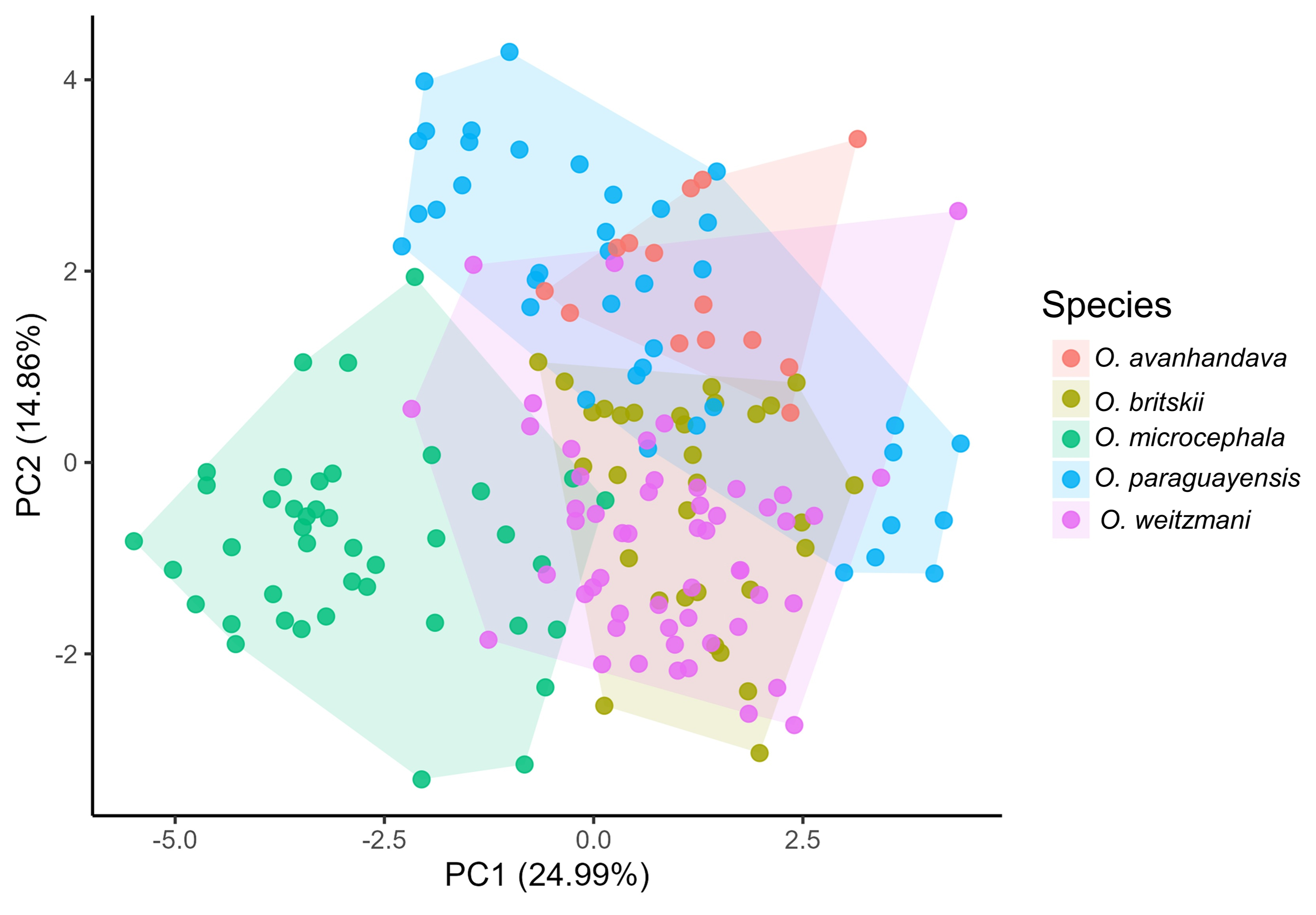
FIGURE 12 | Principal Component Analysis (PCA) of size-corrected morphometric variables of five species of Odontostilbe. Scatterplot of PC1 versus PC2 based on residuals from regressions of log-transformed morphometric variables against standard length (SL). PC1 explains 24.99% of the total variance and PC2 explains 14.86%. Each point represents a specimen; colors correspond to species. Shaded polygons indicate the convex hull delimiting the morphometric space occupied by each species.
Identification key to the species of Odontostilbe from the Paraná-Paraguay basin
1a. Lateral line incomplete, with 6–12 pored scales; mouth terminal; mesopterygoid with teeth arranged in two distinct patches on median portion of bone; males with hooks on first to fifteenth branched anal-fin rays……………….. O. britskii
1b. Lateral line complete……………….. 2
2a. Mouth subterminal……………….. 3
2b. Mouth terminal……………….. 4
3a. Premaxillary teeth with 7–11 cusps, usually 9; five scale rows between lateral line and dorsal-fin origin; horizontal orbit diameter 31.0–39.7% HL, mean 35.5 %; mesopterygoid teeth present in a single patch……………….. O. avanhandava
3b. Premaxillary teeth with 7–9 cusps, usually 7; six scale rows between lateral line and dorsal-fin origin; horizontal orbit diameter 24.6–32.8% HL, mean 28.7%; mesopterygoid teeth absent……………….. O. microcephala
4a. Predorsal region with conspicuous external protuberance; supraneurals 2–4 fused and projected dorsally; olfactory rosette with 11–12 lamellae on each side of median raphe; mesopterygoid teeth absent……………….. O. paraguayensis
4b. Predorsal region without external protuberance; supraneurals separate; olfactory rosette with 20–21 lamellae on each side of median raphe; mesopterygoid teeth arranged in a continuous row on median portion of bone……………….. O. weitzmani
Discussion
Recent studies on Odontostilbe (Burns et al. 1997; Malabarba, 1998; Bührnheim, Malabarba 2006, 2007; Chuctaya et al., 2018, 2020) have highlighted the importance of incorporating additional morphological characters to improve species identification within the genus. These include traditional taxonomic characters such as tooth morphology, together with traits associated with sexual dimorphism and secondary sexual structures, number of lamellae in the olfactory rosette, features of the gill arches, the configuration of dorsal and pelvic fins, pigmentation patterns of the fins, supraneural morphology, and morphometric features of the head and body, all of which may vary among species and occasionally between sexes.
The most informative character to distinguish Odontostilbe paraguayensis from all other species of the genus, as well as from all other Characidae, is the configuration of the supraneurals. In O. paraguayensis, these bones are partially fused, forming a distinctive predorsal structure. Supraneurals are median endochondral bones located in the dorsal skeletogenous septum between the cranium and the dorsal fin (Dahdul et al., 2010). Two hypotheses were initially proposed regarding their origin: (1) that supraneurals are serial homologues of median neural spines, and (2) that teleost supraneurals are serial homologues of pterygiophores. Mabee (1988) rejected both hypotheses and concluded that supraneurals and predorsal bones represent phylogenetic homologues in fishes. Developmentally, supraneurals form sequentially from anterior to posterior as small clusters of chondrocytes dorsal to the anterior precaudal neural spines and subsequently undergo perichondral ossification (Bird, Mabee, 2003). In otophysan fishes, the first and fourth supraneurals are associated with the Weberian apparatus, whereas supraneural 2 forms part of the neural complex and supraneural 3 fuses during development with the neural arches of vertebrae 3 and 4 (Dahdul et al., 2010). The presence, absence, and morphology of supraneurals have been widely used to investigate interrelationships among ostariophysan fishes (Fink, Fink, 1981). Within Odontostilbe, supraneurals vary in number and configuration, but the fused condition is unique to O. paraguayensis. In all other congeners, including O. britskii, the supraneurals remain separated.
Another relevant diagnostic feature involves the morphology and distribution of hooks on the pelvic and anal fins. Hooks on fin rays are common in Cheirodontinae and constitute an important source of information for phylogenetic, reproductive, and behavioral studies (Chuctaya et al., 2018). In Odontostilbe, the distribution of hooks along the branched anal-fin rays varies among species. For instance, hooks occur from the first to the 22nd branched ray in O. pulchra (Gill, 1858), from the first to the 16th in O. ecuadorensis and O. britskii, whereas they are restricted to the first to sixth rays in O. splendida Bührnheim & Malabarba, 2007 and O. paraguayensis. Intermediate patterns occur in other species, including O. pao (first to eighth rays), O. fugitiva (first to ninth rays), O. nareuda (first to ninth rays), O. parecis (first to eighth rays), O. microcephala (first to eighth rays), O. weitzmani (first to seventh rays), and O. avanhandava (first to fourth rays). This variation in the distribution of hooks represents a useful character for distinguishing species within the genus.
Mesopterygoid teeth have been reported in several characiform taxa (Weitzman, 1964; Buckup, 1993; Vari, 1995; Lucena, Menezes, 1998; Toledo-Piza, 2000) and were recently documented in two species of Odontostilbe from the upper Paraná basin (Chuctaya et al., 2018). In O. weitzmani and O. avanhandava, mesopterygoid teeth form a single row, whereas in O. britskii they occur in two distinct groups located on the median portion of the bone. This condition represents an additional diagnostic feature for the species of the genus.
Generic assignment of the new species. Odontostilbe britskii exhibits two synapomorphies proposed by Malabarba (1998) to diagnose the genus Odontostilbe: elongation of the second branched dorsal-fin ray and elongation of the unbranched pelvic-fin ray in males. These sexually dimorphic modifications have been widely used in the redescription of previously known species such as O. fugitiva and O. pulchra, as well as in the description of additional species including O. nareuda, O. ecuadorensis, O. pao, O. splendida, and O. parecis (Bührnheim, Malabarba, 2006, 2007). Besides Odontostilbe, Serrapinnus tocantinensis Malabarba & Jerep, 2014 and Holoshesthes pequira (Steindachner, 1882) have elongated dorsal- and pelvic-fin rays. Odontostilbe britskii, however, does not share all the synapomorphies described in the anal fin and procurrent caudal fin of males that diagnose Serrapinnus Malabarba, 1998 and neither the modified jaw dentition to support a close relationship to Holoshesthes Eigenmann, 1903.
Odontostilbe britskii further differs from all other species of the genus by presenting an incomplete lateral line. This character has been demonstrated to be highly homoplastic and poorly informative as to species interrelationships in Cheirodontinae with at least three independent reductions to an incomplete lateral line and four independent acquisition of a complete lateral line in a consensus parsimony tree including most representatives of this subfamily (Malabarba, 1998:220). Within Cheirodontinae, Cheirodon Girard, 1855, Heterocheirodon Malabarba, 1998, Nanocheirodon Malabarba, 1998, Serrapinnus, Acinocheirodon Malabarba & Weitzman, 1999, Compsura Eigenmann, 1915, Macropsobrycon Eigenmann, 1915, and Aphyocheirodon Eigenmann, 1915 include species with an incomplete lateral line (Malabarba, 1998). However, the placement of O. britskii in these genera can be readily refuted by the lack of the characters that diagnose those genera.
For example, monophyly and relationships of the genera Cheirodon, Heterocheirodon, Nanocheirodon, and Serrapinnus are strongly supported by characters related to the number and sexually dimorphic shape of anal- and procurrent caudal-fin rays of males, that are not shared with O. britskii (Malabarba, 1998; Malabarba, Jerep, 2012, 2014; Jerep, Malabarba, 2014). In addition, O. britskii lacks the specialized organs of the caudal fin of males of Macropsobrycon (Jerep, Malabarba, 2011), Acinocheirodon (Malabarba, Weitzman, 1999), and Compsura (Malabarba, 1998), each showing unique organs formed by modified hooks, tissues and/or scales that constitute synapomorphies diagnosing these genera. The new species also differs from Aphyocheirodon by the morphology of the dentary teeth, which in that genus possess three enlarged cusps forming a cutting edge.
Taxonomic and biogeographic implications. The recognition of Odontostilbe britskii contributes to the understanding of the diversity of Cheirodontinae in the Paraguay-Paraná basin, a region recognized as an important center of diversification for several lineages of small characids (Souza et al., 2023; Dagosta et al., 2024). Despite the long history of ichthyological exploration in this basin, many cheirodontine species remain poorly characterized, particularly those described more than a century ago based on limited material and generalized diagnoses. The re-examination and redescription of historical taxa using modern morphological approaches are therefore essential to clarify species boundaries and stabilize the taxonomy of the group. Integrative studies combining detailed morphology, morphometrics, osteology, and molecular data will be necessary to resolve phylogenetic relationships within Odontostilbe and other cheirodontine genera, ultimately improving our understanding of the evolutionary history and biogeographic patterns of this diverse subfamily.
Comparative material examined. Odontostilbe avanhandava. LIRP 3239, 1, 48.7 mm SL, ribeirão da Batalha, Fazenda Batalha (Pedro Querésma), rio Paranaíba basin, Paracatu, Minas Gerais, Brazil, 17.423611°S 47.453056°W, 27 Apr 2002, C. A. A. Figueiredo & E. S. S. Rego. FMNH 57871, 1, 62.1 mm SL, río Tietê at Salto de Avanhandava, below the falls, Penápolis, São Paulo, Brazil, 21.167648°S 50.117562°W, 14 Sep 1908, J. Haseman. Odontostilbe dierythrura. MCP 38624, 2 c&s (1 male, 1 female) of 7, río Samusabety, río Ichilo basin, system Isiboro-Mamoré-Madeira, Cochabamba Department, Bolivia. Odontostilbe euspilurus. ANSP 143702, 2 c&s (1 male, 1 female) of 8, mouth of río Carbón below Atalaya on north-south road, Cusco/Madre de Dios, Peru. MCP 38420, 13, distributary of río Payamino, a few km upstream from San José de Payamino, Napo basin, Ecuador. Odontostilbe fugitiva. ANSP 178908, 2 c&s (1 female, 1 male) of 12, lower río Itaya at bridge on Iquitos-Nauta highway, ca. 25 miles SSW of Iquitos, Maynas, Loreto, Peru. INPA 18465, 4 c&s (2 males, 2 females) of 73, Ilha da Marchantaria, Amazonas, Brazil. INPA 18506, 3 c&s (1 male, 1 female, 1 unsexed) of 50, Paraná do Xiborena, Amazonas, Brazil. INPA 18512, 1 male c&s, Lago Pirapora, Catalão, Amazonas, Brazil. MZUSP 77844, 2 c&s, 36.9–40.0 mm SL, río Pastaza basin, Ecuador. Odontostilbe microcephala. MCP 38311, 4, 38.8–43.5 mm SL, endorheic drainage of the río Ureña, lower Paraná basin, Rosario de la Frontera, Salta, Argentina, 25.00000°S 64.50000°W, 2 Mar 2001, G. Monasterio de Gonzo & M. Mosqueira. USNM 321173, 5 (2 c&s) of 49, 29.6–44.0 mm SL, río Camatindi, 8 km N of the Tarija Department border, ca. 40 km N of Villamontes, Chuquisaca Department, río Paraguay basin, Bolivia, 20.99271°S 63.39922°W, 2 Oct 1988, W. Starnes, L. Starnes, J. Sarmiento & R. Vasquez. Odontostilbe nareuda. MZUSP 87759, 1 female, 35.3 mm SL, Calama, Brazil, 2 Feb 1981, M. Goulding. FMNH 106433, 1 male c&s of 30, río Madeira basin, creek on right margin of río Nareuda, ca. 3–4 km upstream from mouth of río Tahuamanu, Pando Department, Bolivia. Holoshesthes pequira. UFRGS 8641, 14, rio Uruguay, near a recreational club, Uruguaiana, Rio Grande do Sul, Brazil. UFRGS 5589, 5, arroio do Salso, Uruguaiana, Rio Grande do Sul, Brazil. UFRGS 13365, 22, tributary of the left margin of rio Soberbo, road to Lago do Manso, Cuiabá, Mato Grosso, Brazil. UFRGS 13006, 99, ribeirão Esmerial, BR-163, Mato Grosso, Brazil. MZUSP 21067, 2 c&s (1 male, 1 unsexed) of 53, rio Paraná below Sete Quedas, Paraná State, Brazil, CETESB. Odontostilbe pulchra. INHS 40101, 2 c&s (1 male, 1 female) of 20, Cumuto River, ca. 5 km S of Brazil on the road to Talparo, Trinidad and Tobago. INHS 40081, 4 (2 females 32.6–33.3 mm SL, 2 unsexed 26.3–29.9 mm SL), Quare River, ca. 1 km E of Valencia on road to Arima, Trinidad and Tobago. Odontostilbe weitzmani. MZUSP 16851, 1, 38.9 mm SL, male, rio Mogi-Guaçu, Emas, Pirassununga, São Paulo, Brazil, 21.916666°S 47.383335°W, 22 Oct 1963, H. A. Britski. MZUSP 87947, 11, 42.5–50.5 mm SL, córrego da Lapa near its mouth, Itirapina, São Paulo, Brazil, 22.249918°S 47.863376°W, 31 Jan 2002, E. N. Fragoso.
Acknowledgments
The authors are grateful to Osvaldo Oyakawa, Michel Gianeti, and Alessio Datovo (MZUSP); Carlos Lucena and Roberto Reis (PUCRS); Hernán Ortega (MUSM); Fernando M. Carvajal-Vallejos (UMSS); and Dave Catania (CAS) for access to collections, technical assistance, and/or the loan of specimens. We also thank Dave Catania (CAS) for providing photographs and radiographs of type material. Liliana Ciotek and Pablo Giorgis kindly provided photographs of Odontostilbe paraguayensis in life. Vanessa Meza (PUCRS) assisted with the preparation of Fig. 5. We are also grateful to Carlos Lucena (MCP) and Vinicius Bertaco (MCN) for reviewing an earlier version of the manuscript prior to submission.
References
Almirón A, Casciotta J, Ciotek L, Giorgis P. Guía de los peces del Parque Nacional Pre-Delta. Buenos Aires: Administración de Parques Nacionales; 2015.
Arratia G, Peñafort MB, Menu-Marque S. Peces de la región sureste de los Andes y sus probables relaciones biogeográficas actuales. Deserta. 1983; 7:48–107.
Bertoni AW. Fauna paraguaya: catálogos sistemáticos de los vertebrados del Paraguay. Peces, batracios, reptiles, aves y mamíferos conocidos hasta 1913. Asunción: Ex Sylvis; 1914.
Bird NC, Mabee PM. Developmental morphology of the axial skeleton of the zebrafish Danio rerio (Ostariophysi: Cyprinidae). Dev Dyn. 2003; 228:337–57. https://doi.org/10.1002/dvdy.10387
Britski HA, Silimon KZ, Lopes BS. Peixes do Pantanal. Manual de identificação. Brasília: Embrapa; 1999.
Bührnheim CM, Malabarba LR. Redescription of the type species of Odontostilbe Cope, 1870 (Teleostei: Characidae: Cheirodontinae), and description of three new species from the Amazon basin. Neotrop Ichthyol. 2006; 4(2):167–96. https://doi.org/10.1590/S1679-62252006000200004
Bührnheim CM, Malabarba LR. Redescription of Odontostilbe pulchra (Gill, 1858) (Teleostei: Characidae: Cheirodontinae), and description of two new species from the rio Orinoco basin. Neotrop Ichthyol. 2007; 5(1):1–20. https://doi.org/10.1590/S1679-62252007000100001
Buckup PA. Phylogenetic interrelationships and reductive evolution in Neotropical characidiine fishes (Characiformes, Ostariophysi). Cladistics. 1993; 9(3):305–41. https://doi.org/10.1111/j.1096-0031.1993.tb00227.x
Burns JR, Weitzman SH, Malabarba LR. Insemination in eight species of cheirodontine fishes (Teleostei: Characidae: Cheirodontinae). Copeia. 1997; 1997(2):433–38. https://doi.org/10.2307/1447767
Casciotta JR, Miquelarena AM, Protogino L. A new species of Odontostilbe (Teleostei: Characidae) from the Uruguay Basin, with comments on the diagnostic characters of the genus. Occas Pap Mus Nat Hist Univ Kans. 1992; 149:1–16.
Chuctaya J, Bührnheim CM, Malabarba LR. Two new species of Odontostilbe historically hidden under O. microcephala (Characiformes: Cheirodontinae). Neotrop Ichthyol. 2018; 16(1):e170047. https://doi.org/10.1590/1982-0224-20170047
Chuctaya J, Ohara WM, Malabarba LR. A new species of Odontostilbe Cope (Characiformes: Cheirodontinae) from the rio Madeira basin diagnosed based on morphological and molecular data. J Fish Biol. 2020; 97(6):1701–12. https://doi.org/10.1111/jfb.14533
Corrales de Jacobo MA, Cannon-Veron MB. Relaciones tróficas de la ictiofauna de cuencas autóctonas del Chaco Oriental, Argentina. Rev Bras Biol. 1995; 55(3):419–37.
Dahdul WM, Lundberg JG, Midford PE, Balhoff JP, Lapp H, Vision TJ et al. The Teleost anatomy ontology: anatomical representation for the genomics age. Syst Biol. 2010; 59(4):369–83. https://doi.org/10.1093/sysbio/syq013
Dagosta FCP, Monção MS, Nagamatsu BA, Pavanelli CS, Carvalho FR, Lima FCT etal. Fishes of the upper rio Paraná basin: diversity, biogeography and conservation. Neotrop Ichthyol. 2024; 22(1):e230066. https://doi.org/10.1590/1982-0224-2023-0066
Eigenmann CH. Catalogue of the fresh-water fishes of tropical and south temperate America. In: Scott WB, editor. Reports of the Princeton University expeditions to Patagonia 1896–1899. Zoology. Princeton: Princeton University; 1910. p.375–511. https://doi.org/10.5962/bhl.title.2097
Eigenmann CH. The Cheirodontinae, a subfamily of minute characid fishes of South America. Mem Carnegie Mus. 1915; 7:1–99. https://doi.org/10.5962/bhl.title.46579
Eigenmann CH, McAtee WL, Ward DP. On further collections of fishes from Paraguay. Ann Carnegie Mus. 1907; 4(2):110–57. Available from: http://www.biodiversitylibrary.org/item/38113#page/122/mode/1up
Fink SV, Fink WL. Interrelationships of the ostariophysan fishes (Teleostei). Zool J Linn Soc. 1981; 72(4):297–353. https://doi.org/10.1111/j.1096-3642.1981.tb01575.x
Fink WL, Weitzman SH. The so-called cheirodontin fishes of Central America with descriptions of two new species (Pisces: Characidae). Smithson Contrib Zool. 1974; 172:1–46. https://doi.org/10.5479/si.00810282.172
Fowler HW. Zoological results of the second Bolivian expedition for the Academy of Natural Sciences of Philadelphia, 1936–1937. Part I: the fishes. PNAS. 1940; 92:43–103. Available from: http://www.jstor.org/stable/4064303
Fowler HW. A collection of fresh-water fishes obtained in eastern Brazil by Dr. Rodolpho von Ihering. PNAS. 1941; 93:123–336. Available from: http://www.jstor.org/stable/4064332
Fowler HW. Os peixes de água doce do Brasil. Arq Zool São Paulo. 1948; 6:1–204.
Fricke R, Eschmeyer WN, Van der Laan R. Eschmeyer’s catalog of fishes: genera, species, references [Internet]. San Francisco: California Academy of Science; 2026. Available from: http://researcharchive.calacademy.org/research/ichthyology/catalog/fishcatmain.asp
Géry J. Characoids of the world. Neptune City: TFH Publications; 1977.
Ibarra M, Stewart DJ. Catalogue of type specimens of recent fishes in Field Museum of Natural History. Fieldiana Zool (N S). 1987; 35:1–112. https://doi.org/10.5962/bhl.title.3000
International Union for Conservation of Nature (IUCN). Standards and petitions subcommittee. Guidelines for using the IUCN Red List categories and criteria. Version 16 [Internet]. Gland; 2024. Available from: http://cmsdocs.s3.amazonaws.com/RedListGuidelines.pdf
Jerep FC, Malabarba LR. Revision of the genus Macropsobrycon Eigenmann, 1915 (Characidae: Cheirodontinae: Compsurini). Neotrop Ichthyol. 2011; 9(2):299–312. https://doi.org/10.1590/S1679-62252011005000015
Jerep FC, Malabarba LR. A new species of Serrapinnus Malabarba, 1998 (Teleostei: Characidae: Cheirodontinae) from Rio Grande do Norte State, northeastern Brazil. Neotrop Ichthyol. 2014; 12(2):301–08. https://doi.org/10.1590/1982-0224-20130218
Koerber S, Vera-Alcaraz HS, Reis RE. Checklist of the fishes of Paraguay (CLOFPY). ICP. 2017; 53:1–99.
Liotta J. Distribución geográfica de los peces de aguas continentales de la República Argentina. La Plata: ProBiota, Facultad de Ciencias Naturales y Museo, Universidad Nacional de La Plata; 2005.
López HL, Miquelarena AM, Menni RC. Lista comentada de los peces continentales de la Argentina. ProBiota Ser Tec Didact. 2003; 5:1–85.
López HL, Miquelarena AM, Ponte Gómez J. Biodiversidad y distribución de la ictiofauna mesopotámica. In: Aceñolaza FG, editor. Temas de la biodiversidad del litoral fluvial argentino II. Tucumán: INSUGEO; 2005. p.311–54.
Lucena CAS, Menezes NA. A phylogenetic analysis of Roestes Günther and Gilbertolus Eigenmann, with a hypothesis of the relationships of the Cynodontidae and Acestrorhynchidae (Teleostei: Ostariophysi: Characiformes). In: Reis RE, Kullander SO, Ferraris Jr CJ, editors. Phylogeny and classification of Neotropical fishes. Porto Alegre: Edipucrs; 1998. p.261–77.
Mabee PM. Supraneural and predorsal bones in fishes: development and homologies. Copeia. 1988; 1988(3):827–38. https://doi.org/10.2307/1445705
Malabarba LR. Monophyly of the Cheirodontinae, characters and major clades (Ostariophysi: Characidae). In: Malabarba LR, Reis RE, Vari RP, Lucena ZMS, Lucena CAS, editors. Phylogeny and classification of Neotropical fishes. Porto Alegre: Edipucrs; 1998. p.193–233.
Malabarba LR. Subfamily Cheirodontinae (characins, tetras). In: Reis RE, Kullander SO, Ferraris Jr CJ, editors. Check list of the freshwater fishes of South and Central America. Porto Alegre: Edipucrs; 2003. p.215–21.
Malabarba LR, Jerep FC. A new genus and species of cheirodontine fish from South America (Teleostei: Characidae). Copeia. 2012; 2012(2):243–50. https://doi.org/10.1643/CI-11-143
Malabarba LR, Jerep FC. Review of the species of the genus Serrapinnus Malabarba, 1998 (Teleostei: Characidae: Cheirodontinae) from the rio Tocantins–Araguaia basin, with description of three new species. Zootaxa. 2014; 3847(1):57–79. https://doi.org/10.11646/zootaxa.3847.1.3
Malabarba LR, Weitzman SH. A new genus and new species of South American fishes (Teleostei: Characidae: Cheirodontinae) with a derived caudal fin, together with comments on internally inseminated cheirodontines. Proc Biol Soc Wash. 1999; 112:410–32. Available from: http://direct.biostor.org/reference/77858
Mariguela TC, Ortí G, Avelino GS, Abe KT, Oliveira C. Composition and interrelationships of a large Neotropical freshwater fish group, the subfamily Cheirodontinae (Characiformes: Characidae): a case study based on mitochondrial and nuclear DNA sequences. Mol Phylogenet Evol. 2013; 68:23–34. https://doi.org/10.1016/j.ympev.2013.03.011
Miquelarena AM, Mantinián JE, López HL. Peces de la Mesopotamia argentina (Characiformes: Characidae: Cheirodontinae). INSUGEO Miscel. 2008; 17:51–90.
Mirande JM. Phylogeny of the family Characidae (Teleostei: Characiformes): from characters to taxonomy. Neotrop Ichthyol. 2010; 8(3):385–568. https://doi.org/10.1590/S1679-62252010000300001
Mirande JM, Koerber S. Checklist of the freshwater fishes of Argentina (CLOFFAR). ICP. 2015; 36:1–68.
Oliveira C, Malabarba LR, Burns JR. Comparative morphology of gill glands in externally fertilizing and inseminating species of cheirodontine fishes, with implications on the phylogeny of the family Characidae (Actinopterygii: Characiformes). Neotrop Ichthyol. 2012; 10(2):349–60. https://doi.org/10.1590/S1679-62252012005000005
Pearson NE. The fishes of the eastern slope of the Andes. I. The fishes of the Rio Beni basin, Bolivia, collected by the Mulford expedition. Indiana Univ Stud. 1924; 11:1–83.
Pearson NE. The fishes of the Beni-Mamoré and Paraguay basins, and a discussion of the origin of the Paraguayan fauna. Proc Calif Acad Sci. 1937; 23:99–114. Available from: http://biostor.org/reference/80007
Quantum GIS Development Team. Quantum GIS geographic information system [Internet]. Open Source Geospatial Foundation Project; 2016. Available from: http://qgis.osgeo.org
Ringuelet RA. Zoogeografía y ecología de los peces de aguas continentales de la Argentina y consideraciones sobre las áreas ictiológicas de América del Sur. Ecosur. 1975; 2(3):1–122.
Ringuelet RA, Arámburu RH, Alonso de Arámburu A. Los peces argentinos de agua dulce. La Plata: Comisión de Investigaciones Científicas de la Provincia de Buenos Aires; 1967.
Souza TB, Ferreira DC, Silva HP, Netto-Ferreira AL, Venere PC. DNA Barcoding of Pyrrhulina australis (Characiformes: Lebiasinidae) reveals unexpected cryptic diversity in the group. Neotrop Ichthyol. 2023; 21(4):e230037. https://doi.org/10.1590/1982-0224-2023-0037
Taylor WR, Van Dyke GC. Revised procedures for staining and clearing small fishes and other vertebrates for bone and cartilage. Cybium. 1985; 9(2):107–19.
Toledo-Piza M. The Neotropical fish subfamily Cynodontinae (Teleostei: Ostariophysi: Characiformes): a phylogenetic study and a revision of Cynodon and Rhaphiodon. Am Mus Novit. 2000; 2000(3286):1–88. https://doi.org/10.1206/0003-0082(2000)286%3C0001:TNFSCT%3E2.0.CO;2
Toledo-Piza M, Baena EG, Dagosta FCP, Menezes NA, Andrade MC, Benine RC etal. Checklist of the species of the order Characiformes (Teleostei: Ostariophysi). Neotrop Ichthyol. 2024; 21(4):e230086. https://doi.org/10.1590/1982-0224-2023-0086
Toledo-Piza M, Chernoff B, Mandelburger D, Medina D, Sarmiento J, Willink PW. Diversity and abundance of fishes in the upper and lower rio Paraguay basin and the rio Apa sub-basin, Paraguay. In: Chernoff B, Willink PW, Montambault JR, editors. A biological assessment of the Rio Paraguay basin, Alto Paraguay, Paraguay. Washington DC: Conservation International; 2001. p.73–79.
Tondato KK, Fialho CB, Súarez YR. Reproductive ecology of Odontostilbe pequira (Steindachner, 1882) (Characidae, Cheirodontinae) in the Paraguay River, southern Pantanal, Brazil. Environ Biol Fishes. 2014; 97:13–25. https://doi.org/10.1007/s10641-013-0119-5
Uj A. Les Cheirodontinae (Characidae, Ostariophysi) du Paraguai. Rev Suisse Zool. 1987; 94:9–175. https://doi.org/10.5962/bhl.part.79716
Vari RP. The Neotropical fish family Ctenoluciidae (Teleostei: Ostariophysi: Characiformes): supra and infrafamilial phylogenetic relationships, with a revisionary study. Smithson Contrib Zool. 1995; 564:1–97. https://doi.org/10.5479/si.00810282.564
Wantzen KM, Machado FA, Voss M, Boriss H, Junk WJ. Seasonal isotopic changes in fish of the Pantanal wetland, Brazil. Aquat Sci. 2002; 64:239–51. https://doi.org/10.1007/PL00013196
Weitzman SH. The osteology of Brycon meeki, a generalized characid fish, with an osteological definition of the family. Stanford Ichthyol Bull. 1962; 8:1–77.
Weitzman SH. Osteology and relationship of South American characid fishes of subfamilies Lebiasininae and Erythrininae with special reference to subtribe Nannostomina. Proc U S Natl Mus. 1964; 116(3499):127–70. https://doi.org/10.5479/si.00963801.116-3499.127
Authors

José Igor da Silva1, Yasmim de Santana2 and Manoela Maria Ferreira Marinho2
[1] Instituto de Investigaciones de la Amazonía Peruana, Laboratorio de Taxonomía de Peces – AQUAREC, Iquitos, Peru. (JC) juniorchuctaya@gmail.com (corresponding author).
[2] Universidade Federal do Rio Grande do Sul, Departamento de Zoologia, Programa de Pós-Graduação em Biologia Animal, Av. Bento Gonçalves, 9500, 91501-970, Porto Alegre, RS, Brazil. (LRM) malabarb@ufrgs.br.
[3] Universidade do Estado do Amazonas, Escola Normal Superior, Av. Djalma Batista, 2470, Chapada, 69050-010, Manaus, AM, Brazil. (CB) cmbuhrn@yahoo.com.br.
[4] Universidade Federal do Amazonas, Instituto de Ciências Biológicas, Departamento de Biologia, Coleção Zoológica Prof. Paulo Bührnheim, Av. Rodrigo Octávio Jordão Ramos, 6200, Coroado I, 69080-900, Manaus, AM, Brazil.
Authors’ Contribution 

Junior Chuctaya: Conceptualization, Data curation, Formal analysis, Investigation, Methodology, Project administration, Resources, Software, Validation, Visualization, Writing-original draft, Writing-review and editing.
Cristina Bührnheim: Formal analysis, Investigation, Visualization, Writing-original draft, Writing-review and editing.
Luiz R. Malabarba: Conceptualization, Data curation, Formal analysis, Funding acquisition, Investigation, Methodology, Project administration, Resources, Supervision, Validation, Visualization, Writing-original draft, Writing-review and editing.
Ethical Statement
Not applicable. All material used comes from zoological collections.
Competing Interests
The author declares no competing interests.
Data availability statement
The authors confirm that the data supporting the findings of this study are available within the article.
AI statement
The authors did not use any AI-assisted technologies in the creation of this manuscript or its figures.
Funding
JC is funded by the Conselho Nacional de Desenvolvimento Científico e Tecntológico (CNPq #141479/2017–5). LRM is funded by the CNPq (#308026/2021–7).
Peer Review
How to cite this article
Chuctaya J, Bührnheim C, Malabarba LR. Taxonomic reassessment of Odontostilbe paraguayensis and description of a new species of Odontostilbe (Characidae: Cheirodontinae) with a small geographic distribution. Neotrop Ichthyol. 2026; 24(3):e260040. https://doi.org/10.1590/1982-0224-2026-0040
Copyright
This is an open access article under the terms of the Creative Commons Attribution License, which permits use, distribution and reproduction in any medium, provided the original work is properly cited.
Distributed under
Creative Commons CC-BY 4.0

© 2025 The Authors.
Diversity and Distributions Published by SBI
 Accepted July 3, 2026
Submitted March 26, 2026
Epub September 08, 2026