
 Miguel Ángel Cortés-Hernández1,2,3
  , Veronica Slobodian4, Edna Judith Márquez Fernández5, Gastón Aguilera6 and Juan Marcos Mirande6
PDF: Download Here | Supplementary: Sup | Cite this article
Associate Editor: Marcelo Britto
Section Editor: Bruno Melo
Editor-in-chief: José Birindelli
Abstract
Redescribimos a Pimelodella straminea, una especie ampliamente distribuida en cuencas endorreicas (ríos Salí-Dulce, Primero y Quinto) y exorreicas (ríos Paraná-La Plata y Uruguay) de Argentina y Brasil. Analizamos las poblaciones de P. straminea usando un análisis de taxonomía iterativa, que combina una filogenia molecular basada en dos genes mitocondriales (COI y CytB), la morfometría multivariada y coloración. Nosotros encontramos una baja diferenciación genética de las poblaciones y un solapamiento de los rasgos morfométricos, indicando una misma unidad evolutiva. Proporcionamos datos morfométricos, merísticos, osteológicos y moleculares completos de P. straminea, y la sugerimos como sinónimo senior de P. australis, P. garbei y P. laticeps.
Palabras clave: Análisis multivariado, Cuenca endorreica, Merística, Osteología, Taxonomía iterativa.
Introduction
Heptapteridae is a family of catfish endemic to the Neotropical region and is composed of approximately 251 valid species (Fricke et al., 2026). The heptapterids stand out as one of the most important components of the Neotropical ichthyofauna, being widely distributed in the cis- and trans-Andean drainages of America, from northern Mexico to central Argentina (Bockmann, Guazzelli, 2003; Cortés-Hernández et al., 2023b). The family is estimated to have undergone a remarkable diversification event during the Paleogene into Early Paleocene and Eocene, approximately 60–50 million years ago (Sullivan et al., 2013). Currently, 24 genera are recognized as valid, which are divided into two subfamilies: Heptapterinae and Rhamdiinae (Faustino-Fuster et al., 2021; Silva et al., 2021; Slobodian, Bockmann, 2025). The latter stands out for its greater diversity, harboring five genera and 129 species (Fricke et al., 2026).
Pimelodella Eigenmann & Eigenmann, 1888, is the most species-rich genus of Rhamdiinae, with 85 valid species (Fricke et al., 2026) and is widely distributed in the Neotropics from southeastern Costa Rica to northern Argentina (Slobodian et al., 2017, 2021; Slobodian, Pastana, 2018; Cortés-Hernández et al., 2020; Cortés-Hernández et al., 2023a). However, the taxonomy of the genus is problematic: as no phylogenetic diagnosis has been presented to date to recognize Pimelodella, descriptions of most species are imprecise, and putatively wide distributions have been defined for some species, probably resulting in erroneous records (Slobodian et al., 2017, 2021; Slobodian, Pastana, 2018; Cortés-Hernández et al., 2023a).
Eighteen nominal species of Pimelodella are described from the drainages of the Paraguay, Uruguay, Paraná-La Plata Rivers (Valenciennes, 1835; Steindachner, 1877; Eigenmann, Eigenmann, 1888; Regan, 1903; Eigenmann, Ward, 1907; Miranda-Ribeiro, 1907; Eigenmann, 1910; Miranda-Ribeiro, 1914; Eigenmann, 1917; Miranda-Ribeiro, 1918; Güntert, 1942; van der Stigchel, 1964; Pierre, Slobodian, 2024), of which only five species are listed for Argentina (Mirande, Koerber, 2020): P. gracilis (Valenciennes, 1835) (La Plata, Paraná and Paraguay rivers); P. griffini Eigenmann, 1917 (Paraguay River); P. laticeps Eigenmann, 1917 (Paraguay River); P. mucosa Eigenmann & Ward, 1907 (Paraguay River); and P. taenioptera Miranda-Ribeiro, 1914 (Paraguay River). However, there is a lack of knowledge about the true taxonomic identity of the species of the genus for the country, despite the efforts of Castello (1969), Ruíz-Díaz et al. (2008), Aguilera, Azpelicueta (2015) and Valenzuela et al. (2023) in documenting and extending the geographic distribution of some species of Pimelodella.
Among the Argentinian species, Pimelodella laticeps was described by Eigenmann (1917) and differentiated from the Brazilian subspecies P. laticeps australis by subtle morphological characteristics, such as the length of the maxillary barbels, and the coloration pattern. However, Bockmann, Guazzelli (2003) elevated P. australis to the category of species and proposed P. garbei Miranda Ribeiro, 1918 as its junior synonym based on the unpublished results of Guazzelli (1997), without recognizing the marked morphological similarity exhibited between P. australis and P. laticeps. Up to this date, the specific delimitation of both species is supported mainly by the criteria of geographical distribution, restricting P. laticeps to the drainages of the Argentine territory and P. australis for the Uruguay River basin in Brazil and Uruguay (e.g., Fowler, 1915; Ringuelet et al., 1967; Malabarba, 1989).
Pimelodella straminea (Cope, 1894) has an even more troublesome and unstable taxonomic history. Originally described as Rhamdella straminea for Rio Grande do Sul, Brazil, it has been interpreted as a junior synonym of R. eriarcha (Malabarba 1989; Bockmann, Guazzelli, 2003), or Rhamdia quelen (Lucena, Silva, 1991), or even as a valid species of Rhamdia (Fowler, 1951). It was from the phylogenetic analysis of the genus Rhamdella that it was shown that R. straminea could be a species of the genera Pimelodella or Rhamdia (Bockmann, Miquelarena, 2008). More recently, Slobodian (2017) in an unpublished thesis, confirmed P. straminea as a member of the Pimelodella genus and, furthermore, suggested it might be a senior synonym of P. australis (distinguishable from P. laticeps based on the coloration pattern of the dorsal fin), but the examination of more comparative material was needed in order to take taxonomic decisions. Thus, despite some recent efforts, the species P. australis, P. laticeps and P. straminea are currently recognized as valid, but their delimitation relies mostly on geographic distribution or coloration details and need a revisionary work.
As part of a taxonomic review of Pimelodella species from the eastern flanks of the Andes in Argentina, we found specimens that could be assigned to P. straminea, a species known only from the type material until now. In this study, we re-describe P. straminea, providing relevant morphometric, meristic, and molecular data that complement the existing taxonomic information on this species. We also argue that P. straminea is a senior synonym of P. australis and P. laticeps, and that P. straminea is broadly distributed in Southern South America, from Northern Paraguay to mid-Argentina, present also in Uruguayan and Brazilian streams.
Material and methods
Morphology and meristic. Methods and terminology for measurements follow Slobodian et al. (2017). Measurements were obtained using a digital caliper on the left side of specimens whenever possible and were expressed proportionally to standard length (SL), except for subunits of the head, which are presented as proportions of head length (HL). Meristics and relative position of fins follow Bockmann, Castro (2010). The number of specimens for each count is presented in parentheses. Cleared and stained specimens (c&s) were prepared according to Taylor, Van Dyke (1985). Numbers of branchiostegal rays, gill rakers on first gill arch, vertebrae, ribs, and insertion and number of supporting elements of dorsal and anal fins were determined only in c&s or x-rayed specimens. Osteological and cephalic laterosensory pores nomenclature follows Bockmann, Miquelarena (2008), with modifications of Slobodian, Pastana (2018). Vertebral counts include five vertebrae associated with the Weberian complex, and the compound caudal centrum (PU1+U1) was counted as one element (Lundberg, Baskin, 1969).
Osteological data of P. australis, P. laticeps, and P. straminea were assessed through x-ray images of their type-materials, available at the Primary Type Fish Specimens website at the Field Museum of Natural History, Chicago (https://collections-zoology.fieldmuseum.org/) and the Academy of Natural Sciences, Philadelphia (https://clade.ansp.org/ichthyology/FTIP/search.php?mode=search&tbl=Species&contains=*&Submit=Search). As exploratory method of the morphometric measurements, a principal component analysis (PCA) was carried out. But before that, the missing data were imputed using the Random Forest algorithm in the missRanger v. 2.6.0 package (Mayer, 2024), and subsequently the data were log-transformed. To evaluate if the ordering obtained of the PCA is dominated solely by the size or whether it also incorporates shape information we use shear method (Humphries et al., 1981), transforming component 1 (‘PCA 1’ = PCA 1 + PCA 2) to include the shape information of the components 1 and 2. Subsequently, we evaluated the agreement between the classification of individuals into three classes along the original component and the transformed component. All morphometric analyses were conducted in software RStudio (R Development Core Team, 2025). The geographic distribution map was prepared using QGIS v. 3.28. Institutional abbreviations follow Sabaj (2025).
DNA extraction and sequencing. DNA was extracted from tissues preserved in 95% EtOH, which are deposited in the Ichthyological Collection of Fundación Miguel Lillo (CI-FML), Laboratório de Biologia e Genética de Peixes, Universidade Estadual Paulista, Botucatu, Brazil (LBP), and the Ichthyological Collection of Museo de Historia Natural Unillanos (MHNU-I). We sequenced subunit I of the mitochondrial Cytochrome Oxidase gene (COI) using primers proposed by Ward et al. (2005): FishF1 5’-TCA ACC AAC CAC AAA GAC ATT GGC AC-3’, FishR1 5’-TAG ACT TCT GGG TGG CC AAA GAA TCA-3’, and Cytochrome B gene (CytB) using primers proposed by Palumbi et al. (1991): GLUDG-L 5’-TGA CTT GAA RAA CCA YCG TTG-3’, CB3-H 5’-GGC AAA TAG GAA RTA TCA TTC-3’. The reaction volumes, denaturation, nesting and extension cycles for the COI gene of the Colombian specimens follow a Cortés-Hernández et al. (2023b). For Brazilian specimens amplifications were performed in a total volume of 10μL, with 1μL of 10x buffer (10 mM Tris-HCl+1.5 mM MgCl2), 0.5μL dNTPs (2.0 mM each), 0.4μL MgCl2 (50 nM), 0.1μL Platinum Taq Polymerase (Invitrogen), 0.3μL of each primer (0.01mM), 6.4μL of distilled water and 1μL of template DNA (Slobodian, 2017). The initial denaturation step was conducted at 95°C for 5 min, followed by 35 cycles of denaturation at 94°C for 30 s, annealing at 56°C for 30 s, extension at 72°C for 45 s, and final extension at 72°C for 5 min. For the mitochondrial CytB gene, the same amplification volumes were used as for the COI gene. The initial denaturation step was performed at 95°C for 30s, followed by 35 cycles of denaturation at 94°C for 30 s, annealing at 48°C for 60 s, extension at 72°C for 90 s, and final extension at 72°C for 5 min (modified from Palumbi et al., 1991). The final PCR product was electrophoresed at 1.0 % and 1.5 % agarose gel. Purification and sequencing of both forward and reverse strands were performed by the Korean company Macrogen (http://www.macrogen.com) and an automatic sequencer ABI 3730XL in Laboratories of Analytical Biology at the National Museum of Natural History, Smithsonian Institution.
Sequence alignment and analysis. The obtained electropherograms were individually inspected and assembled in contigs of forward and reverse sequences using Geneious Prime v. 2025.2.1 (www.geneious.com). Comparative sequences available in the GenBank and BOLDSYSTEMS repository were obtained from Pereira et al. (2011), Rosso et al. (2012), Pereira et al. (2013), Reis et al. (2014), Díaz et al. (2016), Berbel-Filho et al. (2018), Jennings et al. (2019), Angrizani et al. (2020), Faustino-Fuster et al. (2021) and Papa et al. (2021). The catalog numbers, voucher numbers and locality of all terminals are summarized in Tab. S1. Sequence alignments were performed for each gene using the MuscleV5 algorithm with default parameters (Edgar, 2004). For sequence concatenation, translation of the consensus sequences (frame 1), and removal of stop codons, Geneious Prime v. 2024.0.4 was used. The substitution saturation index was estimated in DAMBE v. 7.3.32 (Xia, 2018).
RAxML plugin v. 8 (Stamatakis, 2014) was used to construct a gene tree by maximum-likelihood (ML) inference with 1000 bootstrap replicates, using the GTR CAT model. Additionally, a phylogenetic analysis was conducted under the maximum parsimony criterion (MP) in TNT v. 1.6 (Goloboff, Morales, 2023), using extended implied weighting across a broad range of concavity constants K values (Goloboff, 1993, 2014; Goloboff et al., 2008). The analyses were performed using a traditional heuristic search on 100 multiples randomly generated sequences, with the mult command. Clade support was estimated using symmetric resampling with 1000 replicates and the other default parameters; the results were expressed as GC values (Goloboff et al., 2003).
To calculate genetic distances between the Pimelodella lineages, a second matrix was constructed by subsampling the first matrix, where only species for which the COI gene was included. The nucleotide substitution model was selected, and the genetic distances were calculate using MEGA v. 11.0 (Tamura et al., 2021).
Results
Pimelodella straminea (Cope, 1894)
(Figs. 1–3; Tab. 1)
Rhamdella straminea Cope, 1894:93–94 (original description; “Rio Grande do Sul”; syntypes: ANSP 21581–84; ANSP 21604). —Fowler, 1915:213 (taxonomic treatment; specifying the locality; inclusion of ANSP 23216 in type series). —Böhkle, 1984:142 (type catalog). —Malabarba, 1989:143 (taxonomic treatment, junior-synonym of R. eriarcha). —Bockmann, Guazzelli, 2003:422 (taxonomic treatment, junior-synonym of R. eriarcha). —Ferraris, 2007:196 (taxonomic treatment, junior-synonym of R. eriarcha). —Bockmann, Miquelarena, 2008:45–47 (taxonomic treatment, in Rhamdia or Pimelodella, but not Rhamdella).
Rhamdia straminea. —Eigenmann, 1910:387 (taxonomic treatment, used the genus Rhamdia, but treated under Rhamdella). —Gosline, 1945:38 (taxonomic treatment). —Fowler, 1951:578 (taxonomic treatment). —Burgess, 1989:279 (taxonomic treatment). —Lucena, Silva, 1991:38 (taxonomic treatment).
Pimelodella laticeps australis Eigenmann, 1917:231, 233, 243–244 (original description; “Uruguayana”, State of Rio Grande do Sul, Brazil; holotype: FMNH 57962 (formerly CM 6950)). —Henn, 1928:77 (type catalog). —Gosline, 1945:44 (taxonomic list, distribution). —Fowler, 1951:544–545 (taxonomic list). —Ibarra, Stewart, 1987:66 (type catalog). —Malabarba, 1989:141–142 (taxonomic list). —Burgess, 1989:280 (taxonomic list).
Pimelodella australis. —Guazzelli, 1997:14–31 (taxonomic review of coastal south and southeastern Brazilian species). —Bockmann, 1998:114, 370–372 (systematic treatment in Heptapteridae phylogeny). —Bockmann, Guazzelli, 2003:417 (taxonomic checklist). —Guazzelli, 2003:14–16, 240 (phylogenetic relationships among Pimelodella). —Ferraris, 2007:189 (taxonomic checklist). —Volcan et al., 2012:81 (taxonomic list). —Litz, Koerber, 2014:20 (taxonomic list). —Bertaco et al., 2016:417 (taxonomic list). —Nión et al., 2016:33 (taxonomic list) —Slobodian et al., 2017:95 (taxonomic treatment). —Giora, Wingert, 2023:94 (taxonomic list). —Loureiro et al., 2023:128 (taxonomic list).
Pimelodella laticeps Eigenmann, 1917:243, fig. 2, pl. XXX, fig. 2, pl. XXXV, fig. 9 (original description; “Sapucay, Paraguay”; holotype: FMNH 57969 (formerly CM 6957a)). —Henn, 1928:77 (type catalog). —Gosline, 1945:44 (taxonomic list). —Fowler, 1951:545, fig. 559 (in partim) (taxonomic list). —López et al., 1981: unnum. pages (taxonomic list). —López et al., 1982:7–09 (taxonomic list). — Ibarra, Stewart, 1987:66 (type catalog). —Burgess, 1989:280 (taxonomic list). —Bockmann, Guazzelli, 2003:419 (taxonomic treatment). —López et al., 2003:62 (taxonomic list). —Ferraris, 2007:192 (taxonomic treatment). —Litz, Koerber, 2014:21 (taxonomic list). —Mirande, Koerber, 2015:34 (taxonomic list). —Koerber et al., 2017:51 (taxonomic list). —Slobodian et al., 2017:96 (taxonomic treatment Pimelodella species). —Pierre, Slobodian, 2024:15 (taxonomic treatment of Pantanal Pimelodella species).
Pimelodela garbei (sic) Miranda Ribeiro, 1918:639–640 (original description; “Itaqui– Rio Grande do Sul”, Brazil; lectotype: MNRJ 923A, designated by Miranda Ribeiro (1953:403); misspelling of genus name).
Pimelodella garbei. —Gosline, 1945:45 (emendation of originally-assigned genus name; taxonomic list). —Miranda Ribeiro, 1953:403 (lectotype designation). —Britski, 1969:205 (type catalog). —Burgess, 1989:280 (taxonomic treatment). —Guazzelli, 1997:14, 136 (suggested synonymy to P. australis). —Bockmann, Guazzelli, 2003:418 (synonym of P. australis). — Litz, Koerber, 2014:20 (synonym of P. australis). —Ferraris, 2007:189 (synonym of P. australis).
Pimelodella portalegrensis. —Silfvergrip, Paepke, 1997:172 (nomen nudum, not published; name in label by E. Ahl; formerly Pimelodella lateristriga ZMB 7437 and ZMB 25128 (last one reassigned to ZMB 32030, but latter number the same for the holotype of P. conquetaensis)).
Diagnosis. Pimelodella straminea is easily distinguished from all other Pimelodella species by having a well-defined, dense concentration of dark chromatophores in the area between the dorsal and adipose fins (vs. such pigmentation pattern absent). Pimelodella straminea is also distinguished from all Pimelodella species, except P. humeralis,by having a large dusky blotch extending from operculum to the second branched ray of dorsal fin. Pimelodella straminea is distinguished from P. humeralis by having a greater cleithral width (16.6–21.2 vs. 14.0–16.0% of SL), shorter maxillary barbel (44.6–75.3 vs. 93.4–122.1% of SL), tip of the maxillary barbel reaching between pelvic-fin origin and one third of the base of the anal fin (vs. reaching between the anterior and posterior limits of caudal-fin), wider interdorsal distance (9.2–19.4 vs. 3.2–5.7% of SL), shorter adipose fin (15.0–31.6 vs. 41.8–45.3% of SL), greater preadipose length (58.7–68.5 vs. 49.1–53.2% of SL), fewer total vertebrae (38–41 vs. 47–49), medium brown midlateral stripe wide, not well delimited, extending from snout to caudal-fin origin (vs. dark midlateral stripe well delimited, narrow, extending from region posterior to humeral blotch to caudal-fin insertion), dorsal fin brown, except by a hyaline stripe near its base (vs. dorsal fin dark with two hyaline stripes, one near its base and the other almost at its half), presence of pigmentation in the interdorsal space (vs. absence), and adipose-fin base darkly pigmented in all its extension (vs. absence).
Furthermore, P. straminea can be distinguished from other Pimelodella species by the following exclusive character combination: maxillary barbel reaching between pelvic-fin origin and one third of the base of the anal fin; posterior margin of pectoral-fin spine bearing 6–11 retrorse dentations, extending along its basal three-quarters; these dentations are moderate to large; adipose fin slightly more than three and half to four times in SL; 38–41 total vertebrae; medium brown midlateral stripe wide, not well delimited, extending from snout to caudal-fin origin; dorsal fin brown, except by a hyaline stripe near its base, which does not encompass the unbranched ray; space between dorsal and adipose fins with a dense dark concentration of chromatophores, forming a seal; adipose-fin base darkly pigmented in all its extension; and dark oblique spot, extending from operculum to the second branched ray of dorsal fin.
Description. Morphometric data summarized in Tab. 1. Body moderately deep and short, deeper at dorsal-fin origin. Body dorsal profile convex from snout to dorsal-fin origin, dorsal-fin base convex, concave from posterior end of dorsal fin to adipose-fin origin, adipose-fin base straight and downward, concave along caudal peduncle. Body ventral profile straight to slightly convex from jaw tip to pelvic-fin origin, slightly concave between pelvic fin and anal-fin origin, anal-fin base straight and upward, concave along caudal peduncle (Figs. 1–2).
TABLE 1 | Morphometric and meristic data for Pimelodella straminea. Pimelodella australis (holotype and 6 paratypes); P. garbei (lectotype and 3 paralectotypes); P. laticeps (holotype and paratype); P. straminea (4 syntypes). n = Number of specimens; SD = Standard deviation.
| P. australis | P. garbei | P. laticeps | P. straminea | |||||||
Holotype | Range | Lectotype | Range | Holotype | Paratype | Syntypes | Mean | n | Range | SD | |
Standard length (mm) | 61.0 | 39.9-70.8 | 62.6 | 50.3-54.3 | 49.0 | 72.7 | 41.2-54.7 | 64.0 | 31 | 31.3-106.1 | – |
Percentage of standard length | |||||||||||
Body depth | 22.0 | 18.6-22.9 | 22.0 | 19.8-23.2 | 19.8 | 18.9 | 14.3-17.9 | 19.9 | 31 | 17.0-22.8 | 1.4 |
Cleithral width | 19.8 | 18.4-21.2 | 19.3 | 19.6-20.7 | 19.6 | 19.2 | 16.6-18.7 | 18.7 | 31 | 17.3-20.4 | 0.9 |
Predorsal length | 37.1 | 35.4-37.9 | 33.5 | 33.0-37.9 | 36.9 | 37.2 | 34.9-35.8 | 35.4 | 31 | 33.3-38.3 | 1.2 |
Dorsal-fin base | 14.1 | 13.3-14.8 | 13.7 | 13.3-15.7 | 14.2 | 14.7 | 15.0-28.0 | 14.8 | 31 | 13.3-16.1 | 0.8 |
Dorsal-fin spine length | 14.7 | 15.4-18.5 | 15.0 | 13.1-17.5 | 16.5 | 13.5 | 15.4-19.7 | 14.2 | 29 | 11.6-18.0 | 1.5 |
Length of first branched ray of dorsal-fin | 21.5 | 19.4-21.9 | 19.1 | 19.5-19.7 | 19.6 | 18.3 | 17.5-21.4 | 18.7 | 30 | 15.8-22.1 | 1.5 |
Dorsal fin to adipose fin | 11.5 | 11.4-16.4 | 10.2 | 11.2-16.7 | 14.0 | 19.4 | 11.8-17.8 | 13.1 | 31 | 9.2-16.1 | 1.8 |
Preadipose length | 62.2 | 60.7-63.3 | 61.4 | 60.9-65.0 | 64.4 | 66.4 | 58.7-65.6 | 62.5 | 31 | 59.3-68.5 | 2.2 |
Adipose-fin base | 15.0 | 24.9-30.6 | 28.3 | 26.4-31.6 | 25.7 | 24.5 | 24.7-26.8 | 27.8 | 31 | 23.2-31.0 | 2.0 |
Adipose-fin depth | 4.3 | 3.7-5.0 | 2.2 | 1.9-5.0 | 5.4 | 4.2 | 2.4-3.2 | 4.8 | 31 | 3.9-5.9 | 0.4 |
Caudal-peduncle length posterior to adipose-fin | 11.2 | 10.5-12.3 | 10.6 | 10.6-12.7 | 11.1 | 10.4 | 10.0-12.6 | 12.5 | 31 | 10.9-14.5 | 0.8 |
Caudal-peduncle length posterior to anal-fin terminus | 18.5 | 15.5-18.5 | – | – | 16.4 | 16.6 | – | 18.1 | 31 | 15.9-20.7 | 1.0 |
Caudal-peduncle depth | 9.4 | 8.1-9.0 | 9.3 | 9.6-10.2 | 9.7 | 8.6 | 6.8-8.7 | 8.6 | 31 | 7.5-9.5 | 0.5 |
Upper caudal lobe length | 26.1 | 23.3-29.0 | – | – | 27.5 | 24.1 | 20.5 | 25.8 | 30 | 22.9-30.5 | 1.7 |
Lower caudal lobe length | 24.8 | 22.0-28.4 | – | 17.1-18.5 | 25.8 | 23.9 | 23.4 | 24.4 | 30 | 20.4-30.9 | 1.9 |
Preanal length | 70.3 | 67.0-71.2 | 67.4 | 68.9-71.7 | 67.2 | 71.0 | 66.1-70.2 | 68.0 | 31 | 65.9-71.3 | 1.3 |
Anal-fin base | 15.0 | 13.8-18.0 | 14.7 | 12.3-16.5 | 14.9 | 14.3 | 13.1-15.4 | 14.4 | 31 | 11.6-16.8 | 1.0 |
Prepelvic length | 49.6 | 44.4-49.2 | 49.6 | 46.9-52.6 | 50.1 | 48.8 | 45.9-47.4 | 48.1 | 31 | 45.6-51.6 | 1.5 |
Prepectoral length | 25.9 | 23.3-26.5 | 25.6 | 22.1-24.1 | 25.0 | 22.9 | 22.7-26.3 | 23.9 | 31 | 21.4-26.3 | 1.1 |
Pectoral-fin spine length | 20.6 | 17.5-22.2 | 19.0 | 17.3-22.3 | 19.6 | 18.0 | 18.5-20.9 | 16.8 | 31 | 13.1-21.1 | 1.5 |
Length of first branched ray of pectoral-fin | 21.3 | 18.5-21.6 | 18.0 | 17.0-19.6 | 22.2 | 17.7 | – | 19.6 | 29 | 16.9-23.0 | 1.6 |
Snout to anus distance | 55.8 | 55.0-56.0 | 54.1 | 56.5-57.9 | 56.3 | 53.5 | – | 55.1 | 31 | 52.8-57.6 | 1.3 |
Anus to urogenital papilla distance | 4.8 | 3.8-4.9 | 4.4 | 5.2-6.2 | 8.6 | 4.6 | – | 3.9 | 31 | 2.1-5.7 | 0.9 |
Maxilar barbel length | 63.7 | 44.6-71.3 | 50.9 | 56.2-60.4 | 54.3 | 50.6 | 55.4-62.5 | 56.9 | 30 | 45.4-75.3 | 7.0 |
Outer barbel length | 26.6 | 17.2-26.9 | 18.3 | 16.0-25.5 | 21.8 | 23.3 | 17.4-20.6 | 23.7 | 31 | 16.5-29.7 | 2.8 |
Inner barbel length | 12.0 | 9.7-14.1 | 10.3 | 11.1-14.1 | 12.3 | 13.7 | 8.2-9.9 | 12.7 | 31 | 10.0-15.5 | 1.3 |
Head length (measured just in gill membranes) | – | – | – | – | – | – | – | 24.8 | 31 | 22.2-27.8 | 1.1 |
Head length (from tip of snout to distal point of supraoccipital process) | 32.3 | 30.9-33.9 | 32.3 | 31.9-32.7 | 32.1 | 32.9 | 31.2-31.9 | 31.2 | 31 | 29.3-35.1 | 1.2 |
Percentage of head length | |||||||||||
Head width | 57.4 | 54.1-61.3 | 62.3 | 54.6-66.2 | 61.3 | 56.1 | 49.8-60.4 | 54.6 | 31 | 49.3-64.6 | 3.3 |
Head depth | 54.2 | 48.5-54.2 | 54.5 | 52.9-54.8 | 57.6 | 46.3 | 44.2-60.3 | 48.1 | 31 | 41.6-56.1 | 3.4 |
Snout length | 29.4 | 29.6-31.4 | 31.9 | 27.1-30.2 | 30.7 | 28.0 | 28.2-31.7 | 30.0 | 31 | 27.7-35.7 | 1.6 |
Orbital diameter | 18.7 | 16.9-22.2 | 18.3 | 18.3-21.7 | 17.9 | 15.3 | 21.3-24.4 | 17.2 | 31 | 14.9-18.9 | 1.0 |
Mouth width | 29.7 | 27.6-33.9 | 32.1 | 23.8-37.8 | 33.7 | 24.7 | 27.7-28.7 | 28.1 | 31 | 24.5-31.7 | 1.5 |
Interorbital width | 21.3 | 19.7-22.7 | 21.6 | 20.8-24.8 | 20.2 | 20.2 | 18.8-20.2 | 20.7 | 31 | 18.7-24.9 | 1.5 |
Internostril distance | 16.1 | 14.3-17.7 | 15.8 | 13.0-16.9 | 14.8 | 14.1 | 17.0-17.7 | 12.0 | 31 | 9.2-13.8 | 0.9 |
Anterior internarial width | 14.1 | 12.1-15.0 | 11.6 | 13.9-23.2 | 14.6 | 10.8 | 14.6-15.4 | 12.1 | 31 | 10.9-13.7 | 0.7 |
Posterior internarial width | 16.6 | 15.7-17.0 | 19.0 | 12.5-17.9 | 17.8 | 15.0 | 15.4-16.3 | 14.8 | 31 | 12.8-17.9 | 1.2 |
Counts | |||||||||||
Branchiostegal rays | 7 | – | 6 | – | 6 | – | 6 | 6 | |||
Gill rakers on first ceratobranchial | – | – | – | – | – | – | – | 6 | |||
Gill rakers on first epibranchial | – | – | – | – | – | – | – | 1-2 | |||
Total number of vertebrae | 39 | 39-41 | 39 | 39 | 40 | 39-40 | 40-41 | 38-39 | |||
Insertion / termination of the dorsal fin | 5/10-11 | 5/10-11 | 5/10-11 | 5/10-11 | 5/9-10 | 5/10-11 | 5/10 | 5/10-11 | |||
Insertion / termination of the adipose fin | 21/35 | 18-21/31-34 | 19/34 | 21-22/32-33 | 22/32 | 20/35 | – | 19-21/32-34 | |||
Insertion / termination of the anal fin | 21/28-29 | 20-24/27-30 | 21/28-29 | 21/27 | 21/28 | 22/29 | 21/29 | 21-23/27-29 | |||
Dorsal-fin rays | I.6 | I.6 | I.6 | I.6 | I.7 | I.6 | I.6 | I.6 | |||
Pectoral-fin rays | I.8 | I.7-8 | I.7 | I.7-8 | I.7 | I.8-9 | – | I.7-8 | |||
Pelvic-fin rays | i.5 | i.5 | i.5 | i.5 | i.5 | i.5 | i.5 | i.5 | |||
Anal-fin rays | r3.iii.8 | r2-3.ii-iii.7-9 | r2.iii.7 | r2.ii.8 | r2.i.10 | r3.ii-iii.8-9 | – | r2-3.iv-v.8 | |||
Principal rays of caudal-fin | i.7-8.i | i.7-8.i | i.7-8.i | i.7-8.i | i.7-8.i | i.7-8.i | i.7-8.i | i.7-8.i | |||

FIGURE 1 | Left lateral view of Pimelodella straminea. A. ANSP 21581, lectotype, 41.2 mm SL. B. P. australis, junior synonym of P. straminea, FMNH 57962, holotype, 76.7 mm SL, photograph by M. Littmann, FMNH Division of Fishes. C. P. garbei, junior synonym of P. straminea, MNRJ 923A, lectotype, 62.6 mm SL. D. P. laticeps, junior synonym of P. straminea, FMNH 57969, holotype, 48.2 mm SL, photograph by M. Littmann, FMNH Division of Fishes. E. Illustration of holotype of P. laticeps from Eigenmann (1917). Scale bar = 1 cm.
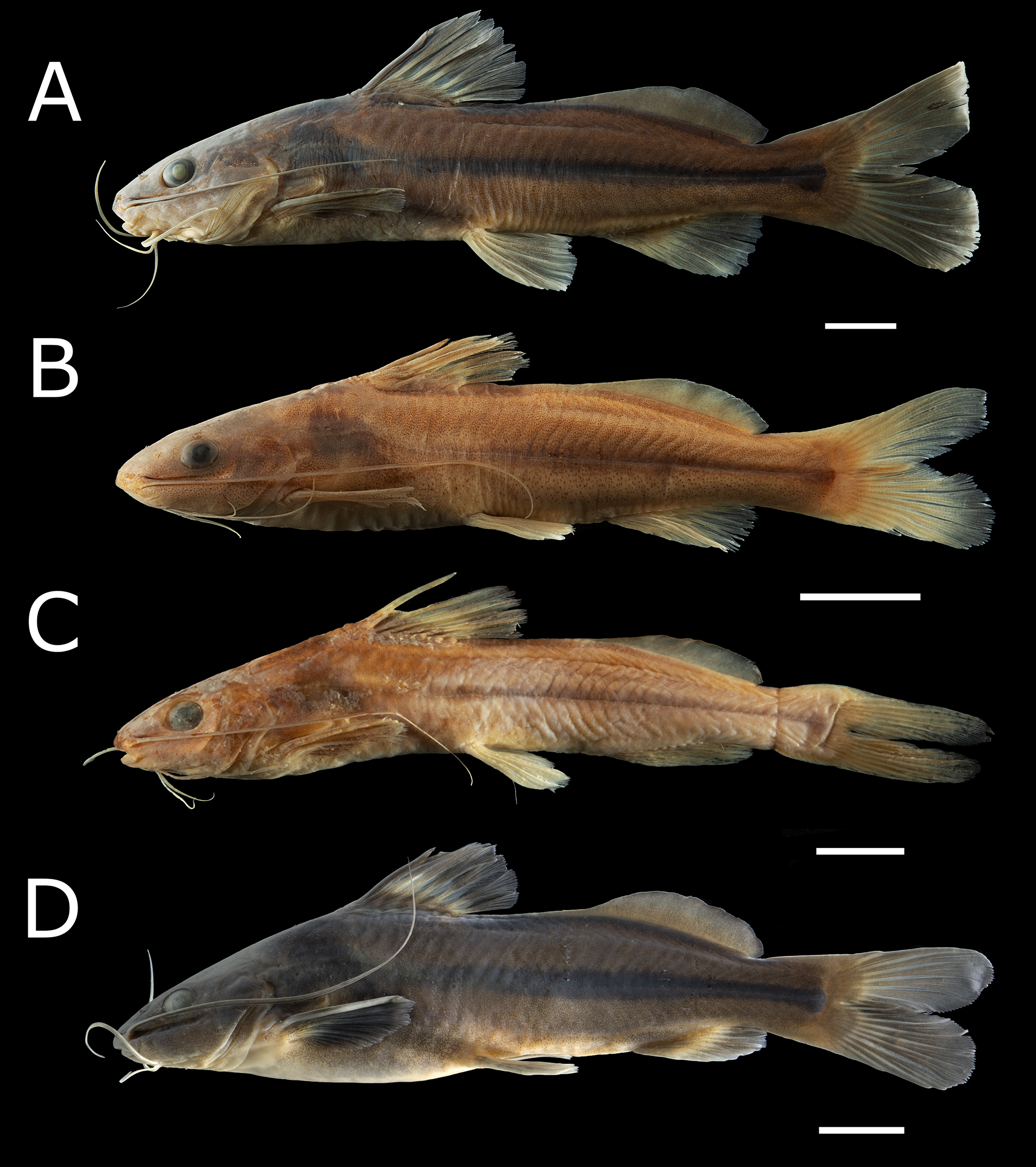
FIGURE 2 | Left lateral view of comparative material of Pimelodella straminea. A. CI-FML 7974, 105.72 mm SL, Argentina, Tucumán, Marapa River, 27°38’09.36”S 65°44’39.55”W. B. CI-FML 1260, 62.7 mm SL, Argentina, Salta, Clavizán River, 26°01’S 65°23’W. C. CI-FML 6193, 75.5 mm SL, Argentina, Buenos Aires, Chascomús, Paraná-La Plata basin, 35°35’23.5”S 58°01’29.3”W. D. MACN-ict 12850, 87.7 mm SL, Argentina, Buenos Aires, Partido de coronel Rosales, Sauce grande River, 38°52’54.5”S 61°35’59.0”W.
Pseudotympanum large, oval, dorsal to posterior process of cleithrum, reaching the straight line of 6th (3) or 7th (2*) vertebrae. Cleithrum posterior process triangular, short, dorsal border slightly concave. Anus and urogenital papilla adjacent. Urogenital papilla tubular, triangular, short. Anus between verticals through adpressed pelvic fin half and last third; urogenital papilla between verticals through adpressed pelvic fin second third and terminus.
Head conical. Mouth subterminal, upper jaw slightly more pronounced than lower jaw. Premaxilla with four or five rows of villiform teeth and dentary with three or four rows of similar teeth. Anterior naris tubular. Posterior naris rounded, slightly closer to anterior ocular margin than to anterior naris, anteromedially bordered by a fleshy margin. Nares disposed in a trapezoidal arrangement. Barbels thin, elliptical in cross-section. Maxillary barbel extending between pelvic-fin origin and anal-fin base first third. Outer mental barbel slightly surpassing pectoral-fin insertion, when stretched parallel to main body axis. Inner mental barbel reaching sutures of the pectoral girdle, when stretched parallel to main body axis. Eye placed dorsolaterally, slightly elliptical, its greatest diameter along horizontal axis. Eye limits well-defined by free orbital rim. Supraoccipital process subrectangular in shape and long, usually reaching anterior nuchal plate (if not reaching, a short gap, less than 20% supraoccipital process length). Branchiostegal membranes almost entirely free, united to isthmus only at medial apex, not joined to each other anteriorly. Branchiostegal rays six (6). Gill rakers on first gill arch 7(7), 8(12) or 9(12); 5(2) or 6(3) gill rakers on ceratobranchial anterior margin, one (2) or two (3) on epibranchial (verified in seven c&s specimen).
Dorsal-fin triangular, distal margin slightly convex, short (first branched dorsal-fin ray four and half to five and half times in SL), adpressed terminus reaching between verticals through adpressed pelvic fin first sixth and last fifth. Dorsal fin with spinelet, spine, and five (1), six (29*) or seven (1) branched rays, originating approximately dorsal to posterior end of pseudotympanum. Spinelet large with wide base, slightly rounded distal tip. Dorsal-fin spine straight, slender, pungent, shorter than first branched ray (11.6–19.7 vs. 15.8–22.1% of SL, respectively), slightly curved towards distal end. Dorsal spine anterior and posterior margin smooth. Anteriormost dorsal-fin pterygiophore inserted posterior to vertebrae 4 neural spine of complex vertebra; posteriormost dorsal-fin pterygiophore located anterior to vertebra 10(2) or 11(13*) neural spine.
Pectoral-fin with distal margin slightly convex, consisting in one unbranched and seven (12), eight (18*), or rarely nine (1) branched rays. First pectoral-fin ray curved with basal portion ossified, forming a spine, distal tip flexible, segmented. Pectoral-fin spine anterior margin with small straight dentations from basal portion to distal third, plus 3 or 5 distal serrations; pectoral-fin spine posterior margin with 6–11 retrorse dentations, extending along its basal two-thirds or three-quarters (Fig. 3); dentations moderate to large (depth half the spine shaft depth).
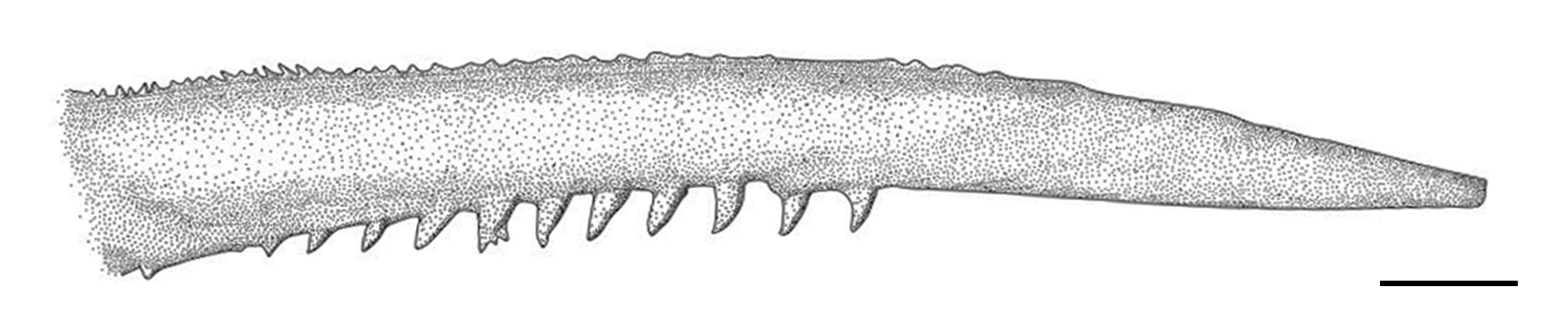
FIGURE 3 | Ventral view of pectoral-fin spine of Pimelodella straminea (left side), CI-FML 7997, 67.7 mm SL. Scale bar = 1 mm.
Pelvic fin with distal margin convex. Pelvic-fin origin at vertical through dorsal-fin terminus or slightly posterior. Adpressed pelvic fin tip surpassing vertical through adipose-fin origin, not exceeding base first fourth. Pelvic-fin rays i,5(31); first ray distinctly shorter than second and third rays (first and second branched rays, respectively).
Anal-fin margin rounded, with iv or v,7(2), 8(20), 9(8) or 10(1) branched rays. Two or three anteriormost anal-fin rays embedded in a thick skin fold. Anal-fin origin between verticals through adipose-fin base anterior fourth to middle. Anal-fin adpressed terminus between verticals through adipose-fin base 90 and 95%. Anteriormost anal-fin pterygiophore tip inserted immediately posterior to vertebra haemal spine 20(1), 21(9), 22(3) or 23(2). Posteriormost anal-fin pterygiophore tip inserted immediately anterior to vertebra haemal spine 27(1), 28(2), 29(9), or 30(4).
Adipose-fin short (23.2–31.0% of SL), slightly more than three and half to four times in SL, forming ascending curve in lateral profile with deepest point approximately at vertical through anal-fin terminus. Adipose-fin posterior limit as a rounded, free lobe. Adipose fin origin posterior to mid-length of trunk, approximately at vertical through vertebral centrum 19(3), 20(2), 21(3), or 22(4). Adipose-fin terminus at vertical through vertebral centrum 32(2), 33(3), 34(5), 35(2) or 36(1).
Caudal-fin deeply forked, dorsal caudal-fin lobe slightly longer than ventral lobe, both lobes with rounded tips. Dorsal lobe with one unbranched and six (3*), seven (26), or eight (1) branched principal rays. Ventral lobe with one unbranched and six (1*), seven (3), eight (27) or nine (1) branched principal rays. Seven rays articulated to dorsal caudal-fin plate (five to hypurals 3+4 and two to hypural 5), and seven (5), eight (2) or nine (1) rays articulated to ventral caudal-fin plate (five or six to hypurals 1+2 and two to parhypural). Parhypural not fused to hypurals 1 and 2. Hypurals 1 and 2 completely fused into single caudal plate. Hypurals 3 and 4 completely fused. Hypural 5 free. Middle caudal-fin ray of dorsal lobe not articulated to caudal plate. Total vertebrae 38(2), 39(9), 40(6*), rarely 41(2). Ribs eight (11*), nine (5), rarely ten (1).
Laterosensory system with non-dendritic branches and simple pores. Supraorbital canal(s) with seven branches: s1, s2, s3, s4, s6 (epiphyseal), s7, and s8 (parietal). Branch s1 located anteromedial to anterior nare. Branch s2 at dorsolateral of short membranous tube on internarial space (slightly closer to anterior nare), complex with the second infraorbital branch (s2 + i2). Branches s3 and s4 emerging from canal segment passing through nasal bone, at vertical anterior to the sutures between the mesethmoid and frontal bones. Contralateral epiphyseal branches of supraorbital canal (s6) not fused, anterior to epiphyseal bar, at posterior margin of anterior fontanel. Branches s7 and s8 emerging at the posterior portion of frontal bone. Supraorbital and infraorbital (i) canals connected posterior to the anterior nare in complex branch s2+i2, and at the sphenotic. Branch i1 located posterior to anterior nare, slightly close to the maxillary barbel. Branch i3 lateral to posterior nare. Branch i4 adjacent to ventral margin of eye, at vertical through anterior ocular margin. Branch i5 just ventral to eye, at end of posteroventrally directed membranous tube. Branch i6 placed posterior to eye, at end of posteriorly directed membranous tube. Preoperculomandibular canal (pm) with 11 sensory branches and pores, emerging from canal associated to the dentary, at dentary-preopercle contact, and at the preopercle. Last preopercular branch complex with first postotic branch, opening in a po1+pm11 pore. Postotic canal (po) with three sensory branches opening in pores. Branch po2 emerging from a posteriorly directed membranous tube, dorsally to dorsal corner of branchial opening. Branch po3 at end of posteriorly directed membranous tube, dorsal to lateral line canal of trunk, and dorsal to pectoral-fin base. Lateral line canal of trunk long, with a pronounced dorsal curvature bordering the pseudotympanum, extending to basal third of interradial membrane between medial caudal-fin rays.
Coloration in alcohol. Background body coloration yellowish. Ventral region of head and body lighter. Dorsal surface of head with dense concentration of dark brown chromatophores, extending from snout tip to base of the supraoccipital process. Dorsal surface of maxillary barbel darker than ventral surface. Mental barbels yellow. Supraoccipital process with dark paired lateral stripes, which delimit its extension until its connection with the nuchal plate, and another paired dorsolateral stripe near dorsal-fin base. Dorsal-fin base darkly pigmented, from spine to posteriormost interradial membrane. Hyaline stripe distal to dorsal-fin base extending until less than half dorsal-fin extension, but not encompassing dorsal-fin spine. Distal half of dorsal fin dusky. Space between dorsal and adipose fins with a dense dark concentration of chromatophores, forming a dark saddle. Adipose-fin base darkly pigmented throughout its entire extension. Dark oblique spot, extending from operculum to vertical line through the second branched ray of dorsal fin; completely covering the pseudotympanum. Brown midlateral stripe wide, originating at snout, diffusely coalescent with pseudotympanum spot anteriorly, but well-defined posterior to vertical line through half dorsal-fin base. This stripe runs posteriorly until caudal-fin base. Pectoral, adipose, anal, and pelvic fins mostly with sparse dark brown chromatophores distributed along fin rays. Ventral lobe of caudal-fin slightly dark, pigmented only along fin-rays (Figs. 1–2).
Geographical distribution. Pimelodella straminea was described from Rio Grande do Sul State, Brazil, probably rio Jacuí, in Laguna dos Patos system. The species present a wide geographical distribution, occurring in several water bodies in Southern South America, from Northern Paraguay to mid-Argentina, present also in Uruguayan and Brazilian streams. Thus, the species occur in the main channel or tributaries of the Salado, Salí-Dulce, Primero, San Juan, Tercero, Cuarto, Quinto, lower Paraná, Sauce Grande, Sauce Chico, Quequén Grande, Laguna dos Patos, and Uruguay river basins (Fig. 4). The examined material identified as P. straminea and analyzed in the present study is listed in S2.

FIGURE 4 | Distribution map of Pimelodella straminea: lectotype (white star), paralectotypes (white diamond) and additional material examined (white circles). Junior synonyms of P. straminea: P. australis, holotype (purple triangle) and paratypes (purple pentagons); P. garbei, lectotype (pink hexagon) and paralectotypes (pink square); P. laticeps, paratypes (yellow cross) and non-types (yellow trapezoid).
Morphometric analysis. The morphometric variation of the Pimelodella species examined from the PCA shows four distinct groupings, the first grouping composed of type specimens of P. straminea + P. laticeps + P. australis + P. garbei greatly superimposed, and the remaining comparative material, attributed to P. straminea, partly superimposed in this grouping. The second, third, and fourth groupings were composed of the specimens of P. gracilis, P. mucosa, and P. longibarbata (Fig. 5A). When the analysis was repeated using the transformed components (‘PCA 1’), a highly concordant scatter plot was obtained (isomorphic) to the pattern observed in the original analysis (Figs. 5A, B). When comparing the classification of individuals in three classes along of the first original component (size) and the transformed component (size + shape), a high stability of the method was evident, where approximately 84% of the individuals remained in the same class, showing a consistent ordering by size even after the incorporation of shape (Tab. 2).

FIGURE 5 | A. Scatter plot ofprincipal component analysis (PCA 1 and PCA 2). B. Scatter plot of sheared components I and II (‘PCA 1’). Pimelodella straminea (black asterisk), its junior synonyms P. australis (gray squares), P. garbei (blue circles), P. laticeps (orange cross), P. mucosa (green inverted triangle and diamond), P. longibarbata (red x) and P. gracilis (cyan triangle). Asterisk refers to the type material.
TABLE 2 | Cross-validation matrix showing the classification of individuals into three classes (low, medium, and high) along the original first principal component and the transformed component. Individuals who maintain stability in bold.
| ‘PCA 1’ transformed (size + shape) | ||
Original PCA 1 (size) | Low | Medium | High |
Low | 15 | 2 | 0 |
Medium | 2 | 52 | 10 |
High | 0 | 2 | 23 |
The first component explained 80.9% of the variance, while the second explained 8.1% showing a cumulative variance of 89.0%. The variables of the rotation matrix with the highest value for PCA 1 were maxillary barbel length, outer barbel length, and inner barbel length. These measures clearly discriminate P. gracilis and P. mucosa from P. straminea in PCA 1. For PCA 2, the highest values were interdorsal length, caudal peduncle length posterior to the anal fin, anal-fin length, maxillary barbel length, caudal peduncle length posterior to the adipose fin, and outer barbel length, clearly separating to P. longibarbata and P. straminea (Tab. S3). Thus, P. straminea and its junior-synonyms herein proposed are separate from the other species analyzed in PCA 1 and 2.
Phylogenetic analysis. The concatenated dataset included a total of 171 terminals and 1,499 bp, 164 sequences of COI (656 bp; 272 variable sites and 258 parsimony informative) and 78 sequences of CYTB (843 bp; 404 variable sites and 379 parsimony informative). The Iss.c values were greater than Iss values, indicating the absence of saturation in all three datasets. According to the Akaike Information Criterion, the most suitable nucleotide substitution model for the COI dataset was T92+G+I with AICc = 5932.9. The overall mean of genetic distances for species of Pimelodella analyzed was 0.10 ± 0.01. Interspecific genetic distances ranged from 1.6% to 13.3% (Tab. 3). Intraspecific variation in P. straminea was from 0.004 ± 0.002.
TABLE 3 | Genetic distances among species of Pimelodella (standard error estimates in bold), based on T92+G model.
|
| 1 | 2 | 3 | 4 | 5 | 6 | 7 | 8 | 9 | 10 | 11 | 12 | 13 | 14 | 15 |
1 | Pimelodella sp. (Orinoco River) |
| 0.016 | 0.015 | 0.015 | 0.015 | 0.018 | 0.016 | 0.017 | 0.017 | 0.023 | 0.015 | 0.014 | 0.017 | 0.016 | 0.019 |
2 | Pimelodella sp. (Barama River) | 0.107 |
| 0.015 | 0.005 | 0.017 | 0.019 | 0.017 | 0.016 | 0.016 | 0.020 | 0.015 | 0.013 | 0.017 | 0.014 | 0.018 |
3 | P. modesta | 0.098 | 0.107 |
| 0.016 | 0.018 | 0.016 | 0.016 | 0.017 | 0.016 | 0.022 | 0.017 | 0.015 | 0.016 | 0.016 | 0.017 |
4 | P. metae | 0.106 | 0.016 | 0.116 |
| 0.016 | 0.017 | 0.016 | 0.016 | 0.016 | 0.020 | 0.015 | 0.013 | 0.017 | 0.014 | 0.017 |
5 | P. cf. eutaenia | 0.098 | 0.115 | 0.123 | 0.112 |
| 0.015 | 0.015 | 0.016 | 0.010 | 0.020 | 0.006 | 0.016 | 0.015 | 0.018 | 0.017 |
6 | P. straminea | 0.122 | 0.133 | 0.100 | 0.117 | 0.101 |
| 0.013 | 0.016 | 0.015 | 0.018 | 0.015 | 0.017 | 0.017 | 0.017 | 0.016 |
7 | P. lateristriga | 0.107 | 0.125 | 0.110 | 0.120 | 0.100 | 0.073 |
| 0.016 | 0.014 | 0.019 | 0.014 | 0.016 | 0.018 | 0.017 | 0.017 |
8 | P. gracilis | 0.119 | 0.115 | 0.119 | 0.110 | 0.111 | 0.101 | 0.112 |
| 0.017 | 0.010 | 0.015 | 0.014 | 0.018 | 0.015 | 0.008 |
9 | P. floridablancaensis | 0.109 | 0.110 | 0.105 | 0.107 | 0.056 | 0.099 | 0.095 | 0.123 |
| 0.021 | 0.009 | 0.016 | 0.014 | 0.017 | 0.017 |
10 | Pimelodella sp. (Piranhas River) | 0.131 | 0.118 | 0.130 | 0.115 | 0.116 | 0.100 | 0.110 | 0.049 | 0.121 |
| 0.019 | 0.016 | 0.020 | 0.018 | 0.009 |
11 | P. chagresi | 0.111 | 0.113 | 0.122 | 0.110 | 0.035 | 0.109 | 0.102 | 0.114 | 0.057 | 0.122 |
| 0.015 | 0.015 | 0.016 | 0.016 |
12 | P. bockmanni | 0.089 | 0.084 | 0.091 | 0.086 | 0.108 | 0.113 | 0.111 | 0.096 | 0.106 | 0.090 | 0.111 |
| 0.016 | 0.007 | 0.014 |
13 | P. avanhandavae | 0.115 | 0.113 | 0.110 | 0.115 | 0.099 | 0.113 | 0.125 | 0.134 | 0.088 | 0.127 | 0.108 | 0.101 |
| 0.018 | 0.016 |
14 | P. aff. cristata (Maroni River) | 0.105 | 0.092 | 0.103 | 0.090 | 0.121 | 0.116 | 0.123 | 0.107 | 0.115 | 0.103 | 0.118 | 0.029 | 0.121 |
| 0.015 |
15 | P. meeki | 0.120 | 0.120 | 0.109 | 0.114 | 0.115 | 0.098 | 0.114 | 0.036 | 0.114 | 0.033 | 0.116 | 0.083 | 0.109 | 0.094 |
|
Analyses under the parsimony criterion were done on a broad range of extended implied weighting parameters (values of K) (Goloboff, 1993; 2014). As their result were stable concerning the relationships of the group of interest, we chose a K = 12, which weights moderately against the homoplasy. For the analyzed dataset, under this value of K, an averagely homoplastic character has approximately 80% of the weight of a character with no homoplasy. Under K = 12 we found more than 10,000 most parsimonious trees (fit = 178.53684; length = 4766 steps), mostly due to the presence of multiple terminals with exactly the same data. Its strict consensus with support values expressed as GC-values (Goloboff et al., 2003), is presented in Fig 6.

FIGURE 6 | Maximum parsimony tree of Pimelodella straminea clade (yellow) based on the Cytochrome Oxidase subunit I and Cytochrome B genes. Numbers near nodes represent GC support values.
Pimelodella straminea was recovered as the sister species of P. lateristriga (Lichtenstein, 1823), both forming a clade with relatively high support (98% in ML and GC = 91 in MP). The 12 specimens of P. straminea coming from the endorheic (Salí-Dulce) and exorheic basins (San Juan, Paraná-La Plata, and Uruguay rivers) of Argentina and Brazil did form reciprocally monophyletic groups in both analyses, supported by a 100% in ML (Fig. 7) and GC = 94 in MP (Fig. 6).

FIGURE 7 | Maximum likelihood tree of Pimelodella straminea clade (yellow). Numbers near nodes represent bootstrap support values.
Material examined. Pimelodella straminea. Type series of P. straminea: ANSP 21581, lectotype (xr), 41.2 mm SL; ANSP 21583, paralectotype (xr), 44.0 mm SL; ANSP 21584, paralectotype (xr), 44.9 mm SL; ANSP 21604, paralectotype (xr), 54.7 mm SL, Brazil,Rio Grande do Sul, Laguna dos Patos system, countryside, near the mountains, 27°21’13”S 54°01’27”W. Type series of P. autralis: Brazil: FMNH 57962, holotype (xr), 76.7 mm SL, Uruguaiana, Uruguay River, 29°44’33.2”S 57°05’39.9”W. FMNH 57963, 21 paratypes, 40.5–70.8 mm SL, collected with the holotype. FMNH 57964, 16 paratypes, 39.9–63.1 mm SL, Cacequy, Ibicuhy River, into the Uruguay River, 29°53’50.8”S 54°50’28.8”W. FMNH 57965, 2 paratypes, 43.6–44.5 mm SL, Cachoeira, Jacuhy River, into Lagoa de Patos. FMNH 57966, 4 paratypes, 43.2–48.9 mm SL, Porto Alegre, Guahyba River in front of town, 30°01’49.9”S 51°14’55.7”W. Type series of P. garbei: MNRJ 923A, lectotype (xr), 62.6 mm SL, MNRJ 923, 10 paralectotypes, 47.0–59.3 mm SL, Itaqui, rio Uruguai, 29°06’58.6”S 56°33’28.7”W. MZUSP 1057, paralectotype, 52.4 mm SL; MZUSP 5280, paralectotype, 43.1 mm SL; MZUSP 5281, paralectotype, 44.6 mm SL; MZUSP 5282, paralectotype, 44.9 mm SL; MZUSP 5283, paralectotype, 47.8 mm SL; MZUSP 5284, paralectotype, 49.5 mm SL; MZUSP 5285, paralectotype, 49.3 mm SL; MZUSP 5286, paralectotype (xr), 50.3 mm SL; MZUSP 5287, paralectotype, 47.2 mm SL; MZUSP 5288, paralectotype, 48.9 mm SL; MZUSP 5289, paralectotype, 51.6 mm SL; MZUSP 5290, paralectotype, 50.8 mm SL; MZUSP 5291, paralectotype, 49.8 mm SL; MZUSP 5292, paralectotype (xr), 54.3 mm SL; MZUSP 5293, paralectotype, 57.3 mm SL; MZUSP 5494, paralectotype, 56.8 mm SL; MZUSP 5296, paralectotype, 56.5 mm SL; MZUSP 5298, paralectotype, 56.7 mm SL, Brazil, Rio Grande do Sul, Itaqui, Uruguai River, 29°8’0.0”S 56°36’0.0”W. Type series of P. laticeps: FMNH 57969, holotype (xr), 49.0 mm SL; FMNH 57970, 3 paratypes (xr), 61.5–72.7 mm SL, Paraguay,Paraguay basin, Sapucaí, 25°39’25”S 56°57’18”W.
Discussion
Pimelodella straminea and its junior synonyms have a troubled taxonomic history. Cope (1894) described this species as Rhamdella straminea for Rio Grande do Sul, Brazil. Despite the absence of a more specified locality for this species, Cope (1894:84) indicated the specimens were collected by Mr. H. H. Smith in the interior, near the mountains. According to Fowler (1915), the type locality was the Jacuhy River (= Yacuí River), Rio Grande do Sul, Brazil, although Cope (1894) did not indicate, and specimens at the ANSP lack the original author labels with this information. Nevertheless, Cope (1894:107) reports that his work added seventeen new species to the Jacuhy River, suggesting that Rhamdella straminea, one of the new species described, was also from this river.
Eigenmann (1910) transferred Rhamdella straminea to Rhamdia genus, without providing justification for this decision, and was followed by Gosline (1945), Fowler (1951), and Burgess (1989). Fowler (1915:213), besides indicating the collecting locality of Rhamdella straminea to “Rio Jacuhy”, in Rio Grande do Sul State, adds ANSP 23216 as identical to the remaining material examined by Cope. Böhlke (1984:142) included this last in the list of types of R. straminea. Malabarba (1989:143) included Rhamdella straminea in the synonymy of R. eriarcha, arguing that the species from the Lagoa dos Patos system are probably synonyms, as only one species of Rhamdella occurs in that locality. This decision was followed by Bockmann, Guazzelli (2003). Lucena, Silva (1991) followed Fowler (1951) and placed Rhamdella straminea under Rhamdia again, but Silfvergrip (1996) did not include R. straminea in his Rhamdia revision.
Bockmann, Miquelarena (2008), in their phylogenetic analysis of Rhamdella, argued that due to the presence of long maxillary barbels and difficult in delimiting the limit of the posterior fontanel, R. straminea should be placed in Pimelodella or Rhamdia, but not Rhamdella. Slobodian et al. (2017), in their examination of P. humeralis material, recognized R. straminea as a species of Pimelodella; however, they did not provide further information about that decision. Slobodian (2017), in her unpublished thesis, mentioned that Rhamdella straminea would be in fact a Pimelodella, due to the presence of the genus diagnostic characteristics (like posterior fontanel long, and supraoccipital process reaching the prenuchal plate), with the exception of ANSP 23216, added by Fowler (1915) to the type-material list, which is a Rhamdia specimen. Also, Slobodian (2017) mentioned P. straminea as probably a senior synonym of P. australis, but would not indicate synonyms before more comparative material of the Lagoa dos Patos system was examined. Thus, up until this work Pimelodella straminea was recognized as a valid species a priori, but only known from its type-material, meanwhile a more thoroughly comparison with P. australis was needed.
On the other hand, Eigenmann (1917:243) described P. laticeps for Sapucay, Paraguay based on a holotype and three paratypes from the same locality; and a new subspecies called P. laticeps australis for Uruguaiana, Rio Grande do Sul, Brazil, based on a holotype and 19 paratypes, despite including also specimens from Ibicuhy river (FMNH 57964, formerly CM 6952), Jacuhy river (FMNH 57965, formerly CM 6953), and non-specified localities in Porto Alegre (FMNH 57966, formerly CM 6954) and Rio Grande do Sul State (IUM 4876, not found), Brazil, stablishing the species for Uruguay and Lagoa dos Patos basins. According to Eigenmann (1917:244), P. australis could be distinguished from P. laticeps by having longer maxillary barbel (i.e., maxillary barbel extending between middle part or end of anal-fin base in P. australis vs. reaching tip of depressed dorsal fin or slightly beyond it in P. laticeps), and being lighter in color, with the dorsal stripe interrupted at the dorsal plate and at posterior limit of dorsal-fin, besides a supraoccipital process lighter than the area bordering it. Both Guazzelli (1997) and Bockmann (1998) proposed elevating Pimelodella laticeps australis to the species rank as P. australis, which was formally published in Bockmann, Guazzelli (2003).
Miranda Ribeiro (1918) described P. garbei based on 36 specimens collected from Itaquí, Rio Grande do Sul, Brazil, probably in the Uruguay River. Posteriorly, Miranda Ribeiro (1953) designated the lectotype and paralectotypes from the type series. In her dissertation, Guazzelli (1997) suggested P. garbei was a junior synonym of P. australis, an act formally published by Bockmann, Guazzelli (2003). Finally, Pimelodella portalegrensis was used by E. Ahl on the label of specimens ZMB 7437 and ZMB 25128, previously identified as P. lateristriga. Silfvergrip, Paepke (1997:172) in their Catalogue of types from the Zoological Museum of Berlin, indicated that this species was never formally described, and was a nomen nudum. They also indicated that ZMB 25128 was reassigned to ZMB 32030, but the latter number is identical to that used for the holotype of Pimelodella conquetaensis Ahl, 1925 (Silfvergrip, Paepke, 1997:166, 172).
Traditionally, P. straminea specimens deposited in biological collections have been assigned different names based on their hydrogeographic distribution. The specimens from the Paraguay, Paraná, and La Plata river basins were identified under the name “P. laticeps” (e.g.,list of fish species of Ringuelet et al., 1967; López et al., 1981, 1982, 2003; Litz, Koerber, 2014; Mirande, Koeber, 2015; Koeber et al., 2017). In contrast, individuals from the Uruguay River basin and the Laguna dos Patos system were recognized as “P. australis” (e.g.,Fowler, 1915; Malabarba, 1989; Volcan et al., 2012; Litz, Koerber 2014; Bertaco et al., 2016; Nión et al., 2016). However, P. straminea was known only from the type material, and the name was not used in scientific collections.
When examining the type series of the aforementioned species and specimens deposited in the ichthyological collections of Argentina and Brazil, we found morphological similarity between specimens assigned to both P. australis (and its junior synonym, P. garbei) and P. laticeps, consistent with the description of P. straminea. Morphometric measurements and genetic sequences allowed us to demonstrate an overlap in morphometric traits (Fig. 5) and genetic nesting for the different populations of “P. australis” and “P. laticeps” from endorheic (Salí-Dulce) and exorheic (San Juan, Paraná-La Plata and Uruguay rivers) basins of both countries (Figs. 6; Tab. S1). Thus, we propose P. australis, P. laticeps, and reiterate P. garbei as junior synonyms of P. straminea,whichhas temporal priority over the other species, according to Article 23.1 of the International Code of Zoological Nomenclature (ICZN, 1999). We also hereby designate ANSP 21581 as the lectotype of P. straminea, and ANSP 21582–84 and 21604 as paralectotypes. The specimen of ANSP 23216 should not be included on the type-material list, as it apparently was not examined by Cope (1894), who explicitly cites five specimens, and corresponds to a Rhamdia specimen.
We conclude that the lack of rigorous taxonomic studies for the recognition of Pimelodella species has led to numerous specimens being indeterminate at the species level or misidentified (e.g., Aguilera, Azpelicueta, 2015; Pierre, Slobodian, 2024). To such an extent that some authors have suggested that the distribution of P. straminea for the Andean Cuyan biogeographic province (Arratia et al., 1983; López et al., 2008), is due to introduction processes that could be linked to attempts by fishermen to increase the food supply for ichthyophagous species of sporting interest (García et al., 2018; Valenzuela et al., 2024). However, we consider that the presence of P. straminea in rivers such as the Sali-Dulce, Primero, San Juan, Quinto, Sauce Grande, Sauce Chico and Quequén Grande, is a natural distribution pattern, consistent with that observed in Psalidodon eigenmanniorum (Cope, 1894), Cheirodon interruptus (Jenyns, 1842), Jenynsia obscura (Weyenbergh, 1877), Oligosarcus jenynsii (Günther, 1864), and Trichomycterus corduvensis Weyenbergh, 1877, which are shared between the Andean Cuyan, Pampean, and Great Rivers provinces (Arratia et al., 1983; López et al., 2008; Acosta et al., 2013), supporting the clear relationships of the Parano-Platense fauna (Arratia et al., 1983; López et al., 2008). In conclusion, we argue that the confusion regarding the available names for Pimelodella species from southern South America stems from a poorly described species (Pimelodella straminea), combined with the absence of large-scale revisionary works based on substantial comparative material. We reiterate that the examination of numerous comparative specimens is essential for resolving the taxonomic problems associated with broadly distributed species, such as many within Pimelodella.
Comparative material examined. Pimelodella gracilis. Argentina: Paraná-La Plata basin: MNHN A-9284, syntype (xr), 170.1 mm SL, “Corrientes dans le Parana et les autres rivières au-dessus de 28° de latitud sud”, 28°00’47”S 58°49’52”W. MACN-ict 2471, 1, 92.8 mm SL, Entre Rios, Paraná Guazú River (long stretch), ca. 33°54’30.1”S 58°52’59.7”W, Feb 1940, Sr. A. Nani & F. Gneri. MACN-ict 2644, 1, 82.8 mm SL, Santa Fe, Rosario, Paraná River, M.A.N estación de piscicultura de Rosario, ca. 32°54’40.9”S 60°40’29.9”W. MACN-ict-3074, 5, 63.0–94.6 mm SL, Santa Fe, Rosario, Paraná River, ca. 32°54’42.7”S 60°40’10.3”W, Sr. S. Siciliano. MACN-ict 3114, 9, 40.7–96.8 mm SL, Entre Rios, Victoria, Charigüe stream (old Paraná), 32°56’10”S 60°36’07”W, 1942, Sr. S. Siciliano. MACN-ict 3153, 3, 79.4–90.1 mm SL, Santa Fe, Island surrounding the city of Santa Fe, Jul 1937, A. Nani & E. Balech. MACN-ict 3229, 8, 58.4–105.1 mm SL, Santa Fe, Rosario, Paraná River, ca. 32°54’42.7”S 60°40’10.3”W, Mar 1944, S. Siciliano. MACN-ict 4633, 1, 88.3 mm SL, Corrientes, estero Santa Lucia Manantiales, 27°42’03.0”S 57°30’00.1”W, Jul 1959, I. Apostol. MACN-ict 5240, 4, 58.5–85.3 mm SL, Entre Rios, Gualeyán River, aprox. 32°58’20.3”S 58°30’57.3”W, 20 Jan 1964, R. López. MACN-ict 6042, 1, 68.7 mm SL, Buenos Aires, de La Plata River (Obras Sanitarias de la Nación – O.S.N), 34°32’50.6”S 58°25’33.0”W, 7 Sep 1966, R. López & H. Castello. MACN-ict 6374, 5, 97.9–121.2 mm SL, Entre Rios, Paraná Guazú River, ca. 33°54’30.1”S 58°52’59.7”W, 13 May 1969, E. Grancelli. MACN-ict 6724, 1, 78.8 mm SL, Entre Rios, Naucas stream, Apr 1974, F. Santos & Castelli. MACN-ict 6775, 11, 44.5–74.4 mm SL, Santa Fe, Colastiné River, ca. 31°37’03.8”S 60°33’07.3”W, 15 Aug 1930, A. Carcelles & Zotta. MACN-ict 7092, 9, 67.0–105.6 mm SL, Santa Fe, Helvecia, San Javier River, 31°06’09.2”S 60°04’55.5”W, Dec 1974, H. Castello. MACN-ict 7369, 4, 62.1–88.7 mm SL, Corrientes, Itati, Corza-Cué, Paraná River, ca. 27°20’28.9”S 57°55’49.3”W, 20 Jul 1977, F. Santos. MACN-ict 8256, 2, 79.7–93.6 mm SL, Buenos Aires, de La Plata River (Obras Sanitarias de la Nación – O.S.N), 34°32’50.6”S 58°25’33.0”W, 22 Dec 1964 to 16 Jan 1965, R. López & H. Castello. MACN-ict 8263, 2, 46.8–49.7 mm SL, Misiones, Yabebiri River, aprox. 27°17’04.9”S 55°31’59.1”W, 27 Jan 1982, H. Castello. MACN-ict 8267, 1, 84.9 mm SL, Buenos Aires, de la Plata River, port of Buenos Aires, ca. 34°35’26.2”S 58°21’28.5”W, 29 Dec 1985, F. Fraga. MACN-ict 9569, 1, 91.4 mm SL, Entre Rios, Victoria, Paraná River, 32°37’22.2”S 60°09’26.5”W, 20 Feb 2010, J. Casciotta et al. MACN-ict 9576, 1, 93.9 mm SL, Entre Rios, Victoria, Paraná River, 32°37’22.2”S 60°09’26.5”W, 20 Feb 2010, J. Casciotta et al. MACN-ict 9632, 1, 109.6 mm SL, Entre Rios, Victoria, Paraná River, 32°37’22.2”S 60°09’26.5”W, 20 Feb 2010, J. Casciotta et al. MACN-ict 9633, 1, 163.9 mm SL, Corrientes, Ituzaingo, Paraná River, 27°35’18.6”S 56°41’28.4”W, 23 Nov 2009, Casciotta et al. MACN-ict 10895, 2, 36.8–41.1 mm SL, Corrientes, Bella Vista, Paraná River, 28°30’30.1”S 59°03’07.6”W, 4 Nov 1995, G. López & Bentos. MACN-ict 11491, 1, 154.3 mm SL, Entre Rios, La Paz, 30°44’26.0”S 59°38’40.0”W, Feb 1997, M. Drioli. MACN-ict 12690, 1, 100.4 mm SL, Misiones, Iguazu Falls, Parque Nacional Iguazú, Iguazú River in Puerto Macuco, 25°38’30’’S 54°27’59.4’’W, 3 Mar 2017, A. Almirón et al. MLP-Ict 2246, 3, 99.4–105.1 mm SL, Buenos Aires, San Pedro, Paraná River, aprox. 33°40’23.9”S 59°38’55.7”W, 28 Mar 1937, Palavicini, Ex M.L.P nº 1-x-37-24. MLP-Ict 4417, 3, 82.2–87.5 mm SL, Buenos Aires, San Pedro, Paraná River, 33°40’23.9”S 59°38’55.7”W, 9 Nov 1946, F. Risso, Ex MLP nº 17-xi-96-46-45. MLP-Ict 5154, 1, 94.7 mm SL, Buenos Aires, San Nicolas, Paso del Tonelero, 33°24’59.4”S 60°05’33.2”W, 22 Sep 1948, E. Mac. Donagh, Ex MLP nº 1-ix-48-18. MLP-Ict 5266, 27, 59.9–93.3 mm SL, Corrientes, Goya, 29°08’38.2”S 59°15’59.9”W, Exp. Museo (M. Galvan & E. Martin), 13 Dec 1949, Ex MLP nº 2-i-49-13. MLP-Ict 5271, 1, 79.9 mm SL, Buenos Aires, Isla Rebechi, Paraná Mini, 34°11’35.0”S 58°29’15.1”W, 13 Dec 1948, Exp. Museo (M. Galvan & E. martin), Ex MLP nº 2-I-49-16. MLP-Ict 5302, 2, 74.4–78.1 mm SL, Corrientes, Goya, 29°08’38.2”S 59°15’59.9”W, 15 Dec 1948, Exp. Museo (M. Galvan & E. martin), Ex MLP nº 1-ii-49-4. MLP-Ict 5470, 1, 116.9 mm SL, Buenos Aires, San Nicolas, 10 Apr 1949, R. Aramburu, Ex MLP nº 2-vi-49-2. MLP-Ict 6778, 9, 31.7–88.5 mm SL, Santa Fe, Setúbal lagoon, 31°35’00.2”S 60°36’59.2”W, 15 Jul 1960, M. Galvan & E. Martin, Ex MLP nº 11-vii-60-8. MLP-Ict 8050, 1, 75.1 mm SL, Chaco, Resistencia, Negro River, Nautical field, 27°28’04.2”S 58°53’49.2”W, 5 Dic 1966, M. Galván, Ex MLP nº 6-VI-68-3. MLP-Ict 9149, 5, 78.3–100.8 mm SL, Santa Fe, Reconquista, Paraná Mini, 34°11’35.0”S 58°29’15.1”W, Jul 1948, Ex MLP nº 1-ii-49-37. MLP-Ict 9305, 1, 91.0 mm SL, Corrientes, Paraná River, 27°28’12.3”S 58°51’35.8”W, Jul 1997, A. D. Chambrier. MLP-Ict 9311, 1, 73.2 mm SL, Entre Rios, Ibicuycito, 33°50’06.0”S 58°52’36.7”W, R. Castillo, Ex MLP nº 1-xi-43-50. MLP-Ict 9312, 41, 34.4–88.3 mm SL, Santa Fe, South of San Jose del Rincon, Colorado stream, 14 Jul 1960, M. Galván and E. Martin, Ex MLP nº 10-vii-60-36. MLP-Ict 9551, 18, 64.7–89.8 mm SL, Corrientes, Carrizal stream, Bella vista, 6 Nov 1985, A. Almirón & J. Casciotta. MLP-Ict 9552, 3, 50.3–83.0 mm SL, Corrientes, Carrizal stream, Bella vista, R. Menni & H. López. MLP-Ict 9553, 3, 75.2–85.1 mm SL, Corrientes, Carrizal stream, Bella vista, 3 Nov 1985, A. Almiron & J. Casciotta. MLP-Ict 9554, 2, 60.0–61.1 mm SL, Corrientes, Carrizal stream, Bella vista, Jul 1981, C. Darrieo, M. Martinez & G. Soave. MLP-Ict 9560, 4, 46.0–51.8 mm SL, Corrientes, Santa Lucia River, Paso Naranjito, 28°20’04.6”S 58°27’35.9”W, 4 Feb 1976, Curso Zoología de Vertebrados. MLP-Ict 9561, 10, 48.4–59.6 mm SL, Corrientes, Santa Lucia River, Nov 1983, A. Almiron & J. Casciotta. MLP-Ict 10546, 22, 63.2–100.5 mm SL, Entre Rios, Balneario de Villaguay, Villaguay stream, 31°51’56.2”S 59°00’09.3”W, 6 Nov 2004, A. Miquelarena, L. Protogino, J. Mantinian & E. Etcheverry. MLP-Ict 10568, 39, 54.7–92.0 mm SL, Entre Rios, Villaguay, Gualeguay River and balsa San Justo, 31°54’48’’S 59°05’59.8’’W, 24 Oct 2008, A. Miquelarena, L. Protogino, J. Mantinian & E. Etcheverry. MLP-Ict 10589, 4, 92.6–112.3 mm SL, Entre Rios, Villaguay, Bergara stream, under the railway bridge, 31°56’S 58°59’W, 23 Oct 2008, A. Miquelarena, L. Protogino, J. Mantinian & E. Etcheverry. MLP-Ict 10604, 3, 52.7–71.8 mm SL, Entre Rios, Villaguay, Gualeguay River, golf course, 31°51’32.4’’S 59°07’40.7’’W, 24 Oct 2008, A. Miquelarena, L. Protogino, J. Mantinian & E. Etcheverry. MLP-Ict 10636, 12, 40.1–85.6 mm SL, Entre Rios, Tala, NN stream on Provincial Route 6, 27 Oct 2008, A. Miquelarena, L. Protogino, J. Mantinian, E. Etcheverry & J. Arias. MLP-Ict 11940, 1, 78.0 mm SL, Corrientes, Ita Ibaté, Tillita stream, tributary of Paraná River, 26 Mar 2010. MLP-Ict 11941, 12, 55.4–94.4 mm SL, Corrientes, Ita Ibaté, 27°25’43.4”S 57°20’17.4”W, 22 to 23 Mar 2009. Uruguay basin: MACN-ict 6429, 1, 81.3 mm SL, Entre Rios, outlet of the Gualeguaychú River with the Uruguay River, 33°04’14.1”S 58°26’25.5”W, 13 Oct 1972, R. Barbetti. MLP-Ict 4888, 7, 42.4–72.8 mm SL, Entre Rios, Gualeguaychú River, 14 to 15 Jul 1947, R. A. Ringuelet, E. Rizzo, M. Galvan & C. Danori, Ex MLP nº 6-vi-47-22. Brazil: Paraná River basin: MZUSP 2250, 1, 108.3 mm SL, São Paulo, Piracicaba, Piracicaba River, 22°41’21.6”S 47°41’12.6”W. MZUSP 22153, 1, 121.7 mm SL, São Paulo, Piracicaba, 22°41’0.0”S 47°51’0.0”W. MZUSP 82381, 1, 117.2 mm SL, São Paulo, Porto Cabral, Parana River ́, 22°15’0.0”S 52°30’0.0”W. Paraguay River basin: MZUSP 23195, 1, 189.7 mm SL, Mato Grosso, Taquari River, about 150 km from Coxim county, 18°13’0.0”S 55°10’0.0”W. MZUSP 24856, 2, 106.1–115.7 mm SL, Mato Grosso, Cuiabá, Cuiaba River, ca. 500 m below the bridge, 15°37’0.0”S 56°6’0.0”W. MZUSP 27728, 3, 135.1–202.7 mm SL, Mato Grosso do Sul, Coxim, Taquari River, 18°30’0.0”S 54°45’0.0”W. MZUSP 28571, 2, 78.1–86.3 mm SL, Mato Grosso do Sul, Coxim, Taquari River, near Coxim county, 18°30’0.0”S 54°45’0.0”W.MZUSP 38033, 7, 59.9–71.1 mm SL, Mato Grosso do Sul, Corumba, Paraguai River, Morrinhos, 19°0’0.0”S 57°39’0.0”W. MZUSP 87788, 1, 148 mm SL, Mato Grosso, Sepotuba River, Salto Maciel Tangará da Serra, 15°55’59.0”S 57°39’0.0”W. Uruguay basin: FMNH 57948, 1 c&s, 111.9 mm SL, Uruguaiana, 29°44’56.8”S 57°05’45.6”W. Paraguay: MACN-ict 7276, 3, 84.0–84.6 mm SL, Itapúa, Hohenau 1, Club de Caza y Pesca de Hohenau, Paraná River, 27°08’51.5”S 55°34’03.8”W, 14 Nov 1981, H. P. Castello. MACN-ict-7720, 7, 63.4–81.7 mm SL, Itapúa, Hohenau 1, Club de Caza y Pesca de Hohenau, Paraná River, 27°08’51.5”S 55°34’03.8”W, 14 Nov 1981, H. P. Castello. MACN-ict 7721, 5, 100.7–147.2 mm SL, Itapúa, Hohenau 1, Club de Caza y Pesca de Hohenau, Paraná River, 27°08’51.5”S 55°34’03.8”W, 14 Nov 1981, H. P. Castello. MACN-ict 7985, 2, 69.9–71.8 mm SL, Itapúa, Encarnación, Pacú Cuá, Paraná River, 27°23’40.5”S 55°49’37.6”W, 15 Nov 1981, H. P. Castello. MLP-Ict 7559, 5, 42.7–55.7 mm SL, Formosa, Sep 1962, A. Arriguti, Ex MLP nº 8-ix-62-14. MLP-Ict 11874, 1, 61.9 mm SL, Alto Paraguay, km 1249, Bahia Negra, 20°13’33.4”S 58°10’11.0”W, 24 Oct 1992, H. López, H. Calandra & C. Darrieu. USNM 232282, xr, 64.4–76.4 mm SL, lago Ypacarai, 63 km W of Military Base at San Bernardino, 25°21’00.9”S 57°17’06.8”W. USNM 232283, xr, 91.2 mm SL, Alto Parana Dept., Puerto Bemone on Paraná River, 24°52’32.9”S 54°25’34.4”W. Uruguay: Uruguay River basin: ANSP 203154, 15, 60.7–109.7 mm SL, Nuevo Berlin, Uruguay River, Río de La Plata drainage, 32°58’33.3”S 58°04’00.8”W. ANSP 203155, 1, 72.9 mm SL, Uruguay River, Río de La Plata drainage, 34°47’35.5”S 56°26’56.6”W. ANSP 203156, 1, 57.3 mm SL, Uruguay, Uruguay River, Río de La Plata drainage, 34°47’35.5”S 56°26’56.6”W.
Pimelodella mucosa. Paraguay: Paraguay basin: CAS 63720, holotype (xr), 97.4 mm SL, Río Paraguay, Bahia Negra on west bank, 20°13’47”S 58°09’54”W. CI-FML 7976 (Ex 6194), 1, 91.7 mm SL, 1 c&s, 77.9 mm SL, Alto Paraguay, Bahía Negra, Negro River, 19°57’43.8”S 58°12’06.5”W, Nov 2002, G. Aguilera & J. M. Mirande. Argentina: CI-FML 458, 25, 60.5–101.3 mm SL, 2 c&s, 67.9–85.5 mm SL, Formosa, La Salada lagoon, 24°41’48.8”S 59°50’27.3”W, 21 Sep 1951, S. A. Pierotti. CI-FML 2023, 10, 60.9–98.1 mm SL, Formosa, esteros Oca lagoon, 26°13’20.6”S 58°10’28.4”W, 16 Nov 1951, S. A. Pierotti. CI-FML 7166, 1, 60.7 mm SL, Formosa, Ingles stream, 25°44’52.2”S 57°50’23.4”W, 19 Oct 1950, Pierotti & Budin. CI-FML 7168, 3, 66.5–83.3 mm SL, Formosa, López lagoon, 24 Nov 1951, Pierotti. CI-FML 7169, 3, 67.1–71.5 mm SL, Formosa, Paraguay River, 26°09’14.0”S 58°07’19.7”W, 24 Nov 1951, Pierotti. MACN-ict 9941, 5, 38.7–93.1 mm SL, Formosa, Parque Nacional Pilcomayo, Blanca lagoon, 25°10’16.0”S 58°07’53.0”W, 16 Feb 2007, C. Baigún, F. Brancolini & P. Minotti. MACN-ict 9969, 4, 52.4–64.9 mm SL, Formosa, Parque Nacional Pilcomayo, Blanca lagoon, 25°10’16.0”S 58°07’53.0”W, 10 Oct 2007, C. Baigún, F. Brancolini & P. Minotti. MACN-ict 12704, 2, 72.6–104.1 mm SL, Formosa, La Buena Fe, Bañado La Estrella, 23°56’25.8”S 60°57’31.4”W, 29 Apr 2013, P. Firpo Lacoste. MLP-Ict 7559, 2, 57.8–60.6 mm SL, Formosa, Sep 1962, A. Arriguti, Ex MLP nº 8-ix-62-14. MLP-Ict 9555, 1, 61.3 mm SL, Formosa, Sep 1962, A. Arriguti.
Acknowledgments
Our most sincere thanks to Mariangeles Arce, Flavio Bockmann, Sergio Bogan, Marcelo Britto, Ricardo Castro, Jeff Clayton, Aléssio Datovo, André Esguícero, Michel Gianeti, Carlos Lucena, Kyle Luckenbill, John Lundberg, Caleb McMahan, Susan Mochel, Cristiano Moreira, Osvaldo Oyakawa, Carla Pavanelli, Mario de Pinna, Roberto Reis, Mark Sabaj, Kevin Swagel, and Anyelo Vanegas Ríos for providing assistance during visits at their institutions, access and loan of material, and providing information, photos and x-rays of types and comparative materials of Pimelodella. Authors also thank Karen L. Álvarez for her illustrations of the pectoral-fin spines and Alejandro M. López by photographing the specimens of P. laticeps and P. mucosa. Reproduction of photograph of the holotype and paratypes of Pimelodella laticeps (available at All Catfish Species Inventory Image Base, http://acsi.acnatsci.org/base/index.html) was kindly allowed by M. Littmann and the Division of Fishes of FMNH. VS thanks Mario de Pinna for his orientation, insights, and suggestions in her doctorate.
References
Acosta JC, Laspiur A, Blanco GM, Protogino LC, Nadalin DO. Lista de los Peces de la provincia de San Juan. La Plata: ProBiota, Serie Técnica y Didáctica nº19; 2013.
Aguilera G, Azpelicueta MM. First record of Pimelodella mucosa Eigenmann & Ward, 1907 (Siluriformes: Heptapteridae) in Formosa, Argentina and comments on the geographical distribution of P. howesi Fowler, 1940. Check List. 2015; 11(5):1–03. https://doi.org/10.15560/11.5.1757
Ahl E. Neue südamerikanische Fische aus dem Zool. Museum Berlin. Sber Ges naturf Freunde Berl. 1925; 106–09.
Angrizani RC, Malabarba LR. Genetic diversity and species delimitation in Rhamdia (Siluriformes: Heptapteridae) in South America, with a redescription of R. quelen (Quoy & Gaimard, 1824). Zootaxa. 2020; 4801(1):85–104. https://doi.org/10.11646/zootaxa.4801.1.3
Arratia G, Peñafort MB, Menu-Marque S. Peces de la región sureste de los Andes y sus probables relaciones biogeográficas actuales. Deserta. 1983; 7:48–107.
Berbel-Filho WM, Ramos TPA, Jacobina UP, Maia DJG, Torres RA, Lima SMQ. Updated checklist and DNA barcode-based species delimitations reveal taxonomic uncertainties among freshwater fishes from the mid-north-eastern Caatinga ecoregion, north-eastern Brazil. J Fish Biol. 2018; 93(2):311–23. https://doi.org/10.1111/jfb.13758
Bertaco VA, Ferrer J, Carvalho FR, Malabarba LR. Inventory of the freshwater fishes from a densely collected area in South America – a case study of the current knowledge of Neotropical fish diversity. Zootaxa. 2016; 4138(3):401–40. https://doi.org/10.11646/zootaxa.4138.3.1
Britski HA. Lista dos tipos de peixes das coleções do Departamento de Zoologia da Secretaria da Agricultura de São Paulo. Pap Avulsos Zool. 1969; 22(19):197–215.
Bockmann FA. Análise filogenética da família Heptapteridae (Teleostei, Ostariophysi, Siluriformes) e redefinições de seus gêneros. [PhD Dissertation]. São Paulo: Universidade de São Paulo; 1998.
Bockmann FA, Castro RMC. The blind catfish from the caves of Chapada Diamantina, Bahia, Brazil (Siluriformes: Heptapteridae): description, anatomy, phylogenetic relationships, natural history, and biogeography. Neotrop Ichthyol. 2010; 8(4):673–706. https://doi.org/10.1590/S1679-62252010000400001
Bockmann FA, Guazzelli GM. Heptapteridae (Heptapterids). In: Reis RE, Kullander SO, Ferraris CJ Jr, editors. Check list of the freshwater fishes of South and Central America. Porto Alegre: Edipucrs; 2003. p.406–31.
Bockmann FA, Miquelarena AM. Anatomy and phylogenetic relationships of a new catfish species from northeastern Argentina with comments on the phylogenetic relationships of the genus Rhamdella Eigenmann and Eigenmann 1888 (Siluriformes, Heptapteridae). Zootaxa. 2008; 1780(1):1–54. https://doi.org/10.11646/zootaxa.1780.1.1
Böhlke EB. Catalog of type specimens in the ichthyological collection of the Academy of Natural Sciences of Philadelphia. Proc Acad Nat Sci Phila. 1984; 14:1–216.
Burgess WE. An atlas of freshwater and marine catfishes. A preliminary survey of the Siluriformes. New Jersey: Tropical Fish Hobbyist Publications; 1989.
Castello HP. Pimelodella griffini (Pisces, Pimelodidae) nueva cita para la fauna Argentina. Consideraciones acerca de la alimentación, del sistema reproductor y de una papila urogenital en tres especies del género Pimelodella. Physis. 1969; 28(77):407–15.
Cope ED. On the fishes obtained by the Naturalist Expedition in Rio Grande do Sul. Proc Am Philos Soc. 1894; 33:84–108.
Cortés-Hernández MA, DoNascimiento C, Ramírez-Gil H. A new species of Pimelodella Eigenmann & Eigenmann, 1888 (Siluriformes: Heptapteridae) from the Orinoco River basin. Zootaxa. 2020; 4808(3):491–506. https://doi.org/10.11646/zootaxa.4808.3.5
Cortés-Hernández MA, Méndez- López A, Donascimiento C. New records of Pimelodella (Siluriformes, Heptapteridae) from Colombia for the Amazon River basin, and redescription of P. serrata. Zootaxa. 2023a; 5293(1):185–95. https://doi.org/10.11646/zootaxa.5293.1.10
Cortés-Hernández MA, López-Castaño JA, Milani N, DoNascimiento C. A new cryptic species of Imparfinis (Siluriformes: Heptapteridae) from the Orinoco River basin, revealed by an iterative approach. J Fish Biol. 2023b; 103(5):1015–30. https://doi.org/10.1111/jfb.15495
Díaz J, Villanova GV, Brancolini F, Del Pazo F, Posner VM, Grimberg A, Arranz SE. First DNA Barcode Reference Library for the Identification of South American Freshwater Fish from the Lower Paraná River. PLoS One. 2016; 11(7):e0157419. https://doi.org/10.1371/journal.pone.0157419
Edgar RC. MUSCLE: multiple sequence alignment with high accuracy and high throughput. Nucleic Acids Res. 2004; 32(5):1792–97. https://doi.org/10.1093/nar/gkh340
Eigenmann CH, Eigenmann RS. Preliminary notes on South American Nematognathi. I.Proc Calif Acad Sci. 1888; 1(2):119–72.
Eigenmann CH, McAtee WL, Ward DP. On further collections of fishes from the Paraguay. Ann Carnegie Mus. 1907; 4(2):110–57.
Eigenmann CH. Catalogue of the fresh-water fishes of tropical and south temperate America. In: Reports of the Princeton University expeditions to Patagonia 1896-1899. Zoology. Fishes Patagonia. 1910; 3(4):375–511.
Eigenmann CH. Pimelodella and Typhlobagrus. Mem Carnegie Mus. 1917; 7(4):229–58.
Faustino-Fuster DR, Meza-Vargas V, Lovejoy NR, Lujen NK. Multi-locus phylogeny with dense Guiana Shield sampling supports new suprageneric classification of the neotropical three-barbeled catfishes (Siluriformes: Heptapteridae). Mol Phylogenet Evol. 2021; 162:107186. https://doi.org/10.1016/j.ympev.2021.107186
Ferraris CJ Jr. Checklist of catfishes, recent and fossil (Osteichthyes: Siluriformes), and catalogue of siluriform primary types. Zootaxa. 2007; 1418:1–628. https://doi.org/10.11646/zootaxa.1418.1.1
Fowler HW. Notes on Nematognathous fishes. Proc Acad Nat Sci Phila. 1915; 67:203–43.
Fowler HW. Os peixes de água doce do Brasil. Volume 1. 3a entrega. Arq Zool. 1951; 6:405–628.
Fricke R, Eschmeyer WN, Van der Laan R. Eschmeyer’s catalog of fishes: genera, species, references [Internet]. San Francisco: California Academy of Science; 2026. Available from: http://researcharchive.calacademy.org/research/ichthyology/catalog/fishcatmain.asp
García MI, Acosta JC, Blanco GM, Acosta R. Nuevos registros de peces introducidos en la Cuenca del río Desaguadero en el centro-oeste de Argentina. Neotrop Biol Conserv. 2018; 13(3):268–73.
Giora J. Wingert JM. Peixes de Guaíba. Porto Alegre: Instituto de Biociencias/UFRGS; 2023.
Goloboff PA. Estimating character weights during tree searches. Cladistics. 1993; 9(1):83–91. https://doi.org/10.1111/j.1096-0031.1993.tb00209.x
Goloboff PA. Extended implied weighting. Cladistics. 2014; 30:260–72. https://doi.org/10.1111/cla.12047
Goloboff PA, Carpenter J, Arias J, Miranda-Esquivel D. Weighting against homoplasy improves phylogenetic analysis of morphological data sets. Cladistics. 2008; 24(5):758–773. https://doi.org/10.1111/j.1096-0031.2008.00209.x
Goloboff PA, Farris JS, Källersjö M, Oxelman B, Ramírez MJ, Szumik CA. Improvements to resampling measures of group support. Cladistics. 2003; 19(4):324–32. https://doi.org/10.1111/j.1096-0031.2003.tb00376.x
Goloboff PA, Morales ME. TNT version 1.6, with a graphical interface for MacOS and Linux, including new routines in parallel. Cladistics. 2023, 39(2):144–53. https://doi.org/10.1111/cla.12524
Gosline WA. Catálogo dos Nematognatos de água-doce da América do sul e central. Bol Mus Nac Zool. 1945; 33:1–138.
Guazzelli GM. Revisão das espécies de Pimelodella Eigenmann & Eigenmann 1888 (Teleostei: Siluriformes: Pimelodidae) dos sistemas costeiros do Sul e Sudeste do Brasil. [Master Thesis]. Rio Grande do Sul: Pontifícia Universidade Católica do Rio Grande do Sul; 1997.
Guazzelli GM. Relações filogenéticas do gênero Pimelodella Eigenmann & Eigenmann 1888 (Siluriformes, Pimelodidae). [PhD Dissertation]. São Paulo: Universidade de São Paulo; 2003.
Güntert H. Beschreibung einiger zum Teil noch unbekannter südamerikanischer Siluriden aus dem Naturhistorischen Museum in Basel. Zool Anz. 1942; 138(1–2):27–40.
Henn AW. List of types of fishes in the collection of the Carnegie Museum on September 1, 1928. Ann Carnegie Mus. 1928; 19(4):51–99.
Ibarra M, Stewart DJ. Catalogue of type specimens of recent fishes in Field Museum of Natural History. Fieldiana Zool. 1987; 35:1–112.
International Commission on Zoological Nomenclature (ICZN). International code of zoological nomenclature. 4th ed. London: International trust for zoological nomenclature Natural History Museum [Internet]. London; 1999. Available from: https://www.iczn.org/the-code/the-international-code-of-zoological-nomenclature
Jennings WB, Ruschi PA, Ferraro G, Quijada CC, Silva-Malanski ACG, Prosdocimi F et al. Barcoding the Neotropical freshwater fish fauna using a new pair of universal COI primers with a discussion of primer dimers and M13 primer tails. Genome. 2019; 62(2):77–83. https://doi.org/10.1139/gen-2018-0145
Koerber S, Vera-Alcaraz HS, Reis RE. Checklist of the fishes of Paraguay (CLOFPY). ICP. 2017; 53:1–99.
Lichtenstein MHC. Verzeichniss der Doubletten des zoologischen Museums der Königl. Universität zu Berlin, nebst Beschreibung vieler bisher unbekannter Arten von Säugethieren, Vögeln, Amphibian und Fishen. Berlin: T. Trautwein; 1823.
Litz TO, Koerber S. Check list of the freshwater fishes of Uruguay (CLOFF-UY). ICP. 2014; 28:1–40.
López HL, Menni RC, Ringuelet RA. Bibliografia de los peces de agua Dulce de Argentina y Uruguay 1967–1981. Biol Acuat. 1981; 1:1–81.
López HL, Menni RC, Ringuelet RA. Bibliografia de los peces de agua Dulce de Argentina y Uruguay Suplemento 1982. Biol Acuat. 1982; 3:1–23.
López HL, Miquelarena AM, Menni RC. Lista comentada de los peces continentales de la Argentina. ProBiota: Serie Técnica y Didáctica. 2003; 5:1–86.
López HL, Menni RC, Donato M, Miquelarena AM. Biogeographical revision of Argentina (Andean and Neotropical Regions): an analysis using freshwater fishes. J Biogeogr. 2008; 35(9):1564–79. https://www.jstor.org/stable/20143376
Loureiro M, González-Bergonzohl I, Mello FT. Peces de agua dulce de Uruguay. Montevideo: Universidad de la República Uruguay; 2023.
Lucena CAS, Silva JFP. Descrição de uma nova espécie do gênero Rhamdella Eigenmann & Eigenmann, 1888 (Siluriformes: Pimelodidae) para o médio rio Uruguai, sul do Brasil. Comun Mus Ciênc Tecnol PUCRS, Sér Zool. 1991; 4(3):28–47.
Lundberg JG, Baskin JN. The caudal skeleton of the catfishes, order Siluriformes. Am Mus Novit. 1969; 2398:1–49.
Malabarba LR. Histórico sistemático e lista comentada das espécies de peixes de ägua doce do sistema da Laguna dos Patos, Rio Grande do Sul, Brasil. Comun Mus Ciênc Tecnol PUCRS, Sér Zool. 1989; 2(8):107–79.
Mayer M. missRanger: Fast Imputation of Missing Values. R package v. 2.6.0. 2024. Available from: https://CRAN.R-project.org/package=missRanger
Miranda Ribeiro A. Peixes do Iporanga – S. Paulo. Resultados de excursões do Sr. Ricardo Krone, membro correspondente do Museu Nacional do Rio de Janeiro. A Lavoura SNA. 1907; 11:185–90.
Miranda-Ribeiro A. Pimelodidae, Trachycorystidae, Cetopsidae, Bunocephalidae, Auchenipteridae e Hypophthalmidae. Rio de Janeiro: Comissão de Linhas Telegraphicas Estrategicas de Matto-Grosso ao Amazonas. 1914; 15 (anexo 5):1–13.
Miranda Ribeiro A. Tres generos e dezesete especies novas de peixes Brasilieros. Rev Mus Paul. 1918; 10:631–46.
Miranda Ribeiro P. Tipos das espécies e subespécies do Prof. Alipio de Míranda Ribeiro depositados no Museu Nacional. Arq Mus Nac Rio de Janeiro. 1953; 42:389–417.
Mirande JM, Koerber S. Checklist of the freshwater fishes of Argentina (CLOFFAR). ICP. 2015; 36:1–68.
Mirande JM, Koerber S. Checklist of the freshwater fishes of Argentina (CLOFFAR-2). ICP. 2020; 72:1–81.
Nión H, Rios C, Meneses P. Peces del Uruguay: lista sistemática y nombres comunes. Montevideo: Infopesca; 2016.
Palumbi SR, Martin A, Romano S, McMillan WO, Stice L, Grabowski G. The simple fool’s guide to PCR. Honolulu: University of Hawaii; 1991.
Papa Y, Le Bail PY, Covain R. Genetic landscape clustering of a large DNA barcoding data set reveals shared patterns of genetic divergence among freshwater fishes of the Maroni Basin. Mol Ecol Resour. 2021; 21(6):2109–24. https://doi.org/10.1111/1755-0998.13402
Pereira LHG, Hanner R, Foresti F, Oliveira C. Can DNA barcoding accurately discriminate megadiverse Neotropical freshwater fish fauna? BMC Genom Data. 2013; 14:20. https://doi.org/10.1186/1471-2156-14-20
Pereira LHG, Maia GMG, Hanner R, Foresti F, Oliveira C. DNA barcodes discriminate freshwater fishes from the Paraíba do Sul River Basin, São Paulo, Brazil. Mitochondrial DNA. 2011; 22(1):71–79. https://doi.org/10.3109/19401736.2010.532213
Pierre V, Slobodian V. A new species of Pimelodella (Siluriformes: Heptapteridae) from the Paraguai basin, Brazil, with a discussion regarding its distribution. Neotrop Ichthyol. 2024; 22(1):e230110. https://doi.org/10.1590/1982-0224-2023-0110
R Development Core Team. R: a language and environment for statistical computing. Vienna, Austria: R Foundation for Statistical Computing; 2024. Available from: https://www.R-project.org/
Regan CT. Descriptions of new South- American fishes in the collection of the British Museum. Ann Mag Nat Hist. 1903; 12(72):621–30. https://doi.org/10.1080/00222930309487043
Reis RE, Malabarba LR, Lucena CA. A new species of Rhamdella Eigenmann & Eigenmann, 1888 (Siluriformes: Heptapteridae) from the coastal basins of southern Brazil. Arq Zool. 2014; 45:41–50. https://doi.org/10.11606/issn.2176-7793.v45iespp41-50
Ringuelet RA, Arámburu RH, Alonso de Arámburu AS. Los peces argentinos de agua dulce. Buenos Aires: Comisión de Investigaciones Científicas; 1967.
Rosso JJ, Mabragaña E, Castro MG, Astarloa JM. DNA barcoding Neotropical fishes: recent advances from the Pampa Plain, Argentina. Mol Ecol Resour. 2012; 12(6):999–1011. https://doi.org/10.1111/1755-0998.12010
Ruíz-Díaz FJ, Soneira P, Almirón AE, Casciotta JR, Gonzalez A, Sánchez S. First record of Pimelodella taenioptera Miranda Ribeiro, 1914 (Siluriformes, Heptapteridae) from the río Paraná above río Paraguay confluence, Argentina. ICP. 2008; 10:1–04.
Sabaj MH. Codes for Natural History Collections in Ichthyology and Herpetology (online supplement). Version 9.7; 2025. Available from: https://asih.org
Silva GSC, Roxo FF, Melo BF, Ochoa LE, Bockmann FA, Sabaj MH et al. Evolutionary history of Heptapteridae catfishes using ultraconserved elements (Teleostei, Siluriformes). Zool Scr. 2021; 50(5):543–54. https://doi.org/10.1111/zsc.12493
Silfvergrip AM. A systematic revision of the neotropical catfish genus Rhamdia (Teleostei, Pimelodidae) [PhD Dissertation]. Stockholm: Stockholm University; 1996.
Silfvergrip AMC, Paepke HJ. Kritischer Katalog der Typen der Fischsammlung des Zoologischen Museums Berlin. Teil 7: Pimelodidae (Siluriformes). Mitt Mus Naturkunde Berl Zoolog Reihe. 1997; 73(1):165–73.
Slobodian V. Taxonomic revision of Pimelodella Eigenmann & Eigenmann, 1888 (Siluriformes: Heptapteridae): an integrative proposal to delimit species using a multidisciplinary strategy. [PhD Dissertation]. São Paulo: Universidade de São Paulo; 2017.
Slobodian V, Abreu-Santos B, Pastana MNL. The rediscovery of Pimelodella longipinnis (Borodin, 1927), an enigmatic Atlantic Rainforest catfish species from Southeastern Brazil (Siluriformes: Heptapteridae). Pap Avulsos Zool. 2021; 61:e20216173. http://doi.org/10.11606/1807-0205/2021.61.73
Slobodian V, Akama A, Dutra GM. A new species of Pimelodella (Siluriformes: Heptapteridae) from the Guiana Shield, Brazil. Zootaxa. 2017; 4338(1):85–100. https://doi.org/10.11646/zootaxa.4338.1.4
Slobodian V, Bockmann FA. Phylogeny and classification of Heptapteridae (Pimelodoidea). In: Arratia G, Reis RE, editors. Catfishes, a highly diversified group. Boca Raton: CRC Press; 2025. p.248-65.
Slobodian V, Pastana MNL. Description of a new Pimelodella (Siluriformes: Heptapteridae) species with a discussion on the upper pectoral girdle homology of Siluriformes. J Fish Biol. 2018; 93(5):901–16. https://doi.org/10.1111/jfb.13795
Stamatakis A. RAxML version 8: a tool for phylogenetic analysis and post-analysis of large phylogenies. Bioinformatics. 2014; 30(9):1312–13. https://doi.org/10.1093/bioinformatics/btu033
Steindachner F. Die Süsswasserfische des südöstlichen Brasilien, III. Sitzber Preuss Akad. 1877; 74:559–694.
Sullivan JP, Muriel-Cunha J, Lundberg JG. Phylogenetic relationships and molecular dating of the major groups of catfishes of the Neotropical superfamily Pimelodoidea (Teleostei, Siluriformes). Proc Acad Nat Sci Phila. 2013; 162:89–110. http://dx.doi.org/10.1635/053.162.0106
Tamura K, Stecher G, Kumar S. MEGA11: Molecular Evolutionary Genetics Analysis Version 11. Mol Biol Evol. 2021; 38(7):3022–27. https://doi.org/10.1093/molbev/msab120
Taylor WR, Van Dyke GC. Revised procedures for staining and clearing small fishes and other vertebrates for bone and cartilage study. Cybium. 1985; 9(2):107–19.
Valenciennes A. Poissons [plates]. In: d’Orbigny A, editor. Voyage dans l’Amérique méridionale. Paris: Chez Pitois- Levrault et ce; 1835. pls.1–16.
Valenzuela AD, Fernández RD, Gómez FR, Acosta JC, Corrales LA, Acosta R, Valdez FM. Nuevos registros de Pimelodella laticeps, Eigenmann, 1917 (Siluriformes, Heptapteridae) y ampliación de su distribución occidental hacia los Andes Centrales de Argentina. Acta Zool Lilloana. 2023; 67(1):187–94. https://doi.org/10.30550/j.azl/2023.67.1/2023-04-19
Van der Stigchel JWB. A new species of pimelodid catfish from eastern Brazil, Pimelodella boschmai nov spec. Zool Meded. 1964; 39(34):327–30.
Volcan MV, Lanés LEK, Gonçalves ÂC, Fonseca AP, Cirne MP. The fish fauna of the Corrientes stream basin, Patos lagoon system, state of Rio Grande do Sul, southern Brazil. Check List. 2012; 8 (1):77–82. https://doi.org/10.15560/8.1.077
Ward RD, Zemlak TS, Innes BH, Last PR, Hebert PD. DNA barcoding Australia’s fish species. Philos Trans R Soc B Biol Sci. 2005; 360:1847–57. https://doi.org/10.1098/rstb.2005.1716
Xia X. DAMBE7: new and improved tools for data analysis in molecular biology and evolution. Mol Biol Evol. 2018; 35(6):1550–52. https://doi.org/10.1093/molbev/msy073
Authors

Miguel Ángel Cortés-Hernández1,2,3 , Veronica Slobodian4, Edna Judith Márquez Fernández5, Gastón Aguilera6 and Juan Marcos Mirande6
[1] FONCYT (Fondo para la investigación Científica y Tecnológica-Agencia Nacional de Promoción de la Investigación, el Desarrollo Tecnológico y la Innovación), Unidad Ejecutora Lillo-Fundación Miguel Lillo (CONICET-FML), San Miguel de Tucumán, Argentina. (MACH) macortes.hernandez95@gmail.com (corresponding author).
[2] Grupo de Investigación Evaluación, Manejo y Conservación de Recursos Hidrobiológicos y Pesqueros, Universidad de los Llanos, Villavicencio, Colombia.
[3] Grupo de Investigación Cuencas, Fundación Neotropical Cuencas, Arauca, Colombia.
[4] Programa de Pós-Graduação em Zoologia – UnB, Laboratório de Ictiologia Sistemática, Instituto de Ciências Biológicas, Universidade de Brasília, Campus Universitário Darcy Ribeiro, 70910-900, Brasília, DF, Brazil. (VS) vslobodian@unb.br.
[5] Laboratorio de Biología Molecular y Celular, Escuela de Biociencias, Facultad de Ciencias, Universidad Nacional de Colombia – Sede Medellín, Medellín, Colombia. (EJMF) ejmarque@unal.edu.co.
[6] Fundación Miguel Lillo – (CONICET-Unidad Ejecutora Lillo), San Miguel de Tucumán, Argentina. (GA) gaguilera@lillo.org.ar, (JMM) mcmirande@gmail.com.
Authors’ Contribution 

Miguel Ángel Cortés-Hernández: Conceptualization, Data curation, Formal analysis, Investigation, Methodology, Supervision, Writing-original draft, Writing-review and editing.
Veronica Slobodian: Conceptualization, Data curation, Resources, Validation, Writing-review and editing.
Edna Judith Márquez-Fernández: Data curation, Methodology, Software, Writing-review and editing.
Gastón Aguilera: Conceptualization, Funding acquisition, Supervision, Writing-review and editing.
Juan Marcos Mirande: Conceptualization, Formal analysis, Software, Supervision, Writing-review and editing.
Ethical Statement
This research was conducted exclusively with specimens previously deposited in museum collections. Consequently, it was not necessary to submit the study for evaluation or obtain approval from Animal Use Ethics Committees.
Competing Interests
The author declares no competing interests.
Data availability statement
The authors confirm that the data supporting the findings of this study are available within the article.
AI statement
The authors did not use any AI-assisted technologies in the creation of this manuscript or its figures.
Funding
MACH thanks the Fondo para la Investigación Científica y Tecnológica (FONCyT) for funding the project “Sistemática de Pimelodella (Siluriformes: Heptapteridae), con revisión de las especies argentinas y contexto filogenético en la familia Heptapteridae” (PICT 2020 N° SERIEA-02141), under direction by Juan Marcos Mirande. This work was carried out with the support of the Coordenação de Aperfeiçoamento de Pessoal de Nível Superior (CAPES) – Finance Code 88881.997350/2024–01. The Research funding for VS was provided by Fundação de Amparo à Pesquisa do Estado de São Paulo (FAPESP, projects #2013/18623–4, 2015/26804–4 and 2017/01073–0), Universidade de Brasília (Edital DPI 04/2024), and Fundação de Amparo à Pesquisa do Distrito Federal (FAPDF, #00193–00000229/2021–21).
Supplementary Material
Supplementary material SUP
Peer Review
How to cite this article
Cortés-Hernández MA, Slobodian V, Márquez Fernández EJ, Aguilera G, Mirande JM. A common but poorly described species of the genus Pimelodella (Siluriformes: Heptapteridae) from southeastern South America. Neotrop Ichthyol. 2026; 24(3):e250147. https://doi.org/10.1590/1982-0224-2025-0147
Copyright
This is an open access article under the terms of the Creative Commons Attribution License, which permits use, distribution and reproduction in any medium, provided the original work is properly cited.
Distributed under
Creative Commons CC-BY 4.0

© 2025 The Authors.
Diversity and Distributions Published by SBI
 Accepted March 25, 2026
Submitted August 19, 2025
Epub September 07, 2026