
 Vinicius C. C. Cassaro1,2
 , Marco P. Gonçalves3, Ricardo Campos-da-Paz3, Guilherme Moreira Dutra4,5 and Aléssio Datovo2
PDF: Download Here | Cite this article
Associate Editor: William Crampton
Section Editor: William Crampton
Editor-in-chief: José Birindelli
Abstract
Uma nova espécie de peixe elétrico do gênero Gymnotus (Ostariophysi: Gymnotiformes: Gymnotidae) é descrita de um sistema costeiro no estado do Espírito Santo, sudeste do Brasil. A espécie nova é alocada no subgênero Gymnotus (Pantherus), cujos membros são caracterizados pelo padrão de colorido composto por manchas escuras de tamanho moderado com margens difusas ao longo do corpo e pela linha lateral descontínua. A nova espécie distingue-se das demais espécies do subgênero por uma série de características merísticas e osteológicas. Caracteres diagnósticos e a composição atual de Gymnotus (Pantherus) são discutidos. Uma chave para a identificação das espécies de Gymnotus (Pantherus) é fornecida.
Palavras-chave: Biodiversidade, Chavede identificação, Gymnotus (Pantherus), Mata Atlântica,Taxonomia.
Introduction
Gymnotus Linnaeus, 1758 (family Gymnotidae) is the most diverse gymnotiform genus currently comprising 46 species distributed from the río Motagua in Guatemala to the río Salado in Argentina (Craig et al., 2019). They inhabit swamps, flooded forests, ponds, and streams, and typically feed on other small aquatic animals (Mago-Leccia, 1994; Albert, 2001; Albert et al., 2005). Gymnotus has been the focus of taxonomic investigations in recent years (e.g., Craig et al., 2018, 2019), and new species have been continuously discovered all over South America (Campos-da-Paz, de Santana, 2019; Kim et al., 2020).
The current classification of the genus, which comprises six subgenera, was proposed by Craig et al. (2019) based on a total-evidence phylogenetic analysis. Gymnotus (Pantherus), corresponding to the former “G. pantherinus clade” (Albert, Miller, 1995), is diagnosed by the absence of lateral bands and the presence of an irregular color pattern composed of rounded blotches along the body (Craig et al., 2019). Gymnotus pantherinus (Steindachner, 1908) was originally described as Giton fasciatus var. pantherinus, based on material collected from coastal rivers near Santos, São Paulo State, Brazil. The original description (Steindachner, 1908) however, is brief, vague, and lacks illustrations. The taxon was subsequently recognized as warranting full species status by Costa (1987). Its distribution was later tentatively expanded to include coastal drainages from Bahia to Rio Grande do Sul states, as well as the upper rio Paraná basin (Campos-da-Paz, 1997; Oyakawa et al., 2006). More recently, two species related to G. pantherinus were described: G. capitimaculatus Rangel-Pereira, 2014 from the rio do Ouro, rio Jucuruçu basin, northeastern Brazil, and G. refugio Giora & Malabarba, 2016 from coastal rivers associated with the Laguna dos Patos, rio Tramandaí, rio Maquiné, and rio Mampituba systems in southern Brazil. Additional recent studies addressing the distribution and diversity of G. pantherinus include Baroni et al. (2021) and Dagosta et al. (2024).
In the present study, we investigated a population previously referred to as Gymnotus pantherinus from tributaries of the rio Barra Seca, a coastal drainage in Espírito Santo State, southeastern Brazil, and propose that it represents a new species, which is described herein.
Material and methods
Morphometric data were obtained as point-to-point linear distances using digital caliper under stereomicroscope, on the left side of specimens whenever possible, following (Campos-da-Paz, de Santana, 2019). Meristic characters follow Kim et al. (2020) except when noticed: (1) total lateral-line pored scales, counted from first pore of lateral line above pectoral-fin base to distal end of caudal appendage; (2) lateral-line scales to first ventral ramus, including perforated and not perforated scales; (1) scale rows above lateral line, counted in a vertical through anal-fin origin. Damaged or regenerating specimens were not considered for taking morphometric and meristic data involving the damaged area. For counting pectoral-fin rays, unbranched rays were represented by lowercase Roman numerals and branched rays by Arabic numerals. Frequencies of each count were displayed in parentheses, and the holotype data was indicated with an asterisk.
For osteological observations two paratypes were cleared and stained according to the protocol of Taylor, Van Dyke (1985). Osteological data of a third paratype was obtained via microcomputed tomography (CT). Parameters for CT scan followed Peixoto et al. (2019). Osteological terminology follows Weitzman (1962) with summarized modifications by Dutra et al. (2021). Lateral-line canal and pore terminology follow Pastana et al. (2019). The precaudal vertebrae count included all those lacking a hemal spine, including those of the Weberian apparatus (Campos-da-Paz, 1999). The area of occupancy was estimated using the software GeoCAT – Geospatial Conservation Assessment Tool (GeoCat, 2025).
Institutional abbreviations follow Sabaj (2020, 2025). Abbreviations used in the text are CS = cleared and counterstained specimens, CT = x-ray microcomputed tomography scanned, XR = x-ray radiography, HL = head length and TL = total length.
Results
Gymnotus (Pantherus) talian, new species
(Figs. 1–17; Tabs. 1–2)
urn:lsid:zoobank.org:act: AC915701-CAC0-4F7F-99BD-A0CD92734267
Gymnotus aff. pantherinus (not Steindachner, 1908). —Sarmento-Soares, Martins-Pinheiro, 2014:81 (tab. 7).
Gymnotus pantherinus (not Steindachner, 1908). —Baroni, 2011:62.
Gymnotus “Linhares”. —Gonçalves, 2005:30–34 (tab. 2, plate 2B).
Gymnotus “Lineage II”. —Baroni et al., 2021:6 (tab. 1).
Holotype. MZUSP 131674, 98.4 mm TL, córrego do Pau Atravessado at Santa Terezinha Farm, rio Barra Seca basin, Linhares, Espírito Santo State, Brazil, 19°08’08”S 39°58’24”W, 30 Apr 2007, S. Baroni, C. Lopes & M. Cardoso.

FIGURE 1 | Gymnotus (Pantherus) talian,MZUSP 131674, holotype,98.4 mm TL, córrego do Pau Atravessado, rio Barra Seca basin at Santa Terezinha Farm, Linhares, Espírito Santo State, Brazil; (A) lateral view of head; (B) lateral view of body. Black arrow indicate the first ventral lateral line ramus.
Paratypes. 28 specimens, all from Brazil, Espírito Santo State, rio Barra Seca basin.MZUSP 131674, 3, 66.8–92.9 mm TL, collected with the holotype. MBML 3768, 5, 108.9–148.3 mm TL, córrego Chumbado on BR-101 road near Reserva Florestal Vale of Rio Doce, Linhares, 19°08’15”S 40°04’19”W, 5 Mar 1948, L. Travassos, H. Travassos & J. T. de Freitas. MBML 5045, 1, 82.2 mm TL, córrego Tesouro, near rio Barra Seca mouth on interior of REBIO trail, Sooretama, 18°55’22”S 40°13’10”W, 21 Apr 2012, L. M. Sarmento-Soares, R. F. Martins-Pinheiro, M. M. C. Roldi & R. B. Soares. MNRJ 13204, 16 (1CT+6XR) + 2CS, 79.9–227.3 mm TL; MNRJ 22836, 1 XR, 183.3 mm TL, córrego Chumbado, tributary of rio Pau Atravessado, at Linhares-São Mateus road, Linhares, ca. 19°08’S 40°04’W, 5 Mar 1948, L. Travassos, H. Travassos & J. T. de Freitas.
Diagnosis. Gymnotus talian is assigned to Gymnotus (Pantherus) based on the character currently regarded as diagnostic for the subgenus (Craig et al.,2019): a color pattern composed of irregular, medium-sized dark blotches about 3–4 scales in diameter, with diffuse, low-contrast margins extending over the body (Fig. 1; vs. small irregular dark spots about 2–3 scales in diameter in G. (Tijax) and some specimens of G. (Gymnotus) bahianus Campos-da-Paz & Costa, 1996; large dark blotches about 10+ scales wide in G. (Tigrinus) onca Albert & Crampton, 2001, and oblique dark bands along at least some part of the body all remaining congeners). The new species also exhibits a second character that may be diagnostic of Gymnotus (Pantherus) (Campos-da-Paz, 1997; Gonçalves, 2005; Rangel-Pereira, 2014; see Discussion): a discontinuous lateral line, composed of several separated segments (Fig. 2; vs. continuous). Among other subgenera, a discontinuous lateral line has been reported only in G. (Tigrinus) onca (Craig et al.,2019: character 38), but this species is unequivocally distinguished from G. (P.) talian by its color pattern (see above) and by counts of pectoral-fin rays (ii,10 vs. ii,12–13, respectively), anal-fin rays (180 vs. 191–229), pored lateral-line scales (80 vs. 86–108), ventral accessory lateral-line rami (20–21 vs. 5–15), and precaudal vertebrae (35 vs. 47–52).
The new species is distinguished from all other members of Gymnotus (Pantherus) by having 12–13 pectoral-fin rays [vs. 14–15 in G. (P.) capitimaculatus and G. (P.) pantherinus, and 15–16 in G. (P.) refugio (Tab. 1), and 58–64 scales to the first ventral lateral-line ramus (vs. 46–55 in G. (P.) capitimaculatus, 52–57 in G. (P.) pantherinus, and 49–56 in G. (P.) refugio). In addition, the following combination of characters further distinguishes G. (P.) talian from the other members of the subgenus: caudal appendage with faint lateral bands [vs. vermiculated pattern not forming lateral bands in G. (P.) pantherinus and G. (P.) refugio (Fig. 3); 6–8 scales above the lateral line (vs. 9–10 in G. (P.) refugio); 86–108 lateral-line scales (vs. 74–84 scales in G. (P.) capitimaculatus); 10–16 teeth in the outer series of the dentary (vs. 18–21 in G. (P.) pantherinus); 13–18 teeth on the upper pharyngeal plate (vs. 20–21 in G. (P.) capitimaculatus, and 25–32 in G. (P.) pantherinus); coronomeckelian bone elongated, extending beneath the bases of the last six teeth of the outer dentary series (vs. short, extending only beneath the bases of the last three teeth in G. (P.) capitimaculatus and G. (P.) refugio, see Fig. 4); and postcleithrum elliptical (vs. elongate in G. (P.) pantherinus and G. (P.) refugio, see Fig. 5).
Description. External morphology. General aspects of body, head, and pigmentation pattern illustrated in Figs. 1–2. Meristic and morphometric data in Tabs. 1–2, respectively. Largest specimen examined 227.3 mm TL. Body slightly cylindrical, elongate, and compressed posteriorly to abdominal cavity, especially at posterior third of TL. Greatest body depth on vertical passing at distal margin of pectoral fin. Dorsal profile of body slightly convex. Ventral profile convex from mandibular symphysis to vertical through pectoral fin origin, and nearly straight to end of caudal appendage. Caudal appendage short.

FIGURE 2 | Trunk of Gymnotus (Pantherus) talian, MZUSP 131674, holotype, 98.4 mm TL, showing discontinuous lateral-line canals (i.e., visible portion restricted to isolated groups of lateral line pores).
TABLE 1 | Summary of diagnostic features among Gymnotus (Pantherus) species. All data collected by the authors.
Species / Characters | Specimens number analyzed | Caudal appendage color | Postcleithrum shape | Coronomeckelian bone shape | Dentary teeth | Upper pharyngeal teeth | Pectoral-fin rays | Scales above lateral line | Scales on lateral line | Scales until first ventral ramus |
G. capitimaculatus | 10 | Faded bands | Elliptical | Short | 11–14 | 20–21 | ii,14–15 | 7–8 | 74–85 | 46–55 |
G. pantherinus | 22 | Vermiculated | Elongate | Elongated | 18–21 | 25–32 | ii,14–15 | 8–10 | 87–105 | 52–57 |
G. refugio | 10 | Vermiculated | Elongate | Short | 11–13 | 17–20 | ii,15–16 | 9–10 | 80–101 | 49–56 |
G. talian | 17 | Faded bands | Elliptical | Elongated | 10–16 | 13–18 | ii,12–13 | 6–8 | 86–108 | 58–65 |

FIGURE 3 | Caudal appendage of Gymnotus (Pantherus) species, lateral view: (A) G. (P.) capitimaculatus, MNRJ 32211, 131.9 mm TL; (B) G. (P.) pantherinus, MZUSP 80014, 157.5 mm TL; (C) G. (P.) refugio, UFRGS 16371, 171.2 mm TL; and (D) G. (P.) talian, MZUSP 131674, 97.9 mm TL.

FIGURE 4 | Lower jaw showing coronomeckelian bone of Gymnotus (Pantherus) species, medial view, left side, inverted image: (A) G. (P.) capitimaculatus, MNRJ 32211; (B) G. (P.) pantherinus, MZUSP 115114; (C) G. (P.) refugio, MZUSP 118093; (D) G. (P.) talian, MNRJ 13204.

FIGURE 5 | Postcleithrum of Gymnotus (Pantherus) species, lateral view, anterior on left: (A) G. (P.) capitimaculatus, MNRJ 32211, right side, inverted; (B) G. (P.) pantherinus, MZUSP 115114, right side, inverted; (C) G. (P.) refugio, MZUSP 118093, left side; (D) G. (P.) talian, MNRJ 13204, right side, inverted.
Head compressed, greatest head depth at supraoccipital region and greatest head width at opercular region. Snout rounded in lateral view. Mouth superior, completely visible at dorsal view of head. Lower jaw protruding anteriorly. Rictus anterior to eye. Anterior nostril small-tubular shaped, at margin of upper lip. Posterior nostril round-shaped, closer to anterior margin of eye than to snout tip. Eye circular, covered by thin membrane, dorsolaterally on anterior half of head. Gill membrane joined to isthmus. Anus and urogenital papilla adjacent, located below opercular region, without ontogenetic displacement.
TABLE 2 | Morphometrics and meristic of the examined specimens of Gymnotus (Pantherus) talian. N = Number of samples analyzed, SD = Standard desviation.
| Holotype | Range | N | Mean | SD |
Total length (mm) | 98.4 | 97.0–194.3 | 14 | – | – |
Head length (mm) | 11.2 | 10.9–19.0 | 17 | – | – |
Percents of total length | |||||
Head length (mm) | 11.4 | 7.0–11.4 | 14 | 9.8 | 1.1 |
Prepectoral distance | 11.5 | 4.8–11.5 | 14 | 7.7 | 2.3 |
Body depth at pectoral fin | 4.4 | 2.5–5.0 | 14 | 4.0 | 0.6 |
Body depth at anal fin | 8.4 | 5.6–8.4 | 14 | 6.9 | 0.8 |
Snout to anus | 10.0 | 6.4–10.0 | 13 | 8.7 | 0.9 |
Preanal fin distance | 23.0 | 13.4–23.1 | 14 | 19.7 | 2.4 |
Anal fin base length | 75.0 | 66.0–75.8 | 14 | 71.1 | 3.1 |
Percents of head length |
|
|
|
|
|
Snout length | 26.3 | 22.3–35.1 | 17 | 28.6 | 3.5 |
Snout to nape | 71.8 | 69.3–78.0 | 17 | 74.5 | 2.4 |
Head depth at nape | 53.2 | 49.5–60.1 | 17 | 54.7 | 2.6 |
Eye diameter | 11.7 | 7.1–11.7 | 17 | 9.4 | 1.2 |
Suborbital depth | 30.4 | 26.8–35.5 | 17 | 31.1 | 2.5 |
Postorbital distance | 67.9 | 59.3–67.9 | 17 | 63.8 | 2.8 |
Interorbital distance | 26.3 | 26.3–37.3 | 17 | 34.4 | 2.6 |
Mouth width | 35.0 | 35.0–45.6 | 17 | 40.5 | 3.1 |
Mouth lenght | 21.4 | 21.4–32.6 | 17 | 27.4 | 3.0 |
Snout to posterior naris | 16.8 | 11.5–21.2 | 17 | 17.5 | 2.7 |
Internasal distance | 9.0 | 7.1–13.8 | 17 | 10.8 | 2.0 |
Posterior naris to eye | 7.9 | 7.0–12.3 | 17 | 9.8 | 1.5 |
Internarial distance | 17.0 | 13.0–18.3 | 17 | 16.0 | 1.5 |
Pectoral fin length | 34.2 | 22.6–34.2 | 17 | 28.3 | 3.1 |
Branchial opening | 31.5 | 24.6–35.3 | 17 | 29.6 | 3.0 |
Head width at opercle | 58.4 | 53.0–63.4 | 17 | 58.0 | 2.7 |
Head width at eye | 44.1 | 43.4–54.3 | 17 | 49.1 | 3.2 |
Body width at pectoral | 53.7 | 49.3–60.9 | 17 | 55.8 | 2.9 |
Anus to anal fin distance | 107.9 | 100.2–111.0 | 16 | 106.2 | 3.6 |
Counts | Mode |
| |||
Pectoral-fin rays | ii,12 | ii,12–ii,13 | 18 | – | – |
Anal-fin rays | 198 | 191–229 | 12 | – | – |
Unbranched anal-fin rays | 3 | 3–4 | 12 | 4 | – |
Lateral-line scales | 98 | 86–108 | 15 | 86 | – |
Scales above lateral line | 7 | 6–8 | 18 | 7 | – |
Scales before first lateral line ramus | 65 | 58–65 | 18 | 60 | – |
Lateral-line rami | 9 | 5–15 | 16 | 11 | – |
Pterygiophore scales | 8 | 6–8 | 18 | 7 | – |
Eletrocyte rows | 3 | 3–3 | 15 | 3 | – |
Pectoral fin ovoid, with ii,12*(9), or ii,13(9) rays. Unbranched anal-fin rays three*(6), or four (6). Total anal fin rays 191(1), 198(1)*, 202(1), 204(1), 205(1), 209(1), 210(1), 212(1), 214(1), 217(1), 219(1), or 229(1). Anal-fin origin posterior to distal margin of pectoral fin. Distal margin of anal fin straight. First unbranched rays very small, rays increasing in size progressively until first branched ray. Branched rays equal in length, except for posterior rays with progressively decreasing in size. Cycloid scales, extending from posterior margin of head to tip of caudal appendage. Lateral-line scales larger than those immediately dorsal and ventral.
Lateral-line discontinuous at anterior portion of body, with isolated groups of scales of usually tree to five perforated scales extending from vertical through pectoral-fin origin to almost tip of caudal appendage. Total lateral line scales 86(5), 89(2), 91(2), 92(1), 93(1), 96(1), 98(2), or 108(1). Scale rows above lateral line at vertical line passing through anal-fin origin six (1), seven*(9), or eight (8). Lateral-line scales until first ventral ramus 58(3), 59(3), 60(4), 61(1), 63(3), 64(3) or 65(1)*. Ventrally oriented lateral line rami 5(1), 7(2), 8(3), 9(3)*, 10(2), 11(3), 12(1) or 15(1). Scale rows on anal-fin pterygiophores six (2), seven (12), or eight*(4). Transparent electric organ, rows of elongated rectangular electrocytes above end of anal fin and on caudal appendage. Electrocytes rows three*(15).
Cephalic lateral-line system. Cephalic lateral-line of head complete. Supraorbital canal with pores S1, S2, S3, S4, S5 and S6. Tubules S7 and i9 diaulic forming a single pore S7+i9. Infraorbital canal with pores IO1, IO2, IO3, IO4 and IO8 (Fig. 6). Mandibular canal with pores M1, M2, M3 and M4. Tubules M5 and PR7 diaulic forming a single pore M5+PR7. Preopercular canal with pores PR1, PR3, PR4, PR5 and PR7 well developed; PR7 close to mandibular canal margin. Postotic canal with pores PO1, PO2, and PO3. Supratemporal canal with single pore ST2.
Jaws. Premaxilla somewhat triangular shaped (Fig. 7A). Premaxillary with 16(1), 20(1), or 25(1) conical teeth distributed in two series. Outer series with 7(1), 9(1), or 10(1) teeth. Inner series with 9(1), 10(1), or 16(1) teeth. Maxilla edentulous slender, broader distally and slightly curved anteriorly (Fig. 7B). Dentary somewhat triangular with associated lateral mandibular canal (Fig. 7C), bearing two or three tubular independently ossified bones. Dentary with 20(1), 23(1), or 28(1) conical teeth distributed in two series. Outer series with 11(1), 15(1), or 16(1) teeth. Inner series with 8(1), 12(1), or 14(1) teeth. Premaxilla and dentary outer teeth series with well-developed conical teeth, and inner teeth series with smaller and possible replacement conical teeth. Meckel’s cartilage elongated, its anterior portion approximately as wide as posterior portion. Coronomeckelian bone elongated, extending through base of last six teeth of outer series of dentary. Angulo-articular somewhat triangular. Retroarticular small, rectangular, located at posteroventral margin of angulo-articular. Angulo-articular and retroarticular articulate with quadrate condyle.

FIGURE 6 | Infraorbital canals of Gymnotus (Pantherus) talian, paratype, MNRJ 13204, left side, lateral view, anterior on left.
Suspensorium and opercular apparatus. Endopterygoid edentulous with well-developed ossified ascendent process (Fig. 8). Quadrate somewhat fan-shaped, its condyle extending anteroventrally from base and articulating with angulo-articular and retroarticular. Metapterygoid slightly trapezoidal, anterior margin twice as large as posterior margin. Symplectic triangular, located in medial crest of preopercle and posteroventral portion of quadrate. Main axis of hyomandibula forming angle of nearly 45° with its dorsal margin. Posterodorsal portion of hyomandibula extending posteriorly to condyle that receives opercular socket. Posterodorsal part of hyomandibula with large foramen for the hyomandibular trunk of facialis nerve.
Preopercle crescent-shaped with an anterior notch, and five ossified connected tubes corresponding to laterosensory canal along its lateral surface. Interopercle elongated and with a narrow crest on anteroventral part, and with posterodorsal expansion with rounded margins. Opercle fan-shaped, with prominent dilatator processes and dorsal margin convex. Subopercle sickle-shaped, tapering posterodorsally.
Hyoid bar and branchiostegal series. Head of urohyal somewhat square-shaped, with small anteroventral foramen (Fig. 9). Body of urohyal with two contralateral ridges extending posteroventrally rendering nearly triangular shape in lateral view. Basihyal somewhat triangular, with posterior portion rounded (Fig. 10). Dorsal hypohyal diamond-shaped (Fig. 9). Ventral hypohyal triangular with socket for urohyal articulation. Anterior ceratohyal rectangular. Posterior ceratohyal triangular, its relative length somewhat as long as ventral hypohyal. Interhyal small and rounded. Branchiostegals four (3). First branchiostegal absent. Second to fifth branchiostegals spatulated. Second and fourth branchiostegals attached to ceratohyal anterior. Fifth branchiostegal attached to posterior ceratohyal.

FIGURE 7 | Jaws of Gymnotus (Pantherus) talian, paratype, MNRJ 13204: (A) premaxilla, ventral view, anterior on top; (B) maxilla, left side, lateral view, anterior on left, and (C) lower jaw, left side, inverted, medial view, anterior on left.

FIGURE 8 | Suspensorium and opercular series of Gymnotus (Pantherus) talian, MNRJ 13204, paratype, left side, lateral view, anterior on left.
Branchial arches. All basibranchials and hypobranchials unossified (Fig. 10A). First basibranchial hourglass shaped, second basibranchial triangular, and third basibranchial somewhat cylindrical. All hypobranchials (1 to 3) triangular in shape. Ceratobranchials 1 to 4 rectangular. First ceratobranchial longest, ceratobranchials 2 to 4 gradually decreasing in size. Ceratobranchial 5 supporting lower pharyngeal plate, which anchors 10(1), or 12(1) conical teeth.
All epibranchials similar in size (Fig. 10B). Epibranchials 1 to 3 rectangular. Fourth epibranchial with a narrow posterolateral crest connecting with accessory element attached to ceratobranchial 4. Fourth epibranchial supporting upper pharyngeal plate, which anchors 13(1) or 18(1) conical teeth. First pharyngobranchial small and rounded, second pharyngobranchial somewhat squared, and third and fourth pharyngobranchial triangular.
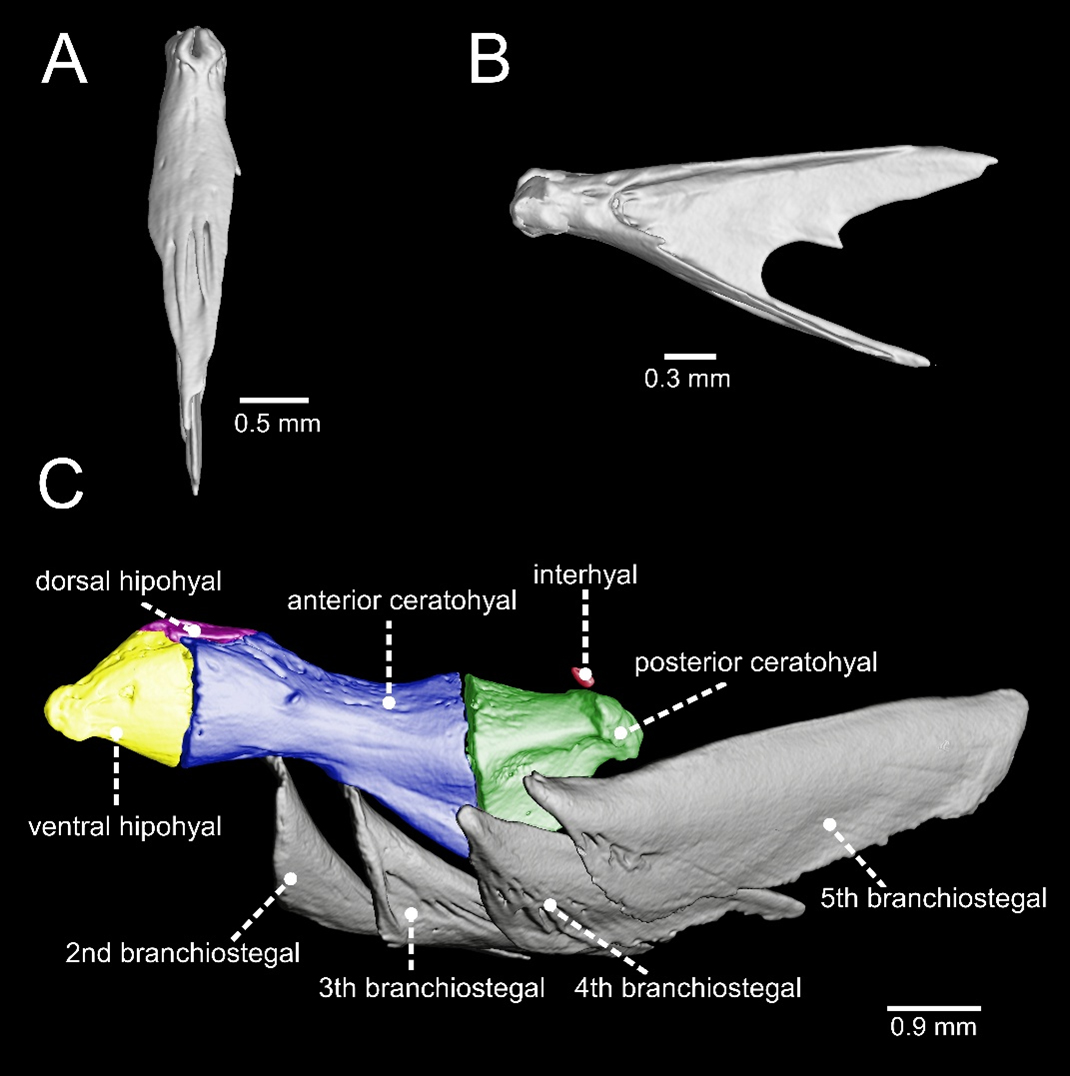
FIGURE 9 | Hyoid bar and branchiostegal series of Gymnotus (Pantherus) talian, MNRJ 13204, paratype: (A) urohyal, ventral view, anterior on top; (B) urohyal, left lateral view, anterior on left; and (C) hyoid bar, left side, lateral view, anterior on left.
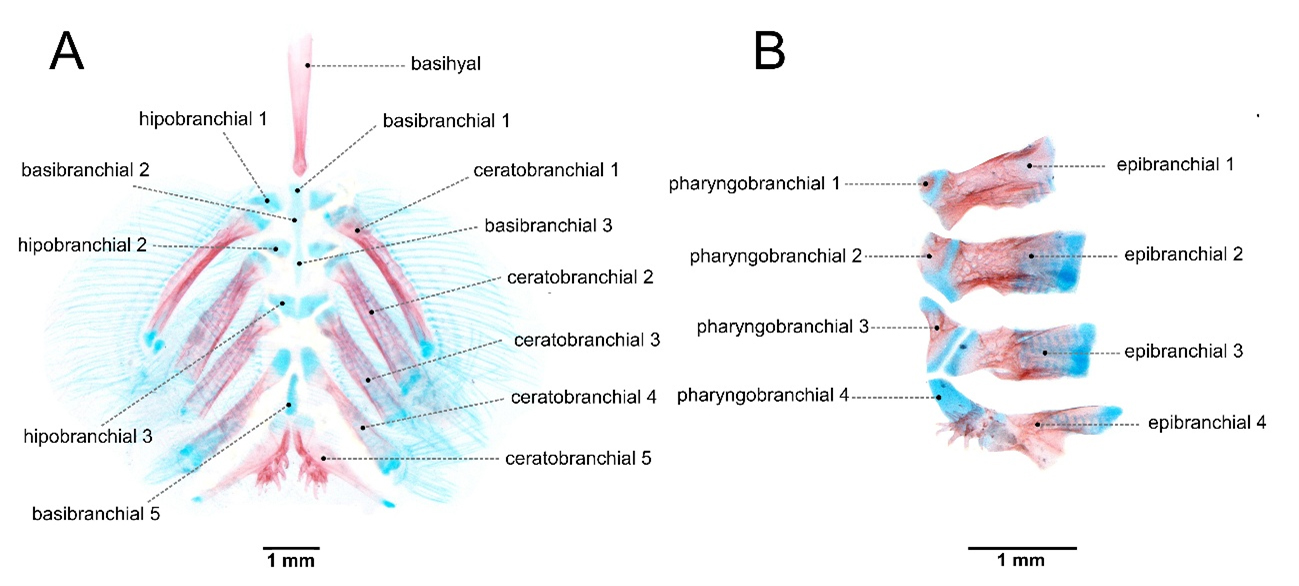
FIGURE 10 | Branchial arches and basihyal of Gymnotus (Pantherus) talian, MNRJ 13204, paratype, anterior on top: (A) dorsal view of inferior elements; (B) ventral view of left superior elements.
Neurocranium. Mesethmoid reaching anterior margin of frontal; anterior portion dorsal to anterior part of vomer and with two small crests and small lateral process (Fig. 11). Frontal nearly straight in lateral profile, about half as long as skull. Cranial fontanels closed. Parietal contacting frontal anteriorly, pterotic laterally, extrascapular and epioccipital posterolaterally, and supraoccipital posteriorly. Ossified lateral ethmoid absent. Orbitosphenoid connected dorsally to frontal, ventrally to parasphenoid, and posteriorly separated from pterosphenoid by segment of cartilage. Pterosphenoid contacting orbitosphenoid anteriorly, and associating with frontal dorsally. Pterosphenoid contacting parasphenoid posteroventrally, forming a lateral fenestra with orbitosphenoid, and contacting with sphenotic posterodorsally. Vomer wider anteriorly, becoming thinner posteriorly, contacting anterior portion of parasphenoid. Parasphenoid surrounding vomer by its anterior portion, posteriorly surrounding ventral margin of prootics and ventral surface of basioccipital. Parasphenoid contacting laterally posteroventral margin of pterosphenoid. Sphenotic somewhat trapezoidal and contacting pterosphenoid anteriorly, frontal anterodorsally, pterotic posterodorsally, and prootic posteroventrally. Prootic contacting basioccipital, exoccipital, pterotic, and sphenotic through cartilage filled sutures, and directly contacting parasphenoid and pterosphenoid. Prootic with single prominent foramen. Pterotic form lateral portion of skull, and contacting prootic and exoccipital ventrally, epioccipital posterodorsally, parietal and extrascapular dorsally, frontal anterodorsally and sphenotic anteroventrally. Supraoccipital contacting parietal anteriorly and exoccipital posterolaterally. Epioccipital forming posterodorsal corner of neurocranium and contacting pterotic anteriorly, exoccipital posteroventrally, parietal and extrascapular anterodorsally, and supraoccipital medially. Exoccipital contacting basioccipital ventrally, pterotic anterodorsally, prootic anteriorly, epioccipital posterodorsally, and supraoccipital dorsally through cartilage filled sutures. Basioccipital contacting prootic anteriorly, parasphenoid ventrally, and exoccipital dorsally.

FIGURE 11 | Microcomputed tomography of neurocranium of Gymnotus (Pantherus) talian, MNRJ 13204, paratype, anterior on left: (A) left lateral view; (B) dorsal view; (C) ventral view.
Weberian apparatus. Supraneural with long anterior process contacting supraoccipital (Fig. 12). Scaphium and intercalarium ossified. Tripus elongated and sickle-shaped. Parapophysis of second vertebra laterally projected. Parapophyses of second and fourth vertebrae not in contact. Parapophysis of fourth vertebrae ventrally curved. Neural arch of third and fourth vertebrae well developed.
Pectoral fin and girdle. Cleithrum somewhat crescent shaped (Fig. 13). Posterior process of cleithrum rounded. Postcleithrum elliptical. Supracleithrum elongated contacting cleithrum ventrally and posttemporal dorsally. Posttemporal triangular, contacting posterolateral surface of neurocranium at epioccipitals and parietal sutures. Coracoid well developed. Mesocoracoid small and somewhat triangular, connecting coracoid with cleithrum. Scapula somewhat squared, connecting radials with cleithrum. All four radials independent and ossified, somewhat thin and fan-shaped.

FIGURE 12 | Weberian apparatus of Gymnotus (Pantherus) talian, MNRJ 13204, paratype, left lateral view, anterior on left.
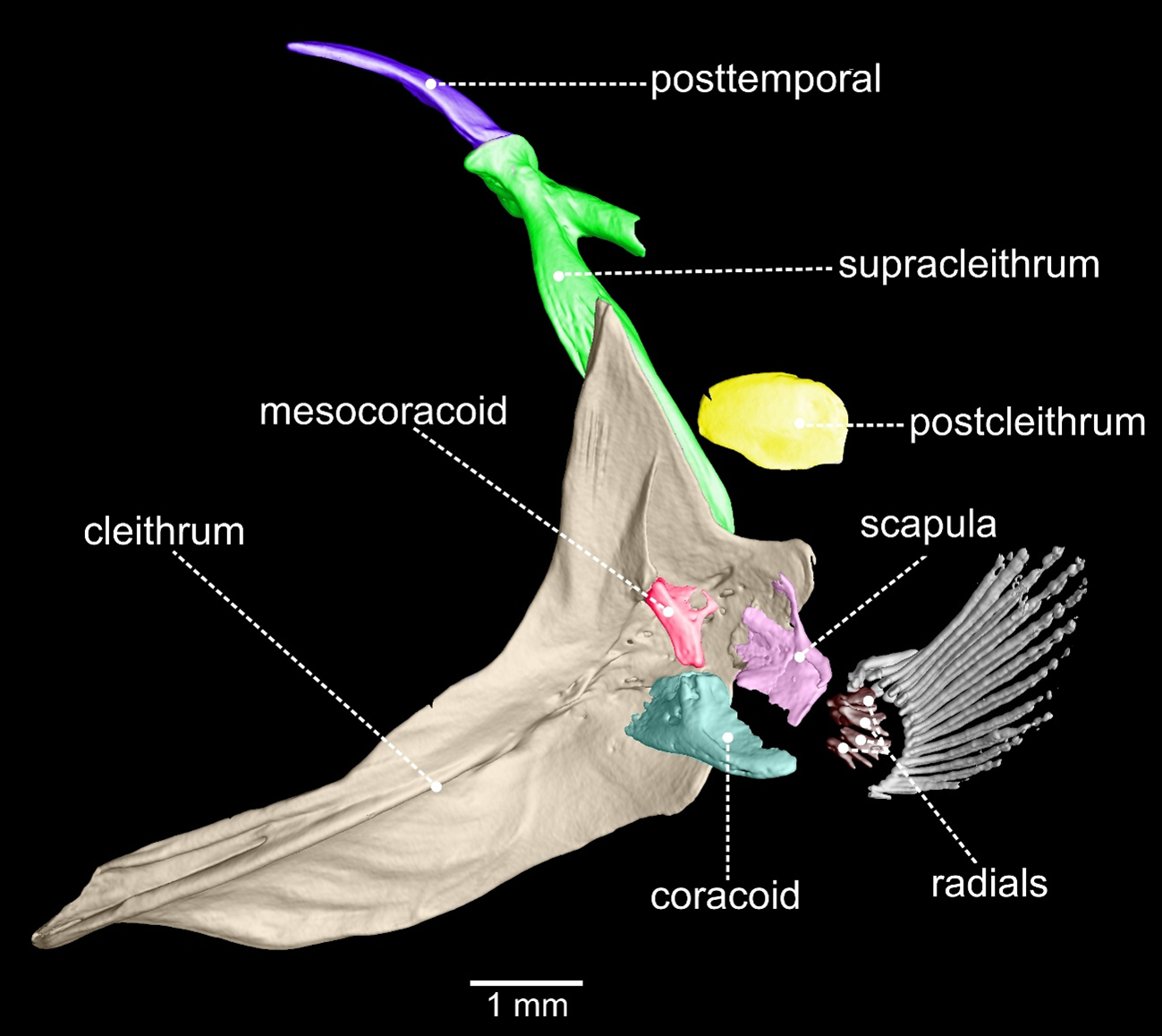
FIGURE 13 | Pectoral fin and girdle of Gymnotus (Pantherus) talian, MNRJ 13204, paratype, right side, medial view, anterior on left.
Post-Weberian axial skeleton and intermuscular bones. Precaudal vertebrae 47(2), 49 (2) 50(2), 51(3), or 52(1). Ribs 43(2), 45(2), 46(2), 47(3), or 48(1) (Fig. 14). Myorhabdoi distributed from neurocranium to neural spine of sixth vertebrae. Epineurals arranged in two series, one with oblique and other with horizontal orientation. Epicentrals unbranched. Epipleurals absent (Fig. 15).
Anal fin supports. Proximal radials with a cartilaginous tip and gradually decreasing in size toward anterior and posterior extremities of fin. Medial radials absent or fused to proximal radial. Distal radials spherical and fully cartilaginous.
Coloration in alcohol. Coloration of head and body dark brown, especially on anterior half of body and above lateral line, becoming gradually yellowish-brown on sides and in ventral and posterior regions (Figs. 1, 2, 3 and 16). Ventral region of head, including branchial membranes and area around anus, light brown. Dorsal region of head and eyes dark brown, with a thin layer of mucus under skin (Fig. 17) Numerous small, discrete, irregular, mostly rounded, dark blotches covering mainly the lateral surface of body. Blotches coalescent with wavy lines and vermiculation on flanks. Blotches absent on ventral areas of some specimens. Some paratypes with almost completely faded blotches due to poor preservation. Anal and pectoral fins with rays covered by dark chromatophores and hyaline interradial membranes. Anal fin light brown on anterior portion of body with chromatophores on rays, or completely hyaline. Caudal appendage with faded lateral bands. Ontogenetic variation in color pattern not observed.

FIGURE 14 | Gymnotus (Pantherus) talian, MNRJ 13204, paratype, 168.6 mm TL, showing precaudal and caudal vertebrae, left lateral view, anterior on left.
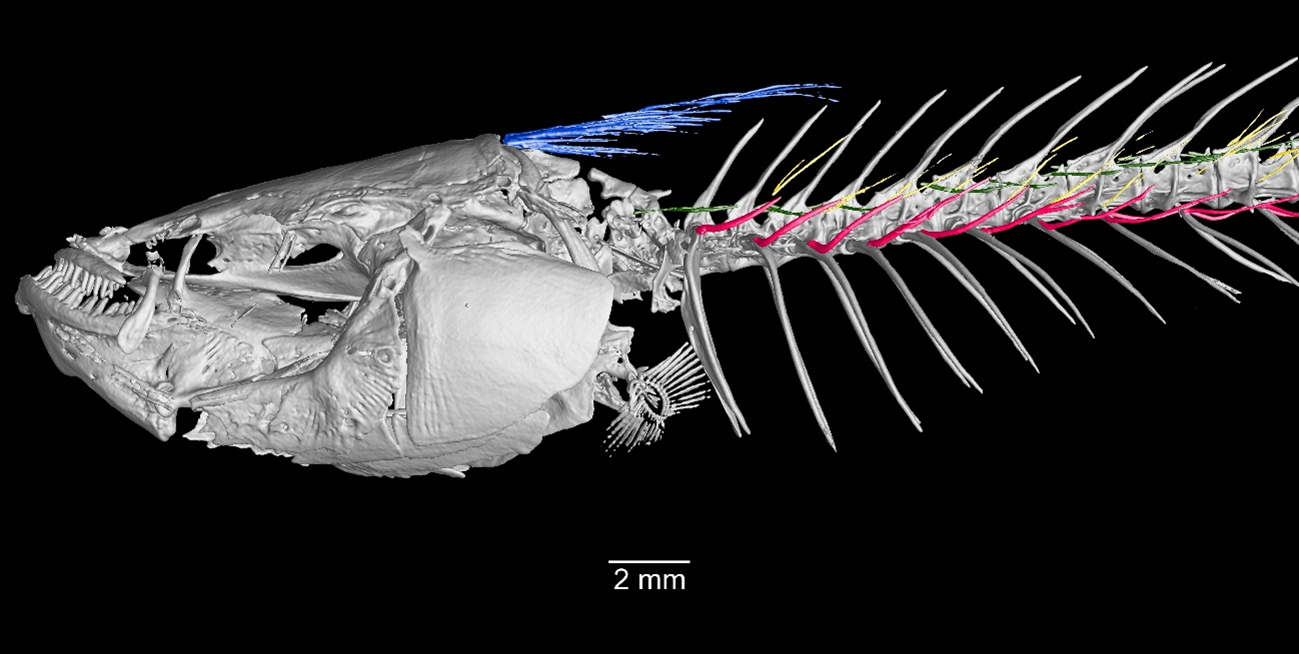
FIGURE 15 | Anterior part of body of Gymnotus (Pantherus) talian, MNRJ 13204, paratype, 168.6 mm TL, showing intermuscular bones, left lateral view, anterior on left. Blue, myorabdoi; green, horizontal epineurals; yellow, oblique epineurals; and pink, epicentrals.
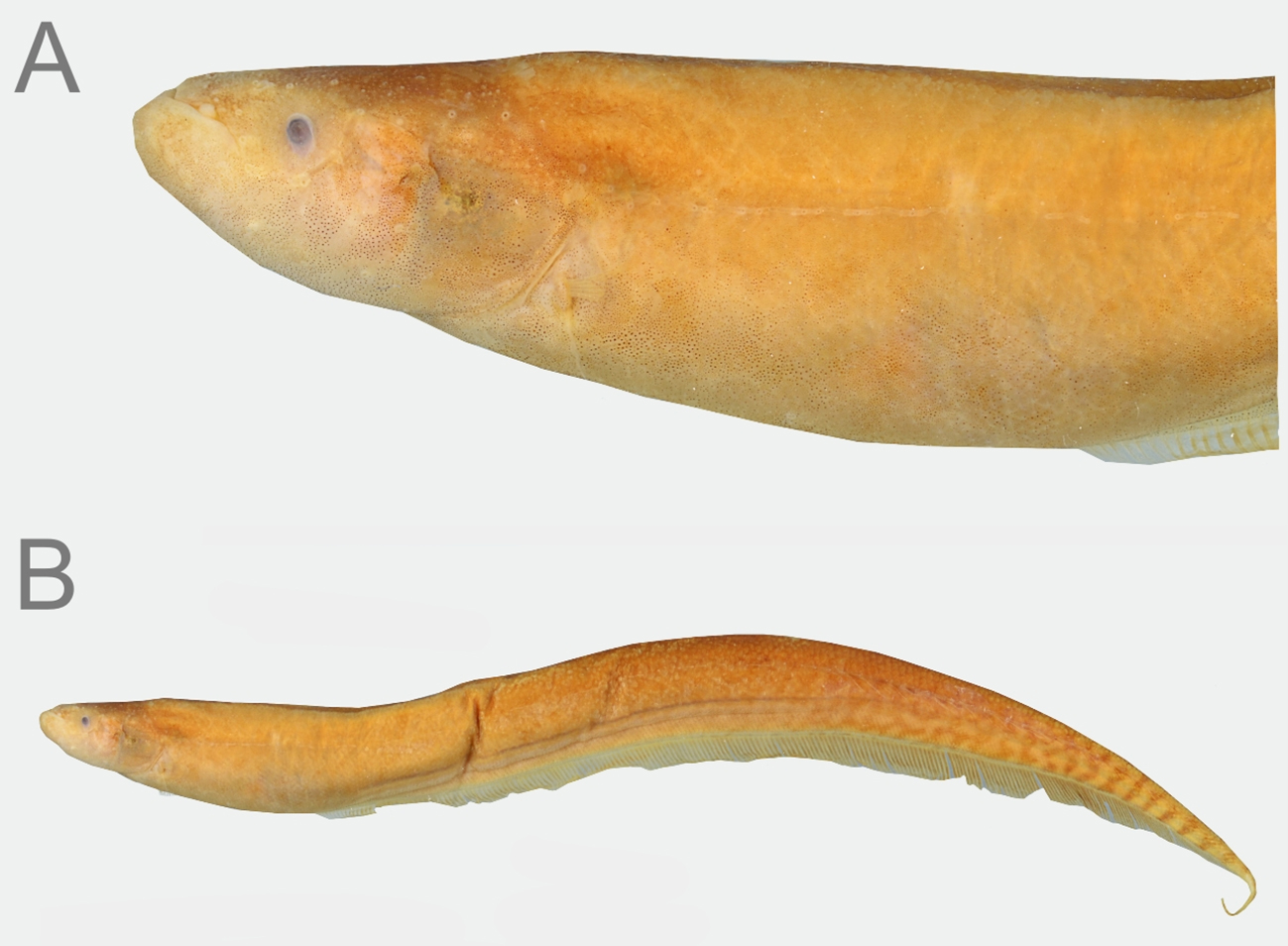
FIGURE 16 | Gymnotus (Pantherus) talian, MNRJ 22836, paratype, 183.3 mm TL, córrego Chumbado, unnamed stream tributary of rio Pau Atravessado at the rio Barra Seca system at Linhares-São Mateus road, Linhares, Espírito Santo, Brazil; (A) left lateral view of head; (B) left lateral view of body.

FIGURE 17 | Gymnotus (Pantherus) talian,MZUSP 131674, holotype,98.4 mm TL, (A) dorsal view of head; (B) ventral view of head.
Geographical distribution. Gymnotus talian is known from córrego do Pau Atravessado and tributaries of rio Barra Seca, a coastal basin in the southeastern Brazil (Fig. 18). Those streams passes through low altitude areas, less than 100 m above sea level, where it inhabits small streams and rivers in forested areas and shaded environments with dark, tea-colored waters (Sarmento-Soares, Martins-Pinheiro, 2014).
Conservation status. The type locality of Gymnotus (Pantherus) talian has undergone significant environmental impacts over recent decades, including deforestation and pollution (Sarmento-Soares, Martins-Pinheiro, 2014). Available records from ichthyological collections of major Brazilian institutions indicate that G. (P.) talian was apparently collected only during three field expeditions (1948, 2007, and 2012). The species’ area of occupancy is approximately 12,000 km², with an extent of occurrence of 125,569 km² (GeoCat, 2025). Part of this region includes the Sooretama Biological Reserve, which appears to retain some degree of habitat integrity. Based on the categories and criteria of the International Union for Conservation of Nature (IUCN Standards and Petitions Subcommittee, 2024), G. (P.) talian can be classified as Least Concern (LC). The conservation status of potential residual populations of the species, however, remains uncertain. This is cause for concern, especially given that no recent collections of fishes belonging to the G. (P.) pantherinus complex have been made in the region.
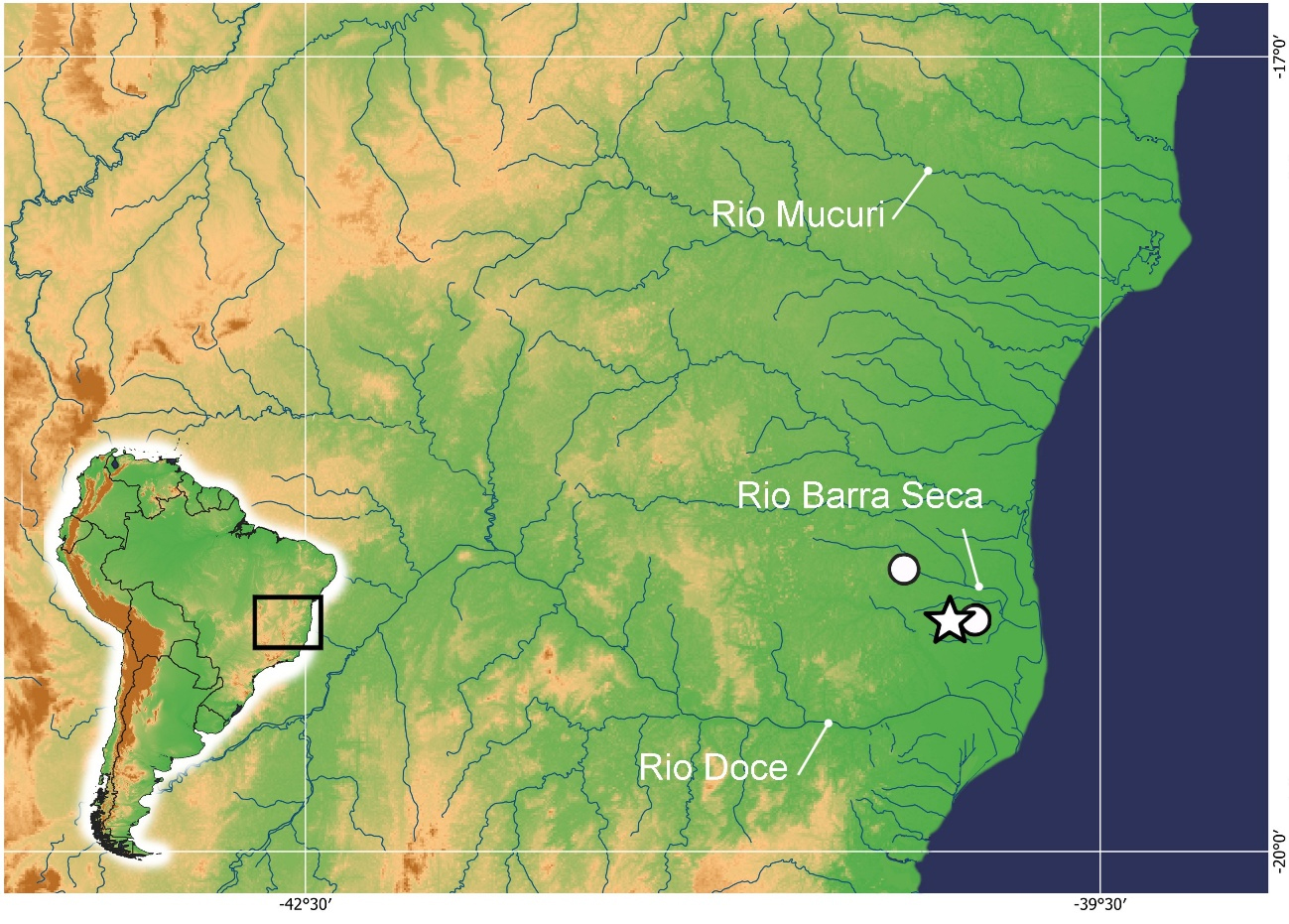
FIGURE 18 | Map of South America shows the distribution of Gymnotus (Pantherus) talian (red star indicates holotype and white circles paratypes) at rio Barra Seca system, Espírito Santo State, Eastern Brazil.
Etymology. The specific epithet “talian” is a reference to the language that emerged from the fusion of Italian dialects and Portuguese. Espírito Santo was one of the first Brazilian states to receive Italian immigrants, and the blend of their dialects with Brazilian Portuguese resulted in a unique linguistic variety formally known as “Talian”, which remains deeply rooted in communities of Italian descent. Talian has since been recognized as part of Brazil’s cultural heritage by IPHAN (the Institute of National Historical and Artistic Heritage). The name also pays tribute to the Italian ancestors of the first author, who settled in the city of Castelo, in southern Espírito Santo. A noun in apposition.
Key to identification for Gymnotus (Pantherus) species
1a. Caudal appendage color pattern with a vermiculated pattern……………….. 2
1b. Caudal appendage color pattern with faded lateral bands……………….. 3
2a. Pectoral fin with ii,14–15 rays (mode ii,14), 52–57 (mode 56) scales until the first ventral lateral line ramus, and coronomeckelian bone elongated……………….. G. pantherinus
2b. Pectoral fin with ii,15–16 rays (mode ii,15), 49–56 (mode 53) scales until the first ventral lateral line ramus, and coronomeckelian short……………….. G. refugio
3a. Pectoral fin with ii,14–15 rays, 9–10 scales above lateral line, 46–55 scales until the first ventral lateral line ramus, 74–84 scales on lateral line, and coronomeckelian bone short……………….. G. capitimaculatus
3b. Pectoral fin with ii,12–13 rays, 6–8 scales above lateral line, 58–64 scales until the first ventral lateral line ramus, 86–108 scales on lateral line, and coronomeckelian bone elongated……………….. G. talian
Discussion
Gymnotus talian is the fourth species assigned to the subgenus Gymnotus (Pantherus). This subgenus is diagnosed from all others by the presence of an irregular color pattern composed of rounded, coalescent blotches with wavy lines and vermiculations on the body (Craig et al., 2019), a condition present in G. talian. The new species also shares with all remaining species of Gymnotus (Pantherus) the presence of a discontinuous lateral line. Externally, the canal connecting the lateral-line pores appears discontinuous, associated only with isolated groups of usually three to five pores, especially near the pectoral region and the anterior portion of the trunk. This distinctive morphology of the lateral line is rare among Gymnotiformes and may provide additional evidence for the monophyly of Gymnotus (Pantherus), as previously suggested by several studies (Campos-da-Paz, 1997; Gonçalves, 2005; Rangel-Pereira, 2014). Craig et al. (2019) coded a discontinuous lateral line as present in all species of Gymnotus (Pantherus) and also in G. onca, a species currently assigned to Gymnotus (Tigrinus). Gymnotus (P.) onca is known only from its holotype, which we were unable to examine. Considering that Albert, Crampton (2001) did not mention the presence of a discontinuous lateral line in the original description, the condition in this species warrants further investigation. Even if a discontinuous lateral line is confirmed in G. onca, given that this species is well nested within Gymnotus (Tigrinus), the condition would have evolved independently from that of Gymnotus (Pantherus).
Color pattern has traditionally been regarded as a key character in the taxonomy of Gymnotus (e.g., Albert, Crampton, 2001, 2003; Craig et al., 2019), and it is likewise important for identifying species of Gymnotus (Pantherus). For example, G. (P.) capitimaculatus and G. (P.) talian exhibit faint bands on the caudal appendage, which contrast with the vermiculated pattern observed in G. (P.) pantherinus and G. (P.) refugio (see Diagnosis). On the other hand, the presence of ventral blotches on the underside of the head, proposed by Rangel-Pereira (2014) as a diagnostic feature of G. (P.) capitimaculatus, was not observed in any specimens examined in this study, suggesting that these blotches are variably present in that species. It is worth noting that Rangel-Pereira (2014) also emphasized that other blotches on the ventral surface of the head are variably present. Variation in color pattern has also been documented in other species of Gymnotus, such as G. (Gymnotus) pantanal and G. (Tigre) paraguensis (Frana et al., 2011; Braga et al., 2021). In any event, because we were unable to examine the type series of G. (P.) capitimaculatus, we prefer not to include this character as diagnostic for G. (P.) talian.
Morphometric characters such as body depth, anal-fin base length, anus-to-anal-fin distance, branchial opening, head depth, caudal-appendage length, mouth width, and interorbital distance have also been proposed as diagnostic features among species of Gymnotus (Pantherus) (Rangel-Pereira, 2014; Giora, Malabarba, 2016). However, in our analyses none of these measurements proved useful for diagnosing species of Gymnotus (Pantherus), owing to the extensive overlap in their ranges. It is noteworthy that Craig et al. (2019) likewise failed to identify morphometric features capable of distinguishing species of Gymnotus (Pantherus), even though they proposed head width as the sole diagnostic character separating G. (P.) pantherinus from G. (P.) refugio. The values for this measurement show substantial overlap between the two species (60.6–73.3% TL in G. refugio vs. 57.0–70.5% TL in G. pantherinus; Craig et al., 2019). Therefore, no morphometric characters are proposed here as diagnostic features among species of Gymnotus (Pantherus).
In turn, meristic data, such as the number of pectoral-fin rays, scales above the lateral line, scales on the lateral line, scales to the first ventral lateral-line ramus, teeth in the outer dentary series, and teeth in the upper pharyngeal plate, proved useful for diagnosing Gymnotus (P.) talian from all other species of Gymnotus (Pantherus)(see Tab. 1). Notably, none of these characters had been previously applied in taxonomic studies of the group (Rangel-Pereira, 2014; Giora, Malabarba, 2016; Craig et al., 2019), although some of them also distinguish G. (P.) capitimaculatus from G. (P.) pantherinus,such as the number of lateral-line scales (74–85 vs. 87–105),and G. (P.) capitimaculatus from G. (P.) refugio, such as the number of scales above the lateral line (7–8 vs. 9–10).
In contrast, these same characters failed to provide a clear diagnosis between G. (P.) pantherinus and G. (P.) refugio, revealing only tendencies, such as slightly higher pectoral-fin ray counts in G. pantherinus (ii,15–16, mode ii,15 vs. ii,14–15, mode ii,14), and slightly higher numbers of scales to the first ventral lateral-line ramus in G. (P.) refugio (52–57, mode 56 vs. 49–56, mode 53 in G. (P.) pantherinus). The difficulty in clearly distinguishing these two species may indicate a possible future synonymy, a hypothesis partially supported by Baroni et al. (2021), who recovered G. (P.) pantherinus as paraphyletic, with G. (P.) refugio nested within three additional lineages of G. pantherinus. Nevertheless, reviewing the taxonomic status of G. (P.) pantherinus and G. (P.) refugio is beyond the scope of the present study, and we therefore refrain from proposing any nomenclatural changes.
Our description of G. (P.) talian is consistent with the findings of Baroni et al. (2021), who also recovered the Linhares lineage as a distinct unit. Moreover, this lineage was inferred to be the sister group of the population from Bahia, which likely corresponds to G. (P.) capitimaculatus. These points highlight a possible convergence between the present morphological evidence and previous molecular data.
Comparative material. Gymnotus (Pantherus): all from Brazil. Gymnotus (Pantherus) capitimaculatus: LBP 22883, 3, 59.3–119.4 mm TL, rio da Barra basin. LBP 22886, 1, 159.8 mm TL, rio da Barra basin. MNRJ 32211, 3 + 1 CS + 1 CT, 50.1–128.5 mm TL, rio João de Corongo. MNRJ 32224, 1, 145.2 mm TL, rio Santo Antônio. MNRJ 50935, 1, 60.8 mm TL, rio Cahy. Gymnotus pantherinus: NMW 76443, 2 XR syntypes, not measured, Santos. NMW 76444, 8 syntypes, not measured, Santos. NMW 11275, 3 XR syntypes, not measured, Santos. LBP 350, 2, 135.7–136.3 mm TL, ribeirão Tamanduá. LBP 608, 1, 87.6 mm TL, Santa Rita farm. LBP 613, 10, 137.7–223.1 mm TL, Santa Rita farm road. LBP 631, 1, 208.8 mm TL, ribeirão do Convento. LBP 637, 4, 119.6–216.6 mm TL, riacho do Convento. LBP 699, 11, 96.1–160.6 mm TL, rio Grande basin. LBP 955, 4, 111.1–214.7 mm TL, rio Corisco. LBP 1077, 9, 71.2–213.1 mm TL, rio Juquiá basin at Estio farm. LBP 1232, 4, 64.6–154.6 mm TL, rio Preto basin. LBP 2963, 1, 129.1 mm TL, rio Paraitinga. LBP 3468, 1, 90.3 mm TL, rio Aduelas basin. LBP 3547, 2, 81.5–92.2 mm TL, unnamed coastal stream. LBP 3863, 1, 82.7 mm TL, rio da Fazenda basin. LBP 4397, 3, 152.7–197.6 mm TL, riacho Taquaral. LBP 4506, 10, 61.1–174.1 mm TL, rio Paranapiacaba. LBP 6352, 1, 121.8 mm TL, ribeirão Grande. LBP 6813, 16, 77.5–128.1 mm TL, rio Preto basin. LBP 7140, 18, 90.7–124.7 mm TL, vala de drenagem. LBP 7439, 5, 128.5–183.3 mm TL, unnamed stream. LBP 7554, 1, 102.4 mm TL, rio Mumuna basin. LBP 7892, 1, 213.6 mm TL, rio Indaiá. LBP 7922, 7, 160.5–196.5 mm TL, rio Tavares. LBP 8215, 4, 65.3–69.4 mm TL, unnamed stream. LBP 8241, 1, 134.3 mm TL, rio Indaiá. LBP 10699, 2, 192.3–200.3 mm TL, rio Jacu. LBP 11153, 5, 142.2–203.1 mm TL, rio Aguapeí. LBP 14309, 3, 122.2–198.6 mm TL, rio Itaguaré basin. LBP 14332, 1, 101.6 mm TL, Sertão da Barra do Una. LBP 14375, 2, 157.5–186.2 mm TL, unnamed stream. LBP 14404, 1, 65.3 mm TL, unnamed stream. LBP 18468, 1, 139.3 mm TL, córrego Bananeiras. LBP 18482, 5, 43.6–101.9 mm TL, rio Taquari. LBP 19507, 1, 69.9 mm TL, ribeirão da Quinta. LBP 20211, 1, 58.1 mm TL, unnamed coastal stream. MNRJ 28567, 1, 87.1 mm TL, rio Japara Mirim. MNRJ 32126, 2, 57.0–130.0 mm TL, rio de Peixe Grande. MNRJ 32289, 4, 80.1–139.8 mm TL, rio São Gonçalo on Itabela and Guaratinga road. MNRJ 40464, 1, 159.1 mm TL, CTR farm. MNRJ 43154, 1, 63.2 mm TL, rio Dona Eugenia. MZUEL 7531, 1, 138.1–150.2 mm TL, rio D’uma. MZUEL 7595, 1, 181.8 mm TL, rio Serrinha or Serra Velha. MZUEL 8718, 3, 52.7–126.5 mm TL, rio São João. MZUEL 8719, 1, 44.1 mm TL, rio Cubatão. MZUEL 8720, 1, 75.5 mm TL, rio Furta Mare. MZUEL 8721, 1, 48.5 mm TL, rio Ipiranga. MZUEL 9245, 1, 118.2 mm TL, small stream near BR road. MZUEL 12485, 1, 157.3 mm TL, stream near Guaraqueçaba. MZUSP 80014, 4, 85.6–154.14 mm TL, Ribeira de Iguape. MZUSP 85915, 5, 80.4–147.8 mm TL, rio Tietê. MZUSP 90374, 1, 152.4 mm TL, rio Trindade. MZUSP 100266, 26, 118.1–163.4 mm TL, rio Momuna. MZUSP 101315, 7, 65.4–137.6 mm TL, Ribeira de Iguape. MZUSP 106526, 1, 136.5 mm TL, rio Tietê. MZUSP 106775, 7, 108.6–213.1 mm TL, rio Tietê. MZUSP 115114, 1, CT, 147.2 mm TL, rio Perequê-Mirim. USNM 218865, 8, 96.5–127.73 mm TL, small blackwater stream just south of Guarutuba. USNM 218865, 1, 126.5 mm TL, arroio Lindo. USNM 297933, 92 + 2 CS, 61.1–220.2 mm TL, unnamed blackwater stream crossing road São Paulo at km 56, northwest of Cananeia. USNM 297939, 15, 49.4–110.1 mm TL, rio da Praia near Guaratuba. Gymnotus refugio: MCP 49069, 2 paratypes, 179.6–201.1 mm TL, puddle in the swam forest at Refugio de Vida Silvestre at Banhado dos Pachecos. UFRGS 9439, 2 paratypes, 81.7–115.4 mm TL, State park of Itapeva. UFRGS 10873, 1 paratype, 125.6 mm TL, puddle in rio Mampituba. UFRGS 13603, 1 paratype, 183.5 mm TL, unnamed stream on Ferraria farm. UFRGS 13607, 3 paratypes, 127.4–154.1 mm TL, arroio Carmelitas, near mouth of Laguna dos Patos. UFRGS 16371, 3 paratypes, 148.9–171.2 mm TL, Refúgio de Vida Silvestre at Banhado dos Pachecos. UFRGS 20196, 2 paratypes, 114.6–160.7 mm TL, arroio Carmelitas. UFRGS 20197, 2 paratypes, 185.3–204.5 mm TL, Refúgio da Vida Silvestre at Banhado dos Pachecos. UFRGS 22709, 6 + 2 CS, 66.1–105.5 mm TL, arroio Carmelitas. MZUSP 118093, 1 + 1 CT paratypes, 111.7–148.7 mm TL, creek in the former Ferraria farm. MCP 45832, 1, 34.1 mm TL, arroio Corrientes. MCP 54115, 1, 63.9 mm TL, arroio Maria Ulghim, rio Camaquã.
Gymnotus (Gymnotus): Gymnotus arapaima: INPA 9963, 5 paratypes, 109.7–148.5 mm TL, Paranã Apará, Brazil. INPA 13506, 1 paratype, 189.7 mm TL), rio Solimões, Paranã Apará, Brazil. Gymnotus bahianus: MNRJ 42284, 2, 145–196 mm TL, rio Formoso, Brazil. MZUSP 111256, 1, 171.0 mm TL, rio Gongogi, Brazil. Gymnotus carapo: USNM 225276, 16, 70.0–142.0 mm TL, Dalbana creek mouth (Corantijn), Surinam. USNM 225284, 10, 51.0–141.0 mm TL, Lana Creek, Surinam. Gymnotus chaviro: CAS 227893, 8 paratypes, 121.4–140.6 mm TL, quebrada dos y medio small terra firme stream, Ucayali, Peru. USNM 263880, 2, 178.5–191.7 mm TL, Reserva Natural de Tambopata, Madre de Dios, Peru. Gymnotus chimarrao: UFRGS 6772, 1 paratype, 176.9 mm TL, UFRGS 6774, 1 paratype, 173.4 mm TL, arroio Grande, rio Taquari basin, Brazil. Gymnotus choco: CAS 72192, 141.4–164.8 mm TL, rio Sucio, Atrato basin, Colombia. Gymnotus cuia: UFRGS 9790, 4 paratypes, 182.5–269.1 mm TL, UFRGS 23700, holotype, 186.7 mm TL, Lagoa Verde, Parque Estadual de Itapuã, Brazil. Gymnotus curupira: INPA 18381, 1 paratype, 118.4 mm TL, INPA 18382, 1 paratype, 142.6 mm TL, Lago Tefé, Brazil. Gymnotus darwini: MNRJ 42281, 6 paratypes, 79.9–156.1 mm TL, MNRJ 42283, 7 paratypes, 65.4–145.9 mm TL, rio Formoso, Reserva Biológica de Saltinho, Brazil. Gymnotus diamantinensis: MCP 33057, 4, 76.0–111.0 mm TL, stream at road between Santa Terezinha and Iberê, Brazil. MZUSP 45329, 1, 93.0 mm TL, rio Preto, Brazil. Gymnotus eyra: AUM 23644, 1, 178.9 mm TL, INHS 37119, 3, 112.7–283.5 mm TL, rio Beni, rio Madeira drainage. Gymnotus interruptus: MNRJ 22923, 13, 92.7–179.3 mm TL, small stream under brigde, rio de Contas basin, Brazil. MZUSP 112050, 6, 29.1–133.7 mm TL, rio Preto, tibutary of rio de Contas, Brazil. Gymnotus mamiraua: INPA 4716, 4 paratypes, 180.5–187.9 mm TL, Lago do Castanho, rio Solimões drainage, Brazil. INPA 9962, 12 paratypes, 61.0–181.3 mm TL, Lago Rato, Lake Mamirauá, Brazil. Gymnotus obscurus: MZUSP 60604, holotype, 206.2 mm TL, MZUSP 75153, 1 paratype, 165.8 mm TL, Lago Mamirauá, rio Solimões basin, Brazil. Gymnotus pantanal: NUP 4184, 6, 131.7–205.2 mm TL, riacho Caracu, rio Paraná basin, Brazil. NUP 22545, 11, 104.4–251.2 mm TL, rio Piquiri, Brazil. Gymnotus riberalta: USNM 264101, 2, 58.2–61.3 mm TL, Reserva Natural de Tambopata, Madre de Dios, Peru. USNM 366210, 1, 146.5 mm TL, Parque Nacional Manu, Madre de Dios, Peru. Gymnotus sylvius: MZUSP 83538, 2 paratypes, 260.0–301.0 mm TL, rio Ribeira de Iguape, Brazil. MZUSP 115441 (2, 190.0–203.0 mm TL), rio Cubatão de Cima, Brazil. Gymnotus varzea: INPA 18423, 1 paratype, 145.8 mm TL, rio Solimões, Reserva da Vila Alencar, Brazil. INPA 18424, 1 paratype, 76.8 mm TL, rio Solimões, Reserva Mamirauá, Brazil.
Gymnotus (Lamontianus): Gymnotus anguillaris: UMMZ 190413, 3, 124.7–261.5 mm TL, Lawa river, Maka Creek, Surinam. Gymnotus arapiuns: MZUSP 115731, 2, 79.4–97.1 mm TL, stream tributary of rio Aripuanã, Mato Grosso, Brazil. Gymnotus aripuana: INPA 35846, 3, 157.2–215.3 mm TL, interflúvio Purus-Madeira, Careiro, Brazil. Gymnotus cataniapo: AMNH 58650, 2 paratypes, 152.5–253.7 mm TL, AMNH 58668, 2 paratypes, 168.4–261.5 mm TL, rio Cataniapo, caño Las Pavas, Venezuela. Gymnotus pedanopterus: ANSP 135790, 5, 55.4–196.3 mm TL, rio Urbani, Venezuela. ANSP 141596, 43, 62.6–318.2 mm TL, isolated lagoon in Jabillal, Venezuela. Gymnotus tiquie: ANSP 188903, 1 paratype, 167.7 mm TL, MZUSP 104507, 1, 169.9 mm TL, igarapé Espuma, rio Tiquié, Brazil.
Gymnotus (Tigre): Gymnotus esmeraldas: CAS 164103, 1, 233.8 mm TL, rio Blanco, rio Esmeraldas drainage, Ecuador. USNM 288039, 1, 161.3 mm TL, Esmeraldas, Estero Sabalera, Ecuador. Gymnotus henni: CAS 217162, 1 paratype, 145.6 mm TL, Valle de Cauca, rio San Juan drainage, Colombia. Gymnotus inaequilabiatus: MLP 3353, 2, 349.0–358.0 mm TL, Misiones, Argentina. MLP 7085, 1, 244.0 mm TL, Santa Fé, Argentina. Gymnotus tigre: USNM 177217, 1, 136.8 mm TL, rio Bobonaza, Ecuador. USNM 270691, 1, 157.9 mm TL, stream tributary of rio Pastaza, Ecuador.
Gymnotus (Tigrinus): Gymnotus coatesi: USNM 103827, 1, 123.7 mm TL, aquarium specimens from NZP. USNM 190296, 1, 185.6 mm TL, Letícia, Colombia. Gymnotus coropinae: USNM 225278, 20, 34.8–133.1 mm TL, guyanese logging camp, Nickerie District, Surinam. USNM 225287, 25, 47.9–111.9 mm TL, Corantinjin River, Surinam. Gymnotus javari: UMMZ 224596, 7 paratypes, 45.4–170.9 mm TL, Quebrada Caraná, rio Javari, Loreto, Peru. USNM 330438, 5, 98.6–167.4 mm TL, South America. Gymnotus jonasi: INPA 13508, 5 paratypes, 67.2–81.2 mm TL, Lago Rato, rio Solimões, Brazil. INPA 15830, 30 paratypes, 82.5–108.9 mm TL, rio Japurá, Paranã Maiana, Brazil. Gymnotus stenoleucus: ANSP 160218, 6, 61.1–113.1 mm TL, rio Parguaza, Venezuela. ANSP 162704, 4, 55.3–72.5 mm TL, rio Autana, Venezuela.
Gymnotus (Tijax): Gymnotus cylindricus: USNM 134701, 22, 151.0–235.0 mm TL, rio Hondo, Guatemala. USNM 134702, 8, 154.0–210.0 mm TL, rio Lato, Guatemala. Gymnotus maculosus: ANSP 64611, 2, 135.0–160.0 mm TL, Lake Amatitlan, Guatemala. USNM 134700, 49 paratypes, 135.0–182.0 mm TL, rio Buena Vista, Guatemala. Gymnotus panamensis: CAS 217109, 1 paratype, 202.0 mm TL, rio Cricamola, Panama.
Acknowledgments
W=For discussions about gymnotiform taxonomy we thank Naércio Menezes, Raimundo Nonato Mendes, Carlos David de Santana, Douglas Bastos, and José Alves-Gomes. Thaks to the following individuals and institutions for allowing access to material under their care: Melanie Stiassny, Scott Schaeffer and Bruno Melo (AMNH), Mark Sabaj and Mariangeles A. Hernandez (ANSP), Jonathan Ambruster and David Werneke (AUM), Luis Rocha and David Catania (CAS), Christopher Taylor and Enrique Santoyo-Brito (INHS), Lúcia Rapp-PyDaniel, Douglas Bastos and Marcelo Rocha (INPA), Cláudio Oliveira (LBP), Roberto Reis and Carlos Lucena (MCP), George Lauder and Andrew Williston (MCZ), James Vanegas-Rios and Diego Nadalin (MLP), Cristiano Moreira, and Paulo Buckup (MNRJ), José Birindelli, Fernando Jerep, and Oscar Shibatta (MZUEL), Osvaldo Oyakawa and Michel Gianetti (MZUSP), Carla Pavanelli, Cláudio Zawadski, and Marli Campos (NUP), Ângela Zanata and Priscila Camelier (UFBA), Andre Netto-Ferreira, Luiz Malabarba, and Juliano Ferrer (UFRGS), Hernán López-Fernandez and Randy Singer (UMMZ), Carine Chamon and Everton de Oliveira (UNT), Lynne Parenti, Kris Murphy, and Jeffrey Clayton (USNM), and Marcelo Loureiro (ZVCP). Barbara Herzig and Helmut Wellendorf (NMW) helped with loans and information about type specimens of Giton fasciatus var. pantherinus and provided us with photographs and radiographs. We thank Juliano Ferrer (UFRGS) for a photograph of a G. refugio paratype. We also thank Alberto Carvalho and Vanessa Tambellini (MZUSP) from the Laboratório de Microtomografia do Centro de Análises Avançadas em Biodiversidade (CAAB), for generating images of CT scan.
References
Albert JS, Miller RR. Gymnotus maculosus, a new species of electric fish (Chordata: Teleostei: Gymnotoidei) from middle America, with a key to species of Gymnotus. Proc Biol Soc Wash. 1995; 108(4):662–78.
Albert JS. Species diversity and phylogenetic systematics of American knifefishes (Gymnotiformes, Teleostei). Misc publ Mus Zool Univ Mich. 2001; 190:1–127. Available from: https://hdl.handle.net/2027.42/56433
Albert JS, Crampton WGR. Five new species of Gymnotus (Teleostei: Gymnotiformes) from an Upper Amazon floodplain, with descriptions of electric organ discharges and ecology. Ichthyol Explor Freshw. 2001; 12(3):241–66.
Albert JS, Crampton WGR. Seven new species of the Neotropical electric fish Gymnotus (Teleostei, Gymnotiformes) with a redescription of G. carapo (Linnaeus). Zootaxa. 2003; 287(1):1–54. https://doi.org/10.11646/zootaxa.287.1.1
Albert JS, Crampton WGR, Thorsen DH, Lovejoy NR. Phylogenetic systematics and historical biogeography of the Neotropical electric fish Gymnotus (Teleostei: Gymnotidae).Syst Biodivers.2005; 2(4):375–417. https://doi.org/10.1017/S1477200004001574
Baroni S. Estudos moleculares em Gymnotus pantherinus (Gymnotiformes, Gymnotidae): uma abordagem sistemática e filogeográfica. [PhD Dissertation]. São Paulo: Universidade de São Paulo; 2011.
Baroni S, Damasceno RP, Almeida-Toledo LF. Paraphyly and evolutionary independent lineages in Gymnotus pantherinus (Gymnotiformes: Gymnotidae) in the Brazilian Atlantic Forest Coastal Streams. Mol Phylogenet Evol. 2021; 161:107159. https://doi.org/10.1016/j.ympev.2021.107159
Braga GSF, Ferreira DC, Marques DKS, Centofante L, Carvalho FR, Venere PC. Gymnotus paraguensis, a good example of phenotypic plasticity in the Pantanal Biome, Brazil. Zebrafish. 2021; 18(2):162–73. https://doi.org/10.1089/zeb.2020.1908
Campos-da-Paz R. Sistemática e taxonomia dos peixes elétricos das bacias dos rios Paraguai, Paraná e São Francisco, com notas sobre espécies presentes em rios costeiros do leste do Brasil (Teleostei: Ostariophysi: Gymnotiformes). [PhD Dissertation]. São Paulo: Universidade de São Paulo; 1997.
Campos-da-Paz R. New species of Megadontognathus from the Amazon basin, with phylogenetic and taxonomic discussions on the genus (Gymnotiformes: Apteronotidae). Copeia. 1999; 1999(4):1041–49. https://doi.org/10.2307/1447979
Campos-da-Paz R, de Santana CD. A new species of the electric knifefish Gymnotus Linnaeus (Gymnotiformes: Gymnotidae) from Northeastern Brazil. Copeia. 2019; 107(1):144–51. https://doi.org/10.1643/CI-18-141
Costa WJEM. Feeding habits of a fish community in a tropical coastal stream, rio Mato Grosso, Brazil. Stud Neotrop Fauna Environ. 1987; 22:145–53. http://doi.org/10.1080/01650528709360728
Craig JM, Malabarba LR, Crampton WGR, Albert JS. Revision of banded knifefishes of the Gymnotus carapo and G. tigre clades (Gymnotidae, Gymnotiformes) from the Southern Neotropics. Zootaxa. 2018; 4379(1):47–73. https://doi.org/10.11646/zootaxa.4379.1.3
Craig JM, Kim LY, Tagliacollo VA, Albert JS. Phylogenetic revision of Gymnotidae (Teleostei: Gymnotiformes), with descriptions of six subgenera. PLoS ONE. 2019; 14(11):e0224599. https://doi.org/10.1371/journal.pone.0224599
Dagosta FCP, Monção MS, Nagamatsu BA, Pavanelli CS, Carvalho FR, Lima FCT et al. Fishes of the upper rio Paraná basin: diversity, biogeography and conservation. Neotrop Ichthyol. 2024; 22(1):1–109. https://doi.org/10.1590/1982-0224-2023-0066
Dutra GM, Peixoto LAW, Abrahão VP, Wosiacki WB, Menezes NA, de Santana CD. Morphology-based phylogeny of Eigenmanniinae Mago-Leccia, 1978 (Teleostei: Gymnotiformes: Sternopygidae), with a new classification. J Zool Syst Evol Res. 2021; 59(8):2010–59. https://doi.org/10.1111/jzs.12535
Frana VA, Graça WJ, Gubiani EA, Konerat JT, Margarido VP. Evidence of the color pattern variation in populations of Gymnotus pantanal (Gymnotiformes) from three streams in the upper Paraná River basin, Brazil. Neotrop Ichthyol. 2011; 9(2):343–50. https://doi.org/10.1590/S1679-62252011005000013
GeoCAT. Geospatial Conservation Assessment Tool. [Internet]. 2025. Available from: https://geocat.iucnredlist.org
Giora J, Malabarba LR. Gymnotus refugio, a new endangered species of electric fish of the Gymnotus pantherinus species-group from southern Brazil (Gymnotiformes: Gymnotidae). Zootaxa. 2016; 4066 (5):581–90. http://doi.org/10.11646/zootaxa.4066.5.6
Gonçalves MP. Revisão taxonômica do complexo Gymnotus pantherinus (Steindachner, 1908) (Teleostei; Gymnotiformes). [Master Thesis]. Rio de Janeiro: Universidade Federal do Rio de Janeiro, Museu Nacional; 2005.
International Union for Conservation of Nature (IUCN). Standards and petitions committee. Guidelines for using the IUCN Red List categories and criteria. Version 16 [Internet]. Gland; 2024. Available from: http://www.iucnredlist.org/documents/RedListGuidelines.pdf
Kim LY, Crampton WGR, Albert JS. Two new species of Gymnotus (Gymnotiformes: Gymnotidae) from Brazil and historical biogeography of the subgenus Lamontianus. Copeia. 2020; 108(3):468–84. https://doi.org/10.1643/CI-19-205
Mago-Leccia F. Electric fishes of the continental waters of America: classification and catalogue of the electric fishes of the order Gymnotiformes (Teleostei: Ostariophysi), with descriptions of new genera and species. Caracas: Fundacion para Desarrollo de las Ciencias Fiscias, Matematicas y Naturales; 1994.
Oyakawa OT, Akama A, Mautari KC, Nolasco JC. Peixes de riachos da Mata Atlântica. São Paulo: Editora Neotropica; 2006.
Pastana MNL, Bockmann FA, Datovo A. The cephalic lateral-line system of Characiformes (Teleostei: Ostariophysi): anatomy and phylogenetic Implications. Zool J Linn Soc. 2019; 2019(189):1–46. https://doi.org/10.1093/zoolinnean/zlz10
Peixoto LAW, Datovo A, Campos-da-Paz R, de Santana CD, Menezes NA. Anatomical, taxonomic, and phylogenetic reappraisal of a poorly known ghost knifefish, Tembeassu marauna (Ostariophysi: Gymnotiformes), using X-ray microcomputed tomography. PLoS ONE. 2019; 14(11):e0225342. https://doi.org/10.1371/journal.pone.0225342
Rangel-Pereira FS. Gymnotus capitimaculatus, a new species of electric fish from rio Jucuruçu basin, northeastern Brazil (Ostariophysi: Gymnotiformes: Gymnotidae). Vertebr Zool. 2014; 64(2):169–75. https://doi.org/10.3897/vz.64.e31474
Sabaj MH. Codes for Natural History Collections in Ichthyology and Herpetology. Copeia. 2020; 108(3):593–669. https://doi.org/10.1643/ASIHCODONS2020
Sabaj MH. Codes for Natural History Collections in Ichthyology and Herpetology (online supplement). Version 9.7. Washington, DC: American Society of Ichthyologists and Herpetologists; 2025. Available from: https://asih.org
Sarmento-Soares LM, Martins-Pinheiro RF. A fauna de peixes na bacia do rio Barra Seca e na REBIO de Sooretama, Espírito Santo, Brasil. Bol Mus Biol Mello Leitão. 2014; 35:49–104.
Steindachner F. Über eine während der brasilianischen Expedition entdeckte Brachyplatystoma-Art aus dem Rio Parnahyba und über eine dicht gefleckte und gestrichelte Varietät von Giton fasciatus aus den Gewässern von Santos (Staat Sao Paulo). Anz Akad Wiss Wien. 1908; 45(9):126–30.
Taylor R, Van Dyke C. Revised procedures for staining and clearing small fishes and other vertebrates for bone and cartilage study. Cybium. 1985; 9(2):107–19.
Weitzman SH. The osteology of Brycon meeki, a generalized characid fish, with an osteological definition of the family. Stanford Ichthyol Bull. 1962; 8:1–77.
Authors

Vinicius C. C. Cassaro1,2 , Marco P. Gonçalves3, Ricardo Campos-da-Paz3, Guilherme Moreira Dutra4,5 and Aléssio Datovo2
[1] Programa de Pós-Graduação em Zoologia, Instituto de Biociências, Universidade de São Paulo, Rua do Matão, Travessa 14, 101, 05508-090, São Paulo, SP, Brazil. (VCCC) viniciusc.cassaro@gmail.com (corresponding author).
[2] Museu de Zoologia da Universidade de São Paulo, Av. Nazaré 481, Ipiranga, 04263-000, São Paulo, SP, Brazil. (AD) adatovo@usp.br.
[3] Laboratório de Ictiologia Neotropical, Departamento de Ecologia e Recursos Marinhos, Instituto de Biociências, Avenida Pasteur 458, sala 408, Universidade Federal do Estado do Rio de Janeiro, Urca, 22290-240, Rio de Janeiro, RJ, Brazil. (MPG) marcopgoncalves@hotmail.com, (RCP) rcpaz@unirio.br.
[4] Departamento de Ecologia e Biologia Evolutiva, Universidade Federal de São Carlos, Rodovia Washington Luiz, km 235, Caixa Postal 676, 13565-905, São Carlos, SP, Brazil. (GMD) guilhermedutr@yahoo.com.br.
[5] Departamento de Biologia Estrutural e Funcional, Instituto de Biociências, Universidade Estadual Paulista Júlio de Mesquita Filho, Rua Prof. Dr. Antônio C. W. Zanin 250, 18618-689, Botucatu, SP, Brazil.
Authors’ Contribution 

Vinicius C. C. Cassaro: Conceptualization, Data curation, Formal analysis, Funding acquisition, Investigation, Methodology, Project administration, Resources, Software, Supervision, Validation, Visualization, Writing-original draft, Writing-review and editing.
Marco P. Gonçalves: Conceptualization, Data curation, Formal analysis, Funding acquisition, Investigation, Resources, Supervision, Visualization, Writing-review and editing.
Ricardo Campos-da-Paz: Conceptualization, Data curation, Formal analysis, Funding acquisition, Investigation, Methodology, Project administration, Supervision, Validation, Visualization, Writing-original draft, Writing-review and editing.
Guilherme Moreira Dutra: Conceptualization, Data curation, Formal analysis, Funding acquisition, Investigation, Methodology, Project administration, Resources, Supervision, Validation, Visualization, Writing-original draft, Writing-review and editing.
Aléssio Datovo: Conceptualization, Data curation, Formal analysis, Funding acquisition, Investigation, Methodology, Project administration, Resources, Software, Supervision, Validation, Visualization, Writing-original draft, Writing-review and editing.
Ethical Statement
This study was carried out under the approval of the Animal Care and Use Committee (ACUC) of the Instituto de Biociências, Universidade de São Paulo (Project #226/2015; CIAEP #01.0165.2014).
Competing Interests
The author declares no competing interests.
Data availability statement
The authors confirm that the data supporting the findings of this study are available within the article.
AI statement
The authors did not use any AI-assisted technologies in the creation of this manuscript or its figures.
Funding
This work was supported by the Fundação de Amparo à Pesquisa do Estado de São Paulo (FAPESP #2022/01032–2 and 2022/15150–7 to VCC, 2018/09445–9 to GMD, and 2023/02499–4 to AD), Coordenação de Aperfeiçoamento de Pessoal de Nível Superior under Grant (CAPES PROEX 343–2024 from Programa de Pós-Graduação em Zoologia, Instituto de Biociências, USP, to VCC), and Conselho Nacional de Desenvolvimento Científico e Tecnológico (CNPq #153825/2024–3 to GMD and 309299/2026-8 to AD). Part of this work was also developed by MPG while an undergradute student at the Departamento de Zoologia, Instituto de Biologia/CCS, Universidade do Brasil, and by Ricardo Campos-da-Paz while a Visitor Professor/Researcher at that same Institution (proc. #23079.020654/00–33). This contribution was also supported by the Diversity and Evolution of the Gymnotiformes Project, FAPESP/Smithsonian (proc. #2016/19075–9), and INCT – Biodiversidade e uso Sustentável de Peixes Neotropicais (proc. #405706/2022–7).
Peer Review
How to cite this article
Cassaro VCC, Gonçalves MP, Campos-da-Paz R, Dutra GM, Datovo A. A new species of the electric fish genus Gymnotus (Gymnotiformes: Gymnotidae) from rio Barra Seca, a coastal basin in the southeastern Brazil. Neotrop Ichthyol. 2026; 24(3):e250217. https://doi.org/10.1590/1982-0224-2025-0217
Copyright
This is an open access article under the terms of the Creative Commons Attribution License, which permits use, distribution and reproduction in any medium, provided the original work is properly cited.
Distributed under
Creative Commons CC-BY 4.0

© 2025 The Authors.
Diversity and Distributions Published by SBI
 Accepted May 4, 2026
Submitted December 23, 2025
Epub October 16, 2026