
 Gabriel Cordero-Martínez1, Norman Mercado-Silva2
  , Ilse J. Ortega-Martínez3, Sandra García de Jesús4 and Juan Suárez-Sánchez1
PDF: Download Here | Supplementary: Sup | Cite this article
Associate Editor: Luciano Montag
Section Editor: Fernando Pelicice
Editor-in-chief: José Birindelli
Abstract
La diversidad funcional es un componente de la biodiversidad que permite analizar las funciones ecológicas de las especies en los ecosistemas. El objetivo de esta investigación es proporcionar una perspectiva sobre la diversidad funcional de la ictiofauna en el Río Amacuzac, y la relación entre la diversidad funcional de especies nativas y no nativas. Describimos y analizamos los patrones de diversidad funcional de la comunidad de peces del Río Amacuzac (Cuenca del Balsas, México) con base en información de 17 especies de peces capturadas. Se caracterizaron 19 caracteres funcionales relacionados con la alimentación, posición en la columna de agua, hábitat, capacidad natatoria, capacidad de filtrado y demanda energética de cada especie en el ecosistema. Se formaron grupos funcionales con base en la similitud de sus rasgos funcionales, contrastando los grupos funcionales entre sitios. El sitio ubicado más aguas abajo de nuestra sección de estudio presentó la mayor diversidad funcional. Se observaron diferencias en la diversidad funcional de las especies nativas y no nativas. Se formaron ocho grupos funcionales, de los cuales, cuatro grupos funcionales se conformaron únicamente por una especie, siendo el grupo funcional 5 el que presentó mayor número de especies (5 especies).
Palabras clave: Funciones ecológicas, Grupos funcionales, Ictiofauna, Rasgos funcionales, Servicios ecosistémicos.
Introduction
The Amacuzac River is located in the upper Balsas River basin, in southern Mexico. It is the most important river in the state of Morelos. The Amacuzac basin is affected by various anthropogenic effects, including pollution, physical modification and species introductions (Trujillo-Jiménez et al., 2009; Mejía-Mojica et al., 2015; Contreras-MacBeath et al., 2020; Mercado-Silva et al., 2020; Cordero-Martínez et al., 2022). Native fishes are strongly affected by these disturbances and several species have suffered population declines or local extirpations of rare species (Mejía-Mojica et al., 2015; Mercado-Silva et al., 2020; Cordero-Martínez et al., 2022) while degradation-resistant fishes are associated with streams with higher human disturbance (Larentis et al., 2022).
Anthropogenic alterations directly modify the structure and composition of fish communities, thus generating changes in their ecological function and diversity. Functional diversity, the component of biodiversity that allows the analysis of ecological functions of species in ecosystems, is evaluated via metrics that allow a multidimensional vision of the ecological role that species play in natural areas or areas with some degree of disturbance (Karr, Rossano, 2001; Rosenfeld, 2002; Troitiño et al., 2007; Benejam et al., 2009; Flynn et al., 2009; Laliberté et al., 2010; Córdova-Tapia, Zambrano, 2015). The study of functional diversity is complementary to the analysis of diversity and can be useful to achieve a better understanding of the relationship between species and the functioning of ecosystems (Rosenfeld, 2002; Violle et al., 2007; Villéger et al., 2008; Gómez-Ortiz, Moreno, 2017; Mercado-Silva et al., 2024).
In the context of functional diversity, an ecosystem may host several species with additive or redundant functions. In the first case, a species has a unique functional role in the ecosystem; while in the second, several species perform the same ecological function. Species richness may be directly related to functional richness; in this case, taxonomically different species may perform similar ecological functions (Naeem, 2002; Rosenfeld, 2002; Petchey, Gaston, 2006; Farias, Jaksic, 2011). Ecosystems with a greater number of redundant species could present greater tolerance to biotic and abiotic alterations (Rice et al., 2013).
Characterizing functional diversity requires the quantification of functional traits. These are defined as biological characteristics (physiological, anatomical or behavioral) measurable at the individual or species level, which directly or indirectly influence their growth, reproduction and survival, as well as the relationship of organisms with the structure and functioning of ecosystems (Cornelissen et al., 2003; Hooper et al., 2005; McGill et al., 2006; Villéger et al., 2010; Weiher et al., 2011; Sgarlatta, 2015; Gómez-Ortiz, Moreno, 2017). One of the main challenges for the study of functional diversity is the precise determination of the functional traits that describe the function of organisms in the ecosystem (Bellwood et al., 2002; Cornelissen et al., 2003). The most suitable traits are those that offer a balance between their functional relevance and their ease of measurement (Dumay et al., 2004; Mouillot et al., 2007). In the case of fish, functional traits related to food acquisition and locomotion are key to understanding their role in the ecosystem (Villéger et al., 2010; Córdova-Tapia, Zambrano, 2015).
The ichthyofauna of the Amacuzac River has been widely explored (Trujillo-Jiménez, Castro-Lara, 2008; Trujillo-Jiménez et al., 2009; Mejía-Mojica et al., 2012, 2013, 2015; Cordero-Martínez et al., 2022; Ramírez-Santillán, 2022). The system currently hosts a native ichthyofauna of nine species, to which at least 16 non-native species have been added (Mercado-Silva et al., 2020; Cordero-Martínez et al., 2022). The expansion of invasive species due to the increase in aquaculture activity in the state is one of the strongest impacts on the native ichthyofauna in the region (Mejía-Mojica et al., 2015; Trujillo Jiménez et al., 2009; Contreras-MacBeath et al., 2020; Mercado-Silva et al., 2020; Cordero-Martínez et al., 2022). However, relatively little research has been done on the functional diversity of a system that, like the Amacuzac River, has many non-native species in its communities (Ramírez-Santillán, 2022). Understanding functional diversity in the sub-basin and its use in other freshwater systems can be of great importance for the development of biological conservation strategies. Native fish communities in the Amacuzac River, despite being taxonomically impoverished and subject to strong anthropogenic pressures, maintain a more diverse and complex set of functional traits than non-native species, since the species that persist are those that, together, cover a wide range of functions (Mejía-Mojica et al., 2015; Trujillo Jiménez et al., 2009; Contreras-MacBeath et al., 2020; Mercado-Silva et al., 2020; Cordero-Martínez et al., 2022). This suggests that native species differ functionally from non-native species, which is manifested in significantly higher values in functional diversity indices, representing a historical functional composition prior to these changes, with greater niche complementarity, where native species use resources efficiently and occupy different ecological roles, while the set of non-native species preferentially harbors tolerant generalist species with overlapping and redundant functional traits, because they share similar traits associated with tolerance to degradation (e.g., omnivorous diet, tolerance to low oxygen levels, high fecundity) (Villéger et al., 2010; Córdova-Tapia, Zambrano, 2015). However, high functional diversity of native species does not necessarily imply that the ecosystem is healthy, but rather represents critical and threatened functional capital, since losing one of these native species could mean the loss of unique and irreplaceable ecological functions (Villéger et al., 2010; Córdova-Tapia, Zambrano, 2015). Our objective is to generate baseline information on the functional role of the species that comprise the fish communities in the Amacuzac River, and to characterize patterns of functional diversity along the river system.
Material and methods
Sampling sites. The Amacuzac River originates in the foothills of the Nevado de Toluca Volcano, in the State of Mexico, where it is called the Chontalcoatlán River. This river flows into the Almoloya, Malinaltenango and the San Gerónimo rivers before it starts flowing underground in the limestone area of the Sierra de Cacahuamilpa. These waters emerge downstream on the border between the states of Guerrero and Morelos, at the site called Dos Bocas. From that point on, it is named the Amacuzac River, and it runs for 104 km until it joins the Mezcala River (Ocampo-Molina et al., 2019; Cordero-Martínez et al., 2022) (Fig. 1).

FIGURE 1| Location of sampling sites of fish communities along the Amacuzac River, Morelos, Mexico.
Along its course, the Amacuzac River receives contributions from the Chalma, Tembembe, Apatlaco, Tetlama, Yautepec and Cuautla rivers, many of which drain urban and agricultural areas in the north of the state of Morelos. The study area presents significant modifications to the vegetation cover, due to agriculture (main crops are sugar cane, rice, vegetables and flowers) and livestock farming (Contreras-MacBeath et al., 2006; Vargas et al., 2006; Eufracio-Torres et al., 2016). However, along its course the river crosses various canyons where native riparian vegetation still dominates, and areas of ecological importance, such as the Man and the Biosphere Program (MAB-UNESCO) Sierra de Huautla Biosphere Reserve (REBIOSH). Various human settlements and farming areas present on the banks of the Amacuzac pour their untreated wastewater directly into the river (Contreras-MacBeath et al., 2006; Vargas et al., 2006; Eufracio-Torres et al., 2016).
The climate in the Amacuzac River region is warm subhumid (Awo(w)(i)g), with rains from June to October and a dry season from November to May. Average annual rainfall is 979 mm with an average annual temperature of 24°C (Trujillo-Jiménez et al., 2009; Eufracio-Torres et al., 2016). Natural vegetation in the basin comprises fragments of tropical dry forest and semi-deciduous forest (Aguilar, 1999; Trujillo-Jiménez et al., 2009; Eufracio-Torres et al., 2016).
We sampled 10 sites located along a 75 km river stretch (between 18°39’16.69”N and 99°27’51.14”W to 18°28’51.80”N and 99°09’58.52”W, at altitudes between 962 to 766 m above sea level (Fig. 1). Sites 1, 3, and 5 are characterized by a high presence of forest and a low presence of urban areas. Sites 2, 4, and 7 exhibit a high presence of stones in the streambed and are located within urban areas. Sites 6, 8, and 9, on the other hand, show a high presence of gravel and rocks in the streambed, a high presence of grasses in the riparian zone, and a high number of urban areas. Site 10, meanwhile, exhibited a low current velocity, a narrower channel width, and a low proportion of forest and urban area; for more details, see Cordero-Martínez et al. (2022). Each sampling site was visited five times every two months between 2019 and 2020, during both wet and dry seasons. In each sampling event, a segment of between 100 and 200 linear m (at a maximum depth of 1.6 m) of river was sampled for fishes. When depth conditions permitted, sampling was carried out in a zigzag pattern along the segment, covering both banks of the river and the central area of the channel, trying to cover all possible habitats. During the rainy season, when flow conditions prevented the full width of the river from being safely covered, sampling was concentrated on the banks and other accessible areas.
Data collection. Three methods were used to sample the fish community at each sampling event: seining, cast netting, and electrofishing. Seine runs were carried out with three- and six-meter seine nets; both seines had a mesh size of 0.5 cm and a depth of 1.5 m. The cast net had a mesh size of 1 cm and an opening diameter of 2.5 m. We used a backpack electrofisher (ETS-Electrofishing Co, Model ABP-3) with two hand-held nets to capture fish. We attempted to cover all available habitat types at a sampling site and to maximize the richness of species captured. Organisms collected were identified to species level (following Meek, 1904; Álvarez, 1970; Armbruster, Page, 2006; Chávez et al., 2006; Schmitter-Soto, 2007) and counted. A total of 7,638 individuals of 18 species were captured, considering all sampling sites and events. For each collection site and event, once the specimens were separated by species (in aerated buckets) total species-specific biomass was obtained (Bm) using spring scales (Pesola ®). Subsequently, a subsample of at least five individuals of each species was selected. These organisms were selected to maximize the representation of the body size structure for each species. These specimens were used to characterize their functional traits (Winemiller, 1991; Sibbing, Nagelkerke, 2001; Karpouzi, Stergiou, 2003; Dumay et al., 2004; Pilger et al., 2010; Villéger et al., 2010; Córdova-Tapia et al., 2017). The reference specimens are housed in the fish collection of the Centro de Investigaciones Biológicas de la Universidad Autónoma del Estado de Morelos, Mexico (CICIB-UAEM) (Tab. S1). The rest of the individuals were released back into the wild. For Ictalurus balsanus (I. bal) and Ictalurus punctatus (I. punc), the sample was less than five individuals per species due to the difficulty of obtaining specimens in the field. These species were considered in the analyses despite their low abundance, because the sizes collected allowed to represent mature stages of the species. Individuals of Copadichromis borleyi were not considered for the functional diversity analyses, because the collected organisms were in early stages of their development and because few individuals were collected (n = 2). Thus, functional diversity analyses considered 17 species.
Organisms selected from the different sampling events were fixed in 5% formalin and eventually preserved in 90% alcohol. For each species, 19 functional traits were characterized (Tab. 1), considering the following number of individuals per species: Amatitlania nigrofasciata (A. nig; n = 38), Amphilophus istlanus (A. ist; n = 30), Andinoacara rivulatus (A. riv; n = 15), Astyanax aeneus (A. aen; n = 23), Atherinella balsana (A. bal; n = 10), Ictalurus balsanus (I. bal; n = 4), Ictalurus punctatus (I. pun; n = 2), Ilyodon whitei (I. whi; n = 10), Graodus boucardi (N. bou; n = 36), Oreochromis sp. (O. sp; n = 9), Poecilia maylandi (P. may; n = 53), Poeciliopsis gracilis (P. gra; n = 47), Pseudoxiphophorus bimaculatus (P. bim; n = 32), Pterygoplichthys disjunctivus (P . dis; n = 5), Pterygoplichthys pardalis (P. par, n = 5), Thorichthys maculipinnis (T. mac, n = 28;), Xiphophorus hellerii (X. hel; n = 10).
TABLE 1 | Description of functional traits used for fishes of the Amacuzac basin and the functional attributes to which they are related. An asterisk indicates that the trait was selected for functional diversity analyses (see Material and Methods).
Functional trait (units) | Functional meaning | Author |
Total length (mm)* | Habitat-locomotion | Mouillot et al. (2007); Salgado-Negret, Paz (2015) |
Head length (mm) | Feeding | Pouilly et al. (2003); Cheal et al. (2012); Soares et al. (2013); Salgado-Negret, Paz (2015); Cadena-Mantilla (2020) |
Mouth width (mm)* | Feeding | Sibbing, Nagelkerke (2001); Lefcheck et al. (2014); Payan-Alcacio (2015); Córdova-Tapia, Zambrano (2016); |
Mouth height (mm)* | Feeding | Willis et al. (2005); Soares et al. (2013); Payan-Alcacio (2015); Córdova-Tapia, Zambrano (2016) |
Branchial arch (mm)* | Filtering capacity | Córdova-Tapia, Zambrano (2016) |
Eye diameter (mm)* | Habitat-feeding | Boyle, Horn (2006); Lisney, Collin (2007); Pineda (2009); Villéger et al. (2010); Elleouet et al. (2014); Lefcheck et al. (2014); Payan-Alcacio (2015); Córdova-Tapia, Zambrano (2016); Cadena-Mantilla (2020) |
Interorbital distance (mm) | Habitat-feeding | Pouilly et al. (2003); Soares et al. (2013); Elleouet et al. (2014); Lefcheck et al. (2014); Payan-Alcacio (2015) |
Body length (mm) | Habitat-locomotion | Salgado-Negret, Paz (2015) |
Body width (mm)* | Locomotion | Córdova-Tapia, Zambrano (2016) |
Body height (HC) (mm)* | Locomotion | Reech et al. (2013); Elleouet et al. (2014); Payan-Alcacio (2015); Córdova-Tapia, Zambrano (2016). |
Caudal peduncle length (mm)* | Locomotion | Payan-Alcacio (2015); Córdova-Tapia, Zambrano (2016); Cadena-Mantilla (2020) |
Caudal peduncle height (mm)* | Locomotion | Payan-Alcacio (2015); Córdova-Tapia, Zambrano (2016); Cadena-Mantilla (2020) |
Mouth position* | Habitat-feeding | Mejía, Garzón-Ferreira (2000); Dumay et al. (2004); Barton (2006); Villéger et al. (2010); Palacios-Salgado (2011); Elleouet et al. (2014); Lefcheck et al. (2014); Payan-Alcacio (2015); Herrera-Valdivia et al. (2016); Cadena-Mantilla (2020) |
Body shape | Locomotion, habitat, feeding | Mejía, Garzón-Ferreira (2000); Karpouzi, Stergiou (2003); Blake (2004); Villéger et al. (2010); Palacios-Salgado (2011); Pease et al. (2012); Córdova-Tapia, Zambrano (2016); Herrera-Valdivia et al. (2016); Cadena-Mantilla (2020) |
Caudal fin shape* | Locomotion | Blake (2004); Fish, Lauder (2006); Fulton (2007); Lauder, Madden (2007); Villéger et al. (2010); Pease et al. (2012); Soares et al. (2013); Elleouet et al. (2014); Lefcheck et al. (2014); Payan-Alcacio (2015); Cadena-Mantilla (2020) |
Feeding* | Feeding guild | Mejía, Garzón-Ferreira (2000); Hood et al. (2005); Winemiller (2005); Palacios-Salgado (2011); Herrera-Valdivia et al. (2016); Cadena-Mantilla (2020) |
Reproduction* | Reproductive guild | Winemiller, Rose (1992); Winemiller (2005); Palacios-Salgado (2011); Herrera-Valdivia et al. (2016); Cadena-Mantilla (2020); Achong-Ramos (2021) |
Position in the water column* | Locomotion, habitat, feeding | Palacios-Salgado (2011); Herrera-Valdivia et al. (2016); Salgado-Negret, Paz (2015); Cadena-Mantilla (2020) |
Biomass (gr) | Energy demand | Mouillot et al. (2007); Gómez-Ortiz, Moreno (2017) |
Functional traits focused on each species type of feeding, position in the water column, habitat, swimming capacity, filtering capacity and energy demand (Tab. 1). Various body measurements and qualitative descriptions of morphological characters were obtained from each specimen. Total length, head length, horizontal mouth opening, vertical mouth opening, branchial arch, eye diameter, interorbital distance, body length, body width, body height, caudal peduncle length, and caudal peduncle height were measured with a digital vernier caliper (mm); these morphological measurements were obtained directly from each individual (Tab. 1). Mouth position (superior, terminal, subterminal, inferior), body shape (elongated, tall, flattened) and caudal fin shape (truncated, rounded, convex, truncated/rounded, emarginate, lunate, concave, notched) were recorded for each species (Tab. 1). Feeding group (detritivore, herbivore, carnivore, omnivore, invertivore), reproduction strategy (simple oviparous, complex oviparous, viviparous) and position in the water column (benthic, midwater, surface) were obtained using published information for each species (Tab. 1).
Statistical analyses. Functional traits used in functional diversity analyses were chosen based on published criteria for those that best represent the relationship between form and function (Winemiller, 1991; Dumay et al., 2004; Mason et al., 2007; Pilger et al., 2010; Villéger et al., 2010; Gómez-Ortiz, Moreno, 2017). Following a selection process using a correlation matrix to determine traits correlated to one another (Martínez-Ortega et al., 2009), 14 functional traits were included in subsequent analyses (Tab. 1). In order to obtain comparable metrics between the data obtained from each functional trait, the values of each of these were standardized to z values (García de Jesús et al., 2016; Cordero-Martínez et al., 2022) for the functional diversity analyses.
Functional diversity analyses. To obtain functional diversity indices for native and non-native species, we used two data matrices: (i) a community matrix containing abundance values, and (ii) a trait matrix that included both continuous and categorical traits. We selected Gower’s dissimilarity index (Gower, 1971) to obtain a matrix of functional dissimilarity between species, as it is a robust and appropriate measure for simultaneously standardizing and integrating quantitative and categorical traits in the same matrix, ensuring the comparability of the analysis (Pavoine et al., 2009; De Bello et al., 2021).
To address potential multicollinearity among traits and reduce dimensionality, a Principal Coordinates Analysis (PCoA) was performed on the Gower dissimilarity matrix. Resulting PCoA axes were then used as standardized functional traits for subsequent calculations of functional diversity indices. Using the matrix and the functional distance matrix, we computed several complementary indices (Villéger et al., 2008; Mammola et al., 2021): Functional evenness (FEve), which measures the regularity of species abundance within the functional space; functional dispersion (FDis), calculated as the abundance-weighted mean distance of species to the functional centroid (Laliberté, Legendre, 2010); and Rao’s quadratic entropy (RaoQ), representing the mean functional dissimilarity between two randomly selected individuals within a community (Botta-Dukát, 2005).
Normality (Shapiro-Wilk test) of FEve, FDis, and RaoQ values were assessed prior to hypothesis testing. Because FEve values significantly deviated from normality, differences between native and introduced species were evaluated using a non-parametric Mann-Whitney U test. In contrast, FDis and RaoQ values did not show strong deviations from normality; therefore, difference between groups were assessed using independent-samples t-test. All analyses compared native versus introduced species, and statistical significance was evaluated using p-values.
Identification of functional groups. Functional groups (FG) (a set of species that share similar characteristics and play similar roles within an ecosystem) present in the Amacuzac River were identified using a cluster analysis implementing Ward’s minimum variance (Chávez-Esponda et al., 2010). To explore the variability in the presence and abundance of the FG between sampling sites, a cluster and similarity analysis was implemented using the Morisita-Horn index (Moreno, 2001). In this analysis, the number of FG and the abundance of the FG at each site were considered (adding data from all collection events). Similarity analyses were carried out in PAST v. 4.06 (Hammer, Harper, 2006).
Results
Functional diversity indices. The highest value of FEve for native species was found in site one (0.919) and the lowest was in site nine (0.352); in the case of the non-native species, the highest value was for site two (0.648) and the lowest was for site six (0.409). For FDis of the native species, the highest value was for site ten (0.333) and site eight had the lowest value (0.193); the highest value for the non-native species was in site eight (0.237) and the lowest value was for site one (0.064). The highest values of RaoQ for the native species was in site ten (0.119) and the lowest values in site eight (0.535) (Tab. 2).
TABLE 2 | Functional diversity indices for native and non-native species in the Amacuzac River, Mexico. FEve = Functional evenness, FDis = Functional dispersion; RaoQ = Rao’s quadratic entropy.
| Native species | Non-native species | |||||
FEve | FDis | RaoQ | FEve | FDis | RaoQ | ||
Site 1 | 0.919 | 0.258 | 0.069 | 0.642 | 0.065 | 0.016 | |
Site 2 | 0.784 | 0.209 | 0.056 | 0.648 | 0.198 | 0.048 | |
Site 3 | 0.867 | 0.285 | 0.082 | 0.447 | 0.213 | 0.051 | |
Site 4 | 0.777 | 0.264 | 0.075 | 0.647 | 0.142 | 0.032 | |
Site 5 | 0.885 | 0.288 | 0.084 | 0.473 | 0.236 | 0.059 | |
Site 6 | 0.816 | 0.296 | 0.094 | 0.411 | 0.221 | 0.052 | |
Site 7 | 0.791 | 0.258 | 0.076 | 0.483 | 0.221 | 0.053 | |
Site 8 | 0.541 | 0.193 | 0.053 | 0.566 | 0.238 | 0.057 | |
Site 9 | 0.352 | 0.259 | 0.073 | 0.566 | 0.221 | 0.054 | |
Site 10 | 0.841 | 0.334 | 0.119 | 0.598 | 0.146 | 0.037 | |
FEve values differed significantly between native and non-native species (Mann-Whitney U = 16.000; P = 0.011). For FDis, the independent samples t-test indicated significant differences between groups (t = 3.422 with 18 degrees of freedom; P = 0.003) as did RaoQ values (t = 4.402 with 18 degrees of freedom; P = <0.001) (Fig. 2).
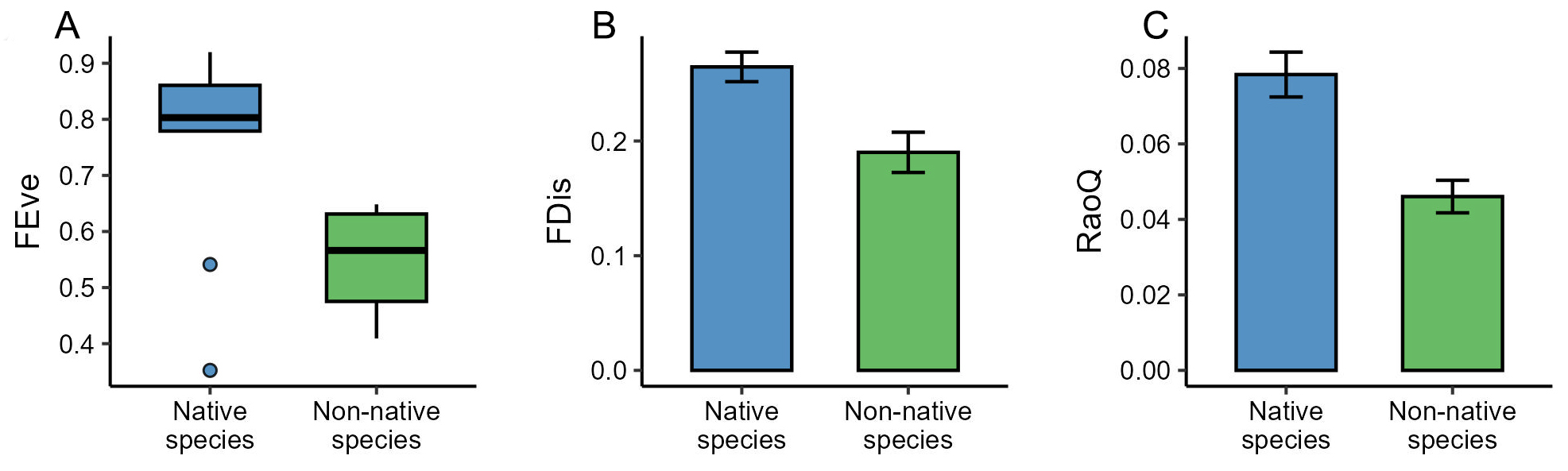
FIGURE 2| Functional diversity for native and non-native species assemblages: (A) FEve (Evenness of abundance), (B) FDis (Mean distance to the centroid of the functional space), and (C) RaoQ (Quadratic entropic diversity). The middle line of the box plot (above) represents the median. The upper side of the box represents the third quartile (75%) and the lower side of the box represents the first quartile (25%). For the bar charts, the height of the bar represents the mean, and error bars symbolize standard error (SE).
Functional groups. Ward’s minimum variance cluster analysis formed eight FG (Fig. 3), with a cutting distance of three, each representing a distinct ecological role within the river ecosystem, as defined by their morphological and life-history traits. FG 1, 2, 6 and 7 were composed of only one species; because this FG are represented by only one species, the loss of that species would lead to a complete loss of the FG. Group 5 had the highest number of species (five), followed by FG 4 (four); the number of species represented in these FG may indicate that the disappearance or decrease of some of the species would not cause the disappearance of the FG. Non-native I. punctatus exclusively represented FG 1, with a total length of 257.50 mm, horizontal mouth opening of 22.27 mm, vertical mouth opening of 15.90 mm, gill arch measurement of 21.01 mm, subterminal mouth position, concave caudal fin shape, omnivorous feeding, and is a benthic species. Their reproduction is complex, oviparous. Ictalurus balsanus, native to the basin, was the only species in FG 2. Average values of total length were 130 mm, horizontal mouth opening 14.49 mm, vertical mouth opening 13.43 mm, and gill arch 13.50 mm. The species has subterminal mouth, concave caudal fin, it feeds on benthic invertebrates and has a benthic position in the water column. FG 3 consisted of non-native Loricariids P. disjunctivus and P. pardalis. The specimens in this group had a total length of 142.61–155.94 mm, a horizontal mouth opening of 12.90–14.21 mm, vertical mouth opening of 11.16–12.53 mm, a gill arch of 13.18–13.90 mm, with an inferior mouth position, and a notched caudal fin shape. They are omnivorous species with complex oviparous reproduction and benthic habits.

FIGURE 3| Dendrogram of the functional groups in the ichthyofauna of the Amacuzac River. Groups formed using the Ward’s method (see Material and Methods). Names of the species in green represent native species. Names in black are non-native species. Key to species abbreviations can be found in the data collection section.
FG 4 was composed of species P. bimaculatus, X. helleri, P. maylandi and P. gracilis, of which only P. maylandi is a native species. The morphological characters that group these species were total length (45.49–61.44 mm), horizontal mouth opening (3.47–5.23 mm), vertical mouth opening (3.28–4.64 mm), gill arch (4.39–6.90 mm), mouth location in an upper position, viviparous reproduction and being species that are located on the surface of the water column. This FG is represented by organisms of the Poeciliidae family. They are the smallest in size compared to other FG, obtain their food from the upper layer of the water column, and tend to exhibit gregarious behavior. Their small size is compensated for by the size of their populations, being the most abundant FG.
FG 5 was composed of A. nigrofasciata, A. istlanus, A. rivulatus, Oreochromis sp. and T. maculipinnis, all of them cichlids. Only A. istlanus is native to the basin. The range of morphological measurements in this group for total length was 60.41–79.87 mm, with a horizontal mouth opening of 4.67–7.21 mm, a vertical mouth opening of 5.87–8.55 mm and a gill arch of 9.46–12.74 mm, with the mouth located in a terminal position. FG 6 consisted exclusively of I. whitei, native to the basin. The species had average values of total length of 56.37 mm, horizontal mouth opening of 4.47 mm, vertical mouth opening of 4.16 mm, gill arch of 5.23 mm, and had a terminal mouth position, with a truncated caudal fin, omnivorous feeding, viviparous reproduction, and a benthic position in the water column. This group is found mainly in shallow waters with a moderate current.
FG 7 consisted only of the A. aeneus, a native species of the basin. This species had an average total length of 80.62 mm, a horizontal mouth opening of 5.85 mm, a vertical mouth opening of 7.25 mm, a gill arch measurement of 9.44 mm, a mouth in terminal position, with a serrated caudal fin shape. It feeds on invertebrates, has simple oviparous reproduction and is located mid water. The species in FG 8 were A. balsana and G. boucardi, both native to the basin. They have a total length of 49.95–57.88 mm, a horizontal mouth opening of 2.84–3.84 mm, a vertical mouth opening of 4.09–4.20 mm, a gill arch of 4.06–5.33 mm and a notched caudal fin shape. They are species with simple oviparous reproduction. This FG is found in the middle and lower water column, feeding primarily on macroinvertebrates. They are fast-swimming organisms and do not exhibit parental care.
In general, the conformation of FG according to the similarity of their traits was given for FG 1, 2 and 3 by species with similar morphological measurements for vertical mouth opening, gill arch and body height. FG 4 and 5 presented similarities in the height of the mouth, gill arch, position of the mouth and their position in the water column (Fig. 3). The FG with the highest abundance of fishes across all sites were FG 1 and 5. Those with the least abundance of fishes were FG 7, 3 and 8 (Fig. 4).

FIGURE 4| Abundance of functional groups (FG) of fishes in the Amacuzac River, Morelos, Mexico.
Presence of functional groups at sampling sites. FG 4, 5 and 8 were present along the entire course of the Amacuzac River (Tab. 3). FG 1 was only present at site four and had a low abundance (n = 2) (Tab. 3). The cluster of sampling sites performed using the Morisita-Horn index with a cut to 0.90 similarity, formed two clusters (Fig. 5). The first cluster was formed by sites in the middle part of the Amacuzac River (3, 4, 5, 6, and 7), where FG 1, 2, 4, 5, and 6 were present. The minimum similarity value was found between sites 4 and 7 (0.888) (Tab. 4), highlighting the exclusive presence of FG 1 and the absence of FG 3 at site 4. The highest similarity in cluster one was found between sites 6 and 7 (0.996) (Tab. 4), which contained FG 2, 3, 4, 5, 7, and 8 (Tab. 4). The second cluster consisted of sites 1, 2, 8, 9, and 10, located at the upstream and downstream ends of our study area. FG 4, 5, and 8 were present at all sampling sites in cluster two. The minimum similarity value was found between sites 1 and 8 (0.801) (Tab. 4), which only shared three FG (4, 5, and 8). The highest similarity was found between sites 2 and 10 (0.996) (Tab. 4), which shared four FG (4, 5, 7 and 8) (Tab. 4).
TABLE 3 | Abundance of functional groups (FG) at sampling sites in the Amacuzac River, Mexico. S = species richness.
| FG 1 | FG 2 | FG 3 | FG 4 | FG 5 | FG 6 | FG 7 | FG 8 | S |
Site 1 | 0 | 0 | 0 | 510 | 30 | 0 | 190 | 127 | 4 |
Site 2 | 0 | 0 | 0 | 821 | 219 | 4 | 57 | 71 | 5 |
Site 3 | 0 | 2 | 0 | 214 | 408 | 0 | 19 | 136 | 5 |
Site 4 | 2 | 2 | 0 | 124 | 464 | 0 | 11 | 80 | 6 |
Site 5 | 0 | 6 | 4 | 215 | 278 | 5 | 32 | 95 | 7 |
Site 6 | 0 | 16 | 1 | 247 | 311 | 0 | 18 | 34 | 6 |
Site 7 | 0 | 8 | 1 | 255 | 285 | 0 | 4 | 50 | 6 |
Site 8 | 0 | 2 | 3 | 670 | 430 | 6 | 0 | 27 | 6 |
Site 9 | 0 | 4 | 2 | 361 | 155 | 0 | 1 | 90 | 6 |
Site 10 | 0 | 16 | 4 | 384 | 85 | 0 | 3 | 39 | 6 |
Total | 2 | 56 | 15 | 3801 | 2665 | 15 | 335 | 749 |
|
TABLE 4 | Analysis of the similarity of functional groups between sampling sites in the Amacuzac River, using the Morisita-horn index.
| Site 1 | Site 2 | Site 3 | Site 4 | Site 5 | Site 6 | Site 7 | Site 8 | Site 9 | Site 10 |
Site 1 | 1 | 0.925 | 0.527 | 0.326 | 0.660 | 0.639 | 0.674 | 0.801 | 0.888 | 0.913 |
Site 2 |
| 1 | 0.662 | 0.503 | 0.766 | 0.796 | 0.828 | 0.948 | 0.972 | 0.996 |
Site 3 |
|
| 1 | 0.959 | 0.982 | 0.961 | 0.957 | 0.835 | 0.786 | 0.631 |
Site 4 |
|
|
| 1 | 0.898 | 0.908 | 0.888 | 0.733 | 0.629 | 0.467 |
Site 5 |
|
|
|
| 1 | 0.977 | 0.980 | 0.897 | 0.870 | 0.737 |
Site 6 |
|
|
|
|
| 1 | 0.996 | 0.939 | 0.872 | 0.768 |
Site 7 |
|
|
|
|
|
| 1 | 0.955 | 0.904 | 0.804 |
Site 8 |
|
|
|
|
|
|
| 1 | 0.966 | 0.934 |
Site 9 |
|
|
|
|
|
|
|
| 1 | 0.966 |
Site 10 |
|
|
|
|
|
|
|
|
| 1 |
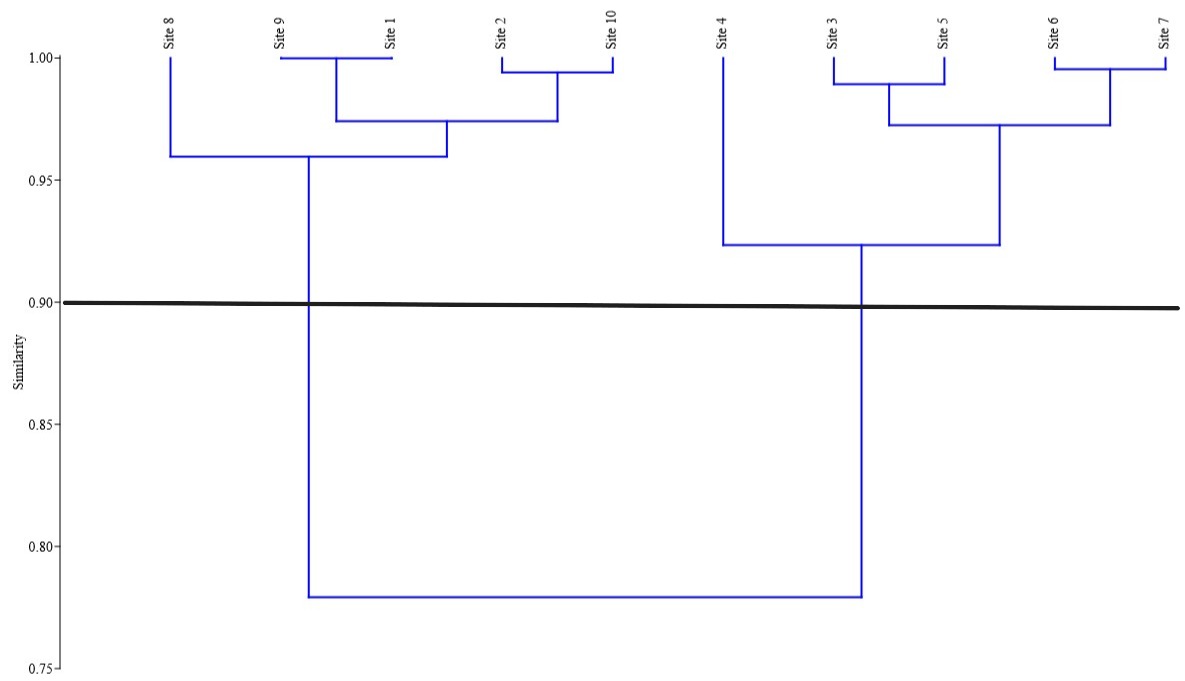
FIGURE 5| Dendrogram of similarity of sampling sites, based on the functional groups of the ichthyofauna of the Amacuzac River (obtained using the Morisita-Horn index).
Discussion
Our results comprise a first approach to understanding functional diversity in the fish community of the Amacuzac River. We identified ecological and morphological functional traits for fishes in the community, estimated several metrics of functional diversity and identified which FG are formed and how they are distributed along the river. These approaches allow simultaneous analysis of species richness, abundance and their life history, along with characteristics that influence fishes’ functionality in the river ecosystem (Violle et al., 2007; Gómez-Ortiz, Moreno, 2017). This could allow better understanding of communities under different disturbance scenarios. Analyzing diversity in an integrative way allows for a more precise understanding of the role of species in ecosystems. (Barragán et al., 2011; Cordero-Martínez et al., 2022).
Species richness showed a clear spatial pattern along the river; sites with the highest species richness also exhibited greater functional complexity, a pattern previously reported for other biological groups (Moreno et al., 2006; Barragán et al., 2011). In the Amacuzac River, sites with higher species richness were characterized by a greater number of non-native species, whereas sites with lower species richness recorded a similar proportion of native and non-native species. This highlights the contribution of non-native species to maintaining ecological functionality in the ecosystem. Deliberate or accidental release of fish has been constantly reported in the Amacuzac River, mainly due to the presence of aquaculture facilities (Contreras-MacBeath et al., 2020; González-Montes de Oca, 2020; Mercado-Silva et al., 2020; Cordero-Martínez et al., 2022). These invasives have contributed to replacing or increasing functional traits and diversity in the Amacuzac. While this trend has been observed elsewhere it has also been observed that the presence of non-native fishes can reduce functional traits related to forms of locomotion and the use of habitat and food resources (Souza et al., 2021).
In response to the establishment of new species, communities change by increasing the functional niche space or generating functional redundancy between species (Moreno et al., 2006; Barragán et al., 2011). In this case, in sites with lower functional complexity may contain unoccupied or underutilized functional niches, representing ecological opportunities that could be accessed by newly stablished species (Mason et al., 2005; Córdova-Tapia, Zambrano, 2015).
The functional diversity indices we explored allowed a more precise understanding of the ecological role species play in the Amacuzac. Functional evenness, which indicates how homogeneously species are distributed in a functional space (Villéger et al., 2010), was highest at site 2, located in the upstream part of the river. In this site we identified a very similar richness and abundance of native and non-native species. This suggests that the occupied functional space is being widely used, and that species are represented in a homogeneous manner when considering their functional traits. This could be a limitation to the establishment of non-native species (Mason et al., 2005) at the site. The opposite is observed at site 4, where low values of functional evenness suggest that the functional space could be underutilized. At this site, occupied functional space was dominated by A. nigrofasciata and A. istlanus. This could generate gaps in the functional space, opening the possibility for the establishment of additional non-native species (Mason et al., 2005) which are pervasive in other areas of the river. Functional redundancy between native and non-native species is observed in all sites. This is usually associated with the disappearance of native species in the ecosystem, especially when resources such as food, shelter, oviposition or breeding space are limited or when the intensity of interactions leads to one of the species being replaced. However, functional redundancy can generate greater resilience in ecosystems, giving them a greater chance of recovering in the face of possible alterations (Barragán et al., 2011; Córdova-Tapia, Zambrano, 2015). Considering this, while in the strictest sense of conservation the establishment of non-native species is a problem for ecosystems, in a system such as the Amacuzac River, which receives constant anthropogenic impacts, such as pollution, water extraction, land use change and the release of non-native species (Contreras-Balderas et al., 2008; Mejía-Mojica et al., 2012; Eufracio-Torres et al., 2026; Escandón-Calderón et al., 2018; Contreras-MacBeath et al., 2020; Mercado-Silva et al., 2020; Cordero-Martínez et al., 2022), the establishment of non-native species and associated greater functional redundancy could help the resilience of the river. The reduction in the population size of some native species would not directly lead to the disappearance of a functional group in the ecosystem.
Functional divergence allows estimation of functional similarity by considering the most dominant species in a community (Villéger et al., 2010). Sites showing higher values of functional divergence were those where dominant species presented a greater differentiation in the functional niche they occupy. Greater differentiation in the functional niche could reduce competition because of a more efficient use of resources (Córdova-Tapia, Mercado-Silva, 2019; Cadena-Mantilla, 2020). However, in the Amacuzac those species that are dominant in abundance are non-native species. This again highlights the impact that the establishment of non-native species in the river has had on the structure, composition and functionality of the native fish (Mejía-Mojica et al., 2012; Contreras-MacBeath et al., 2020; Mercado-Silva et al., 2020; Cordero-Martínez et al., 2022).
Functional dispersion (the average distance of each species to the weighted centroid considering all species in the community in the functional space (Córdova-Tapia, Mercado-Silva, 2019; Laliberté, Legendre, 2010) values were relatively low in the Amacuzac and varied little among sampling sites. This indicates that, in the context of functional traits, the most abundant species did not differ from each other. That the most abundant species belong to the Poecilidae and Cichlidae, could explain a reduced functional dispersion in the Amacuzac River, since differences in the functional traits within these families are also minimal.
Of the eight FG characterized in the Amacuzac basin, six of them present native species. This suggests that most of the functional niches were already being occupied by native species before the arrival of the non-native species. FG 1, 2, 5 and 7 are composed of more than one species. Among these, groups 1 and 5 had native and non-native species. FG 2 had two native species and group 7, only non-natives. The formation of FG with more than one species suggests that the disappearance of one of the species will not generate the disappearance of the FG since the membership of a species in a FG defines its ecological role (Barragan et al., 2011; Córdova-Tapia, Zambrano, 2015). However, the opposite occurs in FG 3 (A. balsana), FG 4 (A. aeneus), FG 6 (I. balsanus) and FG 8 (I. punctatus), formed by only one species, and with only FG 8 being represented by a non-native species. The formation of single-species FG suggests that an alteration in the system leading to that species loss, would also lead to disappearance of the FG from the system, which would result in negative ecological effects. Therefore, we highlight the importance of the presence or absence of particular species and traits, as well as species combinations with specific traits (Barragan et al., 2011; Córdova-Tapia, Zambrano, 2015).
While our description and analysis of the functional diversity of the Amacuzac offers relatively clear patterns, it is worth noting that the collection methodologies used, and the seasonality of our collections could limit the representation of all the species (and functional traits) present in the river. Further, these factors also influence the variation in body size for collected individuals, which could also influence trends in functional indices we investigated. Additionally, site-specific analyses of the diet of collected organisms could provide a better delimitation of feeding guilds in the Amacuzac. Trophic attribute information for species in the Amacuzac arises from what is known for the species in studies from across their range. Site specific information might better describe functional traits related to trophic guilds in the system and could even lead to changes in our interpretation of the functional structure we observed.
Similarity between sampling sites was mostly determined by the abundance of individuals in each FG; sampling sites with greatest similarity were those with equal abundances. Although FG 3 and 8 were present exclusively in some of the sampling sites (3 sites and 1 site, respectively), the low abundance recorded by these FG means that there is no significant difference between the sites where these exclusive FG are present or absent.
Our study describes and analyzes patterns of functional diversity of ichthyofauna along the Amacuzac River, a facet of diversity that has been scarcely explored in the basin. It highlights the importance of continuing to analyze functional diversity in this river and other bodies of water belonging to the basin and in other biological groups in the region. Likewise, it is important to extrapolate this type of research to other regions and allow for comparable metrics; such as the multiple facets of diversity that can reflect different spatial patterns when evaluating the community structure of fish, which is essential for their conservation (Zhang et al., 2023), because fish control other organisms through predation, mediate nutrient flows, and act as ecosystem engineers (Villéger et al., 2017).
References
Achong-Ramos LF. Diversidad funcional del ensamble de peces asociados a fondos rocosos en el litoral centro-norte del Perú. [PhD Dissertation]. Lima: Universidad Nacional Mayor de San Marcos. 2021. Avaliable from: https://repositorioslatinoamericanos.uchile.cl/handle/2250/4879486
Aguilar BS. Ecología del estado de Morelos: enfoque geográfico. Praxis. México. DF; 1999.
Alcaraz C, Vila-Gispert A, García-Berthou E. Profiling invasive fish species: the importance of phylogeny and human use. Divers Distrib. 2005; 11(4):289–98. https://doi.org/10.1111/j.1366-9516.2005.00170.x
Armbruster JW, Page LM. Redescription of Pterygoplichthys punctatus and description of a new species of Pterygoplichthys (Siluriformes: Loricariidae). Neotrop Ichthyol. 2006; 4(4):401–09. https://doi.org/10.1590/S1679-62252006000400003
Barragán F, Moreno CE, Escobar F, Halffter G, Navarrete D. Negative impacts of human land use on dung beetle functional diversity. PLoS ONE. 2011; 6(3):e17976. https://doi.org/10.1371/journal.pone.0017976
Barton M. Bond´s biology of fishes. Thomson Brooks/Cole, 3er Edition; 2006.
Bellwood DR, Wainwright PC, Fulton CJ, Hoey AS. Assembly rules and functional groups at global biogeographical scales. Funct Ecol. 2002; 16(5):557–62. https://doi.org/10.1046/j.1365-2435.2002.00655.x
Benejam L, Argermeier PL, Munné A, García-Berthou E. Assessing effects of water abstraction on fish assemblages in Mediterranean streams. Freshw Biol. 2009; 16(5):557–62. https://doi.org/10.1111/j.1365-2427.2009.02299.x
Blake RW. Fish functional design and swimming performance. J Fish Biol. 2004; 65(5):1183–222. https://doi.org/10.1111/j.0022-1112.2004.00568.x
Botta-Dukát Z. Rao´s quadratic entropy as a measure of functional diversity based on multiple traits. J Veg Sci. 2005; 16(5):533–40. https://doi.org/10.1111/j.1654-1103.2005.tb02393.x
Boyle KS, Horn MH. Comparison of feeding guild structure and ecomorphology of intertidal fish assemblages from central California and central Chile. Mar Ecol Progr Ser. 2006; 319:65–84. https://doi.org/10.3354/meps319065
Cadena-Mantilla DF. Descripción de la diversidad funcional de los peces de la Cuenca del Paraná 3. [PhD Dissertation]. Foz do Iguaçu. Universidad Federal da Integração Latino-Americana; 2020. Avaliable from: http://repositorioslatinoamericanos.uchile.cl/handle/2250/3839359
Chávez JM, de la Paz RM, Krishina S, Pagulaya RC, Carandag JR. New Philippine record of south American sailfin catfishes (Pisces: Loricariidae). Zootaxa. 2006; 1109(1):57–68. https://doi.org/10.11646/zootaxa.1109.1.6
Chávez-Esponda D, Miranda-Cabrera I, Varela-Nualles M, Fernández L. Utilización del análisis de cluster con variables mixtas en la selección de genotipos de maíz (Zea mays). Rev Invest Oper. 2010; 30(3):209–16.
Cheal A, Emslie M, Millerr I, Sweatman H. The distribution of herbivorous fishes on the great barrier. Mar Biol. 2012; 159:1143–54. https://doi.org/10.1007/s00227-012-1893-x
Contreras-Balderas S, Ruiz-Campos G, Schmitter-Soto JJ, Díaz-Pardo E, Contreras-MacBeath T, Medina-Soto M et al. Freshwater fishes and water status in Mexico: a country-wide appraisal. Aquat Ecosyst Health. 2008; 11(3):246–56. https://doi.org/10.1080/14634980802319986
Contreras-MacBeath T, Concepción-Bayás J, Jaramillo-Monroy F. La diversidad biológica en Morelos, Estudio del estado. Comisión Nacional para el Conocimiento y Uso de la Biodiversidad. Distrito Federal, México; 2006.
Contreras-MacBeath ET, Mejía-Mojica H, Beltrán-López RG, Mercado N. Ictiofauna. In: Comisión Nacional para el Conocimiento y Uso de la Biodiversidad, editors. La biodiversidad en Morelos. Estudio de Estado 2. Vol. II. México; 2020. p.275–82.
Cordero-Martínez G, Mercado-Silva N, García de Jesús S, Arce E, Ramírez-Ponce A, Mejía-Mojica H. Specific and taxonomic diversity of the ichthyofauna of the Amacuzac River, Morelos, Mexico. Rev Biol Trop. 2022; 70(1):290–306. https://doi.org/10.15517/rev.biol.trop..v70i1.48830
Córdova-Tapia F, Mercado-Silva N. Diversidad funcional de peces en ambientes antropizados. In: Ornelas-García CP, Álvarez F, Wegier A, editors. Antropización: primer análisis integral IBUNAM-CONACYT. 2019; p.109–23. https://doi.org/10.22201/ib.9786073020305e.2019.c6
Córdova-Tapia F, Zambrano L. La diversidad funcional en la ecología de comunidades. Ecosistemas. 2015; 24(3):78–87. https://doi.org/10.7818/ECOS.2015.24-3.10
Córdova-Tapia F, Hernández-Marroquín V, Zambrano L. The role of enviromental filtering in the functional structure of fish communities in tropical wetlands. Ecol Freshw Fish. 2017; 27(2):522–32. https://doi.org/10.1111/eff.12366
Cornelissen J, Layorel S, Garnier E, Díaz S, Buchmann N, Gurvich D, Poorter H. A handbook of protocols for standardized and easy measurement of plant functional traits worldwide. Aust J Bot. 2003; 51(4):335–80. https://doi.org/10.1071/BT02124
De Bello F, Carmona CP, Dias AT, Götzenberger L, Moretti M, Berg MP. Handbook of trait-based ecology: from theory to R tools. Cambridge University Press; 2021.
Díaz-Rojas A, Díaz-Pardo E. Biología reproductiva del bagre del balsas Ictalurus balsanus (Pisces: Ictaluridae) del Río Amacuzac, Morelos. Anales de la Escuela Nacional de Ciencias Biológicas. Instituto Politécnico Nacional. 1991; 34:173–89.
Dumay O, Tari PS, Tomasini JA, Mouillot D. Functional groups of lagoon fish species in Languedoc Roussillon, southern France. J Fish Biol. 2004; 64(4):970–83. https://doi.org/10.1111/j.1095-8649.2004.00365.x
Elleouet JC, Albouy C, Ben Rais Lasram F, Mouillot D, Leprieur F. A trait-based approach for assessing and mapping niche overlap between native and exotic species: the Mediterranean coastal fish fauna as a case study. Divers Distrib. 2014; 20(11):1333–44. https://doi.org/10.1111/ddi.12235
Escandón-Calderón J, Ordóñez-Díaz JAB, Nieto de Pascual Pola MCC, Ordóñez Díaz, María de Jesús. Cambio en la cobertura vegetal y uso del suelo del 2000 al 2009 en Morelos, México. Rev Mex Cienc Forestales. 2018; 9(46):27–53. https://doi.org/10.29298/rmcf.v9i46.135
Eufracio-Torres AE, Wehncke EV, López-Medellin X, Maldonado-Almanza B. Fifty years of enviromental changes of the Amacuzac riparian ecosystem: a social perceptions and historical ecology approach. Ethnobiol Conserv. 2016; 5(8):1–35. https://doi.org/10.15451/ec2016-11-5.8-1-35
Farias AA, Jaksic FM. Low functional richness and redundancy of a predator assemblage in native forest fragments of Chiloe Island, Chile. J Anim Ecol. 2011; 80(4):809–17. https://doi.org/10.1111/j.1365-2656.2011.01824.x
Fish FE, Lauder GV. Passive and active flow control by swimming fishes and mammals. Annu Rev Fluid Mech. 2006; 38:193–224. https://doi.org/10.1146/annurev.fluid.38.050304.092201
Flynn DBF, Gogol-Prokurat M, Nogeire T, Molinari N, Richers BT, Lin BB et al. Loss of functional diversity under land use intensification across multiple taxa. Ecol Lett. 2009; 12:22–33. https://doi.org/10.1111/j.1461-0248.2008.01255.x
Fulton CJ. Swimming speed performance in coral reef fishes: field validations reveal distinct functional groups. Coral Reefs. 2007; 26:217–28. https://doi.org/10.1007/s00338-007-0195-0
Gómez-Ortiz Y, Martin-Regalado CN, Ortega-Martínez IJ, Pérez-Hernández CX. La diversidad funcional de las comunidades ecológicas. In: Moreno CE, editor. La biodiversidad en un mundo cambiante: fundamentos teóricos y metodológicos para su estudio. Universidad Autónoma del Estado de Hidalgo/Libermex. Ciudad de México; 2019. p.237–64.
Gómez-Ortiz Y, Moreno CE. La diversidad funcional en comunidades animales: una revisión que hace énfasis en los vertebrados. Anim Biodiv Conserv. 2017; 40(2):165–74. https://doi.org/10.32800/abc.2017.40.0165
Gower JC. A general coefficient of similarity and some of its properties. Biometrics. 1971; 27:623–37.
Hammer Ø, Harper DAT. Paleontological data analysis. Blackwell Publishing. 2006. https://doi.org/10.1002/9780470750711
Herrera-Valdivia E, López-Martínez J, Castillo-Vargasmachuca S, García-Juárez AR. Diversidad taxonómica y funcional en la comunidad de peces de la pesca de arrastre de camarón en el norte del Golfo de California, México. Rev Biol Trop. 2016; 64(2):587–602. https://dx.doi.org/10.15517/rbt.v63i3.15852
Hood JM, Vanni MJ, Flecker AS. Nutriment recycling by two phosphorus-rich grazing catfish: the potential for phosphorus-limitation of fish growth. Ecosyst Ecol. 2005; 146:247–57. https://doi.org/10.1007/s00442-005-0202-5
Hooper DU, Chapin FS, Ewel JJ, Hector A, Inchausti P, Lavorel S. Effects of biodiversity on ecosystem functioning: a consensus of current knowledge. Ecol Monogr. 2005; 75(1):3–35. https://doi.org/10.1890/04-0922
Karpouzi VS, Stergiou KI. The relationship between mouth size and shape and body length for 18 species or marine fishes and their trophic implications. J Fish Biol. 2003; 62(6):1353–65. https://doi.org/10.1046/J.1095-8649.2003.00118.X
Karr JR, Rossano EM. Applying public health lessons to protect river health. Ecol Civil Eng. 2001; 4(1):3–18. https://doi.org/10.3825/ece.4.3
Laliberté E, Legendre P. A distance-based framework for measuring functional diversity from multiple traits. Ecology. 2010; 91(1):299–305. https://doi.org/10.1890/08-2244.1
Laliberté E, Legendre P, Shipley B, Laliberté ME. Package ‘fd’. Measuring functional diversity from multiple traits, and other tools for functional ecology. R Package Version 1.0-12. 2014.
Laliberté E, Wells JA, DeClerck F, Metcalfe DJ, Catterall CP, Queiroz C et al. Land-use intensification reduces functional redundancy and response diversity in plant communities. Ecol Lett. 2010; 13(1):76–86. https://doi.org/10.1111/j.1461-0248.2009.01403.x
Larentis C, Kotz Kliemann BC, Neves MP, Delariva RL. Effects of human disturbance on habitat and fish diversity in Neotropical streams. PLoS ONE. 2022; 17(9):e0274191. https://doi.org/10.1371/journal.pone.0274191
Lauder GV, Madden PGA. Fish locomotion: kinematics and hydrodynamics of flexible foil-like fins. Exp Fluids. 2007; 43:641–53. https://doi.org/10.1007/s00348-007-0357-4
Lefcheck JS, Buchheister A, Laumann KM, Stratton MA, Sobocinski KL, Chak STC et al. Dimensions of biodiversity in Chesapeake Bay demersal fishes: patterns and drivers through space and time. Ecosphere. 2014; 5(2):14–48. https://doi.org/10.1890/ES13-00284.1
Lisney TJ, Collin SP. Relative eye size in elasmobranchs. Brain Beha Evol. 2007; 69(4):266–79. https://doi.org/10.1159/000100036
Mammola S, Carmona CP, Guillerme T, Cardoso P. Concepts and applications in functional diversity. Funct Ecol. 2021; 35(9):1869–85. https://doi.org/10.1111/1365-2435.13882
Martínez-Ortega RM, Tuya-Pendás LC, Martínez-Ortega M, Pérez-Abreu A, María-Cánovas A. El coeficiente de correlación de los rangos de Spearman caracterización. Rev Haban Cienc Méd. 2009; 8(2). Avaliable from: http://scielo.sld.cu/scielo.php?script=sci_arttext&pid=S1729-519X2009000200017&lng=es
Mason NWH, Lanoiselée C, Mouillot D, Argiller C. Functional characters combined with null models reveal inconsistency in mechanisms of species turnover in lacustrine fish communities. Oecologica. 2007; 153:441–52. https://doi.org/10.1007/s00442-007-0727-x
Mason NWH, Mouillot D, Lee WG, Wilson B. Functional richness, functional evenness and functional divergence: the primary components of functional diversity. Oikos. 2005; 111:112–18. https://doi.org/10.1111/j.0030-1299.2005.13886.x
McGill BJ, Enquist BJ, Weiher E, Westoby M. Rebuilding community ecology from functional traits. Trends Ecol Evol. 2006; 21(4):178–84. https://doi.org/10.1016/j.tree.2006.02.002
Meek SE. The freshwater fishes or Mexico north of the isthmus of Tehuantepec. Chicago: Field Columbian Museum; 1904.
Mejía-Mojica H, Contreras-MacBearth T, Ruiz-Campos G. Relationship between environmental and geographic factors and the distribution of exotic fishes in tributaries or the Balsas River basin, Mexico. Environ Biol Fish. 2015; 98:611–21. https://doi.org/10.1007/s10641-014-0298-8
Mejía-Mojica H, Paredes-Lira ME, Beltrán-López RG. Primer registro y establecimiento del bagre de canal Ictalurus punctatus (Siluriforme: Ictaluridae) en un tributario del Río Balsas, México. Hidrogiológica. 2013; 23(3):456–59.
Mejía-Mojica H, Rodríguez-Romero FJ, Díaz-Pardo E. Recurrencia histórica de peces invasores en la Reserva de la Biósfera Sierra de Huautla, México. Rev Biol Trop. 2012; 60(2):669–81. Avaliable from: http://www.redalyc.org/articulo.oa?id=44923872013
Mejía LS, Garzón-Ferreira J. Estructura de comunidades de peces arrecifales en cuatro atolones del Archipiélago de San Andrés y Providencia (Caribe sur occidental). Rev Biol Trop. 2000; 48:883–96.
Mercado-Silva N, Mejía-Mojica H, Romero-Espín LT. Los peces invasores como amenaza a los recursos dulceacuícolas. In: Comisión Nacional para el Conocimiento y Uso de la Biodiversidad, editors. La biodiversidad de Morelos, estudio de estado 2 (Vol. II). México; 2020. p.225–29.
Mercado-Silva N, Ramírez C, Rosales-Quintero N, Córdova-Tapia F. Caracterización y uso de los atributos funcionales de la comunidad de peces de la cuenca del Río Lacantún, Chiapas. Rev Mex Biodivers. 2024; 95:e955239. https://doi.org/10.22201/ib.20078706e.2024.95.5239
Moreno CE. Métodos para medir la biodiversidad. Manuales y Tesis SEA. Vol. 1. Zaragoza; 2001.
Moreno CE, Arita HT, Solís L. Morphological assembly mechanisms in neotropical bat assemblages and ensembles within a landscape. Oecologia. 2006; 149:133–40. https://doi.org/10.1007/s00442-006-0417-0
Mouillot D, Dumay O, Tomasini JA. Limiting similarity, niche filtering and functional diversity in brackish lagoon fish communities. Estuar Coast Shelf Sci. 2007; 71(3–4):443–56. https://doi.org/10.1016/j.ecss.2006.08.022
Naeem S. Species redundancy and ecosystem reliability. Conserv Biol. 2002; 12(1):39–45. https://doi.org/10.1111/j.1523-1739.1998.96379.x
Ocampo-Molina L, López-Medellín X, Maldonado-Almanza B, Wehncke EV. Diferencias sociales y de conocimiento en niños de educación básica en comunidades del río Amacuzac, Morelos. Reg Soc. 2019; 31:e1047. https://doi.org/10.22198/rys2019/31/1047
Palacios-Salgado DS. Patrones latitudinales de composición y diversidad funcional de peces asociados a la pesca de camarón del Pacífico Mexicano. [PhD Dissertation]. La Paz: Instituto Politécnico Nacional; 2011. Avaliable from: www.repositoriodigital.ipn.mx/jspui/handle/123456789/16352
Pavoine S, Vallet J, Dufour AB, Gachet S, Daniel H. On the challenge of treating various types of variables: application for improving the measurement of functional diversity. Oikos. 2009; 118:391–402.
Payan-Alcacio JA. Diversidad funcional de la comunidad de peces en hábitat de manglar de la Bahía de La Paz, B. C. S. México. [PhD Dissertation]. La Paz: Instituto Politécnico Nacional; 2015. Avaliable from: www.repositoriodigital.ipn.mx/jspui/handle/123456789/21690
Pease AA, González-Díaz AA, Rodiles-Hernández R, Winemiller KO. Functional diversity and trait-environment relationships of stream fish assemblages in a large tropical catchment. Freshw Biol. 2012; 57(5):1060–75. https://doi.org/10.1111/j.1365-2427.2012.02768.x
Petchey OL, Gaston KJ. Functional diversity: back to basics and looking forward. Ecol Lett. 2006; 9(6):741–58. https://doi.org/10.1111/j.1461-0248.2006.00924.x
Pilger TK, Gido KB, Propst DL. Diet and trophic niche overlap of native and nonnative fishes in the Gila River, USA: implications for native fish conservation. Ecol Freshw Fish. 2010; 19(2):300–21. https://doi.org/10.1111/j.1600-0633.2010.00415.x
Pouilly M, Lino F, Bretenoux JG, Rosales C. Dietary-morphological relationships in a fish assemblage of the Bolivian Amazonian floodplain. J Fish Biol. 2003; 62(5):1137–58. https://doi.org/10.1046/j.1095-8649.2003.00108.x
Ramírez-Santillán KC. Ecomorfología y estructura trófica de los ensambles de peces a lo largo de un gradiente ambiental en la cuenca del Río Amacuzac, Morelos. [PhD Dissertation]. Cuernavaca: Universidad Autónoma del Estado de Morelos; 2022. Avaliable from: www.riaa.uaem.mx/xmlui/handle/20.500.12055/2466
Reech Y, Rochet MJ, Trenkel VM, Jennings S, Pinnegar JK. Use of morphological characteristics to define functional groups of predatory fishes in the Celtic Sea. J Fish Biol. 2013; 83(2):355–77. https://doi.org/10.1111/jfb.12177
Rice J, Dann N, Gislason H, Pope J. Does functional redundancy stabilize fish communities? J Mar Sci. 2013; 70(4):734–42. https://doi.org/10.1093/icesjms/fst071
Rosenfeld JS. Functional redundancy in ecology and conservation. Oikos. 2002; 98(1):156–62. https://doi.org/10.1034/j.1600-0706.2002.980116.x
Salgado-Negret B, Paz H. La ecología funcional como aproximación al estudio, manejo y conservación de la biodiversidad: protocolos y aplicaciones. Bogotá. Editorial Alexander Von Humboldt; 2015.
Sgarlatta MP. Análisis de la diversidad taxonómica y funcional de la comunidad de peces de arrecifes rocosos y de bosques de macroalgas de Baja California, México. [PhD Dissertation]. Baja California: Centro de Investigación Científica y de Educación Superior de Ensenada; 2015. Available from: https://cicese.repositorioinstitucional.mx/jspui/handle/1007/1536
Sibbing FA, Nagelkerke LAJ. Resource partitioning by Lake Tana barbs predicted from fish morphometrics and prey characteristics. Rev Fish Biol Fish. 2001; 10(4):393–437. https://doi.org/10.1023/A:1012270422092
Schmitter-Soto JJ. A systematic revision of the genus Archocentrus (Perciformes: Cichlidae), with the description of two new genera and six new species. Zootaxa. 2007; 1603(1):1–78. https://doi.org/10.11646/zootaxa.1603.1.1
Soares BE, Ruffeil TOB, Montag LFA. Ecomorphological patterns of the fishes inhabiting the tide pools of the Amazonian Coastal Zone, Brazil. Neotrop Ichthyol. 2013; 11(4):845–58. https://doi.org/10.1590/S1679-62252013000400013
Souza CPD, Rodrigues Filho CADS, Barbosa FAR, Leitão RP. Drastic reduction of the functional diversity of native ichthyofauna in a neotropical lake following invasion by piscivorous fishes. Neotrop Ichthyol. 2021; 19(3):e210033. https://doi.org/10.1590/1982-0224-2021-0033
Troitiño E, Giorgi A, Costa C. ¿Es importante proteger afluentes del rio Reconquista? In: Tancredi E, Da Costa-Pereira N, editors. Dimensiones humanas del cambio ambiental en Argentina. ANCYPT-UNLu; 2007. p.267–74.
Trujillo-Jiménez P. Trophic spectrum of the cichlids Cichlasoma (Parapetenia) istlanum and Cichlasoma (Archocentrus) nigrofasciatum in the Amacuzac River, Morelos, Mexico. J Freshw Ecol. 1998; 13(4):465–73. https://doi.org/10.1080/02705060.1998.9663643
Trujillo-Jiménez P, Castro-Lara MA. Dieta de la carpa Notropis moralesi (Pisces: Cyprinidae) en el Río Amacuzac, Morelos, México. Rev Biol Trop. 2008; 57(1–2):195–209.
Trujillo-Jiménez P, López-Lopez E, Díaz-Pardo E, Camargo JA. Patterns in the distribution of fish assemblages in Rio Amacuzac, Mexico: influence of abiotic factors and biotic factors. Rev Fish Biol Fish. 2009; 20(4):457–69. https://doi.org/10.1007/s11160-009-9153-y
Vargas S, Soares D, Guzmán NB. La gestión del agua en la cuenca del Río Amacuzac: diagnósticos, reflexiones y desafíos. Instituto Mexicano de Tecnología del Agua, Universidad Autónoma del Estado de Morelos, Morelos, México; 2006. Available from: http://hdl.handle.net/20.500.12013/1641
Villéger S, Brosse S, Mouchet M, Mouillot D, Vanni MJ. Functional ecology of fish: current approaches and future challenges. Aquat Sci. 2017; 79:783–801. https://doi.org/10.1007/s00027-017-0546-z
Villéger S, Mason NWH, Mouillot D. New multidimensional functional diversity indices for a multifaceted framework in functional ecology. Ecology. 2008; 89:2290–301. https://doi.org/10.1890/07-1206.1
Villéger S, Miranda JR, Hernández DF, Mouillot D. Contrasting changes in taxonomic vs. functional diversity of tropical fish communities after habitat degradation. Ecol Appl. 2010; 20(6):1512–22. https://doi.org/10.1890/09-1310.1
Violle C, Nava ML, Vile D, Kazakou E, Fortunel C, Hummel I et al. Let the concept of trait be functional. Oikos. 2007; 116:882–92. https://doi.org/10.1111/j.0030-1299.2007.15559.x
Weiher E, Freund D, Bunton T, Stefanski A, Lee T, Bentivenga S. Advances, challenges and a developing synthesis of ecological community assembly theory. Philos Trans R Soc Lond. 2011; 366(1576):2403–13. https://doi.org/10.1098/rstb.2011.0056
Willis SC, Winemiller KO, López-Fernández H. Habitat structural complexity and morphological diversity of fish assemblages in a Neotropical floodplain river. Oecologia. 2005; 142:284–95. https://doi.org/10.1007/s00442-004-1723-z
Winemiller KO. Ecomorphological diversification in lowland freshwater fish assemblages from five biotic regions. Ecol Monogr. 1991; 61(4):343–65. https://doi.org/10.2307/2937046
Winemiller KO. Life history strategies, population regulation, and implications for fisheries management. Can J Fish Aquat Sci. 2005; 62(4):872–85. https://doi.org/10.1139/f05-040
Winemiller KO, Rose KA. Patterns of life-history diversification in North American fishes: implications for population regulation. Can J Fish Aquat Sci. 1992; 49(10):2196–218. https://doi.org/10.1139/f92-242
Zhang D, Qiao J, He J, Chu L, Yan Y. A longitudinal gradient in the taxonomic, functional, and phylogenetic diversity of freshwater fish in a subtropical river system. Hydrobiologia. 2023; 850(5):1175–87. https://doi.org/10.1007/s10750-023-05153-2
Authors

Gabriel Cordero-Martínez1, Norman Mercado-Silva2 , Ilse J. Ortega-Martínez3, Sandra García de Jesús4 and Juan Suárez-Sánchez1
[1] Laboratorio de Recursos Naturales, Facultad de Agrobiología, Universidad Autónoma de Tlaxcala, km 10.5 carretera San Martin Texmelucan, 90720, San Felipe Ixtacuixtla, Tlaxcala, Mexico. (GCM) gabriel.cordero.martinez91@outlook.com, (JSS) juan.suarez.s@uatx.mx.
[2] Centro de Investigación en Biodiversidad y Conservación, Universidad Autónoma del Estado de Morelos, Avenida Universidad 1001, Colonia Chamilpa, 62209, Cuernavaca Morelos, Mexico. (NMS) norman.mercado@uaem.mx (corresponding author).
[3] Red de Ecoetología, Instituto de Ecología A.C. Carretera antigua a Coatepec 351, El Haya, 91070, Xalapa, Veracruz, Mexico. (IJOM) ilseormtz@gmail.com.
[4] Laboratorio de Zoología, Facultad de Agrobiología, Universidad Autónoma de Tlaxcala, Km 10.5 carretera San Martin Texmelucan, 90720, San Felipe Ixtacuixtla, Tlaxcala, Mexico. (SGJ) sandra.garcia.dej@uatx.mx.
Authors’ Contribution 

Gabriel Cordero-Martínez: Conceptualization, Data curation, Formal analysis, Funding acquisition, Investigation, Methodology, Project administration, Resources, Software, Supervision, Validation, Visualization, Writing-original draft, Writing-review and editing.
Norman Mercado-Silva: Conceptualization, Funding acquisition, Investigation, Methodology, Project administration, Resources, Supervision, Validation, Visualization, Writing-original draft, Writing-review and editing.
Ilse J. Ortega-Martínez: Conceptualization, Data curation, Formal analysis, Investigation, Methodology, Project administration, Software, Supervision, Validation, Visualization, Writing-original draft, Writing-review and editing.
Sandra García de Jesús: Conceptualization, Data curation, Investigation, Methodology, Project administration, Supervision, Validation, Visualization, Writing-original draft, Writing-review and editing.
Juan Suárez-Sánchez: Investigation, Methodology, Validation, Visualization, Writing-original draft, Writing-review and editing.
Ethical Statement
Authors declare that they all agree with this publication and have made contributions that justify their authorship. They also manifest that they have complied with all relevant ethical and legal requirements and procedures, including minimizing harm to animals in the process of generating information to satisfy the objectives of this research. Collections were carried out under registration assigned to collection MOR-CC-243-201.
Competing Interests
The author declares no competing interests.
Data availability statement
The authors confirm that the data supporting the findings of this study are available on request from the main author, Gabriel Cordero Martínez.
AI statement
Other than those AI tools embedded in word editing and analyses software (i.e., Microsoft Word, Excel), the authors did not use any AI-assisted technologies in the creation of this manuscript or its figures.
Funding
The National Council of Science and Technology (Mexico) supported GCM through scholarship Number 784551. The Program for Professional Development of Teachers Project DSA/103.5/15/3073 to NMS supported field work.
Supplementary Material
Supplementary material SUP
Peer Review
How to cite this article
Cordero-Martínez G, Mercado-Silva N, Ortega-Martínez IJ, Jesús SG, Suárez-Sánchez J. Functional diversity of fish communities in the Amacuzac River, Morelos, Mexico. Neotrop Ichthyol. 2026; 24(2):e250196. https://doi.org/10.1590/1982-0224-2025-0196
Copyright
This is an open access article under the terms of the Creative Commons Attribution License, which permits use, distribution and reproduction in any medium, provided the original work is properly cited.
Distributed under
Creative Commons CC-BY 4.0

© 2025 The Authors.
Diversity and Distributions Published by SBI
 Accepted February 10, 2026
Submitted December 14, 2025
Epub July 20, 2026