
 Paulo Santos Pompeu1
  , Fábio Mineo Suzuki2, Ivo Gavião Prado2, Andressa Mendes Silva-Sene1,2, Daniel Cardoso Carvalho3, Heron Oliveira Hilário3 and Carlos Bernardo Mascarenhas Alves4
PDF: Download Here | Supplementary: Sup | Cite this article
Associate Editor: Andrea Bialetzki
Section Editor: Fernando Pelicice
Editor-in-chief: José Birindelli
Abstract
Este estudo avaliou o papel dos tributários como áreas de reprodução para peixes na bacia do rio das Velhas, um afluente do rio São Francisco altamente impactado. O ictioplâncton foi amostrado a cada três dias, entre novembro de 2022 e fevereiro de 2023, em seis tributários com diferentes níveis de preservação ambiental. Técnicas moleculares (DNA barcoding e metabarcoding) identificaram 36 táxons, incluindo todas as espécies migradoras conhecidas da bacia do rio das Velhas. Ovos e larvas foram encontrados em todos os tributários, com predominância de estágios iniciais de desenvolvimento. Os tributários mais preservados e com maior vazão, em especial os rios Paraúna/Cipó e Curimataí, foram identificados como áreas-chave de desova, sustentando maiores densidades de ictioplâncton e abrigando eventos reprodutivos exclusivos de algumas espécies migradoras de longa distância. Os picos de desova estiveram associados a pulsos de inundação no rio das Velhas, embora a sincronia entre os tributários tenha sido rara. Os resultados destacam a importância ecológica dos tributários preservados para a reprodução dos peixes e a necessidade de manter a conectividade hidrológica. Em especial, a conservação do rio Paraúna/Cipó é crucial para a manutenção da diversidade de peixes e dos processos de recrutamento na bacia do rio das Velhas, especialmente diante das ameaças contínuas, como a poluição e a potencial fragmentação dos rios.
Palavras-chave: Ictioplâncton, Espécies migradoras, Rio das Velhas, Sítios de desova.
Introduction
In South America, long-distance migratory fish are of major importance for fisheries due to their large body size and abundance (Barletta et al., 2015), in addition to providing numerous other ecosystem services (Pelicice et al., 2023). Although they represent only a small percentage of the local fish fauna (Agostinho et al., 2003; Sato, Godinho, 2003), these species are considered high-priority targets for conservation efforts (Barletta et al., 2015). The main threats to this group are associated with alterations to the natural hydrological regime of rivers, fragmentation of aquatic habitats, pollution, introduction of non-native species, and overfishing (Agostinho et al., 2007b; Barletta et al., 2015). As a result, some of these species, such as Brycon orbignyanus and Pseudoplatystoma corruscans, are already listed as threatened with extinction in Brazil (MMA, 2022), due to severe population declines observed over recent decades (Godinho, Godinho, 2003; Oliveira et al., 2017).
In general, the life cycle of most neotropical freshwater migratory fish species involves the upstream movement of adults to spawning areas at the onset of the flood season, followed by a return to feeding grounds after reproduction (Agostinho et al., 2003; Godinho, Pompeu, 2003; Harvey, Carolsfeld, 2003; Lopes et al., 2018; Ropke et al., 2024). The tributaries are among the main spawning areas for fish (Corrêa et al., 2011), as well the upper portions of each basin. For some species, reproductive homing behavior (return to the same spawning sites throughout their lives) has already been detected (Batista, Alves‑Gomes, 2006; Godinho, Kynard, 2006; Godinho et al., 2007; Duponchelle et al., 2016; Peressin et al., 2023).
Spawning typically coincides with river discharge peaks, and the individuals in early life stages are transported downstream, developing mostly in floodplains lakes, which serve as their main nursery habitats due to higher water temperatures, abundant food, and shelter (Agostinho et al., 2003). Delayed entry of larvae into floodplains, after complete absorption of the yolk sac, can result in starvation (Hunter, 1981; Queiroz et al., 2022). Conversely, premature entry, before larvae have developed sufficient swimming ability to maintain position in the water column, can also lead to mortality, as they depend on active movement to remain suspended in lentic environments (Queiroz et al., 2022) and tend to sink to the bottom, where conditions are unfavorable for survival (Agostinho et al., 2007a). Consequently, when floodplains are not distributed over long stretches of the river, it is expected that spawning sites are placed upstream, in locations that are consistent with the time-related distance regions that correspond to the optimal timing for larval development and subsequent entry into floodplains (e.g., Lopes et al., 2019a).
Based on their life cycle, it is evident that the maintenance of migratory fish populations depends not only on hydrological connectivity and the preservation of the natural flow regime (Barletta et al., 2015), but also on the conservation of their critical habitats, particularly spawning sites (Nakatani et al., 2001; Pompeu et al., 2012). Several challenges raise to identify these sites, including the need for high-frequency sampling, since spawning events may occur within short and unpredictable temporal windows, and the difficulty in identifying early developmental stages (Pompeu et al., 2023). Regarding the latter, recent advances in molecular tools have allowed progress in this area by enabling highly precise species-level identification of fish eggs and larvae at an increasingly cheaper costs (Becker et al., 2015; Carvalho, 2022; Pompeu et al., 2023).
In this context, assessing the presence of spawning sites for migratory species in the Velhas River basin is of particular importance. This river is the longest tributary of the São Francisco River and drains the Metropolitan Region of Belo Horizonte (MRBH), home to over 4.5 million inhabitants (Pompeu et al., 2025). There is currently an increase in the volume of sewage treated and investments in improving the quality of treatment. Despite the substantial domestic and industrial wastewater loads, with significant impacts on local fish communities (Alves, Pompeu, 2010; Carvalho et al., 2020), the Velhas River still supports populations of several migratory species (Pompeu et al., 2025).
The presence of juveniles in several floodplain lakes in the lower reaches of the Velhas River (Nestler et al., 2012) supports the possibility of recruitment of migratory species in the basin. However, the existence of breeding sites has never been evaluated. Therefore, in this study, we investigated the temporal and spatial variation in density and species composition of fish eggs and larvae in tributaries of the Velhas River. We tested the hypothesis that these tributaries serve as spawning sites for multiple species, including long-distance migratory ones, thus predicting the predominance of eggs across these environments (Makrakis et al., 2022). Additionally, we evaluated whether those with higher flow and better conservation status are the most important as spawning sites. We also tested whether spawning events occur synchronously in the studied tributaries, to take advantage of possible flood pulses of the Velhas River.
Material and methods
Study area. This study was conducted in six tributaries of the Velhas River, one of the main tributaries of the São Francisco River (Pompeu et al., 2025) (Fig. 1). The Velhas River basin covers approximately 29,000 km² and stretches for about 800 km, draining an area marked by significant environmental diversity and intense human occupation (Macedo, Magalhães, 2007; Alves, Pompeu, 2010). Although its water quality is poor (Pinto et al., 2019), the basin remains largely free of large dams, and its hydrological connectivity and flow regime are still relatively close to natural conditions (Pompeu et al., 2005; Santos et al., 2012). Furthermore, in its middle reaches, the river is fed by well-preserved tributaries (Alves, Pompeu, 2010), which have been hypothesized as potential spawning sites.

FIGURE 1| Map of the study area, showing the locations of the sampling sites in the Velhas River basin, Minas Gerais, Brazil.
The studied tributaries include rivers draining the middle and lower courses of the basin, and they vary in size and conservation status (Tab. 1). Those on the right bank are bigger (Curimataí, Pardo Grande, and Paraúna/Cipó) and better preserved, being under the direct influence of the Southern Espinhaço Mountain Range (Verdi et al., 2015), with more than 60% of their basin with preserved native vegetation (IGAM, 2022). Their water is slightly acidic with lower levels of conductivity (CBH Rio das Velhas, 2014). Among them, the Paraúna/Cipó River stands out as the largest and drains the Serra do Cipó National Park. In contrast, the left-bank tributaries (Bicudo, Onça, and Maquiné) are more influenced by agriculture and urban areas (> 60%) (CBH Rio das Velhas, 2014). Their water is neutral or slightly alkaline, with higher levels of conductivity and phosphorous (IGAM, 2022).
TABLE 1 | Location, land use, average streamflow, and water quality in the six sampled tributaries (CBH Rio das Velhas, 2014; IGAM, 2022).
| Left bank tributaries | Right bank tributaries | ||||
Maquiné | Onça | Bicudo | Curimataí | Pardo | Paraúna/Cipó | |
Coordinates (UTM) | ||||||
N (23K) | 7922526 | 7899017 | 7991551 | 7998704 | 7984323 | 7951016 |
E | 585900 | 593756 | 548271 | 573072 | 582707 | 591811 |
Flow (m3/s) | 8.60 | 8.74 | 20.26 | 28.76 | 28.98 | 42.48 |
Length (km) | 90.45 | – | 149 | – | – | 150 |
Channel width at sampling location (m) | 5 | 12 | 15 | 30 | 41 | 71 |
Distance from the sampling location to the river mouth (km) | 3.7 | 2.3 | 11.1 | 12.8 | 6.3 | 5.8 |
Land cover | ||||||
% native | 16.7 | 27.6 | 34.0 | 60.1 | 62.4 | 73.3 |
% agriculture | 82.1 | 72.2 | 65.5 | 38.7 | 37.5 | 26.6 |
% urban | 1.3 | 0.2 | 0.5 | <0.1 | <0.1 | <0.1 |
Water quality | ||||||
Conductivity (ms) | – | 300.4 | 96.5 | 40.9 | 58.3 | 65.2 |
Dissolved O2 (PPM) | – | 7.9 | 7.1 | 7.4 | 7.9 | 7.6 |
Temperature | – | 24.6 | 22.4 | 24.5 | 24.4 | 24.6 |
pH | – | 7.5 | 7.0 | 6.5 | 6.8 | 6.8 |
Phosphorous (PPM) | – | 0.13 | 0.07 | 0.07 | 0.04 | 0.05 |
Despite the long history of environmental degradation in the Velhas River Basin, especially in the section that crosses the Metropolitan Region of Belo Horizonte, the tributaries still play a key role in maintaining aquatic biodiversity. Estimates indicate that more than 75% of the fish species in the basin inhabit these relatively well-preserved tributaries, including endemic and threatened species (Alves, Pompeu, 2010). Furthermore, the absence of dams along the main river course and the hydrological connectivity between the tributaries and the Velhas River support natural processes such as migration and reproduction of rheophilic species (Nestler et al., 2012). The few small hydropower plants that exist are in headwaters, near natural barriers (waterfalls).
Sampling. Ichthyoplankton sampling was carried out from November 15, 2022, to February 16, 2023. The collections were carried out every three days, in the late afternoon (from 5:00 to 7:00 pm), at all six points located from 2.3 to 12.8 km from the tributaries mouth in Velhas River. The 3-day collection interval ensured that each sample represented a potentially independent spawning event since the hatching time of migratory species of the basin are always less than 24 h (Sato et al., 2003). Such samplings were conducted with the assistance of local residents who were trained for this purpose and were regularly supervised.
An ichthyoplankton conical net (40 cm in diameter), equipped with a flow meter, was deployed in the area exhibiting the highest current velocity (thalweg) for 10 min at a depth of 0.5 m. Collected samples were preserved in 600-mL plastic containers filled with absolute ethanol and subsequently transported to the laboratory for screening using a Bogorov plate under a stereomicroscope.
Densities were calculated for each sample and standardized to the number of individuals per m³ of filtered water (Nakatani et al., 2001). All density calculations were obtained from the total counts of the raw samples (prior to molecular analyses). Eggs and larvae were classified according to their developmental stage (Eggs: Initial cleavage, Initial embryo, Free tail, Final embryo, Larvae: Yolk-sac larvae, Preflexion, Flexion and Postflexion), following Nakatani et al. (2001) and Orsi et al. (2016). Before the molecular analysis, each larva was also morphologically identified to the lowest possible taxonomic level according to the same authors.
Molecular analysis. After screening and separation, samples were subjected to molecular identification using DNA barcoding (i.e., using the COI gene obtained from a single organism) or DNA metabarcoding (i.e., high-throughput DNA sequencing of a pool of organisms), depending on the number of individuals present in each sample. All pools with less than five individuals had each larvae/egg processed individually by DNA barcoding. On the other hand, all pools with more than five individuals were analyzed as a bulk sample by DNA metabarcoding. DNA sequences and data curation spread sheets are available at Zenodo: 10.5281/zenodo.15692742
DNA barcoding. DNA extraction from fish eggs and larvae was performed by heating with proteinase K solution and CHELEX 100® resin (Sigma). Each sample was incubated in a solution with 200 µL of ultrapure water, 0.2 g of CHELEX 100® resin (Sigma), and 4 µL of Proteinase K, at a temperature of 55°C for 90 min. Subsequently, the solution was denatured at 98°C for 5 min, centrifuged for 30 sec at 2,000 rpm, and the supernatant containing the extracted DNA was removed and stored in a freezer at -20°C. Polymerase chain reactions (PCR) for the Cytochrome oxidase subunit I (COI) gene were performed using the primers Fish F1 (TCAACCAACCA CAAAGACATTGGCAC) and Fish R1 (TAGACTTCTGGGTGGCCAAAGAATCA) (Ward et al., 2005) in a thermocycler (Veriti®, Well Thermal Cycler, Applied Biosystems®) with a final volume of 15 µL composed of 11.0 µL of ultrapure water (Promega®), 1.5 µL of 10X buffer containing 0.45 µL of MgCl2, 1.0 µL of template DNA, 0.3 µL of dNTP (10 mM) (Invitrogen®), 0.3 µL of each primer (10 µM), and 0.15 µL of Taq DNA polymerase (5 U/µL). The thermal cycling consisted of an initial denaturation step at 95°C for 2 min, followed by 35 cycles of denaturation at 94°C for 30 sec, primer annealing at 54°C for 30 sec, and extension at 72°C for 1 min: with a final extension at 72°C for 5 min. The amplified fragments were visualized on a 1% agarose gel in 1X TAE (Tris-Acetate EDTA) using SaferDye® (Kasvi) under a UV transilluminator. DNA sequencing was performed by ACTGene Molecular Analyses Ltda. The sequences were analyzed and edited using Sequence Scanner Software 2 (Applied Biosystems® 2012) (http://www.appliedbiosystems.com) and aligned using BioEdit v. 7.2.5 (Hall, 1999). The mitochondrial COI sequences were compared with a search query in GenBank for similar sequences available on the website (http://www.ncbi.nih.gov/BLAST), and taxa were grouped into a dendrogram using the Neighbor-joining test and Kimura 2-parameter model in MEGA 12 (Kumar et al., 2024).
DNA Barcode thresholds for the molecular assignment considered an intra-specific divergence less than 2% (Ward, 2009). Thus, DNA sequences that showed similarity above 98% with reference sequences in the NCBI database were identified at the species level. DNA sequences with similarities between 90% and 98% were classified at the genus level, and DNA sequences with similarity below 90% were classified only at the family level.
Metabarcoding. Ichthyoplankton samples containing a pool of individuals from the same collection point were analyzed by the DNA metabarcoding method as describes elsewhere (Pompeu et al., 2023; Teixeira et al., 2023). This method allows the analysis of various organisms combined in the same sample (bulk sample) through high-performance DNA sequencing. In brief, DNA was extracted using the adapted Salting-out method (Aljanabi, Martinez, 1997) and quantified on a NanoDrop 2000 spectrophotometer (Thermo Scientific), and then the samples were normalized to 100 ng/µL. A 655 bp fragment from the 5’ end of the mitochondrial COI gene was amplified via PCR using a combination of different primers (Fish F1 and Fish R1) (Ward, 2009). Illumina libraries were constructed using Nextera Index kit® adapters (Illumina) (P5 and P7). The samples were successfully amplified in the second PCR, as they showed the expected band pattern for the COI fragment (655 bp COI + 60 bp adapter + 64 bp index = 780 bp). No amplification was observed for the negative control, indicating absence of contamination in the reactions. The DNA library was loaded onto the MiSeq® instrument (Illumina), using the Miseq v. 3 600 cycles sequencing kit (2×300 bp) with a final concentration of 16 pM. Data processing was performed using a customized R script, utilizing the DADA2 (Callahan et al., 2016) and Phyloseq (McMurdie, Holmes, 2013) packages, as well as the Cutadapt program (Martin, 2011) as described in Hilário et al. (2023) and Pompeu et al. (2023). Classification was performed with sequences available in BOLD (https://www.boldsystems.org/), using a Bayesian classifier integrated into the DADA2 package. Additionally, the DNA sequences were subjected to a similarity search against the NCBInr database, using the BLASTn tool (Altschul et al., 1990), with sequence coverage thresholds > 85% and sequence identity > 98%, and relative abundance (RRA) > 0.1%. Identification curation was performed individually for each sample.
Analyses. To identify potential spatial variations in the occurrence of each collected species, a descriptive co-occurrence network was constructed using the ‘igraph’ package (Csárdi et al., 2023), aiming to distinguish between tributary-exclusive species and widely distributed species. The network was based on a presence-absence matrix relating the species recorded to their respective tributaries. The captured species were classified as long-distance migrants, short-distance migrants, or non-migratory (Godinho et al., 2010; Pompeu et al., 2025). To evaluate the hypothesis that the tributaries serve as spawning sites for multiple species, including long-distance migratory ones, we calculated, for each sample in each tributary, the proportion of eggs and larvae captured, as well as the proportion of eggs and larvae at each developmental stage. Individuals with indeterminate developmental stages (0.37% of the total) due to damage were excluded from this analysis. Due to the limited number of sampling sites (six), the assessment of whether those with higher flow and better conservation status (those on the right bank, Tab. 1) are the most important spawning sites was conducted by comparing egg densities among sites using a GLM with a negative binomial distribution. The synchrony between spawning events (presence of eggs or larvae) in the tributaries was tested through Spearman correlation analysis, performed pairwise between the sampled environments. The relationship between the peaks in egg and larval density in each tributary and the flood pulses in the Velhas River was evaluated graphically by comparing the ichthyoplankton density (sum of egg and larval densities) per sample and per tributary with the Velhas River flow along the studied period. All the graphs and analyses were performed with R software (R Development Core Team, 2024).
Results
In all studied tributaries, the presence of fish eggs or larvae was recorded. A total of 1,018 eggs and 103 larvae were collected; 28 pools were analyzed by DNA metabarcoding and 50 larvae and 36 eggs identified using DNA barcode, from which a total of 36 fish taxa were identified (Tab. S1). Only eight eggs and twelve larvae were not genetically identified, due to sequencing errors. In the case of the larvae, their morphological identification did not yield any additional species.
Among the species identified in this study, 16 were found exclusively in a single tributary (Fig. 2). Eight of these species were captured only in the Curimataí River. Six species were exclusive to the Paraúna/Cipó River, three of which are long-distance migratory ones (Brycon orthotaenia, Pseudoplatystoma corruscans, and Salminus franciscanus). The exclusive species in these two tributaries accounted for approximately 47% of the total species captured in this study. In Maquiné Stream and the Bicudo River, one taxon was exclusive to each sampling site: Psalidodon rivularis and Pachyurus sp., respectively.
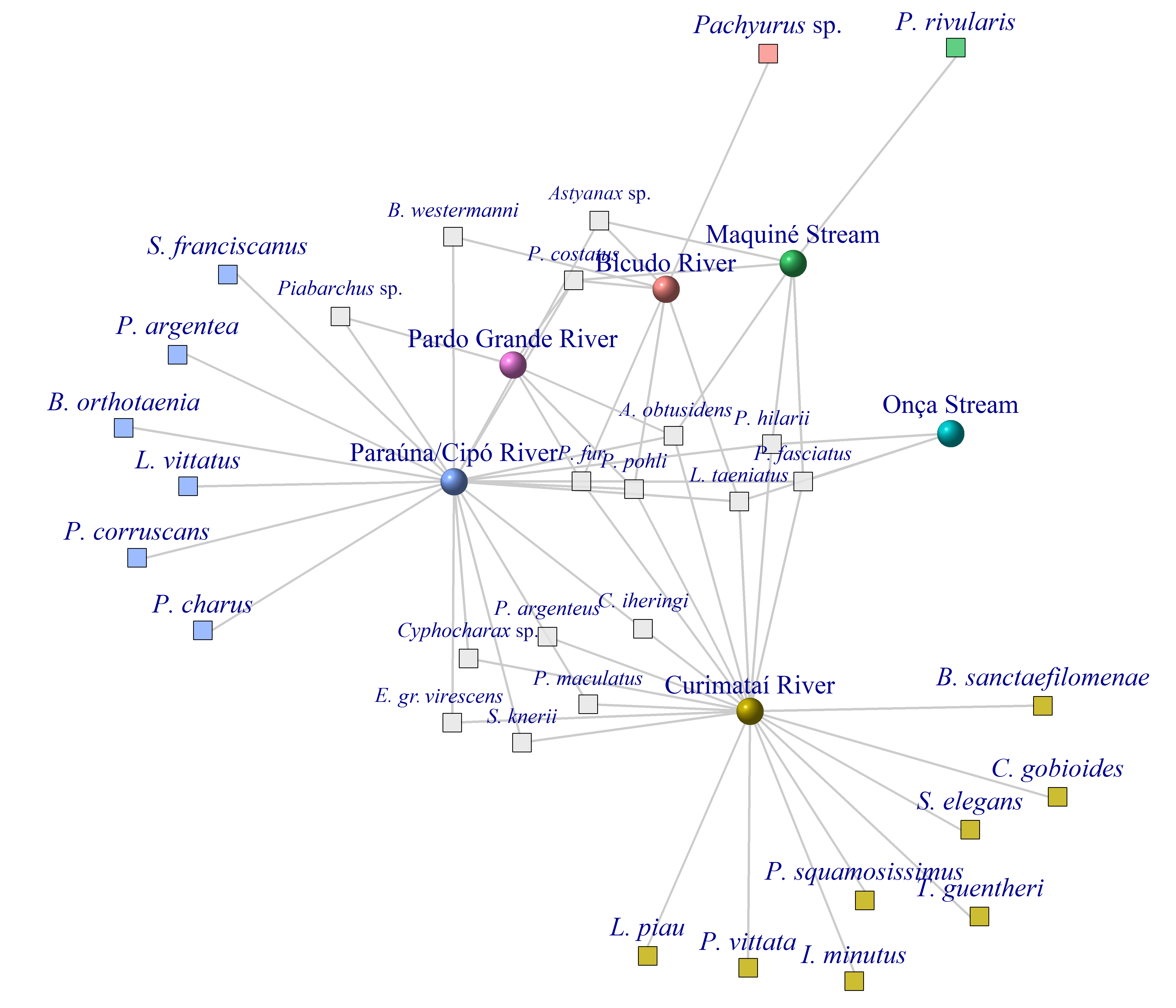
FIGURE 2| Velhas River Network of exclusive (colored squares) and shared (grey squares) species occurrences in each of the tributaries sampled in the Velhas River basin between November 2022 and February 2023.
A significant difference in egg abundance was observed among the sampled tributaries (GLM: Theta = 1.41, AIC = 230.18, p < 0.001), with those having higher flow rates and in better conservation status (right bank) showing the highest densities. The highest egg densities were observed in the Paraúna/Cipó River, exceeding that of all other tributaries except for the Curimataí River, and accounting for over 90% of the total captured eggs. The lowest egg densities were recorded in Maquiné Stream, representing only 0.06% of the total (Fig. 3). For larvae, the highest densities were observed in the Curimataí River and the Paraúna/Cipó River, which, together, comprised more than 80% of the total larvae. Onça Stream was the only site where no larvae were captured (Fig. 3). Except for Maquiné Stream, where more larvae were collected (87%), all other sites had more eggs (Onça 100%, Cipó/Paraúna 95%, Pardo Grande 94%, Bicudo 83% and Curimataí 73%) especially in the initial cleavage stage (Fig. 4).

FIGURE 3| Boxplot of fish eggs and larvae density in each tributary of the Velhas River basin between November 2022 and February 2023. In the box plot, the central line represents the median, the box indicates the interquartile range (25th–75th percentiles), and the whiskers represent the range (minimum–maximum).
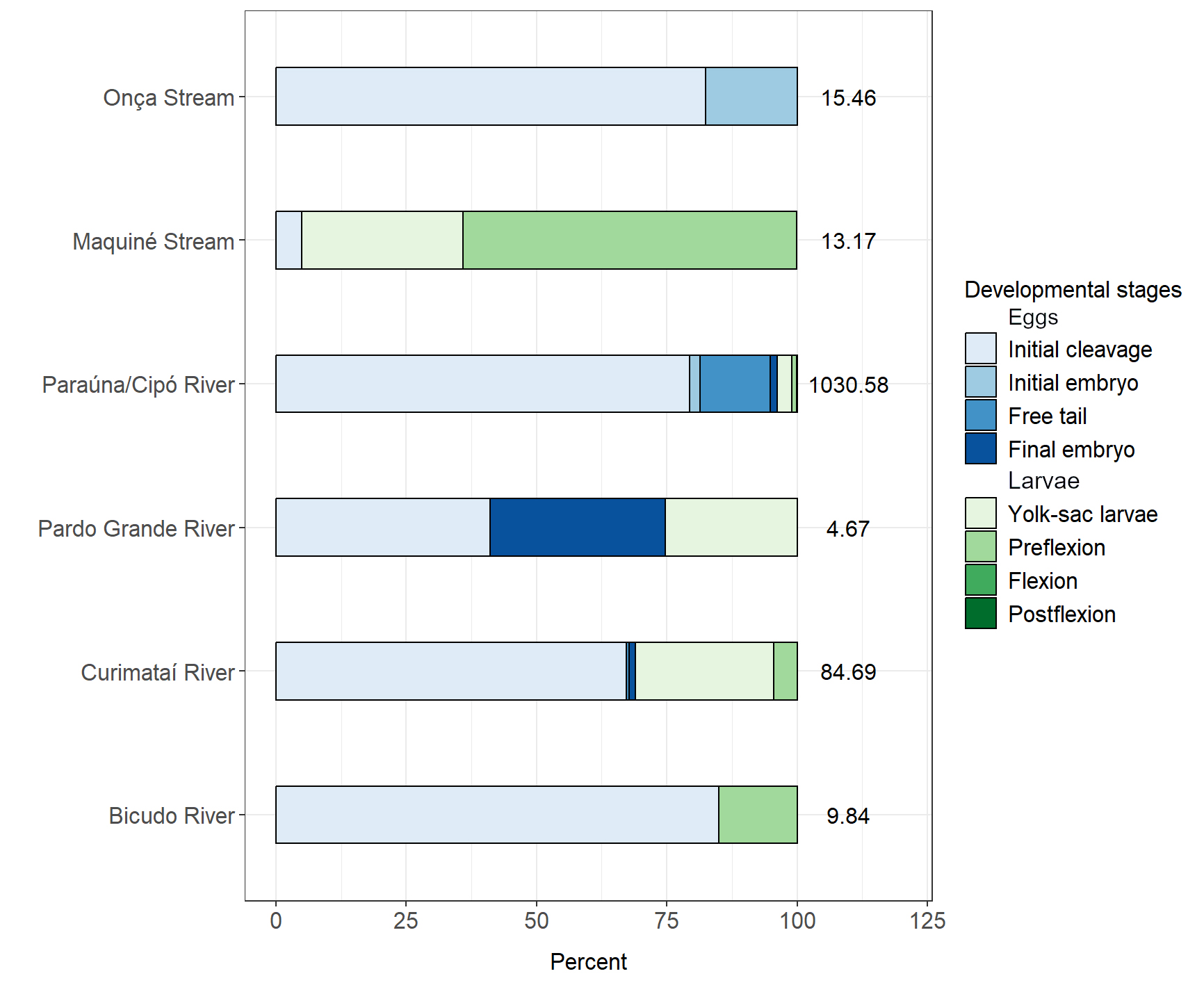
FIGURE 4| Percentage of fish eggs (Initial cleavage, Initial embryo, Free tail, and Final embryo), and larvae (Yolk-sac larvae, Preflexion, Flexion and Postflexion) at each developmental stage in the sampled tributaries of the Velhas River basin between November 2022 and February 2023.
On most sampling days, reproductive activity of at least one species was observed. Overall, major events of reproductive activity (defined as the spawning of at least five species) were recorded immediately prior to the first five flow peak events in the Velhas River (Fig. 5A). At each tributary, a correlation was observed between egg density and larval density (P < 0.05). However, when assessing the correlation between eggs or larvae within the different rivers, such a relationship was observed only for egg density between the Maquiné and Onça streams.

FIGURE 5| A. Number of breeding species (based on the number of species identified in the pool of eggs and larvae genetically analyzed) per sampling day (bars) and the respective flow of the Velhas River (blue line); B. ichthyoplankton mean density (mean of the sum of egg and larval densities across all sampled sites) per sampling day (bars) and the respective flow of the Velhas River (blue line); andichthyoplankton total density (sum of egg and larval densities) (bars) per tributary and per sampling day, and Velhas River flow (blue line) along the studied period. Black arrows indicate spawning events of long-distance migrants.
Peaks of egg and larval density were primarily concentrated during periods of increased discharge in the Velhas River, in the first and second halves of December (Fig. 5B), and were related to the spawning of both long and short-distance migratory fish. They were particularly influenced by the high densities of eggs and larvae in the Paraúna/Cipó River. In this river, the spawning of long-distance migratory species was observed during all density peaks, whereas it was more sporadic in the other tributaries evaluated, although always associated with increased discharge in the Velhas River (Figs. 5–6).

FIGURE 6| Distribution of spawning events for each of the evaluated tributaries over the spawning period, for long-distance (left) and short-distance (right) migratory species: Brycon orthotaenia, Leporinus taeniatus, Arhinolemur obtusidens, Pimelodus fur, Pimelodus maculatus, Pimelodus pohli, Prochilodus argenteus, Prochilodus costatus, Pseudoplatystoma corruscans, Salminus franciscanus.
A variable number of spawning events were detected for each non-migratory species (ranging from one to nine). For most of these species, eggs or larvae were detected only once. Among the migratory species, those classified as long-distance migrants, typically larger-bodied species, exhibited a relatively lower number of spawning events (two to eight) compared to short-distance migrants (11 to 17 events) (Fig. S2). For these species, the spawning events were concentrated particularly within a narrow 12-day window (from December 9 to 21). In this period, in the Paraúna/Cipó River spawning activity of all recorded short- and long-distance migratory species were registered, including the only reproductive events observed for S. franciscanus, P. corruscans, and B. orthothaenia (Figs. 6–7). Interestingly, in the Pardo Grande River, reproductive activity of three long-distance migratory species was recorded on only a single sampling day (November 15). On that same day, eggs from all four short-distance migratory species were also detected (Figs. 5–6).

FIGURE 7| Location of identified spawning sites for the main migratory species of the Velhas River basin, and egg and larvae density in each evaluated tributary.
Discussion
All the studied tributaries are spawning sites for fish. Confirming our prediction, we found eggs and larvae in all of them, with a predominance of early developmental stages. We also confirmed that those tributaries with higher flow and better conservation status are the most important as spawning sites, particularly the Paraúna/Cipó River, both in terms of the number of breeding species and the abundance of ichthyoplankton. Although representing only 30% of the known fish fauna in the basin, which comprises 130 species (Pompeu et al., 2025), the number of taxa identified in the samples is significant, as it includes all known short and long-distance migratory species already registered in the basin. For non-migratory species, their low taxonomic representation was expected, given that the applied methodology targets pelagic eggs, rather than demersal eggs, adhesive eggs or those deposited in nests (Reynalte-Tataje et al., 2024), which are typical of these species (Rizzo et al., 2002; Godinho et al., 2010).
Historically, the Velhas River has exhibited four to six flood pulses between October and April, each lasting only a few days (Santos et al., 2012). This same pattern was observed during the reproductive season studied. During these pulses, an increase in the total number of species engaged in reproductive activity was recorded. In addition to migratory species, which are known to spawn during periods of higher discharge (Agostinho et al., 2003; Reynalte-Tataje et al., 2012; Lopes et al., 2019b), such events may be associated with an increased likelihood of capturing demersal or adhesive eggs. Although these eggs are typically adapted to remain on or adhere to the bottom, intense turbulence or scouring flows can dislodge them and carry them into the water column (Chojnacki et al., 2020; Lehtonen, Veneranta, 2024).
In addition to the temporal overlap between spawning peaks and periods of higher flow in the Velhas River basin, observed at least for long-distance migratory species, there were instances of synchronous multispecies spawning events within the river. However, for these species, spawning synchrony among different tributaries was uncommon. In the upper São Francisco River, synchrony in the reproduction of the two species of the genus Prochilodus of the basin has been reported (Lopes et al., 2018), but between two reproductive sites that are very close to each other. In the case of the rivers studied here, it is possible that local conditions (e.g., local precipitation) influenced the timing of spawning, since they constitute the main triggers (Lopes et al., 2018; Sanches et al., 2020; Röpke et al., 2024).
For some long-distance migratory species, spawning events occurred within brief temporal intervals. This pattern underscores the necessity of high-frequency sampling in such studies, as lower sampling frequencies may lead to an underestimation of the ecological relevance of specific river stretches as spawning habitats (Pompeu et al., 2023), particularly for species most susceptible to the degradation of these critical areas. In the case of the present study, less frequent sampling would certainly have underestimated the importance of the Paraúna/Cipó River, which was the only site where the long-distance migratory species B. orthotaenia, S. franciscanus, and P. corruscans spawned, the latter being a threatened species (MMA, 2022). A study conducted in the upper São Francisco River similarly found that long-distance migratory species spawn in few locations and during narrow temporal windows throughout the reproductive season, whereas species considered to be short-distance migrants exhibit lower spatial and temporal selectivity (Pompeu et al., 2023).
Although all evaluated rivers appear to play significant roles in fish reproduction within the basin, the Paraúna/Cipó River is particularly noteworthy. Its ecological importance may be attributed to its considerable length, as the largest tributary of the Velhas River, and its high degree of conservation. It has also by far the highest flow compared to the others. In addition to recording the highest abundances of eggs and larvae, this tributary also showed the greatest number of reproductive events among all long-distance migratory species, with some of them recorded spawning exclusively in this river. The Cipó River is protected under state legislation (Minas Gerais, 2004) and is designated as a preservation river. Already in the earliest studies conducted in the basin, the importance of this tributary was evident. In the early 2000s, the Cipó River had greater species richness than any of the six sites along the mainstem of the Velhas River (Alves, Pompeu, 2010). It is widely also recognized as the most important reference site in the basin (Alonso et al., 2020) and has played a key role in the recovery of fish fauna to the main Velhas River channel, following the implementation of sewage treatment in the MRBH (Pompeu et al., 2025). Nevertheless, it is important to note that our study encompassed only a single reproductive cycle, and interannual hydrological differences may potentially alter the relative importance of each tributary as an effective spawning site. In addition to the Paraúna/Cipó River, the Curimataí River also demonstrated significant characteristics, particularly through the occurrence of four out of the eight identified long-distance migratory species reproducing in the evaluated tributaries.
As the Cipó and Curimataí rivers are among the largest and best-preserved tributaries, there is evidence that these characteristics are relevant for their use as spawning sites. The lower attractiveness of smaller rivers as spawning sites appears to be a pattern shared with other Neotropical basins (Reynalte-Tataje et al., 2013; Silva et al., 2015). This aspect is particularly important for the Velhas River, whose main channel has compromised water quality due to domestic and industrial pollution (Pompeu et al., 2025). Similarly, long tributaries have been identified as playing an important role as alternative spawning routes in dammed rivers from different Neotropical basins, such as the Paraná (Antonio et al., 2007; Meschiatti, Arcifa, 2009; Silva et al., 2015; Marques et al., 2018) and the Amazon (Vasconcelos et al., 2021). Thus, particularly in watersheds regulated or degraded by pollution, the conservation of long, well-preserved, and free-flowing river stretches is essential for the preservation of the local ichthyofauna.
Although the recorded spawning events of migratory fish species in the studied tributaries confirm their ability to complete their life cycle within the Velhas River basin, the influence of the main channel’s water quality on early life stage survival remains to be evaluated. At the lower portion of the Velhas River there is a floodplain complex that may play an important role in larvae development. The location of the floodplains is consistent with the time-related distance and most of the spawning site seems to correspond to the optimal location for larval development and subsequent entry into floodplains. Moreover, fries and juveniles of migratory species have been captured in such floodplains frequently (Pompeu et al., 2025).
However, by drifting in the Velhar River, high mortality rates due to pollutants originated from untreated sewage deployed at the river may be expected and have already been reported for juveniles and adults individuals of the genera Salminus and Prochilodus (Barreto et al., 2020). Thus, given that the discharge of untreated domestic sewage predominates throughout the basin (Pinto et al., 2019), it is possible that the recruitment of these species is at least partially compromised.
Despite these uncertainties, understanding migratory behavior and identifying key habitats is crucial for planning, both regarding the potential implementation of hydroelectric power plants (Lopes et al., 2025) and the identification of priority areas for conservation (Azevedo‐Santos et al., 2019) However, identifying migratory fish migration in the Neotropics typically relies on costly techniques like telemetry (e.g., Lopes et al., 2018; Hahn et al., 2019). Other approaches have been proposed to advance the understanding of which species undertake migrations, such as evaluating species distribution patterns within a basin and increased reproductive activity in upstream areas (Rauber et al., 2021). As molecular tools are becoming increasingly applied for ichthyoplankton identification, confirming similar patterns in other basins could enable the application of spatial and temporal spawning patterns to distinguish not only potential migratory species but also those with more specialized spawning site requirements and environmental conditions. The use of DNA metabarcoding is particularly promising, yielding robust results even in megadiverse basins (Silva et al., 2023). In this sense, our results highlighted the need to maintain connectivity between the various tributaries and the main channel of the Velhas River, as well as the special attention that should be given to the Paraúna/Cipó River. Although it is legally protected, any damming downstream of its confluence (a stretch not covered by current legislation) would block the connection between the most important spawning site in the basin and the floodplains of the lower Velhas River.
Acknowledgments
We thank the riverside community members for their support during field collections: Clézio, Edna, Erivelton, Marcelo, Ronaldo, and Wanderson. We also thank Carina P. Porto for her support in laboratory activities and André Maciel for field activities support.
References
Agostinho AA, Gomes LC, Suzuki IS, Júlio Jr. HF. Migratory fishes of the Upper Paraná River Basin, Brazil. In: Carolsfeld J, Harvey B, Ross C, Baer A, editors. Migratory fishes of South America: biology, fisheries and conservation status, vol. 380. Canadá: World Fisheries Trust; 2003. p.19–98.
Agostinho AA, Marques EE, Agostinho CS, Almeida DA, Oliveira RJ, Melo JRB. Fish ladder of Lajeado Dam: migrations on one-way routes? Neotrop Ichthyol. 2007a; 5(2):121–30. https://doi.org/10.1590/S1679-62252007000200005
Agostinho AA, Pelicice FM, Petry AC, Gomes LC, Júlio HF. Fish diversity in the upper Paraná River basin: habitats, fisheries, management and conservation. Aquat Ecosyst Health Manag. 2007b; 10(2):174–86. https://doi.org/10.1080/14634980701341719
Aljanabi SM, Martinez I. Universal and rapid salt-extraction of high quality genomic DNA for PCR-based techniques. Nucleic Acids Res. 1997; 25(22):4692–93. https://doi.org/10.1093/nar/25.22.4692
Alonso MB, Carvalho DR, Alves CBM, Pompeu PS. Trophic structure of a fish assemblage in a reference condition river located in a polluted watershed. Environ Biol Fishes. 2020; 103(11):1437–52. https://doi.org/10.1007/s10641-020-01033-z
Altschul SF, Gish W, Miller W, Myers EW, Lipman DJ. Basic local alignment search tool. J Mol Biol. 1990; 215(3):403–10. https://doi.org/10.1016/S0022-2836(05)80360-2
Alves CBM, Pompeu PS. A fauna de peixes da bacia do Velhas River no final do século XX. In: Alves CBM, Pompeu PS, editors. Peixes do Velhas River: passado e presente. Vol. 1. 2nd ed. Belo Horizonte: Argvmentvm; 2010. p.167–89.
Antonio RR, Agostinho AA, Pelicice FM, Bailly D, Okada EK, Dias JHP. Blockage of migration routes by dam construction: can migratory fish find alternative routes? Neotrop Ichthyol. 2007; 5(7):177–84. https://doi.org/10.1590/S1679-62252007000200012
Azevedo-Santos VM, Frederico RG, Fagundes CK, Pompeu PS, Pelicice FM, Padial AA et al. Protected areas: a focus on Brazilian freshwater biodiversity. Divers Distrib. 2019; 25(3):442–48. https://doi.org/10.1111/ddi.12871
Barletta M, Cussac VE, Agostinho AA, Baigún C, Okada EK, Carlos Catella A et al. Fisheries ecology in South American river basins. In: Craig JF, editor. Freshwater Fisheries Ecology; 2015. p.311–48. https://doi.org/10.1002/9781118394380.ch27
Barreto LS, Souza ATC, Martins CC, Araujo SBL, Ribeiro CAO. Urban effluents affect the early development stages of Brazilian fish species with implications for their population dynamics. Ecotoxicol Environ Saf. 2020; 188:109907. https://doi.org/10.1016/j.ecoenv.2019.109907
Batista JS, Alves‑Gomes JA. Phylogeography of Brachyplatystoma rousseauxii (Siluriformes‑Pimelodidae) in the Amazon Basin offers preliminary evidence for the first case of “homing” for an Amazonian migratory catfish. Genet Mol Res. 2006; 5(4):723–40. https://doi.org/10.1590/S1676-56802006000400010
Becker RA, Sales NG, Santos GM, Santos GB, Carvalho DC. DNA barcoding and morphological identification of neotropical ichthyoplankton from the Upper Paraná and São Francisco. J Fish Biol. 2015; 87(1):159–68. https://doi.org/10.1111/jfb.12707
Callahan BJ, McMurdie PJ, Rosen MJ, Han AW, Johnson AJA, Holmes SP. DADA2: high-resolution sample inference from Illumina amplicon data. Nat Methods. 2016; 13(7):581–83. https://doi.org/10.1038/nmeth.3869
Carvalho DC. Ichthyoplankton DNA metabarcoding: Challenges and perspectives. Mol Ecol. 2022; 31(6):1612–14. https://doi.org/10.1111/mec.16387
Carvalho DR, Alves CBM, Moreira MZ, Pompeu PS. Trophic diversity and carbon sources supporting fish communities along a pollution gradient in a tropical river. Sci Total Environ. 2020; 738:139878. https://doi.org/10.1016/j.scitotenv.2020.139878
Comitê de Bacia Hidrográfica do Rio das Velhas (CBH Rio das Velhas). Plano diretor de recursos hídricos da bacia hidrográfica do Velhas River – PDRH Velhas River. 2014. Available from: https://cbhvelhas.org.br/plano-diretor-cbh-velhas/
Chojnacki KA, Erwin SO, George AE, Candrl JS, Jacobson RB, DeLonay AJ. Physical characteristics and simulated transport of pallid sturgeon and shovelnose sturgeon eggs. J Freshw Ecol. 2020; 35(1):73–94. https://doi.org/10.1080/02705060.2020.1736191
Corrêa RN, Hermes-Silva S, Reynalte-Tataje D, Zaniboni-Filho E. Distribution and abundance of fish eggs and larvae in three tributaries of the upper Uruguay River (Brazil). Environ Biol Fishes. 2011; 91(1):51–61. https://doi.org/10.1007/s10641-010-9759-x
Csárdi G, Nepusz T, Müller K, Horvát S, Traag V, Zanini F et al. igraph: network analysis and visualization in R. 2023. https://doi.org/doi:10.5281/zenodo.7682609
Duponchelle F, Pouilly M, Pécheyran C, Hauser M, Renno J, Panfili J et al. Trans-Amazonian natal homing in giant catfish. J Appl Ecol. 2016; 53(5):1511–20. https://doi.org/10.1111/1365-2664.12665
Godinho AL, Kynard B. Migration and spawning of radio-tagged zulega Prochilodus argenteus in a dammed Brazilian river. Trans Am Fish Soc. 2006; 135:811–24. https://doi.org/10.1577/T04-176.1
Godinho AL, Kynard B, Godinho HP. Migration and spawning of female surubim (Pseudoplatystoma corruscans, Pimelodidae) in the São Francisco River, Brazil. Environ Biol Fishes. 2007; 80:421–33. https://doi.org/10.1007/s10641-006-9141-1
Godinho AL, Lamas IR, Godinho HP. Reproductive ecology of Brazilian freshwater fishes. Environ Biol Fishes. 2010; 87(2):143–62. https://doi.org/10.1007/s10641-009-9574-4
Godinho AL, Pompeu PS. A importância dos ribeirões para os peixes de piracema. In: Godinho HP, Godinho AL, editors. Águas, peixes e pescadores do São Francisco das Minas Gerais, vol. 468. Belo Horizonte: PUC Minas; 2003. p.361–72.
Godinho HP, Godinho AL. Águas, peixes e pescadores do São Francisco das Minas Gerais. Belo Horizonte: PUC Minas; 2003.
Hahn L, Martins EG, Nunes LD, Câmara LF, Machado LS, Garrone-Neto D. Biotelemetry reveals migratory behaviour of large catfish in the Xingu River, Eastern Amazon. Sci Rep. 2019; 9(1):8464. https://doi.org/10.1038/s41598-019-44869-x
Hall TA. BioEdit: a user-friendly biological sequence alignment editor and analysis program for Windows 95/98/NT. Nucleic Acids Symp Ser. 1999; 41:95–98.
Hilário HO, Mendes IS, Sales NG, Carvalho DC. DNA metabarcoding of mock communities highlights potential biases when assessing Neotropical fish diversity. eDNA. 2023; 5(6):1351–61. https://doi.org/10.1002/edn3.456
Hunter JR. Feeding ecology and predation of marine fish larvae. Vol. 1. Seattle: University of Washington Press; 1981.
Instituto Mineiro de Gestão das Águas (IGAM). Séries históricas de monitoramentos da qualidade das águas superficiais no estado de Minas Gerais (2021). Belo Horizonte: IGAM; 2022.
Kumar S, Stecher G, Suleski M, Sanderford M, Sharma S, Tamura K. MEGA12: Molecular Evolutionary Genetic Analysis Version 12 for Adaptive and Green Computing. Mol Biol Evol. 2024; 41(12):msae263. https://doi.org/10.1093/molbev/msae263
Lehtonen TK, Veneranta L. Gone with the flow: whitefish egg drift in relation to substrate coarseness under a range of flow velocities. J Fish Biol. 2024; 105(6):1747–54. https://doi.org/10.1111/jfb.15923
Lopes JM, Alves CBM, Peressin A, Pompeu PS. Upstream and downstream migration speed of Prochilodus costatus (Characiformes: Prochilodontidae) in upper São Francisco basin, Brazil. Neotrop Ichthyol. 2019a; 17(2):e180072. https://doi.org/10.1590/1982-0224-20180072
Lopes JM, Alves CBM, Peressin A, Pompeu PS. Influence of rainfall, hydrological fluctuations, and lunar phase on spawning migration timing of the Neotropical fish Prochilodus costatus. Hydrobiologia. 2018; 818(1):145–61. https://doi.org/10.1007/s10750-018-3601-4
Lopes JM, Peressin A, Andrade FR, Moreira MF, Ludwig S, Pimentel JSM et al.Conventional environmental assessments are inadequate for predicting and mitigating impacts of dams on migratory fish in Brazil: an integrative assessment approach for the Neotropics. Aquat Sci. 2025; 87(1):27. https://doi.org/10.1007/s00027-024-01157-9
Lopes JM, Pompeu PS, Alves CBM, Peressin A, Prado IG, Suzuki FM et al. The critical importance of an undammed river segment to the reproductive cycle of a migratory Neotropical fish. Ecol Freshw Fish. 2019b; 28(2):302–16. https://doi.org/10.1111/eff.12454
Macedo DR, Magalhães Jr. AP. Avaliação dos riscos para ocupação urbana: proposição metodológica baseada em geotecnologias. Rev Bras Estud Popul. 2007; 24(2):337–38. https://doi.org/10.1590/S0102-30982007000200010
Makrakis MC, Refatti A, Keckeis H, Silva PS, Assumpção L, Kashiwaqui EA et al. Importance of a turbulent river section below a giant waterfall for fish spawning: indications from drift and dispersion patterns of early life stages. Ecohydrology. 2022; 15(1):e2356. https://doi.org/10.1002/eco.2356
Marques H, Dias JHP, Perbiche-Neves G, Kashiwaqui EAL, Ramos IP. Importance of dam-free tributaries for conserving fish biodiversity in Neotropical reservoirs. Biol Conserv. 2018; 224:347–54.
Martin M. Cutadapt removes adapter sequences from high-throughput sequencing reads. EMBnet J. 2011; 17(1):10. https://doi.org/10.14806/ej.17.1.200
McMurdie PJ, Holmes SP. Phyloseq: an R package for reproducible interactive analysis and graphics of microbiome census data. PLoS ONE. 2013; 8(4):e61217. https://doi.org/10.1371/journal.pone.0061217
Meschiatti AJ, Arcifa MS. A review on the fishfauna of Mogi-Guaçu River basin: a century of studies. Acta Limnol Bras. 2009: 21(1):135–59. Available from: https://actalb.org/article/627da19e782aad07b35c1a3f/pdf/alb-21-1-135.pdf
Minas Gerais. Provides for the protection of the Cipó River basin and other provisions. State Law no 15,082, of April 27, 2004. 2004. Available from: https://www.siam.mg.gov.br/sla/download.pdf?idNorma=147
Ministério do Meio Ambiente (MMA). Portaria no 148, de 7 de junho de 2022. Diário Oficial da União, Seção 1, p. 74. Brasília: MMA; 2022. Available from: https://www.in.gov.br/en/web/dou/-/portaria-mma-n-148-de-7-de-junho-de-2022-406272733
Nakatani K, Agostinho AA, Baumgartner G, Bialetzki A, Sanches P V, Makrakis MC et al. Ovos e larvas de peixes de água doce: desenvolvimento e manual de identificação. Maringá: EDUEM; 2001.
Nestler JM, Pompeu PS, Goodwin RA, Smith DL, Silva LGM, Baigún CRM et al.The river machine: a template for fish movement and habitat, fluvial geomorphology, fluid dynamics and biogeochemical cycling. River Res Appl. 2012; 28(4):490–503. https://doi.org/10.1002/rra.1567
Oliveira DJ, Ashikaga FY, Foresti F, Senhorini JA. Conservation status of the “Piracanjuba” Brycon orbignyanus (Valenciennes, 1850) (Characiformes, Bryconidae): basis for management programs. Biodivers Bras. 2017; 7(1):18–33. https://doi.org/https://doi.org/10.37002/biodiversidadebrasileira.v7i1.612
Orsi ML, Almeida FS, Swarça AC, Garcia AC, Garcia DAZ, Vianna NC et al.Ovos, larvas e juvenis de peixes da bacia do rio Paranapanema: uma avaliação para a conservação. Londrina: Triunfal Gráfica e Editora; 2016.
Pelicice FM, Agostinho AA, Azevedo-Santos VM, Bessa E, Casatti L, Garrone-Neto D et al.Ecosystem services generated by Neotropical freshwater fishes. Hydrobiologia. 2023; 850(12–13):2903–26. https://doi.org/10.1007/s10750-022-04986-7
Pinto CC, Calazans GM, Oliveira SC. Assessment of spatial variations in the surface water quality of the Velhas River Basin, Brazil, using multivariate statistical analysis and nonparametric statistics. Environ Monit Assess. 2019; 191(3):164. https://doi.org/10.1007/s10661-019-7281-y
Pompeu PS, Agostinho AA, Pelicice FM. Existing and future challenges: the concept of successful fish passage in South America. River Res Appl. 2012; 28(4):504–12. https://doi.org/10.1002/rra.1557
Pompeu PS, Alves CBM, Callisto M. The effects of urbanization on biodiversity and water quality in the Velhas River Basin, Brazil. Am Fish Soc Symp. 2005:729–47.
Pompeu PS, Macedo DR, Alves CBM, Luz LD. São Francisco. Rivers of South America. Elsevier; 2025. p.467–512. https://doi.org/10.1016/B978-0-12-823429-7.00011-2
Pompeu PS, Wouters L, Hilário HO, Loures RC, Peressin A, Prado IG et al.Inadequate sampling frequency and imprecise taxonomic identification mask results in studies of migratory freshwater fish ichthyoplankton. Fishes. 2023; 8(10):518. https://doi.org/10.3390/fishes8100518
Queiroz TCB, Baumgartner D, Piana PA, Sanches PV. Egg transport and larval behavior of curimba, Prochilodus lineatus (Valenciennes, 1836; Characiformes, Prochilodontidae) in a drift simulator channel. Acta Sci Biol Sci. 2022; 44:e62680. https://doi.org/10.4025/actascibiolsci.v44i1.62680
Rauber RG, Strictar L, Gomes LC, Suzuki HI, Agostinho AA. Spatial segregation in the reproductive activity of Neotropical fish species as an indicator of the migratory trait. J Fish Biol. 2021; 98(3):694–706. https://doi.org/10.1111/jfb.14614
Reynalte-Tataje DA, Agostinho AA, Bialetzki A. Temporal and spatial distributions of the fish larval assemblages of the Ivinheima River sub-basin (Brazil). Environ Biol Fishes. 2013; 96(7):811–22. http://doi.org/10.1007/s10641-012-0073-7
Reynalte-Tataje DA, Agostinho AA, Bialetzki A, Hermes-Silva S, Fernandes R, Zaniboni-Filho E. Spatial and temporal variation of the ichthyoplankton in a subtropical river in Brazil. Environ Biol Fishes. 2012; 94:403–19. https://doi.org/10.1007/s10641-011-9955-3
Reynalte-Tataje DA, Zaniboni-Filho E, Lopes CA, Ávila-Simas S, Bialetzki A. New technique for identification of ichthyoplankton and its application in biomonitoring studies, management and conservation of Neotropical fish. Environ Manage. 2024; 74:808–17. https://doi.org/10.1007/s00267-024-02010-3
Rizzo E, Sato Y, Barreto BP, Godinho HP. Adhesiveness and surface patterns of eggs in neotropical freshwater teleosts. J Fish Biol. 2002; 61(3):615–32. https://doi.org/10.1111/j.1095-8649.2002.tb00900.x
Röpke C, Cella-Ribeiro A, Ferreira FC, Araújo TR, Dória CRC, Gusmão F et al. The seasonal rate of discharge change as the primary trigger synchronizing freshwater fish reproduction in an Amazonian River. Rev Fish Biol Fish. 2024; 34(4):1619–35. https://doi.org/10.1007/s11160-024-09891-x
Sanches PV, Gogola TM, Silva RO, Topan DA, Picapedra PHS, Piana PA. Arms as areas for larval development of migratory fish species in a Neotropical reservoir and the influence of rainfall over abundances. J Fish Biol. 2020; 97(5):1306–16. https://doi.org/10.1111/jfb.14474
Santos HA, Pompeu PS, Okuma DKL. Changes in the flood regime of São Francisco River (Brazil) from 1940 to 2006. Reg Environ Change. 2012; 12:123–32. https://doi.org/10.1007/s10113-011-0240-y
Sato Y, Fenerich-Verani N, Godinho HP. Reprodução induzida de peixes da bacia do rio São Francisco. In: Godinho HP, Godinho AL, editors. Águas, peixes e pescadores do São Francisco das Minas Gerais. Vol. 468. Belo Horizonte: PUC Minas; 2003. p.275–89.
Sato Y, Godinho HP. Migratory fishes of the São Francisco River. In: Carolsfeld J, Harvey B, Ross C, Baer A, editors. Migratory fishes of South America: biology, fisheries and conservation status. Victoria: World Fisheries Trust; 2003. p.372.
Silva LE, Domingues RR, Sales NG, Villela PM, Silva CB, Hilsdorf AW. Amazonian ichthyoplankton assessment via DNA metabarcoding: a baseline for detecting spawning sites of migratory fishes. Biol Conserv. 2023; 284:110180. https://doi.org/10.1016/j.biocon.2023.110180
Silva PS, Makrakis MC, Miranda LE, Makrakis S, Assumpção L, Paula S et al.Importance of reservoir tributaries to spawning of migratory fish in the upper paraná River. River Res Appl. 2015; 31(3):313–22. https://doi.org/10.1002/rra.2755
Teixeira DF, Hilário HO, Santos GB, Carvalho DC. DNA metabarcoding assessment of Neotropical ichthyoplankton communities is marker-dependent. Ecol Evol. 2023; 13(10):e10649. https://doi.org/10.1002/ece3.10649
Vasconcelos LP, Alves DC, Câmara LF, Hahn L. Dams in the Amazon: the importance of maintaining free-flowing tributaries for fish reproduction. Aquatic Conserv Mar Fresh Ecosyst. 2021; 31(5):1106–16. https://doi.org/10.1002/aqc.3465
Verdi M, Pougy N, Martins E, Martinelli G. A Serra do Espinhaço Meridional. In: Pougy N, Verdi M, Martins E, editors. Plano de ação nacional para a conservação da flora ameaçada de extinção da: Serra do Espinhaço Meridional. Rio de Janeiro: Instituto de Pesquisas Jardim Botânico do Rio de Janeiro, JBRJ Centro Nacional de Conservação da Flora CNC Flora; 2015.
Ward RD. DNA barcode divergence among species and genera of birds and fishes. Mol Ecol Resour. 2009; 9:1077–85. https://doi.org/10.1111/j.1755-0998.2009.02541.x
Authors

Paulo Santos Pompeu1 , Fábio Mineo Suzuki2, Ivo Gavião Prado2, Andressa Mendes Silva-Sene1,2, Daniel Cardoso Carvalho3, Heron Oliveira Hilário3 and Carlos Bernardo Mascarenhas Alves4
[1] Departamento de Ecologia e Conservação, Universidade Federal de Lavras, 37203-202, Lavras, MG, Brazil. (PSP) pompeu@ufla. br (corresponding author), (AMSS) andressasene@hotmail.com.
[2] Pisces – Consultoria e Serviços Ambientais, 37206-662, Lavras, MG, Brazil. (FMS) suzuki.fms@gmail.com, (IGP) ivogaviaoprado@gmail.com.
[3] Conservation Genetics Lab, Graduate Program in Biodiversity and Environment, PUC Minas, 30535-610, Belo Horizonte, MG, Brazil. (DCC) carvalho.lgc@gmail.com, (HOH) heronoh@gmail.com.
[4] Laboratório Nuvelhas, Universidade Federal de Minas, Gerais, Projeto Manuelzão, Av. Antônio Carlos, 6627, 31270-901, Belo Horizonte, MG, Brazil. (CBMA) cbmalves@ufmg.br.
Authors’ Contribution 

Paulo Santos Pompeu: Conceptualization, Data curation, Formal analysis, Funding acquisition, Investigation, Methodology, Resources, Writing-original draft, Writing-review and editing.
Fábio Mineo Suzuki: Formal analysis, Investigation, Methodology, Writing-original draft.
Ivo Gavião Prado: Formal analysis, Investigation, Methodology, Writing-original draft.
Andressa Mendes Silva-Sene: Formal analysis, Investigation, Methodology, Writing-original draft.
Daniel Cardoso Carvalho: Data curation, Formal analysis, Investigation, Methodology, Writing-original draft.
Heron Oliveira Hilário: Data curation, Formal analysis, Investigation, Methodology, Writing-original draft.
Carlos Bernardo Mascarenhas Alves: Conceptualization, Data curation, Formal analysis, Funding acquisition, Investigation, Methodology, Project administration, Resources, Writing-original draft.
Ethical Statement
Experiments were approved by the Ethical Committee for Animal Use in Experiments of the Universidade Federal de Lavras (CEUA number 024/2020) and Collection Licenses of SISBIO number 73184.
Competing Interests
The author declares no competing interests.
Data availability statement
The data supporting the findings of this study are available from the corresponding author, Paulo Pompeu, upon reasonable request.
AI statement
Grammarly AI was used to copyedit the English text.
Funding
We thank CNPq for providing a research fellowship to DCC (312102/2022–4) and PSP (302328/2022–0) and Ecomol for conducting molecular analysis. This project was financed by the Agência Peixe Vivo, at the request of CBH Rio das Velhas, through the Contract No 7392.20, with the Fundação para o Desenvolvimento da Pesquisa (FUNDEP).
Supplementary Material
Supplementary material SUP
Peer Review
How to cite this article
Pompeu PS, Suzuki FM, Prado IG, Silva-Sene AM, Carvalho DC, Hilário HO, Alves CBM. Importance of tributaries for fish reproduction and conservation in a highly anthropized river basin. Neotrop Ichthyol. 2026; 24(2):e250126. https://doi.org/10.1590/1982-0224-2025-0126
Copyright
This is an open access article under the terms of the Creative Commons Attribution License, which permits use, distribution and reproduction in any medium, provided the original work is properly cited.
Distributed under
Creative Commons CC-BY 4.0

© 2025 The Authors.
Diversity and Distributions Published by SBI
 Accepted February 11, 2026
Submitted July 14, 2025
Epub July 20, 2026