
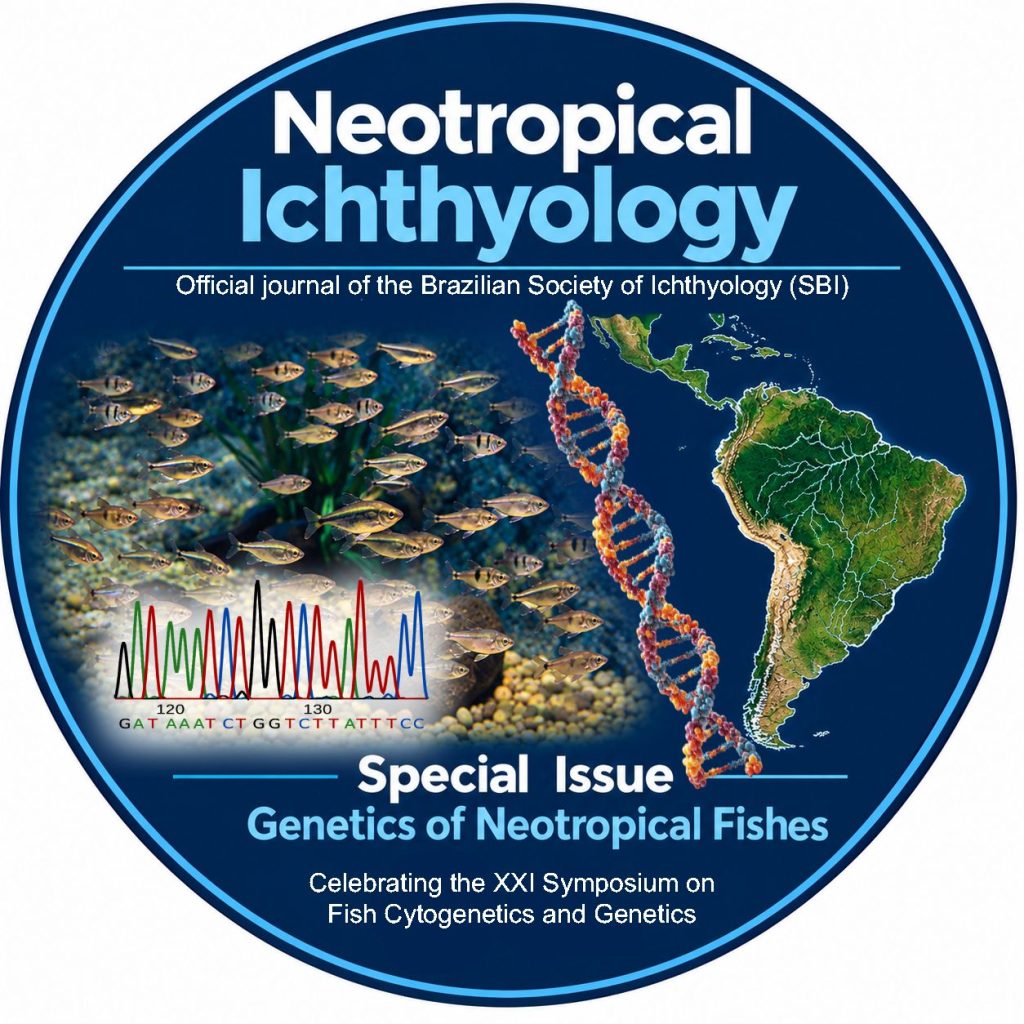
Special Issue of Neotropical Ichthyology
“Genetics in the Neotropics: From Basic to Applied Evolutionary Perspectives”
1. Background and Rationale
The application of genetics to the study of animal diversity has its roots in the development of Mendelian genetics and the consolidation of the Modern Synthesis of Evolution during the twentieth century, when genetic variation became recognized as the fundamental basis of evolutionary change through natural selection, genetic drift, mutation, and gene flow. From the second half of the twentieth century onward, advances in cytogenetics, protein electrophoresis, population genetics, and molecular markers enabled researchers to investigate genetic diversity and evolutionary relationships among populations and species with increasing resolution. More recently, DNA sequencing, genomics, and approaches such as phylogenomics and evolutionary developmental genetics have greatly expanded this field, providing new insights into the processes underlying the origin, diversification, adaptation, and maintenance of animal diversity across different evolutionary timescales.
In Brazil, genetic studies focused on the evolution of animal diversity gained momentum during the 1970s and 1980s, initially through approaches involving cytogenetics, protein electrophoresis, and population genetics. In subsequent decades, the development and widespread adoption of DNA sequencing and molecular marker technologies enabled increasingly detailed investigations of population structure, phylogeography, species delimitation, and phylogenetic relationships across Brazil’s exceptionally diverse fauna. These advances have been particularly important for fishes, contributing to the discovery of cryptic lineages, the recognition of previously overlooked species diversity, the identification of historical patterns of diversification, and a better understanding of the geographic and environmental processes shaping biodiversity.
The Special Issue aims to strengthen the role of Neotropical Ichthyology as a leading venue for genetic and genomic research on fishes of the Neotropical region and to provide a dedicated platform for researchers to disseminate recent advances, discoveries, and applications in fish genetics.
2. Thematic Scope
The Special Issue will encompass four complementary thematic axes:
Cytogenetics and Cytogenomics:
Research addressing chromosome structure and evolution, karyotype macro- and microstructure, genome organization and evolution, chromosomal rearrangements, and their implications for species delimitation, population differentiation, and evolutionary history.
Molecular Species Identification, Phylogenetics, and Phylogenomics:
Studies employing molecular approaches to address taxonomic questions, species identification and delimitation, including environmental DNA (eDNA), as well as investigations of phylogenetic relationships and evolutionary history using molecular and genomic data.
Population and Conservation Genetics and Genomics:
Studies addressing genetic diversity, population structure, gene flow, demographic history, local adaptation, and evolutionary processes at the population level, particularly where genetic and genomic information contributes to species management and biodiversity conservation.
Gene and Genome Expression:
Studies investigating gene and genome expression, molecular responses, and mechanisms underlying phenotypic and physiological variation under different environmental conditions, including pristine, altered, and anthropogenically impacted Neotropical environments.
3. Submission Guidelines and Rules
To ensure a scientifically rigorous, inclusive, and impactful Special Issue, we will adopt a hybrid submission model combining targeted invitations with an open call for original research.
Targeted Invitations (Review Articles):
The organizing team will invite leading researchers in the field to contribute comprehensive review articles addressing the thematic axes described above. We particularly encourage multi-authored contributions involving researchers from different institutions and geographic regions. These reviews will provide broad syntheses of current knowledge and establish a conceptual foundation for the Special Issue.
Open Call (Original Research Articles):
Concurrently, an open call will be issued to the broader scientific community. We welcome original research articles addressing topics that are clearly aligned with one or more of the thematic axes of the Special Issue. All submissions will undergo the standard rigorous peer-review process of Neotropical Ichthyology. The open call is intended to ensure broad participation from the research community and to provide an opportunity to showcase recent advances in fish genetics and genomics across the Neotropical region.
The Special Issue will be organized by Dr. Rodrigo A. Torres and Dr. Roberto F. Artoni, who have previously coordinated special publications associated with the Symposium on Cytogenetics and Genetics of Fishes, in collaboration with a team of editors from Neotropical Ichthyology.
For further information regarding the Special Issue or the submission process, please contact us at neoichth@nupelia.uem.br.