
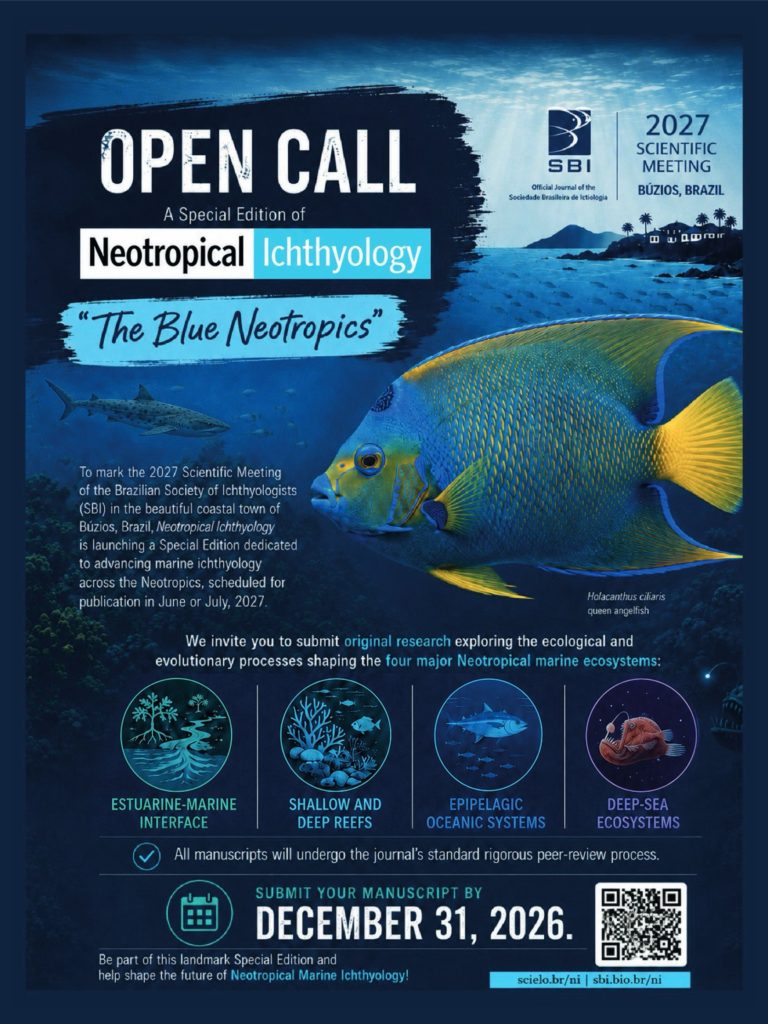
The Blue Neotropics:
A Biogeographical Synthesis of Neotropical Marine Habitats
The term Neotropical has traditionally been associated with terrestrial and freshwater environments. Yet the evolutionary history, biogeographic patterns, and physical connectivity that characterize the Neotropical region extend far beyond the coastline. With this in mind, Neotropical Ichthyology invites contributions to a Special Issue entitled “The Blue Neotropics”, dedicated to advancing our understanding of the marine environments and fishes of the Neotropical realm.
This Special Issue aims to bring together research from across the Tropical Eastern Pacific (TEP), the Tropical Western Atlantic (TWA), including the Caribbean and Brazilian provinces, and the associated warm-temperate transition zones. By connecting these geographically and ecologically diverse systems, the issue will provide an integrated perspective on the evolutionary, biogeographic, ecological, and oceanographic processes shaping Neotropical marine fish diversity.
More broadly, “The Blue Neotropics” seeks to strengthen the connection between marine research and the broader Neotropical ichthyological community, providing a dedicated platform for researchers working on marine fishes and their ecosystems across Central and South America. We particularly welcome studies that address questions extending beyond individual localities or species and that contribute to a broader understanding of patterns and processes across the Neotropical marine realm.
Scope of the Special Issue
The Special Issue will focus on cross-cutting ecological, evolutionary, and biogeographical drivers, including connectivity, endemism, diversity patterns, dispersal, historical biogeography, and oceanographic corridors, across four major marine environments:
The Estuarine–Marine Interface:
Exploring connectivity between freshwater, estuarine, and marine environments, including the influence of river plumes, coastal processes, and transitional habitats on fish diversity and distribution.
Shallow and Deep Reefs:
Encompassing coral, rocky, rhodolith, mesophotic, deep-water, and artificial reefs, with emphasis on their biodiversity, connectivity, evolutionary history, and ecological dynamics.
Epipelagic Oceanic Systems:
Addressing oceanographic processes, pelagic biodiversity, large-scale distribution patterns, connectivity, and migratory corridors of oceanic fishes.
Deep-Sea Ecosystems:
Exploring the largely understudied benthic, bathypelagic, and abyssal environments associated with the Neotropical region and their unique fish diversity and evolutionary history.
We invite your contribution!
We warmly invite researchers working on Neotropical marine fishes and their ecosystems to contribute original research that fits within the thematic scope of this Special Issue. Studies addressing broad ecological, evolutionary, biogeographical, or oceanographic questions are particularly encouraged.
This is an excellent opportunity to bring your research to a broader audience and contribute to a comprehensive synthesis of the Blue Neotropics. We encourage colleagues from Central and South America, as well as researchers working on the Tropical Eastern Pacific and Tropical Western Atlantic, to share their work and help build a more integrated understanding of Neotropical marine ichthyology.
We look forward to receiving your contributions and to bringing together the diverse research communities studying the fascinating marine environments of the Neotropics.