
 Priscilla Caroline Silva1
 , Karine Orlandi Bonato2 and Vinicius Araújo Bertaco3
PDF: Download Here | Supplementary: Sup | Cite this article
Associate Editor: Fernando Carvalho
Section Editor: Bruno Melo
Editor-in-chief: José Birindelli
Abstract
Uma espécie nova de Psalidodon pertencente ao “complexo Psalidodon scabripinnis” é descrita a partir de uma região de mineração altamente explorada no estado de Minas Gerais, para as bacias dos rios Doce e São Francisco. A espécie pode ser facilmente distinguida de todas as outras congêneres pela presença de uma faixa lateral conspícua que inicia imediatamente após os ossos operculares e estendendo-se até o final do pedúnculo caudal, número reduzido de raios na nadadeira anal e baixa contagem de escamas ao longo da linha longitudinal central do corpo, que contém as escamas perfuradas pelo canal da linha lateral. Observa-se diferença no tamanho corporal entre machos e fêmeas, sendo os machos adultos menores que as fêmeas. Além disso, uma nova combinação para algumas espécies de Astyanax, Deuterodon e Psalidodon é proposta com base nos dados genéticos. Considerando a distribuição restrita da espécie nova e as numerosas atividades de mineração ao redor das localidades de ocorrência, o estado de conservação desta espécie deve ser uma preocupação.
Palavras-chave: Bacia do alto rio São Francisco, Bacia do rio Doce, Mineração, Peixes, Taxonomia integrativa.
Introduction
One quarter of all freshwater species are at risk of extinction, with fish species ranking second, behind only the decapods (Sayer et al., 2025). The Neotropical region is responsible for over 3% of the planet’s available freshwater and hosts the greatest diversity of freshwater fish species in the world (Reis et al., 2016; Tonella et al., 2023). Despite their high biodiversity, Neotropical environments are among the most threatened ecosystems, primarily due to the overexploitation of natural resources, climate change, and the introduction of exotic species (Vitule, 2009; Pelicice et al., 2017; Prakash, 2017). The Living Planet Index (LPI), a comprehensive metric designed to assess the decline in the number of vertebrate species over time (Capdevila et al., 2026), has revealed a 4% annual decrease in the number of freshwater fish species since 1970 (Dudgeon, Strayer, 2025). However, it is important to note that this rate may be subject to further adjustment when accounting for the impact of sampling biases in tropical regions. These biases have the capacity to influence the perception of the threat intensity to aquatic biota (Dudgeon, Strayer, 2025).
The southwestern portion of the Iron Quadrangle, located in Minas Gerais State, Brazil, is a region that yielded the most gold in the 18th century (Ladeira, 1988) and still is one of the most mined regions in the world (Machado, Figueirôa, 2022). The headwaters of two important Brazilian river basins are located in this part of the Iron Quadrangle: the das Velhas River basin (the largest tributary of the São Francisco River basin (Alves, Pompeu, 2010) and the Doce River basin, including its tributaries, Piracicaba River, and Piranga River (formed by do Carmo and Piranga rivers) (CBH DOCE, 2025). The practice of mining exerts a direct influence on the aquatic environment, predominantly through the transportation of sediments along river courses and the consequent reduction in water levels, the siltation process. This phenomenon can lead to alterations in the landscape, sometimes causing minor tributaries to dry up completely (Jhariya et al., 2016). These effects may pose a significant risk of biodiversity loss, mainly because the knowledge of the ichthyofauna in this area remains incipient with fish species that have not been described so far.
Studies on the headwaters of this region have reported the occurrence of few species like Oligosarcus argenteus Günther, 1864 (Menezes, 1987), Australoheros oblongus (Castelnau, 1855), ‘Geophagus’sp. (of brasiliensis species group), Gymnotus carapo Linnaeus, 1758,and the non-native species Oreochromis niloticus (Linnaeus, 1758), Lepomis gibbosus (Linnaeus, 1758), Poecilia reticulata Peters, 1859, Xiphophorus hellerii Heckel, 1848(Santos et al., 2012). It is noteworthy that a single species of Psalidodon (P. rivularis (Lutken, 1875)) has been reported in the headwater creeks of Doce and das Velhas which are situated in the Espinhaço region (Santos, Britto, 2021).
Psalidodon rivularis belongs to the “Psalidodon scabripinnis complex”, an artificial group (e.g., Silva et al.,2024) proposed by Bertaco, Lucena (2006), to group species with a series of shared characteristics as massive head, short snout, usually smaller than the orbital diameter, shallow body, and vertically-elongate humeral spot. The species in the “P. scabripinnis complex” were split in three genera: Astyanax Baird & Girard, 1854, Deuterodon Eigenmann, 1907 and Psalidodon Eigenmann, 1911. The new combinations were proposed based on morphological and mainly molecular data (Terán et al., 2020). Psalidodon is supported by two morphological synapomorphies, viz. the presence of five or more cusps on teeth both in the outer premaxillary row and in the maxilla, and four molecular synapomorphies (Terán et al., 2020). The referred genus is included in Acestrorhamphidae (sensu Melo et al., 2024) and was originally described by Eigenmann in 1908 exclusively to allocate Psalidodon gymnodontus Eigenmann, 1911.
In this study, we describe a new species, under the integrative taxonomy approach. We present a haplotype network and a dendrogram of the cytochrome C oxidase, subunit 1 (COI) gene for related species assigned as Psalidodon. New combinations for some Astyanax, Deuterodon, and Psalidodon species are presented.
Material and methods
Morphological analyses. Measurements and counts followed Fink, Weitzman (1974), with the exception of the number of scale rows below the lateral line, which were counted from the scale row ventral to the lateral line to the scale row nearest to the origin of the first pelvic fin ray. Measurements were taken point to point with an electronic caliper on the left side of the specimens whenever possible. Measurements are expressed as percents of standard length (SL) except for subunits of the head, which are recorded as percents of head length (HL). Counts of vertebrae, supraneurals, and procurrent caudal-fin rays were taken from cleared and stained specimens (c&s). Vertebral counts included the vertebrae of the Weberian apparatus counted as four separate elements and the terminal centrum counted as a single element. Institutional acronyms follow Fricke, Eschmeyer (2025). The acronyms “ICT-UFMG”, “DCC”, and “LBPV” refer, respectively, to the Coleção de peixes do Centro de Coleções taxonômicas from Universidade Federal de Minas Gerais, tissue samples from the Laboratório de Genética da Conservação, Pontifícia Universidade Católica de Minas Gerais, and the Laboratório de Biologia de Peixes, Universidade Estadual Paulista “Júlio de Mesquita Filho”, Botucatu.
Morphological data for the species of Astyanax and Psalidodon were obtained from the specimens listed in the comparative material and/or from the original descriptions. For other species not included in the comparative material, only the information from the original descriptions was used. This study was based on museum specimens, therefore no collecting permits were needed.
Molecular analyses. We sequenced 699 base pairs of the COI gene for 48 individuals from 30 species (Tab. S1). The DNA was extracted from gill filaments, muscle, or liver tissue of the samples, with “Phire Animal Tissue Direct PCR Kit” developed by Thermo Scientific® under commercial recommendations. COI was amplified with primers cocktail FishF1t1 and FishR1t1 (Ivanova et al., 2007).
The PCR reactions were carried out in a reaction volume of 20 µL [10.3 µL of H20, 2 µL of 10× reaction buffer (Platinum®Taq), 0.6 µL of MgCl2 (50 mM), 2 µL of dNTPs (2 mM), 2 µL of each primer (2 µM), 0.1 µL (5 U) of Platinum® Taq (Invitrogen), and 1 µL of template DNA]. The PCR conditions were: an initial DNA denaturation at 94°C for 3 min, followed by 35 cycles at 94°C for 30 s, at 52°C for 40 s, and at 72°C for 1 min, and a final extension at 72°C for 10 min. The PCR products were purified using enzymatic method Exosap (25% exonuclease, 25% Shrimp Alkaline Phosphatase and 50% of deionized water), and sequencing was performed by Macrogen Inc, Seoul, South Korea and by Ludwig Biotec at Porto Alegre, RS, Brazil.
Sequences were aligned using Muscle (Edgar, 2004) in MEGA 11 software (Tamura et al., 2021) and alignments were visually inspected for any obvious misalignments and then corrected. The p-distance was estimated twice, one time using the default conditions and the second time considering the best molecular evolutionary model; both analyzes were done in MEGA 11 software (Tamura et al., 2021). To illustrate the relationship between the sequences, a Neighbor Joining tree was used, considering the parameters suggested by Hebert (Hebert et al., 2003) using Mega11 (Tamura et al., 2021). A haplotype network was constructed with DnaSP 6.12 (Rozas et al., 2017) and Network 5.0 softwares (Fluxus technology Ltd.). All work was performed at the Molecular Laboratory of Departamento de Zoologia at the Universidade Federal do Rio Grande do Sul (UFRGS), Porto Alegre, RS, Brazil.
Results
Psalidodon malabarborumSilva & Bertaco, new species
urn:lsid:zoobank.org:act:AE239AE8-5DC2-42F9-AB01-100EB981513C
(Figs. 1–3; Tab. 1)
Astyanax sp. B. —Silva, 2017:70 (tab. S1, listed).
Astyanax sp. n. —Silva et al., 2017 (tab. S1, listed). —Silva et al., 2019 (tab. S2, listed).
Holotype. ICT-UFMG 4018, 37.7 mm SL, Brazil, Minas Gerais State, Mariana, córrego Congonhas, Piracicaba River basin, Doce River system, 20°11’07.4”S 43°25’59.2”W, 15 Jan 2015, I. Ramos.
Paratypes. All from Brazil, Minas Gerais State. Doce River basin: MCNIP 3707, 28, 25.9–58.5 mm, collected with holotype. CIC-MG 239, 1, 36.3 mm SL, Santa Bárbara, córrego Conceição, 20°06’17”S 43°36’13”W, 14 Jun 2022, T. C. Ribeiro. ICT-UFMG 2979, 3, 38.2–46.3 mm SL, Catas Altas, córrego Brumadinho, 20°02’42.04”S 43°27’49.51”W, 28 Sep 2016, T. J. Sousa & I. C. Figueiredo. ICT-UFMG 3202, 1, 55.4 mm SL, Miguel Burnier, Ouro Preto, Ribeirão Mata Porcos, 20°23’22”S 43°51’34”W, 18 Aug 2016, T. J. Sousa & I. C. Figueiredo. ICT-UFMG 3250, 1, 53.4 mm SL, Congonhas, córrego Poço Fundo, 20°26’39”S 43°53’24”W, 4 Dec 2017, T. J. Sousa & I. C. Figueiredo. ICT-UFMG 3347, 2, 33.3–35.9 mm SL, Congonhas, córrego Poço Fundo, 20°26’39”S 43°53’24”W, 21 Mar 2017, T. J. Sousa & I. C. Figueiredo. ICT-UFMG 3351, 2, 33.5–45.5 mm SL, Congonhas, córrego Santo Antônio, 20°27’25”S 43°52’01”W, 20 Mar 2017, T. J. Sousa & I. C. Figueiredo. ICT-UFMG 3366, 2, 60.6–67.2 mm SL, Pires, Congonhas, córrego Bocaina, 20°24’35”S 43°50’06”W, 15 Jul 2017, T. J. Sousa & I. C. Figueiredo. ICT-UFMG 3483, 3, 63.2–73.3 mm SL, Macacos, barragem de água, 20°02’20”S 43°55’49”W, 17 Mar 2018, T. J. Sousa & I. C. Figueiredo. ICT-UFMG 4019, 5, 38.2–47.3 mm SL, Mariana, córrego Congonhas, Piracicaba River basin, 20°11’07.4”S 43°25’59.2”W, 15 Jan 2015, I. Ramos. MCNIP 267, 40, 30.2–82.0 mm SL, Mariana, Mina de Fábrica Nova, Piracicaba River, 20°11’02”S 43°26’21”W, 16 Aug 2011, A. P. Hercos. MCNIP 2775, 2, 34.0–42.2 mm SL, Mariana, córrego Congonhas, Piracicaba River basin, 20°11’07.4”S 43°25’59.2”W, 13 Jan 2014, I. Ramos. MCNIP 2808, 7, 34.7–48.9 mm SL, Mariana, córrego Congonhas, Piracicaba River basin, 20°11’07.4”S 43°25’59.2”W, 15 Jan 2015, I. Ramos. MCNIP 2818, 1, 64.0 mm SL, 20°11’07.4”S 43°25’59.2”W, 15 Jan 2014, I. Ramos. MCNIP 3661, 2, 27.1–38.8 mm SL, Mariana, córrego Congonhas, Piracicaba River basin, 20°11’08”S 43°25’59”W, 13 Feb 2015, I. Ramos & A. P. Hercos. MCNIP 3688, 12, 25.5–58.7 mm SL, Mariana, córrego Congonhas, Piracicaba River basin, 20°11’08”S 43°25’59”W, 12 Aug 2014, I. Ramos. MCNIP 3734, 1, 41.9 mm SL, Mariana, córrego Congonhas, Piracicaba River basin, 20°11’08”S 43°25’59”W, 13 Feb 2015, I. Ramos & A. P. Hercos. MCNIP 3768, 2, 38.8–40.3 mm SL, Mariana, córrego Congonhas, Piracicaba River basin, 20°11’08”S 43°25’59”W, 12 Aug 2014, I. Ramos. MCNIP 3777, 3, 31.0–35.0 mm SL, Mariana, córrego Congonhas, Piracicaba River basin, 20°11’08”S 43°25’59”W, 8 Dec 2014, I. Ramos. MCNIP 3828, 7, 22.0–57.0 mm SL, Mariana, córrego Congonhas, Piracicaba River basin, 20°11’08”S 43°25’59”W, 13 Feb 2015, I. Ramos & A. P. Hercos. MCP 31876, 49, 18.1–87.7 mm SL, Ouro Preto, near to Estação Ecológica do Tripuí, Ribeirão Tripuí, 20°23’28”S 43°32’18”W, 24 Aug 2002, A. L. B Magalhães. MZUSP 109342, 5, 47.3–64.3 mm SL, Mariana, tributary of córrego Ouro Fino, tributary of Gualaxo do Norte, 20°12’12”S 43°26’13”W, 1 Apr 2010, B. Maia. MZUSP 109417, 5, 66.5–52.7 mm SL, Santa Bárbara, córrego das Flexas, tributary of rio Conceição, Piracicaba River basin, 20°10’49”S 43°36’53”W, 18 Apr 2011, G. Padilha. UFRGS 19746, 18, 2 c&s, 35.2–49.5 mm SL, 6 tissue (TEC5691), Ouro Preto, entrance onto the side road off the highway that connects Ouro Preto to Mariana, Ribeirão Tripuí, 20°23’28”S 43°32’18”W, 30 Jan 2015, P. C. Silva. São Francisco River basin: ICT-UFMG 3924, 1, 33.0 mm SL, Itabirito, Ribeirão do Silva, rio das Velhas basin, 20°20’59”S 43°54’75”W, 26 Nov 2023, F. T. Normando. MCNIP 5120, 2, 36.3–59.6 mm SL, Ouro Preto, rio São Francisco, tributary of Ribeirão do Prata, rio das Velhas, 20°24’35.5”S 43°52’35.2”W, 1 Sep 2015, B. P. Nogueira.
Diagnosis. Psalidodon malabarborum can be distinguished from all congeners by the presence of a midlateral stripe starting slightly after the opercular bones, crossing the humeral spot and widening from that point on and extends to the end of the caudal peduncle. The new species is a member of “P. scabripinnis species complex” sensu Bertaco, Lucena (2006) and can be distinguished from all other species in this complex, except P. brachypterygium, P. cremnobates, P. goyanensis (Miranda Ribeiro, 1944), P. hamatus (Bertaco & Malabarba, 2005), P. kalunga (Bertaco & Carvalho, 2010), P. langeanii (Lima & Moreira, 2003), P. laticeps (Cope, 1894), P. paiva Rodrigues-Oliveira, de Assis, Pimentel, Soares, Batista da Silva, Rocha, Menegidio, Pasa & Kavalco, 2025, P. pessalii Teixeira, Salvador, Mirande & Lima, 2025, P. rioparanaibanus Alves, Oliveira, Pasa & Kavalco, 2020, P. serratus (Garavello & Sampaio, 2010), P. uaiso (Carvalho & Langeani, 2013), P. uberaba (Serra & Langeani, 2015), and P. varzeae (Abilhoa & Duboc, 2007), by having 13–16, rarely 17 branched anal-fin rays (mean = 14.7, n = 37) vs. more than 17 branched anal-fin rays. It differs from P. kalunga, P. pessalii, and P. uberaba by the presence of the adipose-fin (vs. absence) and by the number of branched dorsal-fin rays (9 vs. 7–8) that also differs the new species from P. uaiso (dorsal-fin rays 9 vs. 7–8). From P. brachypterygium, P. cremnobates, P. hamatus, and P. laticeps, it differs by having one humeral spot vs. two; and by the predorsal distance 47.7–55.6% vs. 55.7–64.0% in P. brachypterygium, 55.2–65.3% in P. cremnobates and 57.1–63.4% SL in P. hamatus. From P. langeanii, P. laticeps, and P. serratus by the vertically elongate humeral spot vs. horizontally elongate. From P. goyanensis, by the number of teeth in the maxilla (0–1 vs. 2–5), and longitudinal scales (32–35, mean = 33.9 vs. 35–37, mean = 36). From P. rioparanaibanus, by the number of scale rows above the lateral line (4–6 vs. 7–9). From P. varzeae by the presence of one humeral spot vs. two, and number of longitudinal scales (32–35 vs. 37–42). From the three species belonging to P. scabripinnis complex and with occurrence in left riverside of upper São Francisco River basin, (P. paiva, P. terezinhae Rodrigues-Oliveira, de Assis, Pimentel, Soares, Batista da Silva, Rocha, Menegidio, Pasa & Kavalco, 2025 and P. velhochico Rodrigues-Oliveira, de Assis, Pimentel, Soares, Batista da Silva, Rocha, Menegidio, Pasa & Kavalco, 2025), P. malabarborum can be distinguished as follows: from P. paiva, by having melanophores along the posterior margin of scales in all scale rows, forming a reticulated color pattern (vs. melanophores along the posterior margin of scales restricted to the anterior scales of the scale rows below the lateral line); and by the number of cusps on the first teeth of the dentary (5–7 vs. 3–5); From P. terezinhae by the number of anal fin branched rays (13–17 vs. 18–22). From P. velhochico by the number of longitudinal series of scales (32–35 vs. 37–39). In addition, P. malabarborum is distinguished from its congeners in the Doce River nasin and São Francisco River basins as follows: from P. canaaensis and P. fasciatus by having 13–16 branched anal-fin rays vs. 18–24 and 20–27, respectively. From P. rivularis by the presence of a single humeral spot vs. two.
Description. Morphometric data in Tab. 1. Body compressed and elongate; greatest body depth usually located at vertical line through middle portion of pectoral fin. Snout profile rounded or slightly rounded from margin of upper lip to vertical through anterior nostrils. Dorsal profile of head between vertical through posterior nostril and tip of supraoccipital spine straight or slightly convex. Profile of body convex from tip of supraocciptal spine to base of last dorsal-fin ray, and straight from that point to adipose-fin origin. Ventral profile of head in single, gentle arch from dentary symphysis to isthmus.
TABLE 1 | Morphometric data for Psalidodon malabarborum, holotype (H) and paratypes (N = 37). Holotype included in the range and mean. SD = Standard deviation.
| H | Range | Mean | SD |
Standard length (mm) | 37.7 | 21.9–82.0 | 45.7 | – |
Percents of standard length | ||||
Head length | 28.7 | 23.5–30.8 | 27.1 | 1.4 |
Predorsal distance | 50.9 | 47.7–55.6 | 51.9 | 1.7 |
Prepelvic distance | 47.5 | 43.7–54.4 | 48.0 | 2.1 |
Prepectoral distance | 25.4 | 23.8–29.4 | 26.5 | 1.3 |
Preanal distance | 64.7 | 62.2–69.9 | 65.8 | 1.9 |
Depth at dorsal-fin origin | 31.9 | 25.6–33.3 | 29.7 | 2.3 |
Caudal peduncle depth | 12.6 | 10.1–13.9 | 12.0 | 1.0 |
Caudal peduncle length | 17.6 | 12.1–20.8 | 16.5 | 1.8 |
Anal-fin base | 25.5 | 17.1–25.5 | 21.2 | 2.0 |
Dorsal-fin length | 25.9 | 21.9–31.1 | 25.8 | 2.47 |
Pelvic-fin length (male) | 17.6 | 13.7–18.2 | 16.6 | 1.2 |
Pelvic-fin length (female) | – | 13.4–16.5 | 14.7 | 1.0 |
Pectoral-fin length | 18.9 | 17.0–26.5 | 20.2 | 2.1 |
Percents of head length | ||||
Snout length | 21.9 | 18.6–27.8 | 22.4 | 2.4 |
Upper jaw length | 34.4 | 34.4–46.1 | 41.8 | 2.4 |
Orbital diameter | 31.9 | 29.6–38.5 | 34.2 | 2.5 |
Interorbital width | 35.0 | 28.8–37.8 | 34.0 | 2.1 |
Belly in arch, ventral profile from pelvic to anal fin, nearly straight. Body profile along anal-fin base posterodorsal slanted. Caudal peduncle elongate and nearly straight to slightly concave along both dorsal and ventral margins.
Mouth terminal. Maxilla extending posteriorly to vertical through anterior margin of orbit, curved, and aligned at angle of approximately 55 degrees relative to longitudinal body axis when mouth closed. Anterodorsal border of maxilla concave, posterodorsal border convex, and ventral border convex. Maxillary tooth located on a bony projection, dorsally delimited by concavity. Maxilla widened anteroposteriorly. Premaxilla with two tooth rows; outer row with four, rarely five (n = 2) teeth with three, four or five cuspids, of which central one longer. Five teeth in inner premaxillary row; teeth gradually decreasing in length from first to fourth; last tooth distinctly smaller. Symphyseal tooth with 6 or 7 cusps; second through fourth with 6 or 7 cusps; last tooth with 5 or 6 cusps. Maxilla toothless (2), with one (11) or two (6) teeth, with three (1), four (2), five (10) or six cusps (6), of which central one is widest. Four anterior most dentary teeth larger, with five to seven cusps, followed by one medium-sized tooth with three cusps, and then five or six teeth with one to three cusps. Central cusp in all teeth two to three times as long and broad as other cusps. All cusp tips slightly curved posteriorly towards inside of mouth (Fig. 2).
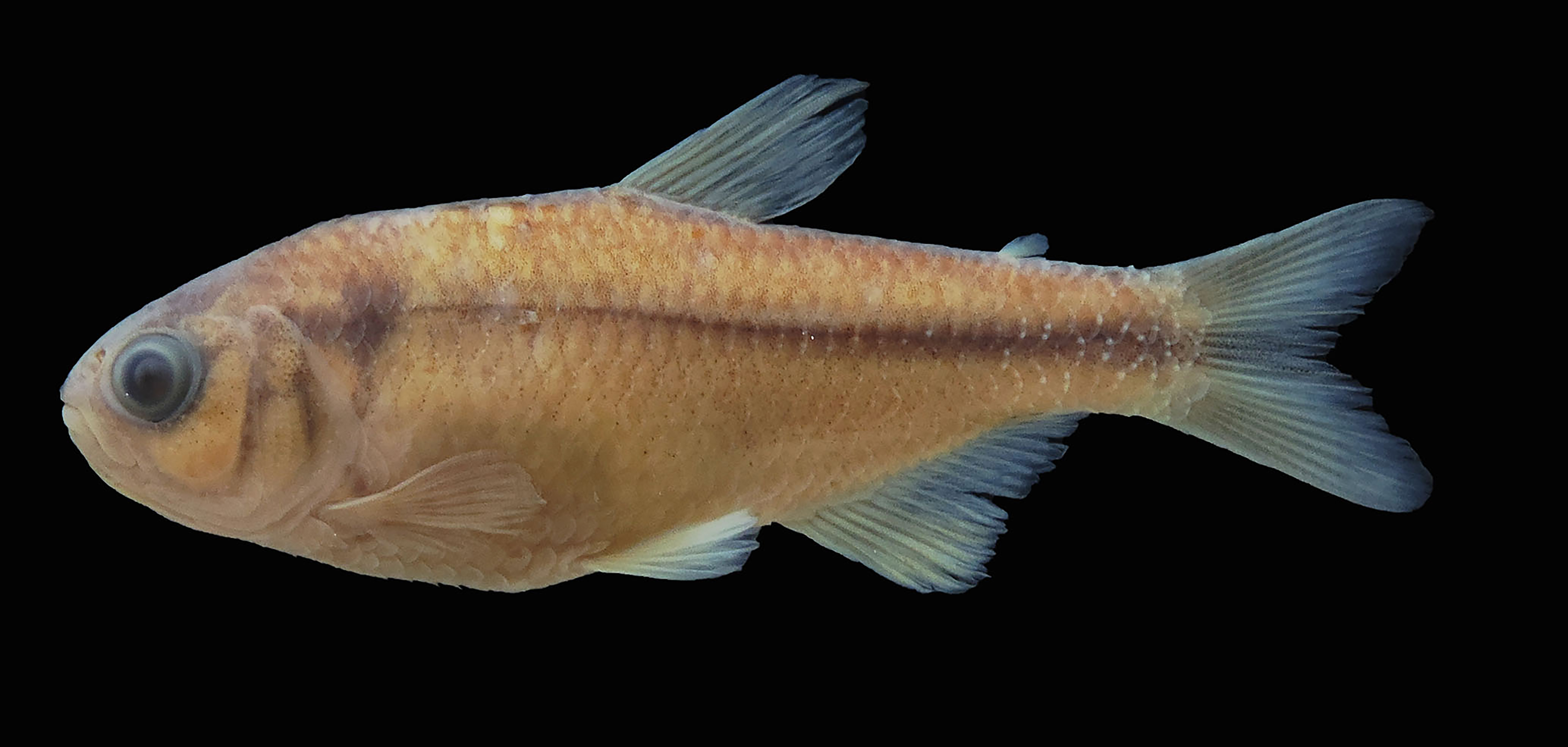
FIGURE 1 | Psalidodon malabarborum, ICT-UFMG 4018, holotype, male, 37.7 mm SL, córrego Congonhas, Piracicaba River basin, Doce River system, Minas Gerais State, Brazil.
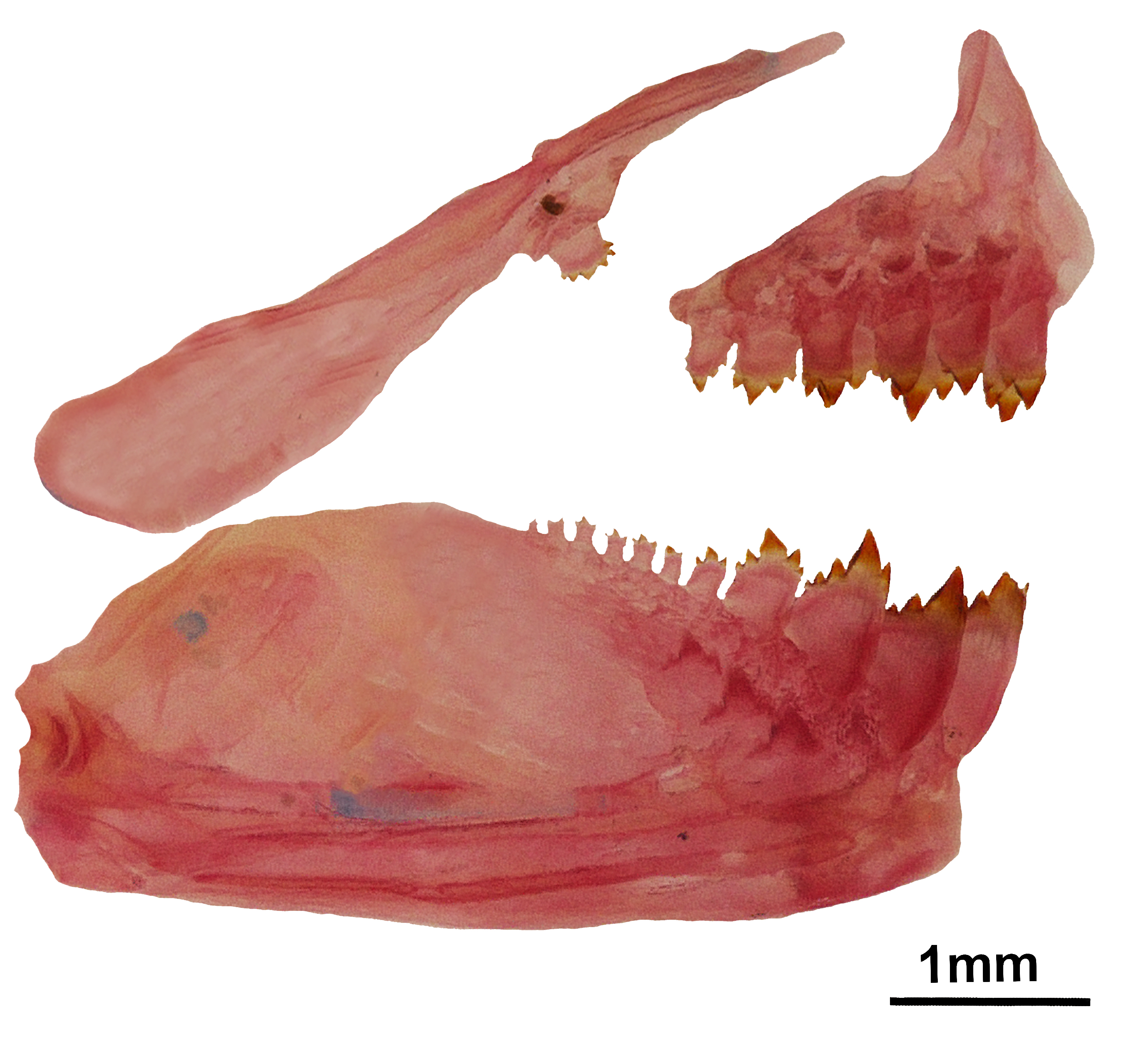
FIGURE 2 | Psalidodon malabarborum, UFRGS 19746, paratype, 41.9 mm SL. The right jaw teeth in lateral view from a clear and stained paratype, UFRGS 19746.
Dorsal-fin rays ii,9(25) or iii,9(12); first unbranched ray approximately one-half length of second ray. Distal margin of dorsal fin nearly convex or slightly straight. Dorsal-fin origin approximately at middle of SL. Adipose fin located approximately at vertical through base of last anal-fin ray. Anal-fin rays ii-iv,13(6), 14(11), 15(13), 16(5), or 17(2). First unbranched ray normally only apparent in cleared and stained specimens. Distal border of anal fin smoothly concave. Anal-fin origin situated at vertical portion of last branched dorsal-fin ray. Pectoral-fin rays i-ii,11(24), 12(13). Tip of pectoral fin falls tree scales short of vertical through pelvic-fin insertion. Pelvic-fin rays i,6(2), 7(34) or 8(1). Pelvic-fin origin located slightly anterior to vertical through dorsal-fin origin. Tip of pelvic fin reaching tip of urogenital papilla in male and falling one scale short of posterior portion of genital open in female, but falling tree to four scales of anal-fin origin in both sexes. Caudal-fin forked with lobes of similar size and 19 principal rays. Dorsal procurrent caudal-fin rays 9–11(3). Ventral procurrent caudal-fin rays 9–10(3).
Scales cycloid, moderately large. Longitudinal scale row along the middle line 32(4), 33(10), 34(9), 35(11) or 36(2). Lateral-line pores along the longitudinal series present in all scales; (12), only in the first 8–15 scales (i.e., lateral line truncated; 11); or skipping one or more scales in the middle of the series (lateral line intermittent; 14). Scale rows between dorsal-fin origin and lateral line 3(1), 4(1), 5(7) or 6(27); 3(1), 4(19), or 5(16) scale rows between lateral line and pelvic-fin origin (rarely 3, n = 1, mean = 4.4, n = 37), one specimen presents 3. Predorsal scales 10–15 (rarely 10, n = 2, 14 or 15, n = 2, mean = 10.7, n = 33), arranged in irregular series. Scale rows around caudal peduncle 13–16 (rarely 16, n = 3, mean = 13.9, n = 37). Scale sheath along anal-fin base formed by 4–5 scales in single series covering base of anterior-most rays. Precaudal vertebrae 15–16; caudal vertebrae 18; total vertebrae 33–34 (n = 2). Supraneurals 5 (n = 2). Gill-rakers on cerotobranchial 9–10; on hipobranchial 2–3 and on epibranchial 6–7 (n = 2).
Coloration in alcohol. Dorsal portion of head light-brown (Figs. 1A, 3A). Infraorbitals, preopercle and opercular bones yellowish, with scarce chromatophores. Lips and snout yellowish, usually without chromatophores. Dorsal portion of body light-brown to yellow-brown. Scales on all extension of the body with central portion yellowish, scales above lateral line with distal portion outlined with dark brown chromatophores. Dark midlateral stripe originating immediately after the preopercle slender at initial portion until the vertical through the dorsal-fin origin, wider and more conspicuous from this point on, continuing onto middle-caudal fin rays, expanded dorsally and ventrally at end of caudal peduncle forming a caudal spot. Humeral spot shaped like a heart, extended three scales above and one or two scales below lateral line. Pectoral, pelvic, dorsal and anal fins usually hyaline. Caudal-fin rays with high concentration of dark-brown chromatophores.
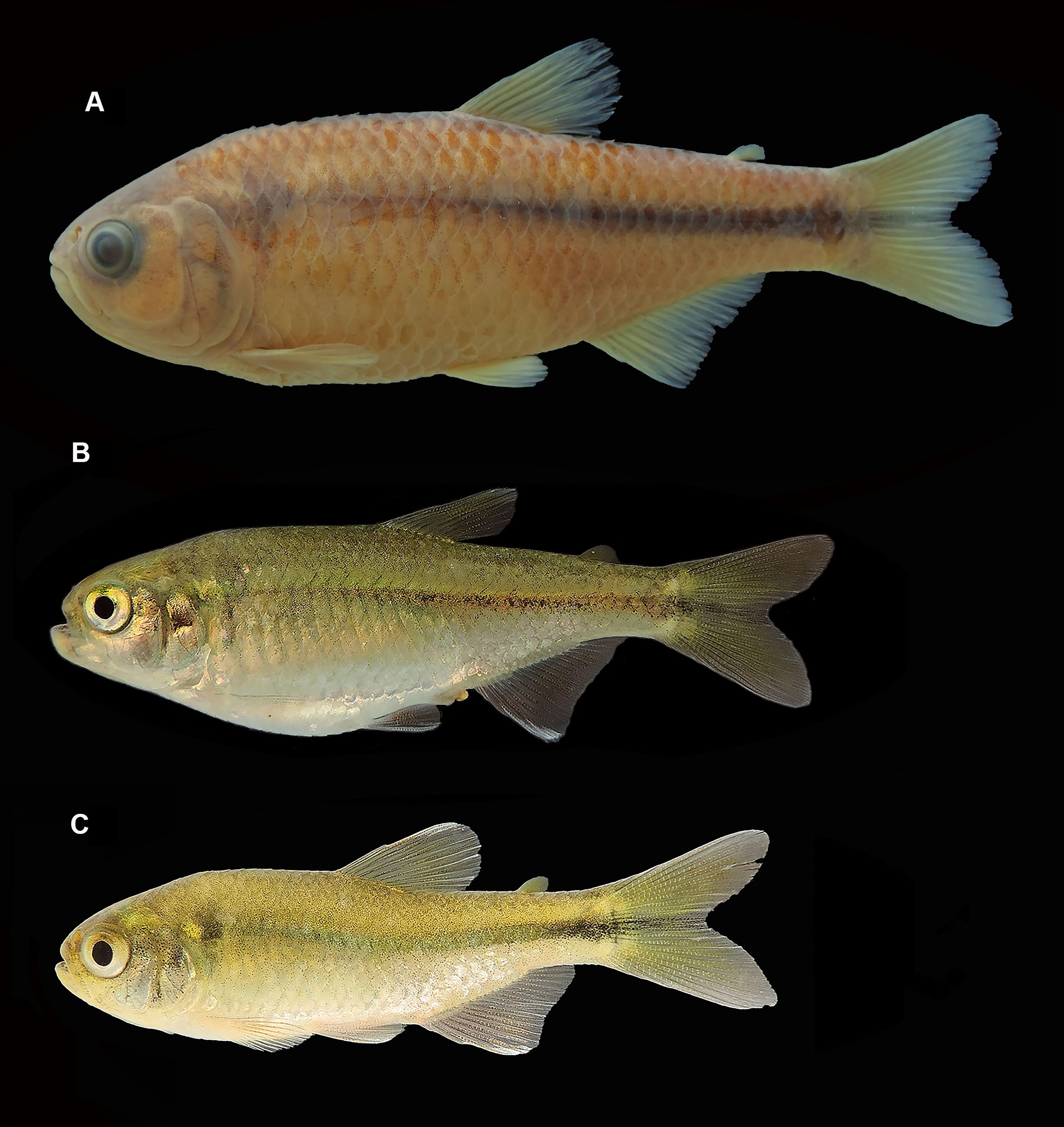
FIGURE 3 | A. Psalidodon malabarborum, paratype, female, MCNIP 3707, 56.0 mm SL. B. Paratype, female in life, UFRGS 19746, 37.6 mm SL C. Paratype, male in life, UFRGS 19746, 37.5 mm SL. Photos by PCS.
Coloration in life. Dorsal and dorsolateral portions of the body yellow or green (Figs. 3B, C). Scales above lateral line with high concentration of chromatophores in distal portion, with the central portion of the exposed scale yellowish to greenish, forming a reticulated pattern on this portion of the body. All body below lateral line silvery. Humeral spot shaped like a heart, strongly marked, black. Caudal spot nearly rounded, inconspicuous. Pectoral, and pelvic fins mostly hyaline with first unbranched rays reddish. Pelvic fins with two first rays white. Anal fin with first unbranched rays reddish and with the distal portion of tree first unbranched rays white. Dorsal fin yellowish, with the distal portion of the first unbranched ray white. Caudal fin yellowish, with distal rays of each lobe red, the middle portion black. Adipose fin yellowish.
Sexual dimorphism. Males with two series of scales above the lateral line until adipose fin covered by sexually dimorphic tubercles, after adipose fin all scales of caudal peduncle with higher concentration of dimorphic tubercles (Fig. 1). Head of males with few sexually dimorphic tubercles. Anal, pelvic, pectoral, and, rarely, dorsal fins on males with delicate bony hooks, distributed in each ray segment from the last unbranched ray to the sixth branched ray, occurring in both branches and being scarce from the fourth to the sixth branched ray. Mature males smaller than females, presenting sexual size dimorphism. Gill glands were not observed on the first gill arch in either males or females.
Geographical distribution. The new species is known for headwaters of Piracicaba River basin, more precisely at Carmo River basin, subbasins of Doce River basin; and headwaters of das Velhas River, São Francisco River basin (Fig. 4).
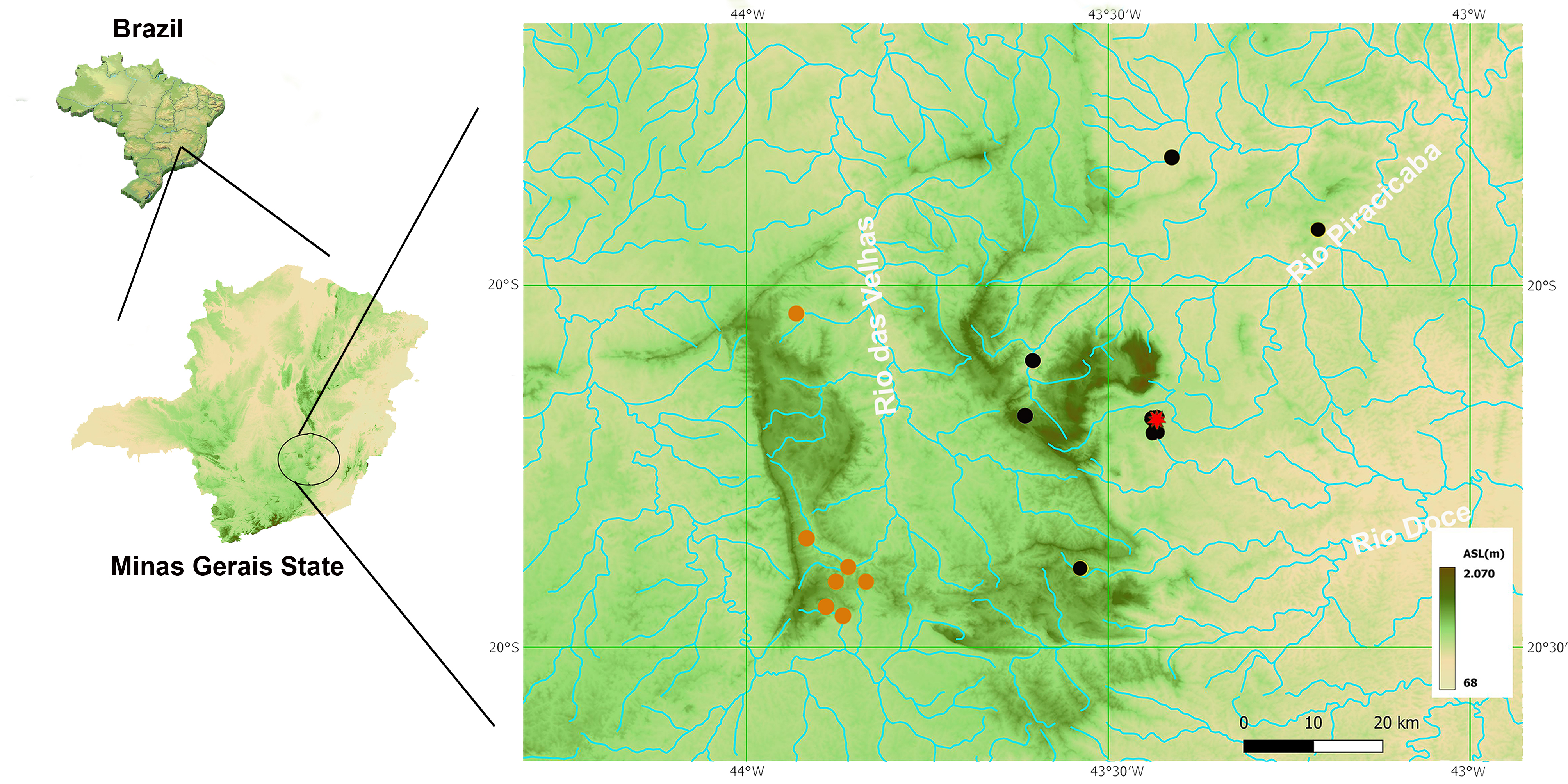
FIGURE 4 | Altitudinal map of Minas Gerais State showing the distribution of the examined material of Psalidodon malabarborum. The yellow dots are material from rio Doce basin and orange dots are lots from São Francisco river basin. Some symbols represent more than one lot or locality. The red dot is the type locality.
Ecological notes. Psalidodon malabarborum is found in stream microhabitats usually characterized by crystalline and rapid waters with rocks covered by sludge and algae. The streams where P. malabarborum is found are lined with riparian vegetation; some have the substrate covered with fine sediment mainly because of siltation resulting from the mining process. The gut contents of a few analyzed species were composed of plant material and aquatic insects.
Conservation status. The new species is known, at moment, from a geographic area heavily impacted by anthropogenic disturbances, including mining activities, a past dam rupture, and tourism, and is located in the iron quadrangle region, Minas Gerais State. Its type locality lies within an active iron ore mine in the Carmo River basin. The Carmo River, which drains into the main channel of the Doce River basin, was severely silted by tailings following the Fundão dam collapse (do Carmo et al., 2017). Only a single paratype lot originates from a protected area, the Serra do Gandarela National Park (CIC-MG 239). The species also occurs in headwaters of rio das Velhas, rio São Francisco basin, with only three specimens recorded from this basin. Also, most specimens, including the holotype, were collected in the area influenced by mining activity. Due to its restricted geographic distribution [B1 – Extend of Occurrence (EOO = 3,097.19 km2) AOO < 100 km2)] and its location in a region with active and expanding mining activity [B1b(iii)], meaning that threats are both potential and real, Psalidodon malabarborum can be categorized as Endangered (EN) according to the International Union for Conservation of Nature categories and criteria (IUCN, 2024).
Etymology. The epithet malabarborum is in honor to Luiz Roberto Malabarba and Cláudia Malabarba, for their dedication to academic life and contributions in the study of the Neotropical freshwater fish, inspirations for the new ichthyologist generation. A noun in a genitive case.
COI sequence. Genbank accession number KY327447.
Genetic results. We recovered two sequences of 461 base pairs each of the cytochrome oxidase subunit one for P. malabarborum. Comparing these sequences with 103 sequences of other Psalidodon, Astyanax, and Deuterodon species under a neighboring dendrogram, the sequences of P. malabarborum were unique (Fig. 5). The two sequences of the new species were closely related to P. dissensus (Lucena & Thofehrn, 2013), P. rivularis, P. paiva, and P. troya (Azpelicueta, Casciotta & Almirón, 2002) forming a group closely related to P. scabripinnis (Jenyns, 1842). These groups, together with P. scabripinnis, were sisters of P. velhochico, this major clade is sister of P. obscurus (Hensel, 1870), new combination, a group formed by P. paranae (Eigenmann, 1914). The group formed by P. malabarborum, P. dissensus, P. paiva, P. rivularis, P. troya, P. scabripinnis, P. velhochico, P. obscurus, and P. paranae, were closely related to a group formed by P. goyanensis, P. fasciatus (Cuvier, 1819) sensu Melo, 2005, P. eigenmanniorum (Cope, 1894), P. aff. fasciatus and P. procerus (Lucena, Castro & Bertaco, 2013) (new combination). These two groups are sister of P. gymnogenys (Eigenmann, 1911) and together with this species are the sister group of a clade formed by P. cremnobates, P. xiru (Lucena, Castro & Bertaco, 2013), P. brachypterygium, and P. laticeps. Psalidodon bagual Bertaco & Vigo, 2015 (new combination) and Psalidodon douradilho Bertaco, 2014 (new combination) are closely related and sister groups of the remaining cited groups. Psalidodon henseli (Melo & Buckup, 2006) is sister of all Psalidodon included in the analysis. The Psalidodon clade was more closely related tothe Astyanax clade and these two formed the sister clade to the Deuterodon clade (Figs. 5, S2). The lowest p-distance of P. malabarborum was 1.1% with P. dissensus (Tab. S3) and the highest was with Deuterodon keronolepis Silva & Malabarba, 2019 (new combination).
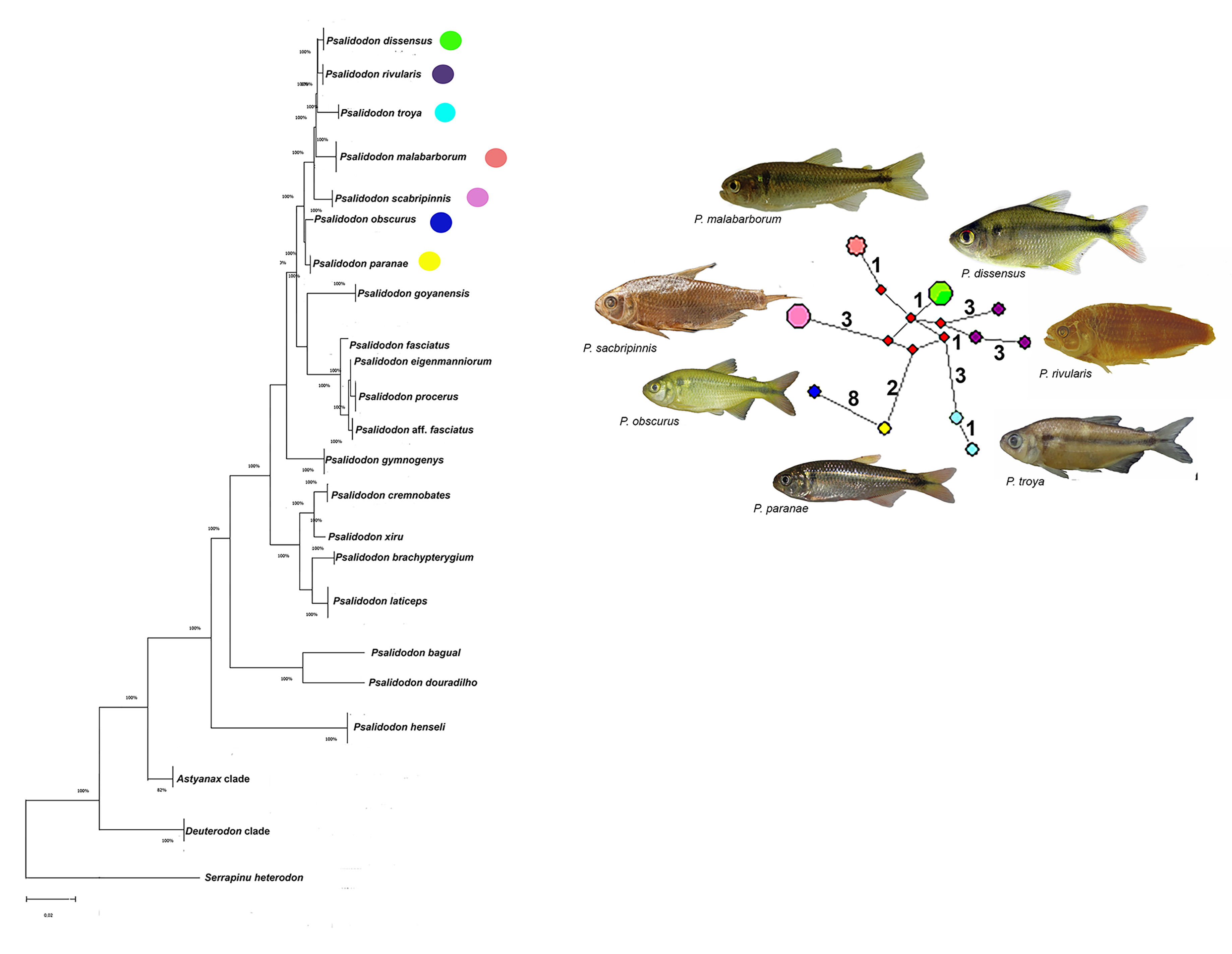
FIGURE 5 | Genetic analyses of coastal characids based on COI gene. A. Neighbor-joining tree of 98 sequences using genetic distances (Tab. S1), with the branch lengths equivalent to the number of base substitutions per site. Bootstrap values (1,000 replications) are indicated next to the branches. B. Haplotype network of a tree section including Psalidodon malabarborum and closely related species in neighbor joining dendrogram. Numbers in each branch refer to the number of mutational steps between haplotypes; branches with no number represent only 1 mutational step. Photos by PCS and from Silva et al. (2024).
On the haplotype network, P. malabarborum sequences formed a unique haplotype. The other 15 sequences of the six closely related species (P. rivularis, P. dissensus, P. paranae, P. scabripinnis, P. troya,and P. obscurus) formed eleven haplotypes (Fig. 5). The haplotype diversity was 0.95, with P. rivularis composed for three haplotypes, P. troya and P. paranae composed of two haplotypes. The other species were composed of unique haplotypes.
Discussion
The new species is hereby assigned to Psalidodon. The genus was reassessed by Terán et al. (2020) as part of a comprehensive revision dividing the Astyanax complex into four genera: Andromakhe Terán, Benitez & Mirande, 2020, Astyanax, Deuterodon, and Psalidodon. This nomenclatural act was justified by the polyphyletic nature of Astyanax as revealed by previous phylogenetic analyses (e.g., Mirande, 2010; Oliveira et al., 2011; Rossini et al., 2016; Silva et al., 2017, 2019). The new generic division reflects the main clades observed using molecular and osteological characters (e.g., Terán et al., 2020). Following Terán et al., 2020, our genetic analyses supports a new combination for Deuterodon keronolepis, Deuterodon microschemos (Bertaco & Lucena, 2006), new combination and Psalidodon procerus (Fig. S2).
In Psalidodon malabarborum, the teeth in the outer series of the premaxilla bears four to five cusps. Terán et al. (2020) proposed that the presence of five or more cusps in the outer premaxillary tooth row is a diagnostic feature for Psalidodon. However, Queiroz et al. (2025) recently observed a different number of cusps in the outer-series premaxillary teeth in Psalidodon canaaensis Queiroz, Henschel & Silva, 2025. This variation in a character originally used by Terán et al. (2020) to diagnose Psalidodon, now documented in species from coastal river drainages, suggests that a more comprehensive analysis is needed. The inclusion of additional species of Psalidodon would help clarify the extent of morphological variation in this character across the genus and establish a more accurate range of cusp numbers on the outer premaxillary teeth, thereby contributing to a better understanding of the generic limits of Psalidodon. The character as currently defined is likely insufficient to delimit Psalidodon without a broader, integrative assessment across more species and character systems. Consequently, despite this genus being recognized, the variation in the range of characters proposed to support the genus and the absence of truly exclusive synapomorphies makes it difficult to allocate species to Psalidodon without genetic support.
The genetic distance (p-distance) between P. malabarborum and other Psalidodon species ranged from 1.1% to 10.7%. Specifically, the distance from species cited within the same occurrence area (P. canaaensis – endemic and restricted to the upper portion of the Doce River basin, P. fasciatus (sensu Melo, 2005; Melo, Buckup, 2006), and P. rivularis (Fricke et al., 2025; Queiroz et al., 2025) ranged from 1.3% to 4.3%. Although the lowest p-distance of P. malabarborum was less than 2% with other Psalidodon species, a proposed threshold for species delimitation in the COI gene (Hebert et al., 2003), it is well documented that this value is highly variable among Psalidodon species (Silva et al., 2024). Therefore, this metric should not be used in isolation to recognize distinct fish species. Furthermore, the species with the lowest genetic distance, Psalidodon dissensus, is easily distinguished from P. malabarborum by morphological traits, as P. dissensus is not part of the P. scabripinnis complex.
Psalidodon malabarborum has all characteristics of the “P. scabripinnis complex”. This complex includes Astyanax, Deuterodon, and Psalidodon species with low number of branched anal fin rays, body deepest and heaviest at a vertical approximately across the
middle of the pectoral fins, and a heavy head, among other characteristics (Bertaco, Lucena, 2006). Currently, some of these species remain within Astyanax and Deuterodon (Fricke et al., 2025), and have a similar count of branched anal fin rays, such as Astyanax courensis Bertaco, Carvalho & Jerep, 2010, A. eremus Ingenito & Duboc, 2014, A. joaovitori Oliveira, Pavanelli & Bertaco, 2017, A. jordanensis Alcaraz, Pavanelli & Bertaco, 2009, A. pirabitira Lucena, Bertaco & Berbigier, 2013, A. totae Ferreira Haluch & Abilhoa, 2005, Deuterodon microschemos, and Psalidodon obscurus. Psalidodon malabarborum can be distinguished from A. courensis, D. microschemos and A. jordanensis by number of longitudinal scales (32–35, mean = 33.9 vs. 35–36, mean = 35.4, 36–38, mean = 37, 36–38, mean = 37.3, respectively), from A. eremus, A. pirabitira, and P. obscurus by presence of one humeral spot vs. two, from A. jenynsii Steindachner, 1877 by predorsal distance (47.7–55.6% vs. 54.1–68.7% SL), from A. joaovitori by body depth (25.6–33.3%, mean = 29.7% vs. 30.0–36.4%, mean = 33.2% SL), and A. totae by number of teeth of maxilla (0–1 vs. 2–5).
As with P. malabarborum, considering both genetic and morphological traits, P. paiva, P. terezinhae, and P. velhochico should be regarded as members of the P. scabripinnis complex. In the description of the aforementioned species, Rodrigues-Oliveira et al. (2025) noted their similarity to P. rivularis sensu stricto and proposed a new species complex, the Psalidodon rivularis complex. However, P. rivularis sensu stricto belongs to the P. scabripinnis complex based on genetic analyses (Fig. 5) and because it exhibits all the characteristics that define this complex: a low number of branched anal-fin rays, a deep and heavy body around the middle of the pectoral fins, and a robust head (Bertaco, Lucena, 2006). Given the morphological traits and our molecular analyses, which place these species in close relation to others recognized as part of the P. scabripinnis complex (Fig. 5), considering a new species complex is unnecessary.
The longitudinal stripe starting immediately behind the opercle, present in P. malabarborum, has not been reported for any other species within the genus Psalidodon. This characteristic is rare across the family Acestrorhamphidae, being documented only for Astyanax nobre Dagosta & Marinho, 2022 and A. joaovitori (Dagosta, Marinho, 2022). Psalidodon malabarborum is easily distinguished from A. scintillans by the presence of an elongated humeral spot and a caudal peduncle spot, both absent in A. scintillans. From A. nobre, it can be distinguished by a lower number of unbranched anal-fin rays (14–17 vs. 18–21 in A. nobre). Finally, it differs from A. joaovitori by the presence of nuptial tubercles, which in P. malabarborum are densely concentrated on the caudal peduncle, versus their absence in A. joaovitori, and by the condition of the lateral line scales, which are variably pored or interrupted in P. malabarborum versus completely pored in A. joaovitori.
In P. malabarborum, the perforation of the lateral line is variable, with states ranging from completely pored to incompletely pored or interrupted across different specimens. Although this variation is not pervasive, its occurrence can complicate diagnosis and potentially lead to the misassignment of the species to an incorrect genus by non-specialists. For decades, lateral line perforation was used in pre-cladistic studies to distinguish Astyanax (typically completely pored) from genera such as Hyphessobrycon Eigenmann, 1908 and Hemigrammus Gill, 1858 (typically incompletely pored) (Eigenmann, 1908). However, intraspecific variation in lateral line perforation appears to be a common trait among species within Acestrorhamphidae. Examples include Astyanax nobre (Dagosta, Marinho, 2022), Deuterodon hastatus (Myers, 1928), D. lutkenii (Boulenger, 1887), D. ribeirae (Eigenmann, 1911), Moenkhausia bonita Benine, Castro & Sabino, 2004, M. cotinho Eigenmann, 1908 (Eigenmann, 1912, 1917), M. celibela Marinho & Langeani, 2010 (Marinho, Langeani, 2010), M. lineomaculata Dagosta, Marinho & Benine, 2015 (Dagosta et al., 2015), M. cambacica Marinho, Ohara & Dagosta, 2021 (Marinho et al., 2021), Psalidodon balbus (Myers, 1927), P. rivularis, and Astyanax turmalinensis Triques, Vono & Caiafa, 2003 (currently it is synonymous with Psalidodon santae Eigenmann, 1907) (PCS, pers. obs., in type series of mentioned species of Astyanax, Deuterodon, and Psalidodon).
The variation in the perforation of the lateral line scales seems to be more recurrent in males of P. malabarborum (9 females with a complete lateral line vs. 6 with truncated or intermittent lateral line; 3 males with complete lateral line 3 vs. 15 with truncated or intermittent lateral line; 4 unsexed specimens with truncated or interrupted lateral line). There are hypotheses about this variation considering it as a potential consequence of the loss of terminal developmental stages due to evolutionary miniaturization (Weitzman, Vari, 1988; Hanken, Wake, 1993). Psalidodon malabarborum mature males range from 33 to 59 mm in SL, which is a small size but not miniature. In other species of Acestrorhamphidae (e.g., aforementioned species) with variable lateral line, specimens exceeding 59 mm SL with truncated of intermittent lateral line have been recorded. This indicates that the variation in lateral line perforation is not solely attributable to miniaturization in Acestrorhamphidae. According to Mogdans (2019), intraspecific variations of the lateral system might represent adaptations to prevailing hydrodynamic conditions that are encountered in the habitats of different populations. The author further cites that both the lateral line and neuromasts possess hair cells as sensory systems, enabling environmental perception, and attribute differences in lateral line shape to the number of neuromasts present on the fish body. This can explain why mainly males of P. malabarborum show lateral line variations, once only males have nuptial tubercles that can be composed by neuromasts. Another consideration that lends considerable weight to this hypothesis is the presence of different lateral line shapes among males from the same locality, which exhibit a range of neuromast densities.
In P. malabarborum, mature males are smaller than mature females. This condition seems to be common for the “P. scabripinnis species complex” (Bertaco, Malabarba, 2001; Teixeira, 2016; Teixeira et al., 2025). The most common secondary sexual characters in male Characiformes are the presence of bony hooks usually on the fins; elongated fins; a differently shaped distal anal-fin margin; different coloration patterns (Camelier et al., 2018) and branchial gland. The difference in size between the sexes is frequently not regarded, emphasizing the necessity for further discussion on this theme.
Our analysis demonstrates that the occurrence of the new species is restricted to the headwaters of the rio das Velhas and Doce river basins, with no records from any other portions of these basins. These headwaters are located at the Espinhaço mountain range, in an area featuring high-altitude points exceeding 1,400 m, with elevation differences of up to 400 m even within a single watershed. Despite the geographical proximity of the headwaters of the São Francisco and rio Doce basins, they are currently isolated. The streams located in the Espinhaço range would be affected by events such as headwater capture, due to intense Quaternary morphodynamic evolution (Saadi, 1995). Such events make the headwaters of different basins, geographically closed, more similar to each other in species composition than to the lower reaches of their own respective basins (Ribeiro et al., 2011). The distribution pattern found here for populations of P. malabarborum in head waters of rio São Francisco and rio Doce is reported by Santos, Britto (2021) for other species as Hasemania nana (Lütken, 1875), P. rivularis, Phalloceros uai Lucinda, 2008, and Trichomycterus alternatus (Eigenmann, 1917). Those findings can hypothesize that headwater streams of different basins located in high lands of Meridional Espinhaço, might share more similarity in fish species composition with each other than with other sections within the same basins.
Psalidodon malabarborum seems to be endemic from headwaters of the rios Doce and São Francisco. The discovery of this new species at this location demonstrates the potential to discover a neglected biological diversity. Therefore, there is an urgent need for taxonomic revisions and inventory studies, especially in regions undergoing rapid anthropogenic change like the Espinhaço, to prevent the loss of biodiversity before it is even documented (Sayer et al., 2025). This is particularly critical for freshwater fish.
Material comparative examined.In addition to the material analyzed in Bertaco, Lucena (2006, 2010), Bertaco et al. (2010), and Silva et al. (2024), the following specimens were analyzed. Brazil. Astyanax pirabitira: MCP 47707, holotype, 65.5 mm SL, MCP 191725, 12, paratypes, 37.8–57.1 mm SL, border between Cambará do Sul and Bom Jesus, Rio Grande do Sul, rio das Antas, rio Jacuí drainage. Astyanax turmalinensis(synonym of Psalidodon santae): DZUFMG 005, holotype, 48.0 mm SL, DZUFMG 006, paratype, 48.2 mm SL, DZUFMG 008, paratypes, 4 of 42, 54.7–43.5 mm SL, DZUFMG 009, paratypes, 2 of 25, 55.8–50.1 mm SL, DZUFMG 015, 2 of 29, Turmalina, córrego divisão na vila de Peixe-Crú, right-bank tributary of the rio Jequitinhonha, ca. 17°07’S 42°57’W. DZUFMG 016, paratypes, 2 of 32, Botumirim, left-bank tributary of the rio Jequitinhonha. Deuterodon giton: MCZ 20936, lectotype of Astyanax giton, 63.4 mm SL, rio Paraíba do Sul, Rio de Janeiro. CAS 42482, paralectotype of A. giton, 55.8 mm SL, rio Paraíba do Sul, Rio de Janeiro. UFRGS 14814, 2 c&s, 47.9–49.9 mm SL, córrego Latão, tributary of rio Doce, Coimbra, Minas Gerais. Deuterodon hastatus: USNM 92952, holotype of Astyanax hastatus, 37.1 mm SL, USNM 94312, 29, 21.1–42.1 mm SL, Rio de Janeiro. UFRGS 10257, 2 c&s, 49.3–49.9 mm SL, Macacu, Rio de Janeiro. Deuterodon intermedius: MCZ 20684, lectotype of Astyanax scabripinnis intermedius, 45.8 mm SL, rio Paraíba, near Rio de Janeiro Municipality, 22°43’S 43°17’W, 1872, Hassler Expedition. MCZ 20684, paralectotypes, 3 of 5, 37.3–34.1 mm SL, collected together with lectotype.UFRGS 10821, 2 c&s, 59.3–62.5 mm SL, Santa Virginia, São Paulo. Deuterodon janeiroensis: MCZ 21057, holotype of Astyanax janeiroensis, 71.7 mm SL, Rio de Janeiro, ca. 22°53’S 43°17’W. Deuterodon microschemos: MCP 37569, holotype, 57.2 mm SL, Iúna, córrego Palmital, rio Itapemirim basin, ca. 20º21’S 41º31’W. UFRGS 15358, 3 of 4, 81.6–89.1 mm SL, rio Mumbaça, Dionísio, Minas Gerais; UFRGS 17542, 2 of 4, 92.2–93.6 mm SL, Baixa Verde, Dionísio, Minas Gerais. Deuterodon ribeirae: type-series of Astyanax ribeirae: FMNH 54725, holotype, 50.6 mm SL, Xiririca; FMNH 149631, paratype, 39.5 mm SL, FMNH 14959, paratype, 42.4 mm SL, FMNH 14962, paratype, 45.9 mm SL, FMNH 14961, paratype, 46.9 mm SL, FMNH 14960, paratype, 41.9 mm SL, FMNH 54726, paratypes, 40of 47, 18.9–55.8 mm SL, Morretes, Paraná. Psalidodon brachypterygium:UFRGS 4950, paratypes of Astyanax brachypterygium, 20, 39.7–60.1 mm SL, Bom Jesus, arroio Água Branca na estrada Bom Jesus/São Joaquim, afluente do rio Pelotas, ca. 28°36’S 50°24’W. Psalidodon canaaensis: ICT-UFMG 3987 (ex. MZUFV 5359), 4, 27.0–84.7 mm SL, downstream Cachoeira Grande, 20°36’22”S 42°36’16”W. Psalidodon cremnobates: UFRGS 4949, paratypes of Astyanax cremnobates, 37.4–55.2 mm SL, São Francisco de Paula, arroio na estrada São Francisco de Paula, tributário do rio Santa Cruz, afluente do rio Caí, ca. 29°23’S 50°32’W. Psalidodon fasciatus: MNHN 8654, syntype, 110.8 mm SL, MNHN 9896, syntypes of Chalceus fasciatus, 2, 82.3–68.4 mm SL, rio San Francisco. Psalidodon hamatus: MCP 34000, holotype of Hyphessobrycon hamatus, 43.1 mm SL, MCP 33930, 10, 26.7–44.8 mm SL, paratypes of H. hamatus, córrego Cana Brava, tributary of rio Vermelho, rio Tocantins drainage,Mambaí, Goiás. Psalidodon kalunga: MCP 44289, holotype of Hasemania kalunga, 53.3 mm SL, UFRGS 11289, 82, 5 c&s, paratypes of H. kalunga, 15.5–53.3 mm SL, córrego in the road GO-241 between Cavalcante and Minaçu, rio Paranã drainage, upper rio Tocantins basin, Goiás. Psalidodon laticeps: ANSP 21852, holotype of Tetragonopterus laticeps, 55.2 mm SL, Jacuí river, ca. 30°56’S 51°16’W. Psalidodon paranae:CAS 22555 (ex. IU 11631), holotype of Astyanax s. paranae, 113.4 mm SL, 24°47’32”S 50°00’42”W. CAS 22556 (ex. IU 11632), 6 of 8, paratypes of Astyanax scabripinnus paranae, 51.0–108.0 mm SL, collected with holotype. Psalidodon parahybae:MCZ 20685, lectotype of Astyanax parahybae, 100.8 mm SL, USNM 120245, paralectotypes of A. parahybae,3 of 3, 87.0–103.0 mm SL, rio Paraíba do Sul, Rio de Janeiro. Psalidodon rivularis:syntypes of Tetragonopterus rivularis: BMNH 1876.10.43-49, 7, 27.5–65.8 mm SL, MNHN 9582, 4, 27.0–45.1 mm SL, NMW 57707, 5, 27.4–58.6 mm SL, NMW 57708, 2, 62.1–69.6 mm SL, USNM 44960, 2, 36.7–67.8 mm SL, ZMUC P 241372, 1, 70.1 mm SL, ZMUC P 241376, 1, 35.7 mm SL, Rio das Velhas, Minas Gerais State. MCNIP 569, 7, 20.3–32.5 mm SL, Barão de Cocais, rio Cocais, rio Piracicaba, rio Doce, Minas Gerais, 19°59’38”S 43°36’44”W. MCNIP 570, 2, 40.0–51.0 mm SL, Mariana, córrego Ouro Fino, rio Gualaxo do Norte, rio Doce, Minas Gerais, 20°12’18”S 20°12’18”W. MCNIP 612, 10, 16.3–55.9 mm SL, Barão de Cocais, córrego do Congo, rio Piracicaba, rio Doce, Minas Gerais, 19°56’15”S 43°34’33”W. Psalidodon santae: USNM 55652, 2, 32.5–54.1 mm, syntypes of Hemigrammus santae,Lagoa Santa, rio das Velhas, rio São Francisco, 19°37’52”S 43°54’07”W. MCNIP 1069, 3, 38.0–56.0 mm SL, Catas Altas, rio Maquiné, ribeirão Paracatu, 20°06’22”S 43°24’12”W. Psalidodon scabripinnis: BMNH 1917.7.14.15, holotype of Tetragonopterus scabripinnis, 68.6 mm SL, Rio de Janeiro, ca. 22°57’S 43°10’W.
Acknowledgments
We are grateful to all curators and collection managers that allow our access to the examined material, specially to Julia Torres and Gilmar Santos for the kind reception at Coleção de Peixes, PUC Minas. We thank all colleagues that sampled the specimens. Thanks to Wesley Dondoni Colombo and Gabriel Deprá for the rich discussions about nomenclatural acts mainly about P. rivularis species. Thanks to Gabriel Deprá, Carlos A. Lucena and two unidentified reviewers for the thoughtful comments and valuable suggestions that improved the quality of the text.
References
Alcaraz HSV, Pavanelli CS, Bertaco VA. Astyanax jordanensis (Ostariophysi: Characidae), a new species from the rio Iguaçu basin, Paraná, Brazil. Neotrop Ichthyol. 2009; 7(2):185–90. https://doi.org/10.1590/S1679-62252009000200008
Alves CBM, Pompeu PS. organizers. Peixes do rio das velhas: passado e presente. Belo Horizonte: Argvmentvm; 2010.
Bertaco VA, Carvalho FR, Jerep FC. Astyanax goyanensis (Miranda-Ribeiro, 1944), new combination and Astyanax courensis, new species (Ostariophysi: Characiformes): two Characidae from the upper rio Tocantins basin, Central Brazil.Neotrop Ichthyol. 2010; 8(2):265–75. https://doi.org/10.1590/S1679-62252010000200004
Bertaco VA, Lucena CAS. Two new species of Astyanax (Ostariophysi: Characiformes: Characidae) from eastern Brazil, with a synopsis of the Astyanax scabripinnis species complex. Neotrop Ichthyol. 2006; 4(1):53–60. https://doi.org/10.1590/S1679-62252006000100004
Bertaco VA, Lucena CAS. Redescription of the Astyanax obscurus (Hensel, 1870) and A. laticeps (Cope, 1894) (Teleostei: Characidae): two valid freshwater species originally described from rivers of Southern Brazil. Neotrop Ichthyol. 2010; 8(1):7–20. https://doi.org/10.1590/S1679-62252010000100002
Bertaco VA, Malabarba LR. Description of two new species of Astyanax Baird & Girard (Teleostei: Characiformes: Characidae) from headwater streams of Southern Brazil, with comments on the “Astyanax scabripinnis species complex”. Ichthyol Explor Freshw. 2001; 12(3):221–34.
Camelier P, Dagosta FCP, Marinho MMF. New remarkable sexually dimorphic miniature species of Hyphessobrycon (Characiformes: Characidae) from the upper rio Tapajós basin. J Fish Biol. 2018; 92(4):1149–62. https://doi.org/10.1111/jfb.13579
Capdevila P, O’Brien D, Marconi V, Johnson TF, Freeman R, McRae L et al. Halting predicted vertebrate declines requires tackling multiple drivers of biodiversity loss. Sci Adv. 2026; 12(7):adx7973. https://doi.org/10.1126/sciadv.adx7973
Do Carmo FF, Kamino LHY, Junior RT, Campos IC, Carmo FF, Silvino G et al. Fundão tailings dam failures: the environment tragedy of the largest technological disaster of Brazilian mining in global context. Perspect Ecol Conserv. 2017; 15(3):145–51. https://doi.org/10.1016/j.pecon.2017.06.002
Comitê da Bacia Hidrográfica do Rio Doce (CBH DOCE). Comitê da Bacia Hidrográfica do Rio Doce [Internet]. 2025. Available from: https://cbhdoce.org.br/institucional/a-bacia
Dagosta FCP, Marinho MMF. New small-sized species of Astyanax (Characiformes: Characidae) from the upper rio Paraguai basin, Brazil, with discussion on its generic allocation. Neotrop Ichthyol. 2022; 20(1):e210127.
https://doi.org/10.1590/1982-0224-2021-0127
Dagosta FCP, Marinho MMF, Benine RC. A new species of Moenkhausia Eigenmann (Characiformes: Characidae) from the upper rio Juruena, Central Brazil. Zootaxa. 2015; 4032(4):417–25. https://doi.org/10.11646/zootaxa.4032.4.6
Dudgeon D, Strayer DL. Bending the curve of global freshwater biodiversity loss: what are the prospects? Biol Rev. 2025; 100(1):205–26. https://doi.org/10.1111/brv.13137
Edgar RC. MUSCLE: multiple sequence alignment with high accuracy and high throughput. Nucl Acids Res. 2004; 32(5):1792–97. https://doi.org/10.1093/nar/gkh340
Eigenmann CH. Zoological results of the Thayer Brazilian Expedition – Preliminary descriptions of new genera and species of tetragonopterid characins. Bull Mus Comp Zool. 1908; 52(6):91–106.
Eigenmann CH. The freshwater fishes of British Guiana, including a study of the ecological grouping of species, and the relation of the fauna of the plateau to that of the lowlands. Mem Carnegie Mus. 1912; 5(1):1–578. https://doi.org/10.5962/bhl.part.14515
Eigenmann CH. The American Characidae – I. Mem Mus Comp Zool. 1917; 43:1–102. https://doi.org/10.5962/bhl.title.49183
Fink WL, Weitzman SH. The so-called cheirodontin fishes of Central America with descriptions of two new species (Pisces: Characidae). Smithson Contrib Zool. 1974; 172:1–46. https://doi.org/10.5479/si.00810282.172
Fricke R, Eschmeyer WN. Eschmeyer’s catalog of fishes: journals [Internet]. San Francisco: California Academy of Science; 2025. Available from: http://researcharchive.calacademy.org/research/ichthyology/catalog/journals.asp
Fricke R, Eschmeyer WN, Van der Laan R. Eschmeyer’s catalog of fishes: genera, species, references [Internet]. San Francisco: California Academy of Science; 2025. Available from: http://researcharchive.calacademy.org/research/ichthyology/catalog/fishcatmain.asp
Hanken J, Wake DB. Miniaturization of body size: organismal consequences and evolutionary significance. Ann Rev Ecol Evol Syst. 1993; 24:501–19. https://doi.org/10.1146/annurev.es.24.110193.002441
Hebert PDN, Cywinska A, Ball SL, deWaard JR. Biological identifications through DNA barcodes. Proc R Soc Lond. 2003; 270(1512):313–21. https://doi.org/10.1098/rspb.2002.2218
International Union for Conservation of Nature (IUCN). Standards and petitions committee. Guidelines for using the IUCN Red List categories and criteria. Version 16 [Internet]. Gland; 2024. Available from: http://www.iucnredlist.org/documents/RedListGuidelines.pdf
Ivanova NV, Zemlak TS, Hanner RH, Hebert PDN. Universal primer cocktails for fish DNA barcoding. Mol Ecol Notes. 2007; 7(4):544–48. https://doi.org/10.1111/j.1471-8286.2007.01748.x
Jhariya DC, Khan R, Thakur GS. Impact of mining activity on water resource: an overview study. National Seminar on Recent Practices & Innovations in Mining Industry. 2016; 271–77.
Ladeira EA. Geological field excursion from Belo Horizonte to Ouro Preto, Minas Gerais, Brazil-Regional stratigraphy and tectonics of the Archean Rio das Velhas greenstone belt and the Proterozoic Minas Supergroup as background for gold metallogenesis. In: Thorman CH, Buscher DP, editors. U.S. Geological Survey; 1988. https://doi.org/10.3133/ofr88656
Machado IF, Figueirôa S. Mining history of Brazil: a summary. Miner Econ. 2022; 35(2):253–65. https://doi.org/10.1007/s13563-021-00293-0
Marinho MMF, Langeani F. Moenkhausia celibela: a new species from the Amazon basin, Brazil (Characiformes: Characidae). J Fish Biol. 2010; 77(4):879–89. https://doi.org/10.1111/j.1095-8649.2010.02719.x
Marinho MMF, Ohara WM, Dagosta FCP. A new species of Moenkhausia (Characiformes: Characidae) from the rio Madeira basin, Brazil, with comments on the evolution and development of the trunk lateral line system in characids. Neotrop Ichthyol. 2021; 19(2):e200118. https://doi.org/10.1590/1982-0224-2020-0118
Melo BF, Ota RP, Benine RC, Carvalho FR, Lima FC, Mattox GM et al. Phylogenomics of Characidae, a hyper-diverse Neotropical freshwater fish lineage, with a phylogenetic classification including four families (Teleostei: Characiformes). Zool J Linn Soc. 2024; 202(1):zlae101. https://doi.org/10.1093/zoolinnean/zlae101
Melo FAG. Revisão taxonômica do complexo de espécies Astyanax fasciatus (Cuvier, 1819) (Teleostei: Characiformes: Characidae). [PhD Dissertation]. Rio de Janeiro: Museu Nacional, UFRJ; 2005.
Melo FAG, Buckup PA. Astyanax henseli, a new name for Tetragonopterus aeneus Hensel, 1870 from southern Brazil (Teleostei: Characiformes). Neotrop Ichthyol. 2006; 4(1):45–52. https://doi.org/10.1590/S1679-62252006000100003
Menezes NA. Três espécies novas de Oligosarcus Günther, 1864 e redefinição taxonômica das demais espécies do gênero (Osteichthyes, Teleostei, Characidae). Bol Zool. 1987; 11:1–39.
Mirande JM. Phylogeny of the family Characidae (Teleostei: Characiformes): from characters to taxonomy. Neotrop Ichthyol. 2010; 8(3):385–568. https://doi.org/10.1590/S1679-62252010000300001
Mogdans J. Sensory ecology of the fish lateral-line system: morphological and physiological adaptations for the perception of hydrodynamic stimuli. J Fish Biol. 2019; 95(1):53–72. https://doi.org/10.1111/jfb.13966
Oliveira C, Avelino GS, Abe KT, Mariguela TC, Benine RC, Ortí G et al. Phylogenetic relationships within the speciose family Characidae (Teleostei: Ostariophysi: Characiformes) based on multilocus analysis and extensive ingroup sampling. BMC Evol Biol. 2011; 1(1):275. https://doi.org/10.1186/1471-2148-11-275
Pelicice FM, Azevedo-Santos VM, Vitule JRS, Orsi ML, Lima Junior DP, Magalhães ALB et al. Neotropical freshwater fishes imperilled by unsustainable policies. Fish Fish. 2017; 18(6):1119–33. https://doi.org/10.1111/faf.12228
Prakash S. Climate change and need of biodiversity conservation: a review. IJAR. 2017; 3(12):554–57. Available from: https://www.allresearchjournal.com/archives/2017/vol3issue12/PartH/6-8-83-494.pdf
Queiroz V, Silva PC, Machado VN, Assis CE, Barros LC, Dergam JD et al. A new endemic species of Psalidodon Eigenmann (Characiformes: Acestrorhamphidae) from the upper rio Doce basin, Brazil. Zootaxa. 2025; 5725(2):231–54. https://doi.org/10.11646/zootaxa.5725.2.3
Reis RE, Albert JS, Di Dario F, Mincarone MM, Petry P, Rocha LA. Fish biodiversity and conservation in South America: fish biodiversity and conservation. J Fish Biol. 2016; 89(1):12–47. https://doi.org/10.1111/jfb.13016
Ribeiro AC, Lima FCT, Menezes NA. Biogeografia dos peixes de água doce da América do Sul. In: Carvalho CJB, Almeida EAB. editors. Biogeografia da América do Sul: padrões e processos. São Paulo: Editora Roca; 2011. p.261–76.
Rodrigues-Oliveira IH, Assis PM, Pimentel LGP, Soares RAS, Silva IB, Rocha RR et al. Unraveling a 150-year-old enigma: Psalidodon rivularis (Acestrorhamphidae: Acestrorhampinae), a species complex or a polymorphic species? Biology. 2025; 14(12):1793. https://doi.org/10.3390/biology14121793
Rossini BC, Oliveira CAM, Melo FAG, Bertaco VA, Astarloa JMD, Rosso JJ et al. Highlighting Astyanax species diversity through DNA barcoding. PLoS ONE. 2016; 11(12):e0167203. https://doi.org/10.1371/journal.pone.0167203
Rozas J, Ferrer-Mata A, Sanchez-DelBarrio JC, Guirao-Rico S, Librado P, Ramos-Onsins SE et al. DnaSP 6: DNA sequence polymorphism analysis of large data sets. Mol Biol Evol. 2017; 34(12):3299–302. https://doi.org/10.1093/molbev/msx248
Santos SA, Britto MR. The ichthyofauna of a poorly known area in the middle-southern Espinhaço mountain range, state of Minas Gerais, Brazil: diagnostics and identification keys. ZooKeys. 2021; 1054:25–66. https://doi.org/10.3897/zookeys.1054.67554
Santos RE, Silva TP, Chehayeb IV, Magalhães ALB. Reproduction of the non-native fish Lepomis gibbosus (Perciformes: Centrarchidae) in Brazil. Rev Biol Trop. 2012; 60(3):1327–34.
Sayer CA, Fernando E, Jimenez RR, Macfarlane NBW, Rapacciuolo G, Böhm M et al. One-quarter of freshwater fauna threatened with extinction. Nature. 2025; 638(8049):138–45. https://doi.org/10.1038/s41586-024-08375-z
Silva PC, Bonato KO, Bertaco VA, Malabarba LR. Integrative diagnosis and review of the conservation status of a Near Threatened species of the “Psalidodon scabripinnis complex”. Neotrop Ichthyol. 2024; 22(4):e240069. https://doi.org/10.1590/1982-0224-2024-0069
Silva PC, Malabarba MC, Malabarba LR. Using ancient DNA to unravel taxonomic puzzles: the identity of Deuterodon pedri (Ostariophysi: Characidae). Neotrop Ichthyol. 2017; 15(1):e160141. https://doi.org/10.1590/1982-0224-20160141
Silva PC, Malabarba MC, Malabarba LR. Integrative taxonomy: morphology and ancient DNA barcoding reveals the true identity of Astyanax taeniatus, a tetra collected by Charles Darwin during the Beagle’s voyage. Zool Anz. 2019; 278:110–20. https://doi.org/10.1016/j.jcz.2018.12.007
Tamura K, Stecher G, Kumar S. MEGA11: molecular evolutionary genetics analysis version 11. Mol Biol Evol. 2021; 38(7):3022–27. https://doi.org/10.1093/molbev/msab120
Teixeira TF. Evolução dos caracteres sexuais secundários em Characidae (Teleostei: Characiformes). [PhD Dissertation]. São Paulo: Universidade de São Paulo; 2016.
Teixeira TF, Salvador GN, Mirande JM, Lima FCT. A new species of Psalidodon (Charadiformes: Acestrorhamphidae) from the upper rio São Francisco basin, Brazil, with comments on Hasemania. Ichthyol Herpetol. 2025; 113(1):131–42. https://doi.org/10.1643/i2024065
Terán GE, Benitez MF, Mirande JM. Opening the Trojan horse: phylogeny of Astyanax, two new genera and resurrection of Psalidodon (Teleostei: Characidae). Zool J Linn Soc. 2020; 190(4):1217–34. https://doi.org/10.1093/zoolinnean/zlaa019
Tonella LH, Ruaro R, Daga VS, Garcia DAZ, Vitorino Júnior OB, Lobato-de-Magalhães T et al. Neotropical freshwater fishes: a dataset of occurrence and abundance of freshwater fishes in the Neotropics. Ecology. 2023; 104(4):e3713. https://doi.org/10.1002/ecy.3713
Vitule JRS. Introdução de peixes em ecossistemas continentais brasileiros: revisão, comentários e sugestões de ações contra o inimigo quase invisível. Neotrop Biol Conserv. 2009; 4(2):111–22. https://doi.org/10.4013/nbc.2009.42.07
Weitzman SH, Vari RP. Miniaturization in South American freshwater fishes: an overview and discussion. Proc Biol Soc Wash. 1988; 101(2):444–65. Available from: https://repository.si.edu/handle/10088/901
Authors

Priscilla Caroline Silva1 , Karine Orlandi Bonato2 and Vinicius Araújo Bertaco3
[1] Departamento de Zoologia, Programa de Pós-Graduação em Zoologia, Laboratório de Ictiologia (LABIC), Universidade Federal de Minas Gerais, Av. Antônio Carlos, 6627, Pampulha, 31270-901, Belo Horizonte, MG, Brazil. priscillacsilva@ufmg.br (corresponding author).
[2] Instituto Federal de Santa Catarina, Rua Bernardino José de Oliveira, 81, 89070-270, Badenfurt, Blumenau, SC, Brazil. kakabio2005@yahoo.com.br.
[3] Museu de Ciências Naturais, Secretaria Estadual de Meio Ambiente e Infraestrutura, Av. Dr. Salvador França, 1427, 90690-000, Porto Alegre, RS, Brazil. vbertaco@gmail.com.
Authors’ Contribution 

Priscilla Caroline Silva: Conceptualization, Formal analysis, Investigation, Methodology, Project administration, Writing-original draft, Writing-review and editing.
Karine Orlandi Bonato: Investigation, Writing-review and editing.
Vinicius Araújo Bertaco: Investigation, Writing-original draft, Writing-review and editing.
Ethical Statement
Not applicable.
Competing Interests
The author declares no competing interests.
Data availability statement
The authors confirm that the data supporting the findings of this study are available within the article.
AI statement
The authors use AI-assisted technology, the DeepSeek (2025) to do the grammar correction.
DeepSeek. (2025). DeepSeek-R1 (Feb 2025 version) [Large language model]. https://chat.deepseek.com/
Funding
PCS had financial support from Conselho Nacional de Desenvolvimento Científico e Tecnológico (PDJ-CNPq process number 205678/2014–9, 150956/2017–7 and 381062/2024–4).
Supplementary Material
Supplementary material SUP
Peer Review
How to cite this article
Silva PC, Bonato KO, Bertaco VA. A new species of Psalidodon (Characiformes: Acestrorhamphidae) from an overexploited region in Minas Gerais State, Brazil. Neotrop Ichthyol. 2026; 24(4):e260018. https://doi.org/10.1590/1982-0224-2026-0018
Copyright
This is an open access article under the terms of the Creative Commons Attribution License, which permits use, distribution and reproduction in any medium, provided the original work is properly cited.
Distributed under
Creative Commons CC-BY 4.0

© 2026 The Authors.
Neotropical Ichthyology published by SBI
 Accepted August 20, 2026
Submitted February 10, 2026
Epub November 27, 2026