
 Laura Montagut-Rojas1
  , Fabrício Barreto Teresa2 and Tiago Pinto Carvalho3,4
PDF: Download Here | Supplementary: Sup | Cite this article
Associate Editor: Evelyn Habit
Section Editor: Fernando Pelicice
Editor-in-chief: José Birindelli
Abstract
Altitudinal gradients provide a natural framework for evaluating how fish communities respond to environmental variation at both local and regional scales. In this study, we examined the functional composition of fishes along the piedmont-lowland altitudinal gradient in the Meta River basin and its association with environmental conditions. We sampled 29 sites in an altitudinal gradient and evaluated taxonomic and functional composition. We measured ten morphological traits related to movement and food acquisition, in association with environmental variables. We found a marked taxonomic and functional turnover across two altitudinal thresholds (240–250 and 350–360 m.a.s.l.), highlighting the role of environmental filters in shaping fish assemblages. We furtheridentified significant associations between body elongation, oral gape position, pectoral fin size, and eye vertical position with physicochemical and geomorphological gradients. These findings demonstrate that the functional structure of fish communities in the Orinoquia is strongly influenced by environmental heterogeneity, underscoring the importance of integrating functional approaches into conservation strategies in the face of rapid loss and transformation of Neotropical aquatic ecosystems.
Keywords: Biogeography, Diversity, Fish ecology, Functional traits, Orinoco Llanos.
Introduction
Understanding factors that influence species distribution across space is essential for improving our ability to predict biodiversity patterns along natural and anthropogenic gradients. Spatial and environmental filters have strong influence on fish distributions within basins at both local and regional scales. Most studies addressing this topic have traditionally adopted a taxonomic perspective, which has allowed to identify changes in richness and community composition (van der Sleen, Albert, 2022). Over the last two decades, studies have increasingly incorporated the composition and diversity of functional traits into a better understanding of the ecological mechanisms underlying these patterns (Toussaint et al., 2016; Gomes et al., 2023). These traits, including morphological, physiological, reproductive, or behavioral attributes, are directly linked to the ecological responses of the organism and their influence in ecosystem processes (Winemiller, 1991; Violle et al., 2007). Considering these functional traits has led to important advances in our understanding of species-environment relationships along both natural and human-modified gradients (Teresa, Casatti, 2017; Villéger et al., 2017; Pagotto et al., 2022; Gomes et al., 2023).
The distribution of species within basins results from patterns acting at regional scales, related to ecological and historical processes (Carvajal‐Quintero et al., 2015; Cilleros et al., 2016; Lamothe et al., 2018; Brejão et al., 2021), and at local scales, where biotic and abiotic factors interact to delimit the composition of the species pool (Willis et al., 2005; Lujan et al., 2013; Echevarría et al., 2017; Angulo‐Valencia et al., 2022). For instance, regional scale features like geology, vegetation physiognomy, or river geomorphology directly influence local characteristics such as substrate composition, riparian vegetation, and the presence of rapids or pools. While at the local scale, biotic and abiotic factors such as competition for resources, instream physical structures, nutrient availability and limnological variations in the conditions may determine the distribution of specific species within a given habitat (Jackson et al., 2001; Romero, Casatti, 2012). These characteristics change along river, creating distinct species assemblages from upstream to downstream (Lujan et al., 2013; Cilleros et al., 2017).
In this context, altitudinal gradients provide a natural framework for studying ecological dynamics, as they integrate patterns that operate simultaneously at different spatial scales (Pease et al., 2012; Kirk et al., 2022). Elevational gradients reflect stepwise environmental variation that imposes strong environmental filters, because of changes induced by multiple ecological factors. This results in increased abiotic stress as species approach their tolerance limits at higher elevations, thereby restricting the composition of fish assemblages (Jaramillo-Villa et al., 2010; Bailly et al., 2016). These changes may reflect ecological thresholds, in which modifications in environmental conditions result in taxonomic and functional turnover. Thus, the analysis of changes at regional scales, such as those occurring between the Piedmont and the Lowlands, allows the identification of differentiated diversity patterns along rivers system.
Alongside altitudinal gradients, the River Continuum Concept (RCC) provides a theoretical framework for understanding how aquatic communities vary longitudinally along river networks, influenced by environmental changes such as temperature and the diversity of food sources (Vannote et al., 1980). However, RCC represents a simplified framework originally developed for temperate streams and may not fully capture the ecological complexity of tropical river systems, particularly those characterized by strong altitudinal gradients. In such systems, environmental factors such as temperature and dissolved oxygen concentration strongly influence species diversity (Carvajal‐Quintero et al., 2015). Alterations in these conditions, often linked with reduced forest cover can decrease the biomass of less tolerant fish species, including large piscivores and macroinvertebrate feeders (Arantes et al., 2019). Conversely, habitat structural complexity influences ecological interactions by expanding niche diversity and species density, often reflected in a higher diversity of trophic groups (Willis et al., 2005). Therefore, ecological factors associated with altitudinal gradients and longitudinal river structure are intertwined and jointly shape regional and local species pools (Cadotte, Tucker, 2017).
The western portion of the Orinoco River basin features a network of dendritic river systems that connect small to medium sized rivers, originating in the Andes Mountains, to piedmont and floodplain ecosystems, reflecting ecological and evolutionary dynamics (Abell et al., 2008; Bustamante, 2019). Although taxonomic knowledge has increased in different parts of the basin (Urbano-Bonilla et al., 2014, 2018, 2021; Trujillo et al., 2016; Zamudio et al., 2017; Agudelo-Zamora H et al., 2020; Andrade-López et al., 2021; Cortés Hernández et al., 2023), trait-based ecological studies in the Orinoco are scarce (Echevarría, González, 2017, 2018), evidencing a significant knowledge gap. Understanding how fish assemblages change functionally along environmental gradients, such as elevation, is critical for identifying ecological thresholds at which environmental changes can lead to abrupt shifts in assemblage composition.
Here, we examined the functional composition of fish assemblages along the piedmont-lowland altitudinal gradient and their association with environmental conditions. This study was conducted in several tributaries of the Meta River basin, allowing us to test the trait-environment relationships in fish assemblages inhabiting streams and rivers from the Andes piedmont to the large rivers in the lowlands. We hypothesized that the influence of the environmental gradient would drive changes in the taxonomic and functional composition of fish assemblages across ecoregions. We predicted that restrictive environmental conditions in high-altitude rivers would simplify the taxonomic composition of fish assemblages and select specific functional traits, whereas more complex habitats at lower altitudes would favor greater trophic and mobility diversity. Understanding functional and taxonomic responses of fish assemblages across ecoregional scales may help inform conservation planning, the selection of strategic areas to maintain functional diversity and the monitoring of ecosystem integrity, which is particularly relevant given the ongoing loss and modification of aquatic ecosystems in these regions.
Material and methods
Sampling sites. We sampled 29 sites in the main tributaries of Meta River in the Casanare department, Colombia. The sampled rivers basins included the Casanare, Ariporo, Pauto, Cravo Sur, Cusiana, and Upía (Fig. 1). Whenever possible, two collections were conducted in piedmont rivers and two in lowlands (Tab. S1). Sampling was carried out during the low-water season between February 13 and 26, 2022 (Figs. 2A–D). At each site, standardized collections were conducted along a 100 m transect that included both river margins and the main channel, using 20 cast net throws, 5 seine net sweeps, and 5 electrofishing passes, the latter only when conductivity conditions allowed. In the field, fish were kept in buckets and anesthetized with eugenol to minimize stress before being sacrificed. Specimens were initially fixed in a 10% formalin solution and, after 48 h, transferred to a 70% ethanol solution.
In the laboratory, specimens were taxonomically identified using keys from Van der Sleen, Albert (2017), Urbano-Bonilla et al. (2018) and specific taxonomic reviews. Fish collected was deposited at the ichthyology collection of the Museo de Historia Natural of Pontificia Universidad Javeriana, Bogotá (MPUJ), with catalog numbers MPUJ 16647 to 17167. The collection data was published in SIB Colombia and can be seen at https://doi.org/10.15472/kzzasm.
These fluvial systems are of Andean origin, a geomorphological formation that has influenced the reorganization of drainage networks and intensified the diversification and dispersal of the continent’s exceptional freshwater fish fauna (Cassemiro et al., 2023). The department of Casanare in Colombia is characterized by a high landscape diversity, including mountain between 1,000 to 4,000 m a.s.l. shaped by tectonic activity associated with the Eastern Andean Cordillera. In this region, narrow streams with clear waters and fast currents predominate. This continues into the piedmont, a transitional zone between the mountains and the lowland plains, located between 300 and 1,500 m a.s.l., characterized by the transport of large loads of alluvial sediments and the presence of wider creeks and rivers with clear waters, rocky and gravel substrates, and swift currents. Finally, the lowland plains, which include alluvial and aeolian environments, are composed of floodplain depressions and fluvial levees formed by large meandering rivers, which transport high suspendedsediment loads. Depositional here is dominated by silt-loam and clay-loam textures (Mora-Fernandez, Rodriguez-Posada, 2017; Bustamante, 2019).

FIGURE 1 | Location of the sampling sites in the department of Casanare, Colombia. The 29 sampling points are shown in purple circles; however, three of them overlap as they represent nearby stations.
Environmental variables. Measured environmental variables included water flow velocity and water depth using a Global Water flow meter, as well as conductivity, pH, temperature and dissolved oxygen (measured with a YSI ProQuatro multiparameter device). These variables were measured at three points along the transect (sample station), and their averages were calculated. Altitude was determined by a GPS at the middle point of the transect.
To determine river order, we used the Strahler classification method, based on DEM (Digital Elevation Model) imagery from the ALOS/PALSAR satellite (2006–2011) via ASF (The Alaska Satellite Facility) (NASA, 2022). Data processing was performed using the open-source software QGIS (Quantum Geographic Information System) and SAGA (System for Automated Geoscientific Analyses). In some cases, in lowland tributaries where DEM resolution was limited, river order was manually estimated based on results from nearby tributaries.

FIGURE 2 | Examples of representative Piedemont and Lowland ecosystems. A. Piedemont river (Pauto River, order 7). B. Piedmont Stream (Guamo Stream, order 3). C. Lowland River (Ariporo River, order 6). D. LowlandStream (Yaguarapo Stream, order 4).
Functional traits. Using a digital caliper (Mitutoyo model CD-6¨CSX) and following the methodology proposed by Toussaint et al. (2016) we measured 10 functional traits related to movement and food acquisition: body standard length (LS), body elongation (BODY_E), eye vertical position (EYE_POS), relative eye size (EYE_SIZE), oral gape position (ORAL_POS), relative maxillary length (MAX_LEN), body lateral shape (BODY_SHAP), pectoral fin vertical position (PEC_FIN_POS), pectoral fin size (PEC_FIN_SIZE) and caudal peduncle throttling (CAUDAL_THROT) (Fig. S2; Tabs. S3, S4). Measurements were taken for all collected species, ranging from 1 to 10 individuals per species. To minimize ontogenetic variability, juvenile specimens were excluded, and for species with pronounced sexual dimorphism (e.g., Corynopoma riisei), only females were measured. For species with ventral mouths, such as those from the Loricariidae family, the mouth position trait value was set to 0, while for Gymnotiformes species lacking a caudal fin, the trait value was set to 1 (Toussaint et al., 2016).
Statistical analysis. To describe the taxonomic composition changes along the sampling stations, we performed a non-metric multidimensional scaling (NMDS) analysis using a species abundance matrix by sampling site and Bray-Curtis dissimilarity index. This approach allowed a graphical representation of species and sites in a space where their positions reflect their degree of similarity. The NMDS results indicated the need to apply a specific statistical method to identify threshold points related to changes in fish composition. Therefore, we used Threshold Indicator Taxa Analysis (TITAN), which allowed us to determine thresholds and indicator species along the evaluated altitudinal gradient (711–138 m.a.s.l.) (Baker, King, 2010). TITAN is a statistical method that examines and maximizes the association between the predictor variable and individual species. It identifies significant indicator species and their response direction, that is, whether the change in species distribution and frequency was the same for more than 95% of the 1,000 bootstrapped runs (i.e., high purity), whether the gradient pressure is positive or negative, and divide the samples into two groups: a low-value group (z-) and a high-value group (z+). In this analysis, species that appeared in fewer than three sites were excluded to avoid values that represent potential biases (Baker, King, 2010; Zhang et al., 2019).
To evaluate changes in functional composition and the trait-environment relationship, we conducted RLQ ordination analysis (Dolédec et al., 1996). This multivariate technique is based on the joint ordination of three matrices: the R matrix, which has sampling sites as rows and the values of environmental variables as columns; the L matrix, which contains the sites as rows and the species as columns; and the Q matrix, which has the species as rows and the values of functional traits as columns. We used relative abundance values as input for the L matrix to minimize the effect of differences between abundant and rare species (Ribeiro et al., 2016). The environmental variable matrix R and functional trait matrix Q were not logarithmically transformed to preserve the inherent morphological differences among species.
Additionally, we tested the statistical significance of the trait-environment associations in the RLQ analysis using a Monte Carlo permutation test with simulated R and Q matrices (null model 5 proposed by (Dray et al., 2014). Finally, we identified environmental variables and functional traits with significant correlations by calculating Pearson correlation coefficients (r). This analysis focused on normalized scores from the R and Q matrices corresponding to RLQ axes 1 and 2, which best represented the variation. The scores of each axis were correlated with the values of each environmental variable and functional trait to identify the relationships between environmental characteristics and functional traits (Vallet et al., 2010; Ribeiro et al., 2016).
All analyses were carried out in R v. 4.4.1 within the RStudio environment (R Foundation for Statistical Computing) using the vegan and Tidyverse packages for NMDS and Pearson correlation coefficient analyses; the TITAN2 package for Threshold Indicator Taxa Analysis; and ade4 for RLQ.
Results
A total of 132 species belonging to five orders and 30 families were collected (Tab. S5). The NMDS analysis of site composition showed a stress value of 0.141, indicating a good fit and representation of the distances (Fig. 3). The first two axes explained 79.23% of the variance among sites, with the first axis (NMDS1) explaining 54.91% and representing the altitudinal of gradient. The second axis (NMDS2) represented 24.32% of the variation in assemblage composition.
The TITAN2 analysis revealed two distinct altitudinal thresholds in community composition (Tab. S6). The assemblage of species indicative of lower altitudes (z−) showed a pronounced increase below the altitudinal threshold of 240–250 m.a.s.l. (Fig. 4). In contrast, species associated with higher altitudes (z+), displayed a marked peak around 350–360 m.a.s.l. (Fig. 4). Among all taxa analyzed, 16 species wereidentified as significant indicators of specific positions along the altitudinal gradient (purity and reliability > 0.905). Of these, 12 species were associated with lower altitudes (Fig. 5), while four species were indicators of higher altitudes (Astyanax metae, Hemibrycon metae, Parodon apolinari and Knodus deuterodonoides) (Fig. 5).
A total of 95.4% of the variation in the trait-environment relationship was explained by the first two RLQ axes. Axis 1 accounted for the largest portion (79.2%), reflecting a contrast between sites at higher altitudes (positive RLQ1 scores) and those at lower altitudes, with higher stream order, greater depth, higher temperature, and increased flow velocity (negative RLQ1 scores) (Tab. 1). Axis 2 (15.7%) captured a gradient related to stream order, dissolved oxygen, and pH, indicating variation in both stream size and water chemistry (Tab. 1).
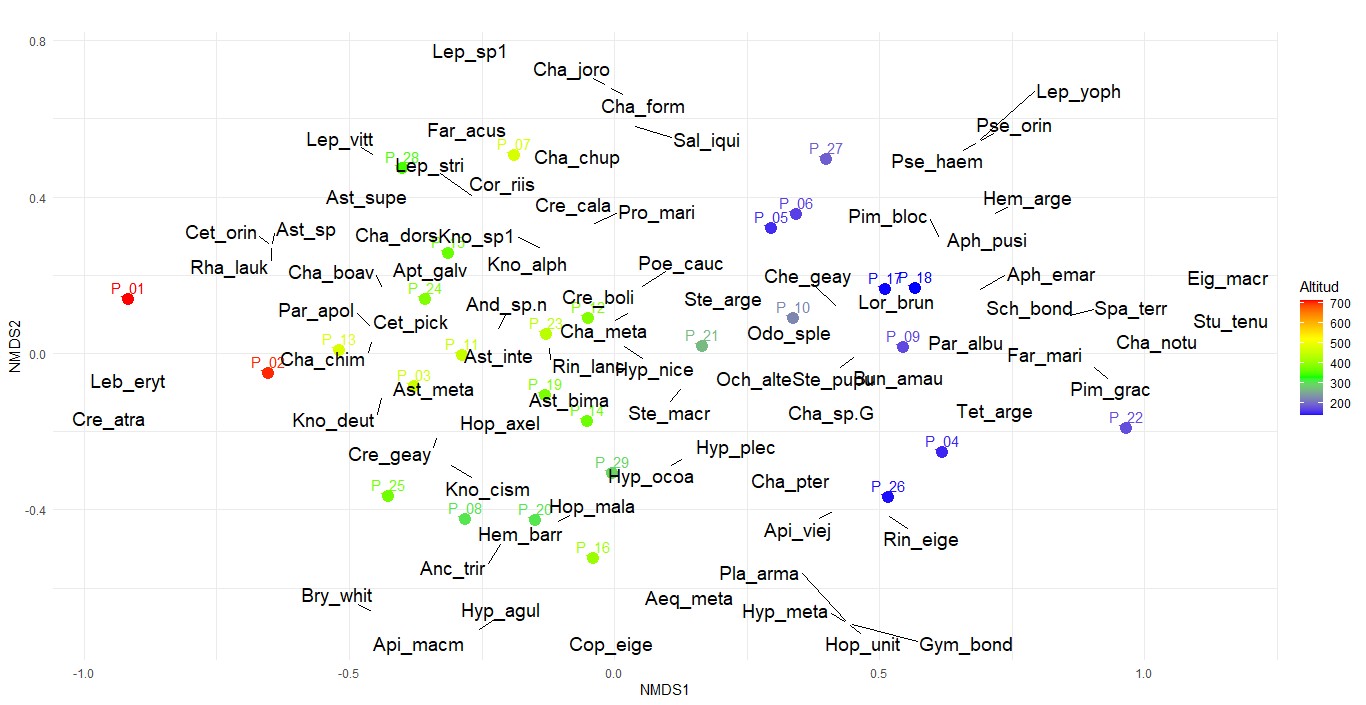
FIGURE 3 | Non-metric Multidimensional Scaling (NMDS) analysis with a color gradient reflecting the altitudinal change of the sampled sites. The sampling points are represented by the abbreviation “P”, followed by consecutive numbering. Species abbreviations are provided in Tab. S2.

FIGURE 4 | TITAN Z- and Z+ sum values indicate the change points in the altitudinal gradient. Solid and dotted red lines indicate the accumulated and frequency of species with negative responses, respectively. Discontinuous and dotted blue lines indicate the accumulated and frequency of species with positive responses, respectively.

FIGURE 5 | TITAN, distributions of the estimated change points for indicator species. The red ridges represent the intensity (ridge height) and variability (narrow or wide ridge) of species with a negative correlation (Z-) to the altitudinal gradient (in meters). The blue ridges represent the intensity (ridge height) and variability (narrow or wide) of species with a positive correlation (Z+).
The species distribution across the RLQ axes is shown in Fig. 6.Species associated with higher-altitude, lower-order, colder and shallower streams (positive RLQ1 scores) tended to exhibit lower body elongation, lower body size, and traits such as deeper body shape, reduced caudal peduncle throttling, larger eyes, greater maxillary length, a more dorsally positioned oral gape and smaller pectoral fins positioned more ventrally (Fig. 7). In contrast, species occurring at lower elevations and in high-order, warmer and deeper streams (negative RLQ1 scores) tended to exhibit more elongated body (indicated by higher body elongation and lateral shape values), larger body size, and traits such as increased caudal peduncle throttling, smaller eye, shorter maxillae, a more ventrally positioned oral gape, and larger pectoral fins positioned more dorsally. Eye position exhibited no clear trend along this axis (Fig. 7). When the TITAN altitudinal thresholds overlaid onto RLQ axis 1, clear shifts in functional traits were observed associated with species turnover (Fig. 6).
The second axis of RLQ revealed that species occurring in deeper, more alkaline and well oxygenated rivers (positive RLQ2 scores) tended to display more elongated body (indicated by higher body elongation and lateral shape values), eyes that are both larger and inserted higher on the head, longer maxilla, pectoral fins that are larger and positioned more dorsally (Fig. 8). Conversely, species inhabiting shallower, more acidic and less oxygenated streams (negative RLQ2 scores) tended to exhibit deeper bodies, smaller and lower set eyes, shorter maxillae, and smaller pectoral fins inserted lower on the flank (Fig. 8). Body size, oral gape position, and caudal peduncle throttling exhibited no clear trend along this axis.
TABLE 1 | Pearson correlation coefficients for the relationship between the sites scores on the first and second axes of RLQ analysis and the original values of the environmental variables. * Significant correlation (p-value < 0.05).
Environmental variables | RLQ 1 | RLQ 2 |
Altitude | 0.79* | 0.17 |
Conductivity | <0.01 | -0.41 |
Dissolved oxygen | -0.30 | -0.68* |
pH | -0.35 | -0.82* |
Flow velocity | -0.48* | -0.29 |
Temperature | -0.64* | 0.04 |
Stream order | -0.72* | -0.61* |
Depth | -0.75* | 0.10 |

FIGURE 6 | First (left) and second (right) RLQ axes showing the mean position of each species (dark circles) along the environmental gradients. Horizontal bars indicate standard deviations, and vertical bars along the horizontal axis indicate the position of sites along the gradient. RLQ axis 1 represents the altitudinal-order gradient, associated with depth, temperature, and flow velocity. RLQ axis 2 represents species associated with stream order, pH, and dissolved oxygen. Species abbreviations are provided in Tab. S5.

FIGURE 7 | Relationships between species coordinates along RLQ axis 1 and their functional trait values. Each panel shows the correlation between a morphological trait and the species position along the first RLQ axis. Points represent individual species, and black lines indicate linear trend. Vertical dashed lines indicate the RLQ axis 1 positions corresponding to the altitudinal thresholds at which assemblage composition changed, as identified by the TITAN analysis.

FIGURE 8 | Relationships between species coordinates along RLQ axis 2 and their functional trait values. Each panel shows the correlation between a morphological trait and the species’ position along the first RLQ axis. Points represent individual species, and black lines indicate linear trend.
Discussion
We found a taxonomic and functional shift in the ichthyofauna in response to an environmental gradient primarily defined by altitude, river order, depth, pH, and dissolved oxygen. The NMDS analysis revealed a clear clustering of sites and species along the piedmont-floodplain gradient, suggesting a consistent pattern of taxonomic turnover strongly associated with elevation. This pattern is consistent with findings reported for other Neotropical basins (Jaramillo-Villa et al., 2010; Carvajal‐Quintero et al., 2015; Cilleros et al., 2016) and at a global scale (Toussaint et al., 2016; van der Sleen, Albert, 2022). However, the TITAN analysis, which allows the detection of species-specific responses along the gradient, revealed that most of the ichthyofaunal turnover in the Meta River basin is concentrated within two altitudinal thresholds (240–250 m.a.s.l. and 350–360 m.a.s.l.), suggesting regional-scale transition zones and the action of strong environmental filters shaping the ecological dynamics of these systems. In addition to altitude, the longitudinal gradient represented by river order-showed significant functional responses of fish assemblages to chemical factors (temperature, pH, and dissolved oxygen) and physical factors (channel depth and flow velocity), reinforcing the role of these gradients as drivers of functional turnover along the fluvial system.
Additionally, the altitudinal thresholds identified by TITAN2 revealed a pattern of fragmented taxonomic turnover along a relatively broad gradient (240–360 m.a.s.l.), with indicator species associated with both high and low elevations. These results expand our understanding of the transition zone between piedmont and floodplain ecosystems, contrasting with previous studies that proposed more abrupt boundaries, such as the 300 m.a.s.l. limit suggested by (Toussaint et al., 2016; Usma, Trujillo et al., 2011; van der Sleen, Albert, 2022), the 200 m threshold propose by (Zamudio et al., 2017) or the classification ecoregions (Orinoco llanos and Orinoco piedmont) propose by Abell et al. (2008) However, the observed pattern does not necessarily imply a gradual transition; on the contrary, it suggests the action of environmental filters operating within this altitudinal range, promoting a functional and taxonomic reorganization of fish assemblages. Biotic or abiotic factors filter the functional space as species approach their tolerance limits (Lujan et al., 2013; Cunha et al., 2019; Poveda‐Cuellar et al., 2022), favoring a subset of functional strategies and reducing the observed assemblage composition (from 13 indicator species at lower elevations to only four at higher elevations). The identification of critical thresholds between piedmont and floodplain ecosystems allows recognizing them as distinct ecological units, with assemblages that, although interconnected, respond in particular ways to environmental conditions. This approach is essential for guiding conservation strategies that account for the vulnerability of fish communities to abrupt anthropogenic changes.
Complementing these taxonomic results, the RLQ analysis revealed that, among the functional traits measured, differences in body elongation, body size, mouth position and eye position were significantly associated with environmental variation in altitude, river order, and depth. Body elongation and body size showed a negative relationship with elevation, consistent with expectations that larger body sizes are more common at lower elevations. This trait, defined as the ratio between body length and height, has been proposed as a predictor of trophic position, predator-prey dynamics, and is inversely related to water velocity, indicating fishes that occupy high-flow habitats characteristic of mountainous regions (Winemiller, 1991; Zamudio et al., 2016; Villéger et al., 2017). On the other hand, mouth position a functional trait linked to feeding strategies and vertical habitat use showed a positive association with altitude. This pattern suggests a higher proportion of species with superior mouths in headwater and piedmont sections, consistent with the River Continuum Concept, which predicts a greater reliance on allochthonous inputs in upstream reaches (Vannote et al., 1980). As the altitude decreases, there is an increase in subterminal, terminal, and benthic mouths associated with feeding strategies targeting midwater or bottom resources. This pattern is also consistent with RCC expectations, which propose a longitudinal transition from allochthonous to autochthonous and benthic energy sources in downstream river sections.
These ecomorphological patterns provide functional evidence that the physical gradients proposed by Vannote et al. (1980) in the RCC are associated withtrophic and functional reorganization of fish communities along the fluvial continuum. Although functional thresholds were not explicitly tested, the coincidence between taxonomic turnover identified by TITAN and marked shifts in functional trait distributions along RLQ axis 1 supports the interpretation of a coupled taxonomic-functional shifts, resulting from the gradual replacement of environmental conditions, energy sources, and ecological processes from headwaters to large rivers. In upstream reaches, scraper or benthic species with inferior or subterminal mouths (e.g., Chaetostoma spp., Parodon apolinari) are adapted to feeding on periphyton or benthic invertebrates, whereas in intermediate sections, omnivorous and invertivorous species with subterminal or terminal mouths (e.g., Hemibrycon metae or Astyanax metae) exploit resources from both the bottom and the water column. In the lowland large rivers, characterized by slow currents and greater depth, filter-feeding, detritivorous and piscivorous species with terminal or subterminal mouths and compressed bodies (e.g., Prochilodus mariae, Pimelodus spp., Hypostomus spp.) dominate, reflecting the functional reorganization expected along the fluvial gradient.
RLQ axis 2 reflected a trait-environment relationship associated with the environmental contrast between headwater streams and large rivers. Environmental gradients of habitat size, pH, and dissolved oxygen significantly influenced body elongation, pectoral fin size, and eye position and size. The latter being a trait related to visual capacity for locating and capturing prey or avoiding predators (Pease et al., 2012; Zamudio et al., 2016). This correlation suggests that, in higher order rivers with higher pH and well-oxygenated waters, conditions associated with large rivers of the Orinoco lowlands, there is an increase in elongated species with dorsally positioned eyes, commonly found in families of non-armored catfishes (e.g., Aspredinidae, Heptapteridae, or Pimelodidae) and more frequently in benthic species of the Loricariidae family (e.g., Sturisoma tenuirostre, Lasiancistrus tentaculatus, or Limatulichthys griseus). These species contrast with other endemic loricariids from the piedmont, which exhibit lower body elongation and relatively smaller eyes (e.g., Chaetostoma spp.).
Another key trait was pectoral fin size (significantly correlated with both RLQ1 and RLQ2), which is related to critical locomotor abilities such as braking, acceleration, and generating undulatory movements to maintain position (Willis et al., 2005; Villeger et al., 2017). This trait distinguished species with small and rounded fins (low RLQ1 scores), associated with greater adherence capacity or camouflage beneath rocky substrates common in the piedmont, from those with larger and more elongated fins (high RLQ2 scores), which enhance fine-scale maneuverability in rivers and streams at lower elevations, where channels tend to be deeper and environments more structurally complex. This functional trait turnover suggests a differentiation among benthic species, primarily belonging to the order Siluriformes. In mountainous areas, the reduction in habitat structural complexity, along with shallower rivers and increased hydrological dynamism, may act as a filter that restricts certain functional traits within this specific group of species, distinguishing different behaviors, metabolic rates, growth strategies, and reproductive modes (Cilleros et al., 2017; Carvalho, Tejerina-Garro, 2018; Poveda‐Cuellar et al., 2022).
Overall, our results show that limnological variations in depth, temperature, pH, and dissolved oxygen in the Meta River basin influenced both taxonomic and functional turnover along increasing altitudinal and longitudinal gradients, enhancing our ability to predict ecological responses of fish assemblages to environmental change. These functional responses complement traditional taxonomic approaches (van der Sleen, Albert, 2022), although it is important to recognize that morphological traits, while reflecting a key component of ecological performance, represent only one dimension of functional diversity (Pease et al., 2012). In this regard, approaches that integrate physiological, life-history, reproductive, or anti-predator traits, along with metrics of functional richness, dispersion, or originality (Vitule et al., 2017), could deepen our understanding of ecosystem processes and environmental services associated with piedmont and lowland ecoregions. In the current context of accelerated deforestation, habitat degradation, and loss of fluvial connectivity (Clerici et al., 2020; Correa Ayram et al., 2020; Albert et al., 2021), it is essential to incorporate functional diversity into conservation strategies, as habitat homogenization, river disconnection, and species introductions disrupt key ecological processes and disproportionately affect particularly vulnerable functional groups that support the structure and maintenance of aquatic ecosystems (Leitão et al., 2016; Arantes et al., 2019; Brejão et al., 2021; Angulo‐Valencia et al., 2022; Basile, 2022; Pagotto et al., 2022).
Acknowledgments
We are grateful to Professor Andrea T. Thomaz, the University of British Columbia (Canada), and Pontificia Universidad Javeriana for their support, financial assistance, and for facilitating the participation of L. M-R. in the project “Riverscape genetics: linking river environments with adaptive potential in Neotropical freshwater fish”. We also thank Alexander Urbano-Bonilla for his valuable suggestions on a previous version of the manuscript and his support during the fieldwork phase, as well as Daniel Grosso for his collaboration in this stage.
References
Abell R, Thieme ML, Revenga C, Bryer M, Kottelat M, Bogutskaya N et al. Freshwater ecoregions of the world: a new map of biogeographic units for freshwater biodiversity conservation. BioScience. 2008; 58(5):403–14. https://doi.org/10.1641/B580507
Agudelo-Zamora H, Méndez-López A, Alfonso-Saenz O, Zamudio JE, Donascimiento C, Díaz-Timote J et al. Lista de peces presentes en la cuenca del río Cravo Sur. [Internet]. v. 1.2. Bogotá: Universidad Nacional de Colombia; 2020. Available from: https://doi.org/10.15472/eeofde
Albert JS, Destouni G, Duke-Sylvester SM, Magurran AE, Oberdorff T, Reis RE et al. Scientists’ warning to humanity on the freshwater biodiversity crisis. Ambio. 2021; 50(1):85–94. https://doi.org/10.1007/s13280-020-01318-8
Andrade-López JM, Urbano-Bonilla A, López-Pinto Y, Agudelo-Zamora HD. Especies de peces registradas en las sub-cuencas hidrográficas de la jurisdicción de Corpochivor (Boyacá-Colombia). [Internet]. v. 2.2. Corpochivor – Corporación Autónoma Regional de Chivor. Dataset/Occurrence. Available from: https://doi.org/10.15472/z0qxnk 2021
Angulo-Valencia MA, Dias RM, Alves DC, Winemiller KO, Agostinho AA. Patterns of functional diversity of native and non-native fish species in a neotropical floodplain. Freshw Biol. 2022; 67(8):1301–15. https://doi.org/10.1111/fwb.13918
Arantes CC, Winemiller KO, Asher A, Castello L, Hess LL, Petrere M et al. Floodplain land cover affects biomass distribution of fish functional diversity in the Amazon River. Sci Rep. 2019; 9(1):16684. https://doi.org/10.1038/s41598-019-52243-0
Bailly D, Cassemiro FAS, Winemiller KO, Diniz-Filho JAF, Agostinho AA. Diversity gradients of Neotropical freshwater fish: evidence of multiple underlying factors in human-modified systems. J Biogeogr. 2016; 43(8):1679–89. https://doi.org/10.1111/jbi.12749
Baker ME, King RS. A new method for detecting and interpreting biodiversity and ecological community thresholds. Methods Ecol Evol. 2010; 1(1):25–37. https://doi.org/10.1111/j.2041-210X.2009.00007.x
Basile M. Rare species disproportionally contribute to functional diversity in managed forests. Sci Rep. 2022; 12(1):5897. https://doi.org/10.1038/s41598-022-09624-9
Brejão GL, Hoeinghaus DJ, Roa-Fuentes CA, Pérez-Mayorga MA, Ferraz SFB, Casatti L. Taxonomic and functional turnover of Amazonian stream fish assemblages is determined by deforestation history and environmental variables at multiple scales. Neotrop Ichthyol. 2021; 19(3):e20210042. https://doi.org/10.1590/1982-0224-2021-0042
Bustamante C. Gran libro de la Orinoquía Colombiana. Bogotá: Instituto de Investigación de Recursos Biológicos Alexander von Humbolt – Deutsche Gesellschaft für internationale Zusammenarbeit (GIZ). GmbH; 2019.
Cadotte MW, Tucker CM. Should environmental filtering be abandoned? Trends Ecol Evol. 2017; 32(6):429–37. https://doi.org/10.1016/j.tree.2017.03.004
Carvajal-Quintero JD, Escobar F, Alvarado F, Villa-Navarro FA, Jaramillo-Villa Ú, Maldonado-Ocampo JA. Variation in freshwater fish assemblages along a regional elevation gradient in the northern Andes, Colombia. Ecol Evol. 2015; 5(13):2608–20. https://doi.org/10.1002/ece3.1539
Carvalho RA, Tejerina-Garro FL. Headwater–river gradient: trait-based approaches show functional dissimilarities among tropical fish assemblages. Mar Freshw Res. 2018; 69(4):574–84. https://doi.org/10.1071/MF17149
Cilleros K, Allard L, Grenouillet G, Brosse S. Taxonomic and functional diversity patterns reveal different processes shaping European and Amazonian stream fish assemblages. J Biogeogr. 2016; 43(9):1832–43. https://doi.org/10.1111/jbi.12839
Cilleros K, Allard L, Vigouroux R, Brosse S. Disentangling spatial and environmental determinants of fish species richness and assemblage structure in Neotropical rainforest streams. Freshw Biol. 2017; 62(10):1707–20. https://doi.org/10.1111/fwb.12981
Clerici N, Armenteras D, Kareiva P, Botero R, Ramírez-Delgado JP, Forero-Medina G et al. Deforestation in Colombian protected areas increased during post-conflict periods. Sci Rep. 2020; 10(1):4971. https://doi.org/10.1038/s41598-020-61861-y
Correa-Ayram CA, Etter A, Díaz-Timoté J, Rodríguez-Buriticá S, Ramírez W, Corzo G. Spatiotemporal evaluation of the human footprint in Colombia: four decades of anthropic impact in highly biodiverse ecosystems. Ecol Indic. 2020; 117:106630. https://doi.org/10.1016/j.ecolind.2020.106630
Cortés-Hernández CH, Suarez-Contento LY, Baquero EA, Collazos-Lasso LF. Fish diversity of a tributary of the Meta River, in the flat highlands of the Colombian Orinoquia. Acta Zool Lilloana. 2023; 67(2):449–71. https://doi.org/10.30550/j.azl/1837
Cunha ER, Winemiller KO, Silva JCB, Lopes TM, Gomes LC, Thomaz SM et al. α and β diversity of fishes in relation to a gradient of habitat structural complexity supports the role of environmental filtering in community assembly. Aquat Sci. 2019; 81(2):38. https://doi.org/10.1007/s00027-019-0634-3
Dolédec S, Chessel D, ter Braak CJF, Champely S. Matching species traits to environmental variables: a new three-table ordination method. Environ Ecol Stat. 1996; 3(2):143–66. https://doi.org/10.1007/BF02427859
Dray S, Choler P, Dolédec S, Peres-Neto PR, Thuiller W, Pavoine S et al. Combining the fourth-corner and the RLQ methods for assessing trait responses to environmental variation. Ecology. 2014; 95(1):14–21. https://doi.org/10.1890/13-0196.1
Echevarría G, González N. Fish trait diversity in littorals of two floodplain lakes of the highly biodiverse Caura River, Venezuela. Ecol Freshw Fish. 2017; 27(1):158–69. https://doi.org/10.1111/eff.12333
Echevarría G, González N. Fish taxonomic and functional diversity in mesohabitats of the River Kakada, Caura National Park, Venezuela. Nat Conserv Res. 2018; 3(Suppl. 2):21–39. https://doi.org/10.24189/ncr.2018.048
Echevarría G, Rodríguez JP, Machado-Allison A. Seasonal fluctuations in taxonomic and functional diversity in assemblages of catfishes in the Venezuelan Arauca River Floodplain. Stud Neotrop Fauna Environ. 2017; 53(1):38–53. https://doi.org/10.1080/01650521.2017.1387426
Gomes LC, Dias RM, Ruaro R, Benedito E. Functional diversity: a review on freshwater fish research. Neotrop Ichthyol. 2023; 21(2):e20230022. https://doi.org/10.1590/1982-0224-2023-0022
Jackson DA, Peres-Neto PR, Olden JD. What controls who is where in freshwater fish communities; the roles of biotic, abiotic, and spatial factors. Can J Fish Aquat Sci. 2001; 58(1):157–70. https://doi.org/10.1139/f00-239
Jaramillo-Villa U, Maldonado-Ocampo JA, Escobar F. Altitudinal variation in fish assemblage diversity in streams of the central Andes of Colombia. J Fish Biol. 2010; 76(10):2401–17. https://doi.org/10.1111/j.1095-8649.2010.02629.x
Kirk MA, Rahel FJ, Laughlin DC. Environmental filters of freshwater fish community assembly along elevation and latitudinal gradients. Glob Ecol Biogeogr. 2022; 31(3):470–85. https://doi.org/10.1111/geb.13439
Lamothe KA, Alofs KM, Jackson DA, Somers KM. Functional diversity and redundancy of freshwater fish communities across biogeographic and environmental gradients. Divers Distrib. 2018; 24(11):1612–26. https://doi.org/10.1111/ddi.12812
Leitão RP, Zuanon J, Villéger S, Williams SE, Baraloto C, Fortunel C et al. Rare species contribute disproportionately to the functional structure of species assemblages. Proc R Soc B. 2016; 283(1828):20160084. https://doi.org/10.1098/rspb.2016.0084
Lujan NK, Roach KA, Jacobsen D, Winemiller KO, Vargas VM, Ching VR et al. Aquatic community structure across an Andes-to-Amazon fluvial gradient. J Biogeogr. 2013; 40(9):1715–28. https://doi.org/10.1111/jbi.12131
Mora-Fernandez C, Rodriguez-Posada ME. Fauna y Flora del Casanare, de la montaña a la sabana: Una visión integral del territorio. 1a ed. Yopal: Gobernación de Casanare; 2017.
National Aeronautics and Space Administration (NASA). NASA’s Earth Observing System Data and Information System (EOSDIS) [Internet]. 2022. Available from: https://Search.Asf.Alaska.Edu/#/?Zoom=3.000¢er=-97.494,39.673&dataset=ALOS
Pagotto JPA, Pessoa LA, Goulart E, Mise FT, Ortega JCG, Landgraf GO. Environmental degradation of streams leads to the loss of ecomorphologically similar fish species. Hydrobiologia. 2022; 849(10):2299–316. https://doi.org/10.1007/s10750-022-04868-y
Pease AA, González-Díaz AA, Rodiles-Hernandez R, Winemiller KO. Functional diversity and trait-environment relationships of stream fish assemblages in a large tropical catchment. Freshw Biol. 2012; 57(5):1060–75. https://doi.org/10.1111/j.1365-2427.2012.02768.x
Poveda-Cuellar JL, López-Delgado EO, Zúñiga-Upegui PT, Villa-Navarro FA. What controls fish functional diversity patterns in Colombian Andean streams? Ecol Freshw Fish. 2022; 31(1):87–101. https://doi.org/10.1111/eff.12615
Ribeiro MD, Teresa FB, Casatti L. Use of functional traits to assess changes in stream fish assemblages across a habitat gradient. Neotrop Ichthyol. 2016; 14(1):e140185. https://doi.org/10.1590/1982-0224-20140185
Romero RM, Casatti L. Identification of key microhabitats for fish assemblages in tropical Brazilian savanna streams. Int Rev Hydrobiol. 2012; 97(6):526–41. https://doi.org/10.1002/iroh.201111513
Teresa FB, Casatti L. Trait-based metrics as bioindicators: Responses of stream fish assemblages to a gradient of environmental degradation. Ecol Indic. 2017; 75:249–58. https://doi.org/10.1016/j.ecolind.2016.12.041
Toussaint A, Charpin N, Brosse S, Villéger S. Global functional diversity of freshwater fish is concentrated in the Neotropics while functional vulnerability is widespread. Sci Rep. 2016; 6(1):22125. https://doi.org/10.1038/srep22125
Trujillo F, Antelo R, Usma S, editors. Biodiversidad de la cuenca baja y media del río Meta. Bogotá: Fundación Omacha, Fundación Palmarito, WWF; 2016.
Usma JS, Trujillo F, editors. Biodiversidad del Casanare: ecosistemas estratégicos del Departamento. Bogotá D.C.: Gobernación de Casanare -WWF Colombia; 2011.
Urbano-Bonilla A, Agudelo-Zamora H, Díaz-Timoté J. Peces de la cuenca del río Cravo Sur: una aproximación al estado actual de su conocimiento. In: Antelo-Albertos R, Diaz-Olaya MR, Durán-Hernández ZL, Rojano C, editors. El reto de conservar y producir: Biodiversidad y sistemas productivos en la cuenca media y baja del río Cravo sur. Sello Editorial UNAD; 2021. p.738.
Urbano-Bonilla A, Ballen GA, Herrera-R GA, Zamudio J, Herrera-Collazos EE, DoNascimiento C et al. Fishes of the Cusiana River (Meta River basin, Colombia), with an identification key to its species. ZooKeys. 2018; 733:65–97. https://doi.org/10.3897/zookeys.733.20159
Urbano-Bonilla A, Prada-Pedreros S, Zapata Á, Barrera-Cataño JI, Moreno-Cárdenas AC. Composición y riqueza íctica en quebradas y ríos del piedemonte de la cuenca del río Cusiana, Orinoquia colombiana. Biota Colomb. 2014; 15(Suppl. 1). Available from: http://revistas.humboldt.org.co/index.php/biota/article/view/342
Vallet J, Daniel H, Beaujouan V, Rozé F, Pavoine S. Using biological traits to assess how urbanization filters plant species of small woodlands. Appl Veg Sci. 2010; 13(4):412–24. https://doi.org/10.1111/j.1654-109X.2010.01087.x
Van der Sleen P, Albert JS. editor. Field guide to the fishes of the Amazon, Orinoco, and Guianas. Vol 115. Princeton University Press; 2017.
Van der Sleen P, Albert JS. Patterns in Freshwater Fish Diversity. In: Encyclopedia of Inland Waters. Elsevier; 2022. p.243–55. https://doi.org/10.1016/B978-0-12-819166-8.00056-6
Vannote RL, Minshall GW, Cummins KW, Sedell JR, Cushing CE. The River Continuum Concept. Can J Fish Aquat Sci. 1980; 37(1):130–37. https://doi.org/10.1139/f80-017
Villéger S, Brosse S, Mouchet M, Mouillot D, Vanni MJ. Functional ecology of fish: current approaches and future challenges. Aquat Sci. 2017; 79(4):783–801. https://doi.org/10.1007/s00027-017-0546-z
Violle C, Navas ML, Vile D, Kazakou E, Fortunel C, Hummel I et al. Let the concept of trait be functional! Oikos. 2007; 116(5):882–92. https://doi.org/10.1111/j.0030-1299.2007.15559.x
Vitule JRS, Agostinho AA, Azevedo-Santos VM, Daga VS, Darwall WRT, Fitzgerald DB et al. We need better understanding about functional diversity and vulnerability of tropical freshwater fishes. Biodivers Conserv. 2017; 26(3):757–62. https://doi.org/10.1007/s10531-016-1258-8
Willis SC, Winemiller KO, Lopez-Fernandez H. Habitat structural complexity and morphological diversity of fish assemblages in a Neotropical floodplain river. Oecologia. 2005; 142(2):284–95. https://doi.org/10.1007/s00442-004-1723-z
Winemiller KO. Ecomorphological Diversification in lowland freshwater fish assemblages from five biotic regions. Ecol Monogr. 1991; 61(4):343–65. https://doi.org/10.2307/2937046
Zamudio J, Maldonado-Ocampo J, Hererra-Collazos EE. Protocolo para la medición de rasgos funcionales en peces dulceacuícolas. In: Salgado-Negret B, editor. La ecología funcional como aproximación al estudio, manejo y conservación de la biodiversidad: protocolos y aplicaciones. 1st ed. Vol 1. Instituto de Investigación de Recursos Biológicos Alexander von Humboldt; 2016. p.126–79.
Zamudio J, Urbano-Bonilla A, Preciado-Silva V, Rodríguez-Cubillos D, Herrera-Collazos EE. Ichthyofauna of piedmont and savannah environments in the Casanare River drainage, Orinoco Basin, Colombia. [Internet]. 2017. Available from: http://repository.humboldt.org.co/handle/20.500.11761/34239
Zhang Y, Wang XN, Ding HY, Dai Y, Ding S, Gao X. Threshold responses in the taxonomic and functional structure of fish assemblages to land use and water quality: a case study from the Taizi River. Water. 2019; 11(4):661. https://doi.org/10.3390/w11040661
Authors

Laura Montagut-Rojas1 , Fabrício Barreto Teresa2 and Tiago Pinto Carvalho3,4
[1] Universidad Internacional del Trópico Americano, Carrera 19 #39-40, 850002 Yopal, Casanare, Colombia. lauramontagut20@gmail.com (corresponding author).
[2] Universidade Estadual de Goiás, Campus Central, Rodovia BR-153, 3105, 75132-903, Anápolis, GO, Brazil. fabricioteresa@yahoo.com.br.
[3] Universidad Nacional de Colombia – sede Bogotá, Facultad de Ciencias, Instituto de Ciencias Naturales, Carrera 30 N° 45-03, Bogotá D.C., Colombia. (current address). carvalho.ictio@gmail.com.
[4] Laboratorio de Ictiología, Unidad de Ecología y Sistemática (UNESIS), Departamento de Biología, Facultad de Ciencias, Pontificia Universidad Javeriana, Carrera 7 N° 43-82, Bogotá D.C., Colombia.
Authors’ Contribution 

Laura Montagut-Rojas: Conceptualization, Data curation, Formal analysis, Investigation, Methodology, Software, Writing-original draft, Writing-review and editing.
Fabrício Barreto Teresa: Conceptualization, Data curation, Formal analysis, Methodology, Writing-original draft, Writing-review and editing.
Tiago Pinto Carvalho: Conceptualization, Data curation, Formal analysis, Methodology, Project administration, Supervision, Writing-original draft, Writing-review and editing.
Ethical Statement
Procedures were approved by Pontificia Universidad Javeriana ethical committee for the project Riverscape genetics: linking river environments with adaptive potential in Neotropical freshwater fish (ID: 00009167) and approved by the animal care committee of University of British Columbia (ID: A20-0034) which was responsible for financial support of the collections made. Specimens were collected using a “Permiso Marco” permit to TPC with Pontificia Universidad Javeriana and a sample mobility license from Agencia Nacional de Licencias Ambientales (ANLA permit #2022018006–1–000).
Competing Interests
The author declares no competing interests.
Data availability statement
Occurrence and collection data for the fish specimens analyzed in this study are publicly available through SIB Colombia at https://doi.org/10.15472/kzzasm. The environmental and functional trait datasets generated and analyzed during the current study are available from the corresponding author upon reasonable request.
AI statement
Artificial intelligence (ChatGPT-5.5) was used exclusively for grammar and style checking on the final text revision to improve English version.
Funding
FBT is supported by the Conselho Nacional de Desenvolvimento Científico e Tecnológico (CNPq) productivity fellowship (304564/2025–7).
Supplementary Material
Supplementary material SUP
Peer Review
How to cite this article
Montagut-Rojas L, Teresa FB, Carvalho TP. Changes in the taxonomic and functional composition of fishes along the altitudinal gradient of the Piedmont-Lowland in the Meta River basin. Neotrop Ichthyol. 2026; 24(3):e250165. https://doi.org/10.1590/1982-0224-2025-0165
Copyright
This is an open access article under the terms of the Creative Commons Attribution License, which permits use, distribution and reproduction in any medium, provided the original work is properly cited.
Distributed under
Creative Commons CC-BY 4.0

© 2025 The Authors.
Diversity and Distributions Published by SBI
 Accepted June 7, 2026
Submitted September 18, 2025
Epub October 9, 2026