
 Caroline Apolinário-Silva1, Roberta C. Clemente1
  , Ana J. C. Marques1, Maria V. H. Rodrigues1, Thais Kotelok-Diniz1, Wilson Frantine-Silva1, Amanda A. Moreira1, Bruno A. Galindo1, Augusto S. Zanatta1, Carlos E. G. Aggio1, Dyego L. F. Caetano2, Lenice Souza-Shibatta3, Silvia H. Sofia4 and Dhiego G. Ferreira1
PDF: Download Here | Supplementary: Sup | Cite this article
Associate Editor: Claudio Oliveira
Section Editor: Izeni Farias
Editor-in-chief: José Birindelli
Abstract
Eventos de fragmentação e reconexões em sistemas fluviais durante as oscilações climáticas do Pleistoceno têm sido associados à diversificação de linhagens e aos contatos secundários subsequentes do cascudo Neotropical Hypostomus ancistroides ao longo da bacia do alto rio Paraná (BARP). No entanto, essas informações ainda são desconhecidas para diversas drenagens na porção sul da BARP, incluindo a sub-bacia do rio das Cinzas, onde algumas evidências sugerem a predominância de uma linhagem distinta em comparação com aquelas predominantes em outras áreas da BARP, mesmo entre sub-bacias geograficamente próximas, o que sustenta a hipótese de que influências em pequena escala de eventos do Pleistoceno podem ter ocorrido entre essas drenagens. Essa hipótese foi testada por meio da análise de três segmentos de DNA mitocondrial (região D-loop, genes ATPase e COI) de H. ancistroides provenientes da sub-bacia do rio Cinzas e de outras sub-bacias dos rios Paranapanema e BARP. As estimativas de tempo de divergência indicaram diversificação de linhagens durante o Pleistoceno, e a hipótese principal foi corroborada pela distribuição heterogênea de linhagens distintas entre sub-bacias vizinhas, incluindo uma linhagem particular predominante na sub-bacia do rio das Cinzas, bem como evidências de variações nos níveis históricos de conectividade, uso de rotas de colonização distintas e áreas de captura de cabeceiras.
Palavras-chave: ATPase, D-loop, Hypostomus ancistroides,Oscilações climáticas, Rio das Cinzas.
Introduction
The South American freshwater ichthyofauna, the most diverse in the world, began its diversification even before the separation of this continent from Africa in the Late Cretaceous, about 110 million years ago (Mya) (Lundberg et al., 1998; Albert, Reis, 2011; Reis et al., 2016). It has been influenced by the interaction of multiple factors throughout history, including geomorphological and climatic changes, repeated marine incursions and regressions, changes in river courses, and historical connections (Lundberg et al., 1998; Hubert, Renno, 2006; Albert, Reis, 2011). In this scenario, while some major endemic clades emerged in the Early Cenozoic or Late Cretaceous, many higher-level taxa (genera and above) appeared during the Paleogene period, and the ichthyofauna was already largely modern by the end of the Miocene (∼11.6–5.3 Mya) (Lundberg et al., 1998; Albert et al., 2020). The upper Paraná River basin (UPRB), in particular, although it appears to have maintained its main physiographic structure over the last nine million years (Albert, Reis, 2011), has exhibited evidence of influence from multiple geological and climatic events that occurred from the Miocene to the Pleistocene. These include marine incursions, climatic oscillations (Hubert, Renno, 2006; Hollanda Carvalho et al., 2016; Cardoso et al., 2021), as well as inter-basin connections (Lundberg et al., 1998; Serra et al., 2007; Roxo et al., 2014) and intra-basin headwater capture events (Lucena et al., 2012; Frota et al., 2016; Cavalli et al., 2018; Ferreira et al., 2023), which have driven diversification among fish populations and species, including members of the armored catfish genus Hypostomus Lacepède, 1803 (Hollanda Carvalho et al., 2016; Cardoso et al., 2021).
Hypostomus is among the most species-rich catfish genera, with 144 currently recognized species within the family Loricariidae (Siluriformes) (Fricke et al., 2025). Like other Loricariidae members, this genus includes fish species commonly known as “suckermouth armored catfishes” (Reis et al., 2003). They occur across major Neotropical hydrographic systems, such as the Amazon, Paraguay-Paraná-Plata, and São Francisco River basins (Britski et al., 1988; Weber, 2003; Cardoso et al., 2012), where they inhabit the bottoms of streams, large rivers, and lowland lagoons (Oyakawa et al., 2005; Cardoso et al., 2012). The genus Hypostomus originated in the Amazon/Orinoco ecoregion (∼20 Mya, see Cardoso et al., 2021) and subsequently dispersed throughout tropical South America and the eastern Andes, undergoing great diversification in body size and shape, color pattern and habitat diversity, mainly due to inter-basin dispersal and intra-basin speciation events (Montoya-Burgos, 2003; Cardoso et al., 2012; Hollanda Carvalho et al., 2016).
In the Paraguay-Paraná-Plata system (the second largest in South America), Hypostomus forms a polyphyletic group, apparently established through multiple independent colonization events (four or more) during the Middle Miocene, possibly involving unrelated ancestral lineages from the Amazon basin (Montoya-Burgos, 2003; Silva et al., 2016; Cardoso et al., 2012, 2021). Following inter-basin dispersal events (e.g., headwater captures), the UPRB may have acted as a “biogeographic corridor”, facilitating the dispersal of the genus throughout the Paraguay-Paraná-Plata system, as well as into the São Francisco River and southern Brazilian coastal drainages (Cardoso et al., 2021). Within the UPRB, influences of Pleistocene climatic events on Hypostomus have been demonstrated through mitochondrial data (ATP synthase gene) obtained from Hypostomus ancistroides (Ihering, 1911), which suggest that climatic oscillations and geomorphological processes during this epoch shaped overlapping phylogeographic patterns across the basin. These processes likely involved alternating cycles of prolonged isolation followed by subsequent mergers of different populations (Hollanda Carvalho et al., 2016). In this context, while isolation contributed to the evolution of distinct genetic lineages along the UPRB, subsequent dispersal opportunities (e.g., flooding of barriers and headwater captures events) would have promoted secondary contact among many of these lineages along sub-basins of the drainage system. In the southern UPRB, for example, recent mitochondrial D-loop data also indicate secondary contact between different lineages of H. ancistroides in the lower section of the Laranjinha River, the main tributary of the Cinzas River, Paranapanema River basin (Apolinário-Silva et al., 2021). Although not included in previous phylogeographic analyses (e.g., Hollanda Carvalho et al., 2016), these data suggest that the Cinzas River sub-basin harbors a predominant genetic lineage distinct from those in adjacent basins, raising several questions about the evolutionary history of H. ancistroides along the Paranapanema River basin.
In fact, if neighboring tributaries exhibit the predominance of different genetic lineages, it is plausible to hypothesize that the genetic distributions of H. ancistroides along the Paranapanema River basin, and within the Cinzas River sub-basin, could represent fine-scale evidence of influences attributed to Pleistocene events, including factors that affected historical connectivity, altered colonization routes, and shaped opportunities for dispersal and secondary contact. In addition, the hypothesis of the predominance of a particular lineage along the Cinzas River sub-basin would also highlight this drainage as “an area harboring a distinct fraction of the genetic diversity” of H. ancistroides, reinforcing arguments that consider this basin a Priority Area for Biodiversity Conservation (MMA, 2016). The present study tested these hypotheses using a mitochondrial multilocus approach, analyzing sequences from the D-loop region, the ATP synthase (ATPase) gene, and the cytochrome oxidase subunit I (COI) gene in samples of H. ancistroides obtained from Cinzas River sub-basin, other Paranapanema River tributaries, and additional drainages across the UPRB.
Material and methods
Sampling, DNA extraction, amplification and sequencing. The upper Paraná River basin (UPRB) drains around 900,000 km2 of South American territory (Fig. 1), encompassing all drainages connected to the Paraná River upstream of the Itaipu Hydroelectric Power Plant (Castro et al., 2003). The Paranapanema River, in turn, is the largest tributary (929 km long) in the southern portion of the UPRB, comprising several important sub-basins, such as the Cinzas River, a watershed that drains 9,658.8 km2 within Paraná State, Brazil (Britto et al., 2003; Vianna, Nogueira, 2008). With regard to dispersal barriers that are still apparent in the study area, three waterfalls (Fig. 1) should be highlighted: i – Salto Grande Falls (about 20 m high) in the Paranapanema River main channel, a waterfall that is currently submerged by a dam (UHE Salto Grande) (Leuzzi et al., 2004) and appears to have produced historical genetic differences in ichthyofauna occurring upstream and downstream of the obstacle (Almeida et al., 2003; Ferreira et al., 2022); ii- Salto Cavalcante Falls (about 15 m high) in the Cinzas River main channel, which separates the upper section from the rest of the sub-basin (Vianna, Nogueira, 2008); iii – Cachoeirinha Falls (over 20 m high) in the middle section of the Cachoeirinha Stream (S1CI), a left bank tributary of the Cinzas River (Fig. 1).

FIGURE 1| Genetic diversity (D-loop) estimated for samples (N> 15) of Hypostomus ancistroides in the sub-basins of the Paranapanema River, upper Paraná River. N: Number of individuals analyzed, H: number of haplotypes found, h: haplotype diversity, π: nucleotide diversity, D: Tajima’s neutrality test (Tajima, 1989), Fs: Fu neutrality test (Fu, 1997) and pattern (unimodal or multimodal) in the Mismatch distribution test. Samples N > 15 were obtained in the main channel (CI2, CI4 and CI5) and in tributary streams (S1CI, S3CI-S6CI) of the Cinzas River; in the main channel (LA1-LA7) and in tributary streams (S1LA-S3LA, S5LA, S7LA, S8LA) of the Laranjinha River, in the Congonhas River (CO), in the Paranapanema River main channel (PPM), in the Pirapó River (PI), and in the Jaguariaíva River (JA). *Significant values P ≤ 0.05.
To test the hypothesis that different lineages occur between sub-basins of the UPBR, the mitochondrial DNA data were first analyzed from a populational-level standpoint using the D-loop region. For this purpose, D-loop sequences from 1,405 individuals of H. ancistroides (only five obtained from databases) were analyzed, including: data from the Cinzas River sub-basin (CI) obtained by Apolinário-Silva et al. (2021) along the Laranjinha River main channel (LA1-LA7) and eight tributary streams (S1LA-S8LA); as well as individuals collected in the present study along the Cinzas River main channel (CI1-CI2 upstream and CI3-CI5 downstream of Salto Cavalcante Falls) and six tributary streams (S1CI-S6CI). Data were also obtained from the Paranapanema River, including the middle section of its main channel (PPM) and one tributary stream (S1PP), as well as from other sub-basins, including the Tibagi River (TB1 in the main channel, CO in the Congonhas River, and S1TB-S4TB in tributary streams), the Pirapó (PI), Jaguariaíva (JA), and Itapetininga (IT) rivers. Additional specimens were collected from other UPRB tributaries, including the Ivaí (IV) and Piquiri (PQ1 – upper and PQ2 – lower) rivers, and tributary streams of the Itaipu Reservoir (IR1 and IR2). Individuals from the Iguaçu River (IG), which is not part of the UPRB, were also included. Although reliable D-loop sequences of H. ancistroides in databases are scarce, the dataset also included five sequences available on GenBank, from the Grande (GR = 1), Tietê (TI = 3) and Ribeira de Iguape (RG = 1) rivers (Fig. 1; Tab. S1).
Most tributary streams of the Cinzas and Laranjinha rivers were sampled in three longitudinal stretches (upper, middle and lower), generally with more than 20 individuals per site; however, sample sizes varied across the studied drainages (Tab. S1). The fish sampling was performed using fishing sieves, cast nets, and trawl nets along a 300 m stretch at each site (delimited with 2 mm mesh nets), with a minimum effort of 1 h per site. Voucher specimens were euthanized using eugenol and subsequently subjected to taxonomic confirmation (based on morphology) by specialists (supported by the COI gene analyses in the present study), following identification keys for the UPRB (Dias, Zawadzki, 2018; Ota et al., 2018). Some voucher specimens were deposited at the Museu de Zoologia, Universidade Estadual de Londrina (catalog numbers MZUEL 19310–19339).
In a second step, one individual representing each distinct D-loop haplotype was used to analyze the mitochondrial DNA segment that encodes subunits 6 and 8 of the ATP synthase enzyme (ATPase gene), allowing estimates of divergence time between lineages and comparisons with ATPase data previously obtained by Hollanda Carvalho et al. (2016) in several drainages across the UPRB (NCBI accession numbers in Tab. S1), including the Paranaíba (PB), Grande (GR), São José dos Dourados (SJ), Tietê (TI), and Ivaí (IV) rivers; the Paraná River main channel (PR); the lower section of the Paranapanema River (PPL) and some of its tributaries (Capivara – CP, Pardo – PA, Tibagi – TB and Pirapó – PI rivers); as well as the Ribeira de Iguape River (RG), which is not part of the UPRB. Finally, a representative of each D-loop haplotype was also used to analyze part of the cytochrome c oxidase subunit I (COI) gene, enabling divergence-time estimates using concatenated sequences (COI+ D-loop + ATPase), phylogenetic analyses, and comparisons with BOLD (The Barcode of Life Data Systems) and GenBank sequences (NCBI and BOLD accession numbers in Tab. S1) obtained from the Grande (GR), Tietê (TI), Pardo (PA), Itapetininga (IT), Ivinhema (IN) and Tocantins (TO) river basins (Fig. 1).
The mitochondrial DNA segments analyzed in the present study were amplified via polymerase chain reaction (PCR) using the primers DLA-III 5’-TATTTAAAGRCATAATCTCTTGAC-3’ and HygDL-R 5’-WTGCKARTATGTGCCGYYTG-3’ (Cardoso et al., 2012) for the D-loop region; 8.2_L8331 5’-AAAGCRTYRGCCTTTTAAGC-3’ and CO3.2 H9236 5’-GTTAGTGGTCAKGGGCTTGGRTC3’ (Hollanda Carvalho et al., 2016) for the ATPase gene; and Fish F1 5′TCAACCAACCACAAAGACATTGGCAC-3′ and Fish R1 5′-TAGACTTCTGGGTGGCCAAAGAATCA -3′ (Ward et al., 2005) for the COI gene. PCR reactions were performed in a final volume of 15 μL, containing 1X PCR Master Mix (Promega), 0.65 µM of each primer (forward and reverse), and 15 ng of DNA. Amplifications were carried out in a thermal cycler with an initial denaturation of 5 min at 94°C, followed by 35 cycles of 94°C for 30 s, 55°C for 30 s (standardized for D-loop, ATPase and COI) and 72 °C for 1 min, with a final extension of 10 min at 72°C. PCR products were purified using ExoSAP IT® (Prodimol) and prepared for bidirectional Sanger sequencing using BigDye Terminator v. 3.1 kit (Applied Biosystems), according to the manufacturer’s instructions. The readings were carried out on an ABI-PRISM 3500 XL automated sequencer (Applied Biosystems), followed by editing and alignment in MEGA 11 (Tamura et al., 2021). Sequences of all identified haplotypes were deposited in the GenBank (NCBI accession numbers in Tabs. S2, S3, S4).
Haplotype analysis, phylogenetic relationships, and diversification through time. DnaSP v. 5 (Librado, Rozas, 2009) was used to identify the different haplotypes in the D-loop, ATPase and COI data, as well as in the concatenated data. For D-loop data, Arlequin v. 3.5.1.3 (Excoffier, Lischer, 2010) was employed just on samples with more than 15 individuals (N > 15, aiming to minimize sampling bias) to estimate the haplotype diversity (h), nucleotide diversity (π), Tajima’s D (Tajima, 1989) and Fu’s Fs (Fu, 1997) statistics, pairwise mismatch distributions, and pairwise ΦST values – using significant estimates based on 10,000 permutations.
Haplotype networks based on the median-joining algorithm (Bandelt et al., 1999) were constructed using Network v. 4.6.1.1 (Fluxus Technology Ltd, http://www.fluxus-engineering.com), including data from the three mitochondrial regions (analyzed separately and concatenated). The D-loop haplotype network was constructed using sampling sites specified individually (in rivers and streams), whereas the ATPase and COI networks were constructed by grouping each river with its respective tributary streams.
Phylogenetic relationships were inferred for each mitochondrial marker (D-loop region, and ATPase and COI genes), as well as for the concatenated dataset, using Bayesian inference (BI). In general, concatenated analyses included only individuals sequenced in the present study, and MEGA 11 (Tamura et al., 2021) was used to concatenate the D-loop, ATPase, and COIsequences from a representative of each distinct D-loop haplotype. Sequences were summarized into haplotypes, including H. ancistroides samples from UPRB as reported in previous studies and outgroups selected according to Hollanda Carvalho et al. (2016) and the species placed outside the H. ancistroides clade by Cardoso et al. (2021) (see NCBI and BOLD accession numbers in Tab. S1; Figs. S5–S7). Analyses were performed in BEAST v. 2.7.7 (Bouckaert et al., 2019) under a strict molecular clock model and a nucleotide substitution model independently estimated for each gene (TN93+G+I for D-loop, ATPase and COI; TIM+G+I for concatenated dataset) using bModelTest (Bouckaert, Drummond, 2017). Divergence times (from concatenated dataset and ATPase data only) were estimated using two independent strategies: (i) an ATPase-based analysis calibrated with a fixed mutation rate of 0.013 substitutions per site per million years (equivalent to 1.3% per million years; Bermingham et al., 1997) and conducted under the standard Yule tree prior; and (ii) a D2a-calibrated analysis based on the divergence interval reported by Cardoso et al. (2021). The D2a calibration was implemented as a uniform prior in Ma (mega-annum), with offset = 7.09 Ma and upper bound = 19.71 Ma, and was run under the Calibrated Yule tree prior to avoid distortion of the calibrated-node distribution (Heled, Drummond, 2012). For both strategies, four independent MCMC runs of 10 million generations were performed, sampling every 1,000 generations, and convergence was assessed in Tracer v. 1.7.2 (Rambaut et al., 2018), ensuring Effective Sample Size (ESS) > 200 for all parameters. Runs were combined and summarized in a maximum clade credibility tree using TreeAnnotator (BEAST v. 2.7.7), with a 10% burn-in and posterior probability threshold of 0.7, and visualized in FigTree v. 1.3.1 (http://tree.bio.ed.ac.uk/software/figtree/).
Results
Population genetics and phylogenetic relationships. Analysis of 553 base pairs (bp) of the mitochondrial DNA D-loop region revealed 96 different haplotypes, of which only four were from GenBank data, and 268 variable sites (NCBI accession numbers in Tab. S2). Considering the Bayesian phylogenetic inference (Fig. S6), our ATPase and COI results and the findings of Hollanda Carvalho et al. (2016), a total of 12 haplogroups (HG1-HG12) were assigned to the D-loop haplotypes (HD), including five detected along the Paranapanema River basin: HG3 predominant in the Cinzas River sub-basin (CI+LA); HG7 with one representative in LA; HG1 predominant in the Tibagi River sub-basin (TB+CO) and other drainages to the west (PI and PP); HG5 predominant in the Jaguariaíva River (JA); and HG6 detected in the Itapetininga and Laranjinha rivers (Figs. 2, S6; Tab. S1). The remaining seven haplogroups were distributed throughout the Ivaí (HG9), Piquiri (HG8, HG4, HG10 and HG11), Iguaçu (HG4 and HG8), Tietê (HG2) and Grande (H12) rivers, and tributary streams of the Itaipu Reservoir (HG8, HG10 and HG11).
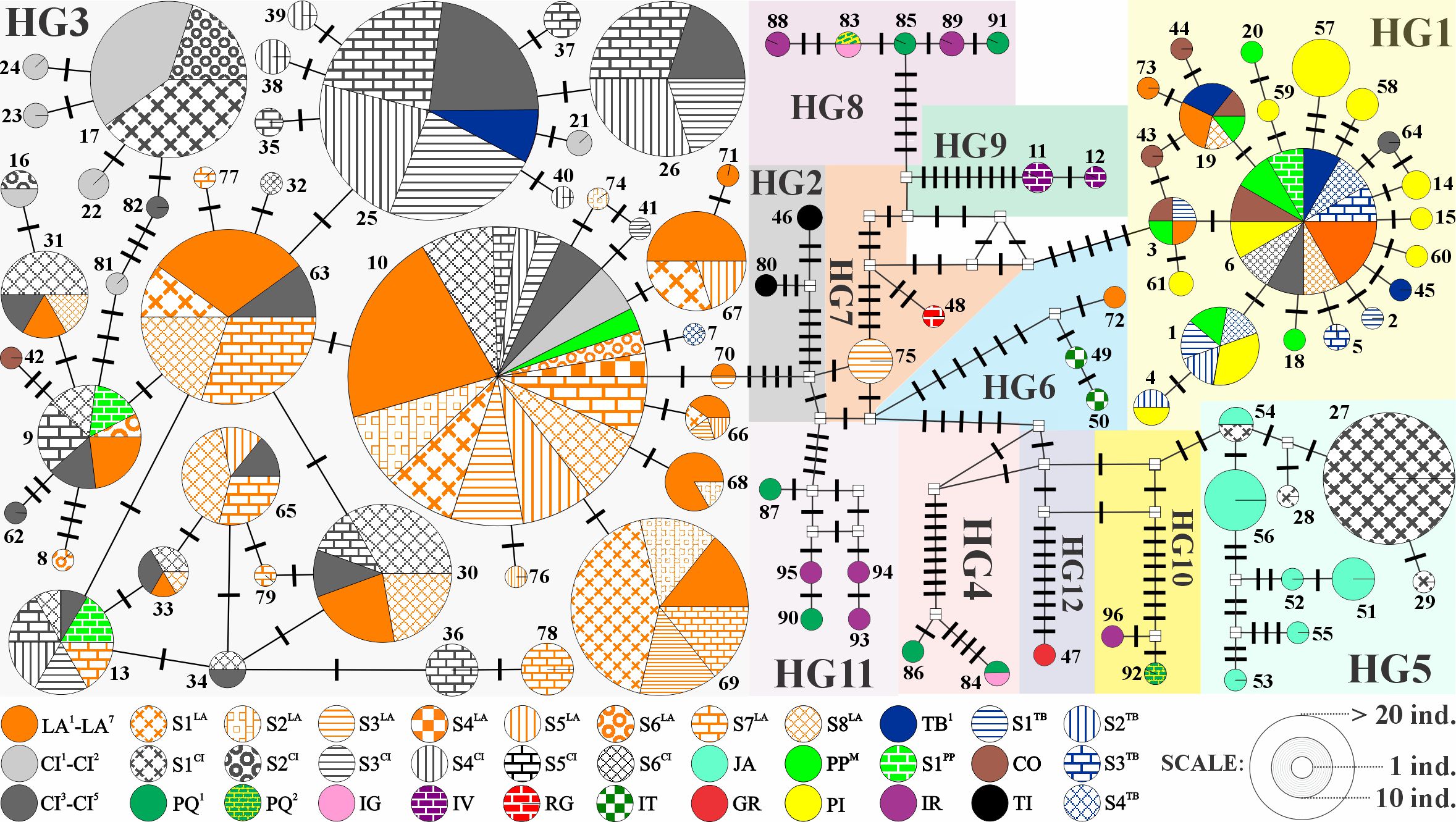
FIGURE 2| Pairwise genetic differentiation (ΦST – D-loop) among samples (N > 15) of Hypostomus ancistroides obtained along the sub-basins of the Paranapanema River (upper Paraná River basin). Cinzas River main channel (CI2, CI4 and CI5) and its tributary streams (S1CI, S3CI-S6CI), Laranjinha River main channel (LA1-LA7) and its tributary streams (S1LA-S3LA, S5LA, S7LA, S8LA), Congonhas River (CO), Paranapanema River main channel (PPM), Pirapó River (PI), and Jaguariaíva River (JA). *Significant values P ≤ 0.05. Non-significant values are shown in bold.
In the genetic diversity estimates (samples N > 15), the h ranged from 0.131 (LA2) to 0.905 (CI5), while the πranged from 0.01% (S1LA) to 10.60% (S6CI). Tajima’s D values were significant (Pvalue < 0.05) innine samples (LA1, LA2, LA3, LA4, LA6, S5LA, S7LA, CO and PPM), five samples (LA1, LA2, LA3, S1LA, and S5LA) showed significant Fu’s Fs values, and the mismatch distribution was unimodal in nine samples (S3CI, S4CI, LA1, LA2, LA3, LA5, S1LA, S2LA, S5LA) (Tab. 1; Fig. S5). Most of pairwise ΦST values were significant (Pvalue < 0.05), ranging from 0.010 (LA1 x S1LA) to 0.967 (S1LA x CO) (Tab. 2).
TABLE 1 | Genetic diversity (D-loop) estimated for samples (N> 15) of Hypostomus ancistroides in the sub-basins of the Paranapanema River, upper Paraná River. N: Number of individuals analyzed, H: number of haplotypes found, h: haplotype diversity, π: nucleotide diversity, D: Tajima’s neutrality test (Tajima, 1989), Fs: Fu neutrality test (Fu, 1997) and pattern (unimodal or multimodal) in the Mismatch distribution test. Samples N > 15 were obtained in the main channel (CI2, CI4 and CI5) and in tributary streams (S1CI, S3CI-S6CI) of the Cinzas River; in the main channel (LA1-LA7) and in tributary streams (S1LA-S3LA, S5LA, S7LA, S8LA) of the Laranjinha River, in the Congonhas River (CO), in the Paranapanema River main channel (PPM), in the Pirapó River (PI), and in the Jaguariaíva River (JA). *Significant values P ≤ 0.05.
Samples N >15 | N | H | h | π | D | Fs | Mismatch |
CI2 | 33 | 6 | 0.583 | 0.60% | -0.865 | 1.528 | multimodal |
CI4 | 18 | 6 | 0.680 | 0.30% | -1.593 | -0.580 | multimodal |
CI5 | 22 | 12 | 0.905 | 0.90% | -1.454 | -1.125 | multimodal |
S1CI | 63 | 4 | 0.513 | 1.30% | 2.780 | 14.388 | multimodal |
S3CI | 76 | 5 | 0.286 | 0.10% | -0.544 | -0.882 | unimodal |
S4CI | 91 | 6 | 0.595 | 0.10% | -0.301 | -0.966 | unimodal |
S5CI | 94 | 9 | 0.703 | 0.20% | 0.505 | -0.779 | multimodal |
S6CI | 85 | 12 | 0.812 | 10.60% | 0.934 | 0.011 | multimodal |
LA1 | 31 | 4 | 0.187 | 0.04% | -1.731* | -3.436* | unimodal |
LA2 | 30 | 3 | 0.131 | 0.02% | -1.507* | -2.355* | unimodal |
LA3 | 28 | 4 | 0.267 | 0.05% | -1.527* | -2.610* | unimodal |
LA4 | 30 | 4 | 0.434 | 0.36% | -2.439* | 2.561 | multimodal |
LA5 | 39 | 5 | 0.435 | 0.10% | -1.079 | -1.855 | unimodal |
LA6 | 24 | 7 | 0.736 | 0.81% | -1.580* | 1.994 | multimodal |
LA7 | 33 | 10 | 0.805 | 1.08% | -1.199 | 1.640 | multimodal |
S1LA | 85 | 4 | 0.092 | 0.01% | -1.308 | -3.049* | unimodal |
S2 LA | 92 | 5 | 0.293 | 0.08% | -0.513 | -0.840 | unimodal |
S3 LA | 79 | 5 | 0.252 | 0.28% | -0.654 | 1.254 | multimodal |
S5 LA | 89 | 5 | 0.280 | 0.06% | -1.641* | -2.679* | unimodal |
S7 LA | 76 | 8 | 0.698 | 0.53% | -1.538* | 1.501 | multimodal |
S8 LA | 87 | 8 | 0.507 | 0.23% | -0.549 | -1.108 | multimodal |
CO | 19 | 5 | 0.637 | 0.54% | -2.135* | 1.445 | multimodal |
PPM | 16 | 7 | 0.833 | 0.71% | -2.226* | 0.563 | multimodal |
PI | 36 | 9 | 0.832 | 0.60% | -0.610 | -1.536 | multimodal |
JA | 28 | 7 | 0.698 | 0.33% | -1.371 | -0.882 | multimodal |
TABLE 2 | Pairwise genetic differentiation (ΦST – D-loop) among samples (N > 15) of Hypostomus ancistroides obtained along the sub-basins of the Paranapanema River (upper Paraná River basin). Cinzas River main channel (CI2, CI4 and CI5) and its tributary streams (S1CI, S3CI-S6CI), Laranjinha River main channel (LA1-LA7) and its tributary streams (S1LA-S3LA, S5LA, S7LA, S8LA), Congonhas River (CO), Paranapanema River main channel (PPM), Pirapó River (PI), and Jaguariaíva River (JA). *Significant values P ≤ 0.05. Non-significant values are shown in bold.
| CI2 | CI4 | CI5 | S1CI | S3CI | S4CI | S5CI | S6CI | LA1 | LA2 | LA3 | LA4 | LA5 | LA6 | LA7 | S1LA | S2LA | S3LA | S5LA | S7LA | S8LA | CO | PPM | PI |
CI2 |
|
|
|
|
|
|
|
|
|
|
|
|
|
|
|
|
|
|
|
|
|
|
|
|
CI4 | 0.436* |
|
|
|
|
|
|
|
|
|
|
|
|
|
|
|
|
|
|
|
|
|
|
|
CI5 | 0.354* | 0.156* |
|
|
|
|
|
|
|
|
|
|
|
|
|
|
|
|
|
|
|
|
|
|
S1CI | 0.496* | 0.542* | 0.488* |
|
|
|
|
|
|
|
|
|
|
|
|
|
|
|
|
|
|
|
|
|
S3CI | 0.664* | 0.060* | 0.390* | 0.692* |
|
|
|
|
|
|
|
|
|
|
|
|
|
|
|
|
|
|
|
|
S4CI | 0.613* | 0.009 | 0.375* | 0.682* | 0.097* |
|
|
|
|
|
|
|
|
|
|
|
|
|
|
|
|
|
|
|
S5CI | 0.557* | 0.007 | 0.256* | 0.658* | 0.063* | 0.057* |
|
|
|
|
|
|
|
|
|
|
|
|
|
|
|
|
|
|
S6CI | 0.136* | 0.081* | 0.072* | 0.228* | 0.157* | 0.171* | 0.164* |
|
|
|
|
|
|
|
|
|
|
|
|
|
|
|
|
|
LA1 | 0.536* | 0.523* | 0.104* | 0.590* | 0.691* | 0.577* | 0.384* | 0.094* |
|
|
|
|
|
|
|
|
|
|
|
|
|
|
|
|
LA2 | 0.537* | 0.519* | 0.101* | 0.588* | 0.689* | 0.575* | 0.381* | 0.092* | -0.017 |
|
|
|
|
|
|
|
|
|
|
|
|
|
|
|
LA3 | 0.453* | 0.297* | 0.050 | 0.552* | 0.521* | 0.477* | 0.332* | 0.091* | 0.023 | 0.024 |
|
|
|
|
|
|
|
|
|
|
|
|
|
|
LA4 | 0.516* | 0.476* | 0.091* | 0.578* | 0.665* | 0.560* | 0.372* | 0.089* | 0.014 | -0.010 | 0.033 |
|
|
|
|
|
|
|
|
|
|
|
|
|
LA5 | 0.546* | 0.469* | 0.119* | 0.605* | 0.643* | 0.560* | 0.385* | 0.104* | 0.042 | 0.015 | 0.020 | 0.013 |
|
|
|
|
|
|
|
|
|
|
|
|
LA6 | 0.391* | 0.213* | 0.001 | 0.502* | 0.455* | 0.426* | 0.300* | 0.080* | 0.051 | 0.048 | 0.002 | 0.038 | 0.061* |
|
|
|
|
|
|
|
|
|
|
|
LA7 | 0.354* | 0.169* | 0.016 | 0.487* | 0.376* | 0.370* | 0.270* | 0.088* | 0.066* | 0.064* | 0.024* | 0.057 | 0.081* | -0.025 |
|
|
|
|
|
|
|
|
|
|
S1LA | 0.677* | 0.693* | 0.221* | 0.697* | 0.763* | 0.660* | 0.474* | 0.147* | 0.010* | 0.002 | 0.100 | 0.017* | 0.100* | 0.130* | 0.142* |
|
|
|
|
|
|
|
|
|
S2LA | 0.591* | 0.702* | 0.447* | 0.696* | 0.776* | 0.719* | 0.602* | 0.171* | 0.665* | 0.663* | 0.507* | 0.622* | 0.620* | 0.458* | 0.386* | 0.723* |
|
|
|
|
|
|
|
|
S3LA | 0.517* | 0.324* | 0.095* | 0.617* | 0.481* | 0.459* | 0.345* | 0.140* | 0.050 | 0.049 | 0.041 | 0.042 | 0.071* | 0.027 | 0.048 | 0.088* | 0.466* |
|
|
|
|
|
|
|
S5LA | 0.647* | 0.567* | 0.192* | 0.692* | 0.675* | 0.609* | 0.442* | 0.150* | 0.003 | 0.007 | 0.021 | 0.041 | 0.029* | 0.113* | 0.130* | 0.055* | 0.648* | 0.087* |
|
|
|
|
|
|
S7LA | 0.477* | 0.282* | 0.057* | 0.610* | 0.432* | 0.434* | 0.319* | 0.129* | 0.150* | 0.149* | 0.130* | 0.144* | 0.163* | 0.104* | 0.078* | 0.222* | 0.444* | 0.162* | 0.200* |
|
|
|
|
|
S8LA | 0.564* | 0.376* | 0.105* | 0.659* | 0.516* | 0.501* | 0.345* | 0.142* | 0.072* | 0.071* | 0.087* | 0.070* | 0.093* | 0.093* | 0.094* | 0.113* | 0.506* | 0.104* | 0.099* | 0.082* |
|
|
|
|
CO | 0.834* | 0.884* | 0.778* | 0.666* | 0.949* | 0.933* | 0.908* | 0.272* | 0.934* | 0.933* | 0.879* | 0.926* | 0.930* | 0.819* | 0.770* | 0.967* | 0.954* | 0.901* | 0.955* | 0.864* | 0.921* |
|
|
|
PPM | 0.816* | 0.866* | 0.750* | 0.641* | 0.944* | 0.927* | 0.900* | 0.254* | 0.925* | 0.923* | 0.863* | 0.914* | 0.920* | 0.795* | 0.746* | 0.963* | 0.949* | 0.892* | 0.951* | 0.852* | 0.914* | -0.011 |
|
|
PI | 0.859* | 0.900* | 0.823* | 0.706* | 0.948* | 0.935* | 0.914* | 0.320* | 0.934* | 0.933* | 0.894* | 0.927* | 0.931* | 0.852* | 0.812* | 0.962* | 0.952* | 0.908* | 0.953* | 0.877* | 0.925* | 0.279* | 0.151* |
|
JA | 0.836* | 0.891* | 0.803* | 0.375* | 0.946* | 0.928* | 0.898* | 0.272* | 0.935* | 0.934* | 0.884* | 0.927* | 0.929* | 0.837* | 0.788* | 0.965* | 0.950* | 0.894* | 0.952* | 0.859* | 0.914* | 0.874* | 0.858* | 0.886* |
Analysis of 841 bp of the ATPase gene, as well as 617 bp of the COI gene, revealed 27 different ATPase haplotypes (HA) and 13 different COI haplotypes (HC) (NCBI accession numbers in Tabs. S3, S4) among representatives of the 92 D-loop haplotypes generated in present study (excluding four from the database), totaling 69 ATPase haplotypes (102 variable sites) and 24 COI haplotypes (56 variable sites) in conjunction with GenBank and BOLD data (Fig. 3), including data from Hollanda Carvalho et al. (2016). ATPase data showed almost all the same haplogroups assigned to D-loop data, except HG11 and HG12 (D-loop), which clustered in HG2 of ATPase data (Figs. 3, S7). In the case of COI data, the main haplogroups obtained from the other loci (HG1, HG3, HG4, HG5, HG6 and HG8) were also detected and kept the same names (Figs. 3, S8). However, due to the lower variation and the smaller amount of GenBank and BOLD sequences, only nine haplogroups were assigned to COI haplotypes (HG1-HG9), so that some haplogroups assigned to D-loop and ATPase data had no representatives or merged, receiving other names in the COI data: HG2ATPase was encompassed by HG1COI; HG7D-loop/ATPase was encompassed by HG3COI; HG10D-loop/ATPase received the name of HG7COI; HG9D-loop/ATPase was encompassed by HG8COI; HG9COI was assigned to a haplotype from the Grande River (Tab. S1). On the other hand, the concatenated data (D-loop553 bp, plus ATPase 841 bp, plus COI 617 bp = 2011 bp) also show patterns (Figs. S9–S10) very similar to those obtained from the D-loop data.
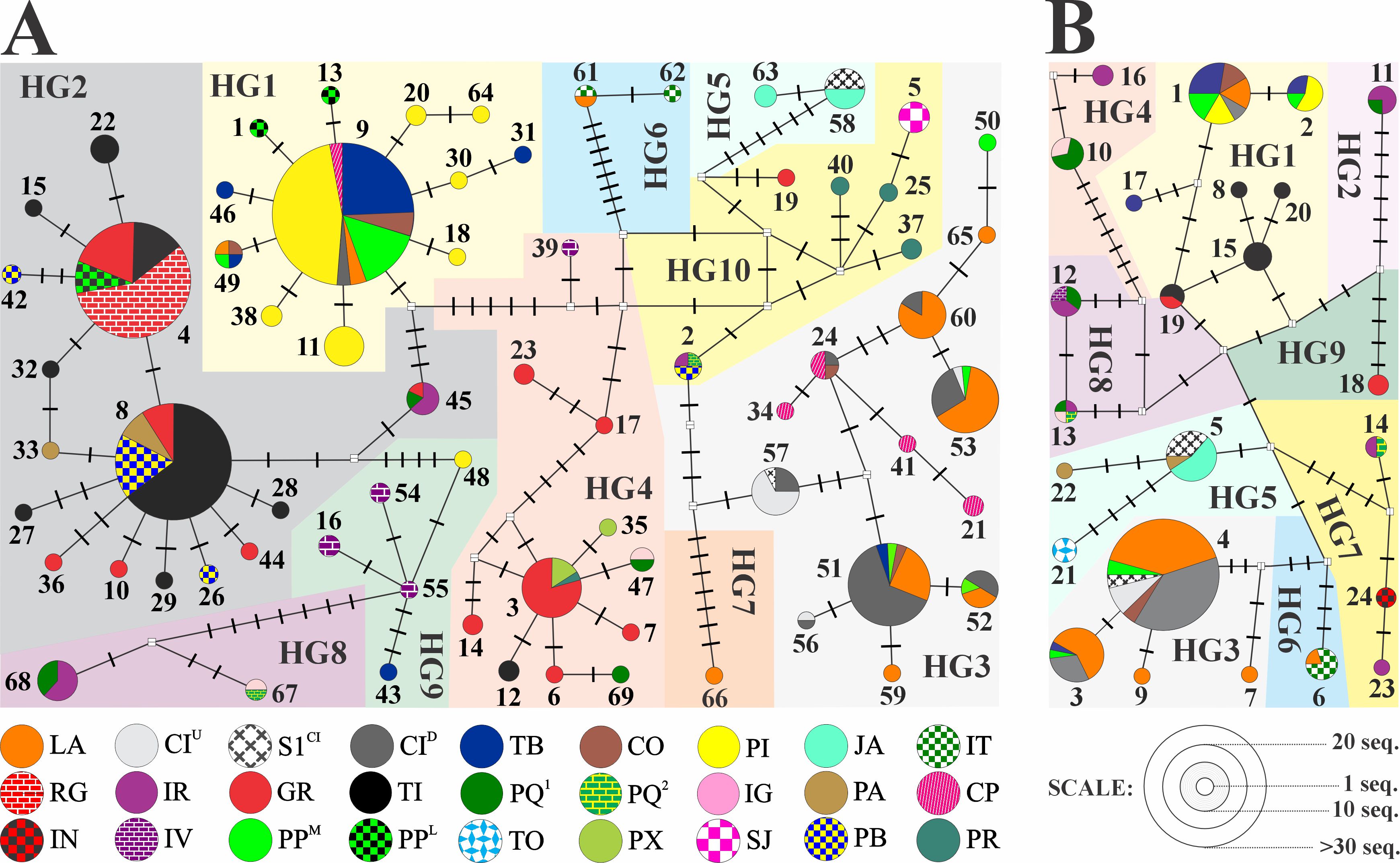
FIGURE 3| Haplotype network obtained from the sequencing of A. ATPase (69 haplotypes) and B. COI (24 haplotypes) genes for samples of Hypostomus ancistroides investigated along sub-basins of the Paranapanema River and other locations in the upper Paraná River basin. Circle sizes are proportional to the haplotype frequency (scale: seq. = sequences from representatives of each D-loop haplotype and from databases) and black traces represent mutation steps. The main haplogroups (HG1, HG3, HG4, HG5 and HG6) kept the same names in the analysis of the three loci. In this analysis, the samples were organized as follows: TB – Tibagi River and its tributary streams; CO – Congonhas River; LA – Laranjinha River and its tributary streams; CIU and CID – Cinzas River and its tributary streams (upstream and downstream of Salto Cavalcante waterfall, respectively); S1CI – Cachoeirinha Stream (due to headwater captures); tributary streams of the Itaipu Reservoir (IR); Paranapanema Rive main channel (middle – PPM, lower – PPL); as well as the Pirapó (PI), Jaguariaíva (JA), Itapetininga (IT), Pardo (PA), Capivara (CP), Piquiri (PQ1 – upper; PQ2 – lower), Ivaí (IV), Iguaçu (IG), Ribeira de Iguape (RG), Grande (GR), São José dos Dourados (SJ), Ivinhema (IN), Peixe (PX), Tietê (TI), Paranaíba (PB), Paraná (PR) and Tocantins (TO) rivers.
Phylogenetic relationship and divergence time among lineages. Phylogenetic analysis using Bayesian statistical methods showed congruent topologies from all mitochondrial data (D-loop, ATPaseand COI data separately and concatenated data set), indicating a clear separation between the branches that include HG3, which is predominant along the Cinzas River sub-basin, and HG1, which is predominant in the western portion of the Paranapanema River basin, including its main channel and the Pirapó and Tibagi sub-basins (Figs. S6–S8, S10). Considering the divergence time among lineages, both Bayesian approaches, ATPase-based (Fig. S11) and D2a calibration (Cardoso et al., 2021), showed highly time divergence estimations, therefore only the D2a calibrated tree is shown (Fig. 4). The lineages of H. ancistroides were split in two highly supported groups, the first including (HG1, HG2, HG9, HG11, HG8 and HG4) and a second one including (HG3, HG7, HG5, HG10, and HG6) (also supported in ATPase only tree; Figs. S12A, B), with divergence time estimated in 1.52 [1.16–1.96] Mya (middle Pleistocene). In the two lineages, several further splits occurred in the mitochondrial lineages between 1.5 and 0.5 Mya to originate the recovered haplogroups.

FIGURE 4| Divergence time among lineages (haplogroups) of Hypostomus ancistroides estimated from concatenated mitochondrial data (D-loop+ATPase+COI data) using the Cardoso et al. (2021) time estimations for D2a clade [7.86–15.67] (Mya – millions of years ago). Branches within each haplogroup are collapsed. Haplogroups are numbered and colored as in Fig. 2. Posterior probability values are given next to the nodes. Blue bar indicates 95% credibility intervals.
Discussion
Three mitochondrial DNA regions analyzed corroborate the hypothesis that the lineage of H. ancistroides predominating in the Cinzas River sub-basin (haplogroup HG3) is not the same lineage that predominates in other large neighboring sub-basins within the Paranapanema River basin, including the Tibagi River sub-basin (predominated by HG1), which confluence is geographically very close (~ 70 km). These differences were also corroborated by population data (from D-loop haplotypes), which indicated high genetic structuring levels among samples from different sub-basins, supporting that the Cinzas River sub-basin may represent “an area harboring a specific fraction of the genetic diversity” of H. ancistroides along the UPRB. Additionally, the divergence-time estimates indicate that H. ancistroides lineages likely diversified during the Pleistocene, consistent with the findings of Hollanda Carvalho et al. (2016), supporting the hypothesis that events during this period greatly influenced the evolutionary history of H. ancistroides along the Cinzas River sub-basin (even at a fine-scale), as well as throughout the Paranapanema River basin.
Lineage distribution and divergence time. Geomorphological changes in the upper Paraná River during the Pleistocene have been associated with climatic and tectonic variations that influenced processes of sedimentation, erosion and landscape reorganization (Riccomini, Assumpção, 1999; Stevaux, 2000; Sanches et al., 2024). The UPRB tectonism, although more subtle during this period, includes evidence of ancient fault reactivations, determining vertical displacements and relief adjustments that may have contributed, for example, to drainage captures and river course redirections (Riccomini, Assumpção, 1999; Fortes et al., 2007; Sowinski et al., 2024). In the Cinzas River sub-basin, particularly, the reactivation of these faults has been associated with watershed asymmetry patterns, alterations in the topographic surface, anomalies in the drainage network patterns and disturbances in the longitudinal profiles (Sanches et al., 2024). Extreme climatic oscillations of the Pleistocene, in turn, determined profound influences on the relief, river dynamics and sedimentation patterns of the UPRB, reflecting the alternation between long arid and semi-arid periods (glacial, drier) and long periods of increased humidity (interglacial, warmer) (Stevaux, 1994, 2000; Albert, Reis, 2011; Albert et al., 2020). Considering their influences on ichthyofauna, extreme reductions in water levels during long drought periods resulted in geographic barriers (e.g., drought zones and disconnections between hydrographic systems), promoting isolation of populations in the sub-basins (contraction of the available habitat to fishes), thus contributing to the establishment of lineages or even allopatric speciation (Lundberg et al., 1998; Albert, Reis, 2011). On the other hand, large increases in the water level of hydrographic systems during more humid periods would have contributed to watershed expansions and increased connectivity between drainages, allowing dispersal events and genetic exchange between populations (Hubert, Renno, 2006).
Genetic evidence suggesting influences of Pleistocene climate oscillations has already been obtained for different Neotropical fish species (Ochoa et al., 2015; Lima et al., 2016; Costa et al., 2019), including species from the Paraguay-Paraná-Plata system (Artoni et al., 2006; Mondin et al., 2018; Ferreira et al., 2023). In the case of H. ancistroides, Hollanda Carvalho et al. (2016) argued that habitat fragmentation and reconnection during this period likely determined population isolation and the establishment of different lineages of H. ancistroides throughout the UPRB, as well as the subsequent merging of populations and secondary contact between these lineages. Our data corroborates this interpretation and indicates scenarios of past fine-scale connectivity limitations that may have contributed to distinct colonization patterns between neighboring sub-basins. Based on phylogenetic data, the separation between the branches that gave rise to the haplogroups detected in the Paranapanema River basin (HG1 compared with HG3, HG5 and HG6 – 1.52 [1.16–1.96] Mya) would predate the colonization process of H. ancistroides along this hydrographic system, since HG1, HG3, HG5 and HG6 are close to very distinct haplogroups occurring farther north in the UPRB, which is likely the origin center of the species (Cardoso et al., 2021). In this scenario, it seems plausible that the different lineages arrived in the Paranapanema River basin at different times and via different colonization routes, one from the west and another from the east.
HG1 occupied the western portion of the Paranapanema River basin, spreading along the main channel and tributaries (e.g., Pirapó and Tibagi sub-basins) until reaching some past obstacle in the stretch between the Tibagi and Cinzas confluences, which would have blocked the dispersal of HG1 to upstream areas, including the Cinzas River sub-basin. Consequently, HG1 became predominant in western drainages (PI, TB, CO, PPL and PPM) and rare in the Cinzas River sub-basin. In the case of HG3, ancestors appear to have originated from the upper Paranapanema River (east portion), dispersing downstream through the Salto Grande Falls, as supported by the greater similarity of HG3 to haplogroups (HG5 and HG6) occurring in eastern drainages (IT and JA), as well as by the presence of an HG6 haplotype (HD72/HA61/HC06) in the Cinzas River sub-basin. While HG3 colonized and diversified along the Cinzas River sub-basin, its dispersal to western drainages would have been limited by the obstacle between the Tibagi and Cinzas confluences, and its dispersals to eastern drainages limited by the Salto Grande Falls (~ 20 m high) (Leuzzi et al., 2004). Since Salto Grande Falls tend to isolate the upper section of the Paranapanema River basin, it seems plausible that colonization of H. ancistroides upstream of these waterfalls occurred through past connections (e.g., headwater captures) between upper Paranapanema River drainages and headwaters of neighboring watersheds, enabling dispersal of individuals from distinct lineages from those that occupied western drainages. For example, the Pardo River (located upstream of Salto Grande Falls) contains HG5 (COI data) and HG2 (ATPase data), the latter common in the Tietê River basin, suggesting past connectivity. In fact, inter-basin dispersal through headwater captures is an important aspect of the evolutionary history of Hypostomus throughout Neotropical systems (Cardoso et al., 2021). In H. ancistroides, these events may have facilitated the dispersal from the UPRB to the Ribeira de Iguape coastal basin (Hollanda Carvalho et al., 2016), possibly involving colonizers from the Tietê River basin.
Currently, the stretch between the Tibagi and Cinzas confluences (~ 70 km) is flooded by the Capivara Reservoir (Leuzzi et al., 2004) and no longer represents a barrier. Before flooding, this reach was described as a long segment of large rapids without major waterfalls (Vianna, Nogueira, 2008), suggesting that some gene flow would have been possible. However, during extreme Pleistocene droughts, drastic reductions in water level may have produced extremely unfavorable conditions for species such as H. ancistroides in long-rapids stretches, potentially creating disconnections. H. ancistroides is a benthic detritivore fish (bottom scraper) (Suzuki et al., 2000; Oliveira, Bennemann, 2005) that, unlike many other species of the genus, prefers lentic, deeper, and turbid waters rich in suspended sediments and nutrients (Uieda et al., 1997; Casatti et al., 2005; Teresa, Casatti, 2013; Cardoso et al., 2021), feeding at night by foraging on branches, leaves and submerged wood (Casatti et al., 2005). Thus, long rapids with extremely low water volume (at sub-basins mouths and in the stretchs between them) could have limited both dispersal and gene flow after population establishment. Although challenging to reconstruct, similar scenarios (together with other barriers) may also have occurred elsewhere in the UPRB, preventing certain haplogroups from entering the Paranapanema River through the Paraná River main channel. Some haplogroups rare within Paranapanema drainages occur in sympatry to the south and north of the river mouth (e.g., HG4, HG8, and HG10 – ATPase data), both in the Paraná River main channel and in its tributaries (PR, IR, PB, SJ, PQ1, PQ2, and IV).
Secondary contacts – reconnections and headwater captures. Although it is difficult to determine what may have limited the past dispersal of HG3 (westwards) and HG1 (eastwards) in the Paranapanema River, it seems clear that the subsequent elimination of this obstacle likely enabled secondary contacts between these haplogroups, as evidenced by the low frequency of HG1 in the Cinzas River sub-basin (only in the lower section) and the rare occurrence of HG3 in the Tibagi River sub-basin drainages and adjacent areas of the Paranapanema River, i.e., the dispersal of these haplogroups into drainages where they are not predominant is apparently more recent. In the case of the “long rapids” hypothesis, after a long period of extremely low water levels due to Pleistocene droughts, the subsequent occurrence of a prolonged humid and flooding period (Albert et al., 2020) would have raised water levels and eliminate obstacles, favoring gene flow and the exchange of individuals from different haplogroups. This scenario would have been possible, for example, during the last interglacial period (ending about 0.1 Mya) (Kukla et al., 2002), which is considered the most humid and warm interval of the Late Pleistocene (0.126–0.012 Mya) (Albert, Reis, 2011) and includes evidence of population expansions for fish species from the Paraguay-Paraná-Plata system (Mondin et al., 2018). At the same time, dispersal opportunities after the Last Glacial Maximum (LGM ~ 0.026–0.020 Mya) (Clark et al., 2009) also seem plausible, since drainage systems would have been returning to higher water levels, enabling reconnections. In any case, the more recent dispersal of HG3 and HG1 toward drainages where they are not predominant is corroborated both by the haplotype distributions and by populational genetic data (D-loop), mainly from samples obtained in the lower section of the Cinzas and Tibagi river sub-basins (CI5, S6CI, LA6, LA7, S7LA, and CO), which showed patterns associated with encounter between distinct lineage, including h > 0.5 combined with π > 0.5 % (Grant, Bowen, 1998) and a multimodal mismatch distribution (Rogers, Harpending, 1992).
Indeed, the extent of this secondary contact between HG1 and HG3 also corroborates the scenario of more recent dispersal after reconnections, since the coexistence of these haplogroups seems limited to the lower sections of the Cinzas and Tibagi River sub-basins and adjacent areas in the Paranapanema River (including the Capivara River – CA), not extending to drainages further west, such as PI, PPL or PR, nor to the middle and upper sections of the Cinzas River sub-basin. Since the last reconnection must have occurred thousands of years ago (possibly during the last interglacial period or after LGM), the patterns obtained (extension of secondary contact, h > 0.5 combined with π > 0.5 % and multimodal mismatch distribution) also suggest a relationship between the speed of the dispersal process and biological characteristics of the species. Indeed, H. ancistroides is a non-migratory fish that shows limited movement range throughout its life (Apolinário-Silva et al., 2021), which suggests slower dispersal and gene flows, involving several successive generations.
According to Apolinário-Silva et al. (2021), genetically structured populations of this species can occur even over short geographic distances, showing isolation by distance and gene flow consistent with the Stepping-Stone model (Kimura, Weiss, 1964). In this context, the data obtained allow us to infer the occurrence of two dispersal waves in the Cinzas River sub-basin: i – the main colonization by HG3 ancestors, which dispersed in the mouth-to-source direction throughout the watershed, evolving and diversifying along the main channel and tributaries. This process also overcame the obstacle imposed by Salto Cavalcante Falls (about 15 m high), so that HG3 is also predominant in the upper Cinzas River section, showing specific haplotypes that diversified upstream of the obstacle; ii – the more recent dispersal after reconnection, due to the period of humidity and flooding (Albert et al., 2020), already discussed for HG1. In this context, similar processes may also have occurred for the Tibagi River sub-basin, with HG1 representing the first dispersal wave and HG3 the second. However, although this second dispersal wave is referred to as “more recent,” it is important to note that a very large number of generations would have been required for the establishment of the geographical extent of the secondary contacts reported here (both between HG1 and HG3, and between HG3 and HG5), including the potential formation of new haplotypes after secondary contact (e.g., HD64 and HD73 in Cinzas River sub-basin), which also requires a long time. In this scenario, influences of contemporary anthropogenic actions (e.g., aquarium trade) do not seem parsimonious when considering the time required by the evolutionary dynamics of mtDNA (haploid uniparental inheritance, absence of genetic recombination, slow mutation rate) (Avise, 2004) and the gene-flow pattern of H. ancistroides (Stepping-Stone model).
Secondary contacts from headwater captures were also detected, evidencing another important smaller-scale influence of Pleistocene events. Since almost all drainages analyzed in the upper Cinzas River sub-basin showed the predominance of HG3 haplotypes, except SC1 (the Cachoerinha Stream, a right-bank tributary of the upper Cinzas River), in which the HG5 (separated from HG3 about 1.2 Mya) was the most frequent haplogroup, this scenario appears to be clear genetic evidence of headwater captures between the Cinzas and Jaguariaíva river sub-basins, since HG5 was the only haplogroup detected in the Jaguariaíva River. Although Cinzas and Jaguariaíva river sub-basins occur in different sections of the Paranapanema River (upstream and downstream of Salto Grande Falls), their headwaters show marked geographical proximity, particularly between tributaries of the Cachoeirinha Stream and the Jaguariaíva River (Fig. S13), which could have facilitated past connections.
Evidence and discussions regarding potential headwater captures between neighboring sub-basins in the upper Paraná River are not unprecedented (Lucena et al., 2012; Lippert et al., 2014; Frota et al., 2016) and constitute parsimonious explanations for faunal exchanges between adjacent drainages, such as those reported among the Iguaçu, Piquiri, Ivaí, Ribeira de Iguape rivers and tributaries of the Paranapanema river (Ribeiro, 2006; Frota et al., 2016; Cavalli et al., 2018; Morais-Silva et al., 2018). Such events have been commonly associated with intense geological activities and reactivation of ancient faults during the Cenozoic, particularly in areas influenced by the Serra da Esperança and the Ponta Grossa Arch (Ribeiro, 2006; Frota et al., 2016). In the case of the Cinzas River, they highlight the tectonic influence of the Ponta Grossa Arch on the Piraí Depression (in the Central Southeastern Brazilian Rift), which includes the headwaters of the Cinzas, Tibagi and Itararé river sub-basins (encompassing the Jaguariaíva River), as well as the Ribeira de Iguape coastal basin (Santos et al., 2022). According to morphometric, morphological and sedimentological evidence (Sordi et al., 2022), headward erosion has caused drainage rearrangements (including drainage captures) across the Piraí Depression since at least the Pliocene, and includes, in particular, a Cinzas River headwater area (near the Cachoeirinha Stream) that appears to have been captured from the Jaguariaíva River sub-basin, consistent with our genetic results. For ichthyofauna, surveys by Frota et al. (2020) and genetic data from Ferreira et al. (2023) had already suggested headwater captures as dispersal route and exchange for species between the Cinzas and Itararé river sub-basins during the Pleistocene, considering tectonic events in the Ponta Grossa Arch, such as those occurring around 1.7 Mya (Morais-Silva et al., 2018).
The analyses also suggest headwaters captures in other areas of the UPPR, including headwaters of the Ivaí and Tibagi rivers (HA43), as well as headwaters of tributaries of the Piquiri (PQ2) and Iguaçu (IG) rivers (HD83/HA67/HC14) in the area influenced by Serra da Esperança; however, the dataset is not sufficient for firm conclusions. Finally, the presence of HC21 (COI) in headwaters of the Tocantins River basin likely reflects human-mediated introduction (aquariophilia), since H. ancistroides is not native to this basin (Reis et al., 2003) and HC21 belongs to the predominant haplogroup in the eastern Paranapanema River basin (HG5).
Considering the topics discussed above, it seems plausible that Pleistocene events played a major role in shaping the complex evolutionary history of widely distributed non-migratory fish in the UPRB, such as H. ancistroides, leaving signatures of fragmentation, reconnections, and headwater captures that can be detected even at small spatial scales from heterogeneous distributions of mitochondrial lineages among very close neighboring sub-basins of the Paranapanema River basin. This scenario appears to reflect the use of different colonization routes by distinct lineages along a hydrographic system, as well as the presence of natural obstacles and discontinuities in the drainage system during Pleistocene droughts, which may have contributed to the predominance of a lineage in the Cinzas River sub-basin that differs from those predominant in other Paranapanema River sub-basins and in the UPRB, raising questions about the occurrence of similar patterns in other species with comparable ecological behavior. Despite evidence of secondary contact, the predominance of a lineage that evolved within the Cinzas River sub-basin highlights this drainage as “an area harboring a specific fraction of the genetic diversity along the UPRB”, reinforcing its importance as a sub-basin designated as a Priority Area for Biodiversity Conservation (APCB) by the Brazilian Ministry of the Environment (MMA, 2016).
Acknowledgments
We would also like to thank Dr. Oscar A. Shibatta (UEL) for his assistance in identifying the species studied; Dr. Luiz H. G. Pereira (UNILA) for donating samples from Itaipu Reservoir tributaries.
References
Albert JS, Reis RE. Historical biogeography of Neotropical freshwater fishes. Berkeley: University of California Press; 2011.
Albert JS, Tagliacollo VA, Dagosta F. Diversification of Neotropical freshwater fishes. Annu Rev Ecol Evol Syst. 2020; 51(1):27–53. https://doi.org/10.1146/annurev-ecolsys-011620-031032
Almeida FS, Sodré LMK, Contel EPB. Population structure analysis of Pimelodus maculatus (Pisces, Siluriformes) from the Tietê and Paranapanema Rivers (Brazil). Genet Mol Biol. 2003; 26(3):301–05. https://doi.org/10.1590/S1415-47572003000300014
Apolinário-Silva C, Galindo BA, Nascimento RHC, Frantine-Silva W, Kotelok-Diniz T, Sofia SH et al. Fine-scale genetic structure of suckermouth Hypostomus ancistroides populations: the importance of Neotropical streams for fish conservation. Biol J Linn Soc. 2021; 134(1):198–213. https://doi.org/10.1093/biolinnean/blab039
Artoni RF, Shibatta OA, Gross MC, Schneider CH, Almeida MC, Vicari MR et al. Astyanax aff. fasciatus Cuvier, 1819 (Teleostei; Characidae): evidences of a species complex in the upper rio Tibagi basin (Paraná, Brazil). Neotrop Ichthyol. 2006; 4(2):197–202. https://doi.org/10.1590/S1679-62252006000200005
Avise JC. Molecular markers, natural history and evolution. 2nd ed. Sunderland: Sinauer Associates; 2004.
Bandelt HJ, Forster P, Röhl A. Median-joining networks for inferring intraspecific phylogenies. Mol Biol Evol. 1999; 16(1):37–48. https://doi.org/10.1093/oxfordjournals.molbev.a026036
Bermingham ES, McCafferty A, Martin A. Fish biogeography and molecular clocks: Perspectives from the Panamanian Isthmus. In: Kocher T, Stepien C, editors. Molecular systematics of fishes. New York: Academic Press; 1997. p.113–28.
Bouckaert RR, Drummond AJ. bModelTest: Bayesian phylogenetic site model averaging and model comparison. BMC Evol Biol. 2017; 17(1):42. https://doi.org/10.1186/s12862-017-0890-6
Bouckaert R, Vaughan TG, Barido-Sottani J, Duchêne S, Fourment M, Gavryushkina A et al. BEAST 2.5: an advanced software platform for Bayesian evolutionary analysis. PLoS Comput Biol. 2019; 15(4):e1006650. https://doi.org/10.1371/journal.pcbi.1006650
Britski HA, Sato Y, Rosa ABS. Manual de identificação de peixes da região de Três Marias: com chaves de identificação para os peixes da bacia do São Francisco. Brasília: CODEVASF; 1988.
Britto SGC, Sirol RN, Vianna NC, Jardim SM, Santos JC, Pelisari E. Peixes do rio Paranapanema. São Paulo: Duke Energy; 2003.
Cardoso YP, Almiron A, Casciotta J, Aichino D, Lizarralde MS, Montoya-Burgos JI. Origin of species diversity in the catfish genus Hypostomus (Siluriformes: Loricariidae) inhabiting the Paraná river basin, with the description of a new species. Zootaxa. 2012; 3453(1):69–83. https://doi.org/10.11646/ZOOTAXA.3453.1.5
Cardoso YP, Queiroz LJ, Bahechar IA, Posadas PE, Montoya-Burgos JI. Multilocus phylogeny and historical biogeography of Hypostomus shed light on the processes of fish diversification in La Plata Basin. Sci Rep. 2021; 11(1):e5073. https://doi.org/10.1038/s41598-021-83464-x
Casatti L, Rocha FC, Pereira DC. Habitat use by two species of Hypostomus (Pisces, Loricariidae) in Southeastern Brazilian streams. Biota Neotrop. 2005; 5(2):157–65. https://doi.org/10.1590/S1676-06032005000300012
Castro RMC, Casatti L, Santos HF, Ferreira KM, Ribeiro AC, Benine RC et al. Estrutura e composição da ictiofauna de riachos do rio Paranapanema, sudeste e sul do Brasil. Biota Neotrop. 2003; 3(1):1–31. https://doi.org/10.1590/S1676-06032003000100007
Cavalli D, Frota A, Lira AD, Gubiani ÉA, Margarido VP, Graça WJ. Update on the ichthyofauna of the Piquiri River basin, Paraná, Brazil: a conservation priority area. Biota Neotrop. 2018; 18(2):e20170350. https://doi.org/10.1590/1676-0611-BN-2017-0350
Clark PU, Dyke AS, Shakun JD, Carlson AE, Clark J, Wohlfarth B et al. The last glacial maximum. Science. 2009; 325(5941):710–14. https://doi.org/10.1126/science.1172873
Costa CLN, Perez SI, Louvise J, Tonhatti CH, Clemente-Carvalho RBG, Petry AC et al. Demographic expansion and contraction in a Neotropical fish during the Late Pleistocene-Holocene. Open J Stat. 2019; 9(4):470–83. https://doi.org/10.4236/ojs.2019.94032
Dias AC, Zawadzki CH. Identification key and pictures of the Hypostomus Lacépède, 1803 (Siluriformes, Loricariidae) from the rio Ivaí, upper rio Paraná basin. Check List. 2018; 14(2):393–414. https://doi.org/10.15560/14.2.393
Excoffier L, Lischer HEL. Arlequin suite ver 3.5: a new series of programs to perform population genetics analyses under Linux and Windows. Mol Ecol Resour. 2010; 10(3):564–67. https://doi.org/10.1111/j.17550998.2010.02847.x
Ferreira DG, Carlsson J, Galindo BA, Frantine-Silva W, Apolinário-Silva C, Meschini JS et al. The role of free-flowing tributary rivers in the maintenance of genetic diversity of a migratory fish species living in a river fragmented by dams. Hydrobiologia. 2022; 849(5):1221–37. https://doi.org/10.1007/s10750-021-04782-9
Ferreira DG, Galindo BA, Souza TC, Pereira LB, Bernardes VAP, Marques AJC et al. Genetic diversity of the species Cnesterodon hypselurus (Cyprinodontiformes: Poeciliidae) in Cinzas River basin: new record and headwater capture evidences. Neotrop Ichthyol. 2023; 21(1):e230007. https://doi.org/10.1590/1982-0224-2023-0007
Fortes E, Volker S, Stevaux JC, Marques AJ. Anomalias de drenagem e controles morfotectônicos da evolução dos terraços do baixo curso do rio Ivinhema-MS. Geociências. 2007; 26(3):249–61.
Fricke R, Eschmeyer WN, Van der Laan R. Eschmeyer’s catalog of fishes: genera, species, references [Internet]. San Francisco: California Academy of Science; 2025. Available from: http://researcharchive.calacademy.org/research/ichthyology/catalog/fishcatmain.asp.
Frota A, Gonçalves EVR, Deprá GC, Graça WJ. Inventory of the ichthyofauna from the Jordão and Areia river basins (Iguaçu drainage, Brazil) reveals greater sharing of species than thought. Check List. 2016; 12(6):1–12. https://doi.org/10.15560/12.6.1995
Frota A, Ota RR, Deprá GDC, Ganassin MJM, Graça WJ. A new inventory for fishes of headwater streams from the rio das Cinzas and rio Itararé basins, rio Paranapanema system, Paraná, Brazil. Biota Neotrop. 2020; 20(1):e20190833. https://doi.org/10.1590/1676-0611-BN-2019-0833
Fu YX. Statistical test of neutrality of mutations against population growth, hitchhiking and background selection. Genetics. 1997; 147(2):915–25. https://doi.org/10.1093/genetics/147.2.915
Grant WS, Bowen BW. Shallow population histories in deep evolutionary lineages of marine fishes: insights from sardines and anchovies and lessons for conservation. J Hered. 1998; 89(5):415–26. https://doi.org/10.1093/jhered/89.5.415
Heled J, Drummond AJ. Calibrated tree priors for relaxed phylogenetics and divergence time estimation. Syst Biol. 2012; 61(1):138–49. https://doi.org/10.1093/sysbio/syr087
Hollanda Carvalho P, Lima SMQ, Zawadzki CH, Oliveira C, de Pinna M. Phylogeographic patterns in suckermouth catfish Hypostomus ancistroides (Loricariidae): dispersion, vicariance and species complexity across a Neotropical biogeographic region. Mitochondrial DNA Part A. 2016; 27(5):3590–96. https://doi.org/10.3109/19401736.2015.1079822
Hubert N, Renno JF. Historical biogeography of South American freshwater fishes. J Biogeogr. 2006; 33(8):1414–36. https://doi.org/10.1111/j.1365-2699.2006.01518.x
Kimura M, Weiss GH. The stepping stone model of population structure and the decrease of genetic correlation with distance. Genetics. 1964; 49(4):561–76. https://doi.org/10.1093/genetics/49.4.561
Kukla GJ, Bender ML, Beaulieu JL, Bond G, Broecker WS, Cleveringa P et al. Last interglacial climates. Quat Res. 2002; 58(1):2–13. https://doi.org/10.1006/qres.2001.2316
Leuzzi MSP, Almeida FS, Orsi ML, Sodré LMK. Analysis by RAPD of the genetic structure of Astyanax altiparanae (Pisces, Characiformes) in Reservoirs on the Paranapanema River, Brazil. Genet Mol Biol. 2004; 27(3):355–62. https://doi.org/10.1590/S1415-47572004000300009
Librado P, Rozas J. DnaSP v5: a software for comprehensive analysis of DNA polymorphism data. Bioinformatics. 2009; 25(11):1451–52.
Lima SMQ, Vasconcellos AV, Berbel-Filho WM, Lazoski C, Russo CAM, Sazima I et al. Effects of Pleistocene climatic and geomorphological changes on the population structure of the restricted-range catfish Trichogenes longipinnis (Siluriformes: Trichomycteridae). Syst Biodivers. 2016; 14(2):155–70. https://doi.org/10.1080/14772000.2015.1104398
Lippert BG, Calegari BB, Reis RE. A new species of Otothyropsis (Siluriformes: Hypoptopomatinae) from eastern Brazil. Copeia. 2014; 2014(2):238–44. https://doi.org/10.1643/CI-13-057
Lucena ALM, Renesto E, Oliveira C, Mateus RP, Zawadzki CH. Genetic differentiation among ten populations of the genus Neoplecostomus (Teleostei: Loricariidae) from the upper Paraná River basin. Biochem Syst Ecol. 2012; 44:325–32. https://doi.org/10.1016/j.bse.2012.06.020
Lundberg JG, Marshall LG, Guerrero J, Horton B, Malabarba MCSL, Wesselingh F. The stage for Neotropical fish diversification: a history of tropical South American rivers. In: Malabarba LR, Reis RE, Vari RP, Lucena ZM, Lucena CAS, editors. Phylogeny and classification of Neotropical fishes. Porto Alegre: Edipucrs; 1998. p.13–48.
Ministério do Meio Ambiente (MMA). APCBs – Áreas Prioritárias para a Conservação da Biodiversidade. Download de dados geográficos: ambiente físico e diversidade. 2016. Available from: http://mapas.mma.gov.br/i3geo/datadowload.htm
Mondin LAC, Machado CB, Resende EK, Marques DKS, Galetti Jr. PM. Genetic pattern and demographic history of Salminus brasiliensis: population expansion in the Pantanal region during the Pleistocene. Front Genet. 2018; 9:1–08. https://doi.org/10.3389/fgene.2018.00001
Montoya-Burgos JI. Historical biogeography of the catfish genus Hypostomus (Siluriformes: Loricariidae), with implications on the diversification of Neotropical ichthyofauna. Mol Ecol. 2003; 12(7):855–67. https://doi.org/10.1046/j.1365-294X.2003.01857.x
Morais-Silva JP, Oliveira AV, Fabrin TMC, Diamante NA, Prioli SMAP, Frota A et al. Geomorphology influencing the diversification of fish in small-order rivers of neighboring basins. Zebrafish. 2018; 15(4):389–97. https://doi.org/10.1089/zeb.2017.1551
Ochoa LE, Pereira LHG, Costa-Silva GJ, Roxo FF, Batista JS, Formiga K et al. Genetic structure and historical diversification of catfish Brachyplatystoma platynemum (Siluriformes: Pimelodidae) in the Amazon basin with implications for its conservation. Ecol Evol. 2015; 5(10):2005–20. https://doi.org/10.1002/ece3.1486
Oliveira DC, Bennemann ST. Ictiofauna, recursos alimentares e relações com as interferências antrópicas em um riacho urbano no sul do Brasil. Biota Neotrop. 2005; 5(1):95–107. https://doi.org/10.1590/S1676-06032005000100011
Ota RR, Deprá GC, Graça WJ, Pavanelli CS. Peixes da planície de inundação do alto rio Paraná e áreas adjacentes: revised, annotated and updated. Neotrop Ichthyol. 2018; 16(2):e170094. https://doi.org/10.1590/1982-0224-20170094
Oyakawa OT, Akama A, Zanata AM. Review of the genus Hypostomus Lacépède, 1803 from rio Ribeira de Iguape basin, with description of a new species (Pisces, Siluriformes, Loricariidae). Zootaxa. 2005; 921(1):1–27. https://doi.org/10.11646/ZOOTAXA.921.1.1
Rambaut A, Drummond AJ, Xie D, Baele G, Suchard MA. Posterior summarization in Bayesian phylogenetics using Tracer 1.7. Syst Biol. 2018; 67(5):901–04. https://doi.org/10.1093/sysbio/syy032
Reis RE, Albert JS, Di Dario F, Mincarone MM, Petry P, Rocha LA. Fish biodiversity and conservation in South America. J Fish Biol. 2016; 89(1):12–47. https://doi.org/10.1111/jfb.13016
Reis RE, Kullander SO, Ferraris Jr. CJ. Check list of the freshwater fishes of South and Central America. Porto Alegre: Edipucrs; 2003.
Ribeiro AC. Tectonic history and the biogeography of the freshwater fishes from the coastal drainages of eastern Brazil: an example of faunal evolution associated with a divergent continental margin. Neotrop Ichthyol. 2006; 4(2):225–46. https://doi.org/10.1590/S1679-62252006000200009
Riccomini C, Assumpção M. Quaternary tectonics in Brazil. Episodes. 1999; 22(3):221–25. https://doi.org/10.18814/epiiugs/1999/v22i3/010
Rogers AR, Harpending H. Population growth makes waves in the distribution of pairwise genetic differences. Mol Biol Evol. 1992; 9(3):552–69. https://doi.org/10.1093/oxfordjournals.molbev.a040727
Roxo FF, Albert JS, Silva GS, Zawadzki CH, Foresti F, Oliveira C. Molecular phylogeny and biogeographic history of the armored Neotropical catfish subfamilies Hypoptopomatinae, Neoplecostominae and Otothyrinae (Siluriformes: Loricariidae). PLoS ONE. 2014; 9(8):e105564. https://doi.org/10.1371/journal.pone.0105564
Sanches E, Salamuni E, Silva CL, Santos M, Santos JM, Peyerl WRL. Cenozoic morphotectonic evolution of the eastern edge of Paraná Sedimentary Basin, southern Brazil. J South Am Earth Sci. 2024; 137:e104838. https://doi.org/10.1016/j.jsames.2024.104838
Santos M, Ladeira FSB, Batezelli A, Nunes JOR, Salamuni E, Silva CL et al. Interactions between tectonics, bedrock inheritance and geomorphic responses of rivers in a post-rifting upland (Ponta Grossa Arch region, Brazil). Braz J Geol. 2022; 52(1):e20210002. https://doi.org/10.1590/2317-4889202220210002
Serra JP, Carvalho FR, Langeani F. Ichthyofauna of the rio Itatinga in the Parque das Neblinas, Bertioga, São Paulo State: composition and biogeography. Biota Neotrop. 2007; 7(1):81–86. https://doi.org/10.1590/S1676-06032007000100011
Silva GSC, Roxo FF, Lujan NK, Tagliacollo VA, Zawadzki CH, Oliveira C. Transcontinental dispersal, ecological opportunity and origins of an adaptive radiation in the Neotropical catfish genus Hypostomus (Siluriformes: Loricariidae). Mol Ecol. 2016; 25(7):1511–29. https://doi.org/10.1111/mec.13583
Sordi MV, Morais ES, Biffi VHR. Drainage evolution in the Piraí depression (southern Brazil): evidence for headward erosion in large south american river systems. J. South Am. Earth Sci. 2022; 119:e104022. https://doi.org/10.1016/j.jsames.2022.104022
Sowinski ACB, Salamuni E, Santos M, Calegari SS. Interactions between Cenozoic tectonics and landscape dynamics in Londrina, Paraná, Brazil. Rev Bras Geomorfol. 2024; 25(1):e2467. https://doi.org/10.20502/rbgeomorfologia.v25i1.2467
Stevaux JC. The upper Paraná River (Brazil): geomorphology, sedimentology and paleoclimatology. Quatern Int. 1994; 21:143–61. https://doi.org/10.1016/1040-6182(94)90028-0
Stevaux JC. Climatic events during the late Pleistocene and Holocene in the upper Paraná River: correlation with NE Argentina and South-Central Brazil. Quatern Int. 2000; 72(1):73–85. https://doi.org/10.1016/S1040-6182(00)00023-9
Suzuki HI, Agostinho AA, Winemiller KO. Relationship between oocyte morphology and reproductive strategy in loricariid catfishes of the Paraná River, Brazil. J Fish Biol. 2000; 57(3):791–807. https://doi.org/10.1111/j.1095-8649.2000.tb00275.x
Tajima F. Statistical method for testing the neutral mutation hypothesis by DNA polymorphism. Genetics. 1989; 123(3):585–95. https://doi.org/10.1093/genetics/123.3.585
Tamura K, Stecher G, Kumar S. MEGA11: molecular evolutionary genetics analysis version 11. Mol Biol Evol. 2021; 38(7):3022–27. https://doi.org/10.1093/molbev/msab120
Teresa FB, Casatti L. Development of habitat suitability criteria for Neotropical stream fishes and an assessment of their transferability to streams with different conservation status. Neotrop Ichthyol. 2013; 11(2):395–402. https://doi.org/10.1590/S1679-62252013005000009
Uieda VS, Buzzato P, Kikuchi RM. Partilha de recursos alimentares em peixes em um riacho de serra do Sudeste do Brasil. An Acad Bras Ciênc. 1997; 69(2):243–52.
Vianna NC, Nogueira MG. Ichthyoplankton and limnological factors in the Cinzas River – an alternative spawning site for fishes in the middle Paranapanema River basin, Brazil. Acta Limnol Bras. 2008; 20(2):139–51.
Ward RD, Zemlak TS, Innes BH, Last PR, Hebert PDN. DNA barcoding Australia’s fish species. Phil Trans R Soc B. 2005; 360(1462):1847–57. https://doi.org/10.1098/rstb.2005.1716
Weber C. Subfamily Hypostominae (Armored catfishes). In: Reis RE, Kullander SO, Ferraris Jr. CJ, editors. Check list of the freshwater fishes of South and Central America. Porto Alegre: Edipucrs; 2003. p.351–72.
Authors

Caroline Apolinário-Silva1, Roberta C. Clemente1 , Ana J. C. Marques1, Maria V. H. Rodrigues1, Thais Kotelok-Diniz1, Wilson Frantine-Silva1, Amanda A. Moreira1, Bruno A. Galindo1, Augusto S. Zanatta1, Carlos E. G. Aggio1, Dyego L. F. Caetano2, Lenice Souza-Shibatta3, Silvia H. Sofia4 and Dhiego G. Ferreira1
[1] Grupo de Pesquisas em Ecologia, Recursos Naturais e Limnologia (GERCOL), Universidade Estadual do Norte do Paraná, Campus Cornélio Procópio, Rodovia PR-160, km 0, 86300-830, Cornélio Procópio, PR, Brazil. (CA) carolapolinario07@gmail.com, (RCC) roberta.carol03@gmail.com (corresponding author), (AJCM) anajuliacardoso2507@gmail.com, (MVHR) mhortenciorodrigues@gmail.com, (TKD) thaiskotelok@gmail.com, (WFS) wilson.frantine@uenp.edu.br, (AAM) amanda.moreira@uenp.edu.br, (BAG) bruno@uenp.edu.br, (ASZ) zanatta@uenp.edu.br, (CEGA) aggiocarlos@uenp.edu.br, (DGF) dhiego@uenp.edu.br.
[2] Grupo de Estudos e Pesquisa em Recursos Hídricos e Ecologia Aplicada (GEPRHEA), Universidade Estadual do Norte do Paraná, Campus Jacarezinho, Rua Padre Mello, 1200, 86400-000, Jacarezinho, PR, Brazil. (DLFC) dyego_jcz@uenp.edu.br.
[3] Laboratório de Sistemática Molecular, Programa de Pós-Graduação em Ciências Biológicas, Universidade Estadual de Londrina, Rod. Celso Garcia Cid, km 380, 86051-970, Londrina, PR, Brazil. (LSS) lenicesouza@hotmail.com.
[4] Laboratório de Genética e Ecologia Animal (LAGEA), Departamento de Biologia Geral, Universidade Estadual de Londrina, Rod. Celso Garcia Cid, km 380, 86051-970, Londrina, PR, Brazil. (SHS) shsofiabelh@gmail.com.
Authors’ Contribution 

Caroline Apolinário-Silva: Conceptualization, Data curation, Formal analysis, Investigation, Methodology, Resources.
Roberta C. Clemente: Methodology, Software, Writing-review and editing.
Ana J. C. Marques: Methodology, Software, Visualization.
Maria V. H. Rodrigues: Data curation, Investigation, Writing-review and editing.
Thais Kotelok-Diniz: Methodology, Software.
Wilson Frantine-Silva: Data curation, Investigation, Methodology, Software, Writing-original draft.
Amanda A. Moreira: Conceptualization, Data curation, Project administration.
Bruno A. Galindo: Conceptualization, Funding acquisition, Supervision, Writing-review and editing.
Augusto S. Zanatta: Funding acquisition, Investigation, Project administration.
Carlos E. G. Aggio: Funding acquisition, Investigation, Resources.
Dyego L. F. Caetano: Data curation, Methodology, Visualization.
Lenice Souza-Shibatta: Project administration, Supervision, Validation.
Silvia H. Sofia: Investigation, Software, Writing-original draft.
Dhiego G. Ferreira: Conceptualization, Methodology, Project administration, Supervision, Writing-original draft.
Ethical Statement
All procedures followed environmental authorization SISBIO/MMA nº 23315–1 and were approved by the Ethics Committee of the Universidade Estadual de Londrina (CEUA nº 28522.2013.89).
Competing Interests
The author declares no competing interests.
Data availability statement
The authors confirm that the data supporting the findings of this study are available within the article and in the supplementary material of this article.
AI statement
The authors did not use any AI-assisted technologies in the creation of this manuscript or its figures.
Funding
This study was funded by Fundação Araucária (grant nº 362/2012), and Coordenação de Aperfeiçoamento de Pessoal de Nível Superior (CAPES) to CAS for the scholarship provided – Finance Code 001.
Supplementary Material
Supplementary material SUP
Peer Review
How to cite this article
Apolinário-Silva C, Clemente RC, Marques AJC, Rodrigues MVH, Kotelok-Diniz T, Frantine-Silva W, Moreira AA, Galindo BA, Zanatta AS, Aggio CEG, Caetano DLF, Souza-Shibatta L, Sofia SH, Ferreira DG. Mitochondrial multilocus data suggests fine-scale influences of Pleistocene events on the spatial distribution of lineages of a fish species among neighboring sub-basins in the southern upper Paraná River. Neotrop Ichthyol. 2026; 24(2):e250142. https://doi.org/10.1590/1982-0224-2025-0142
Copyright
This is an open access article under the terms of the Creative Commons Attribution License, which permits use, distribution and reproduction in any medium, provided the original work is properly cited.
Distributed under
Creative Commons CC-BY 4.0

© 2025 The Authors.
Diversity and Distributions Published by SBI
 Accepted February 6, 2026
Submitted August 13, 2025
Epub July 20, 2026