
 Alessandra Pasian Lonardoni1,2
  , Cristhiana Paula Röpke2,3, Ariana Cella-Ribeiro4, Marilia Hauser5 and Gislene Torrente-Vilara1,2
PDF: Download Here | Supplementary: Sup | Cite this article
Associate Editor: Ana Cristina Petry
Section Editor: Fernando Pelicice
Editor-in-chief: José Birindelli
Abstract
Compreender como a história evolutiva e os fatores ambientais moldam as estratégias de história de vida é essencial para prever respostas das assembleias de peixes tropicais às mudanças ambientais. Analisamos as estratégias de história de vida de 117 espécies de peixes amazônicos amostradas no rio Madeira. A variação dos atributos foi fortemente influenciada pela filogenia, indicando conservatismo evolutivo, com o tamanho dos oócitos e o cuidado parental contribuindo mais para as diferenças interespecíficas. Foram observadas fortes correlações entre o tamanho da primeira maturação, o tamanho do oócito e o cuidado parental, enquanto as demais associações foram fracas. Fatores ambientais, especialmente a hidrologia, também desempenharam papel significativo na diversidade das estratégias de história de vida. As estratégias reprodutivas formaram um contínuo, desde espécies de equilíbrio que produzem poucos oócitos grandes com cuidado parental até espécies periódicas que produzem muitos oócitos pequenos, com formas intermediárias combinando ambos os atributos. Esses resultados demonstram que a diversidade de estratégias emerge da interação entre história evolutiva e contexto ambiental e provavelmente é vulnerável à regulação dos rios. O conjunto de dados fornece base para prever respostas das espécies frente às mudanças ambientais em curso.
Palavras-chave: Bacia Amazônica, Estratégias reprodutivas, Hidrologia, Regulação fluvial, Vulnerabilidade das espécies.
Introduction
Amazonian fish represent approximately 15% of the world’s freshwater diversity, making the region the richest hotspot for freshwater species (Jézéquel et al., 2020). This extraordinary diversity reflects a broad spectrum of morphological, physiological, and behavioral adaptations related to habitat use, feeding, and reproduction (Wootton, 1998; Helfman et al., 2009). Many of these attributes are interconnected and expressed through species’ life-history strategies.
Life history theory, a cornerstone concept in ecology, proposes that natural selection cannot simultaneously optimize all aspects of an organism’s biology. Because resources such as energy and time are limited, species face trade-offs in their allocation to growth, survival, and reproduction (Stearns, 1976). These trade-offs shape fundamental strategies, such as investing in survival versus reproduction, growth versus reproduction, or producing many small oocytes versus fewer high-quality offspring.
As a result, life-history strategies represent a key dimension of the ecological niche, encapsulating evolved solutions that maximize fitness under specific environmental conditions (Olden et al., 2006; Tedesco et al., 2008). Traditionally, these strategies have been arranged along the r-k continuum: r-selection species reproduce early, are small-bodied, and thrive in variable environments, whereas k-selected species reproduce later, grow larger, and persist in more stable habitats (Pianka, 1970). Building on this foundation, Winemiller, Rose (1992) developed a triangular model that more accurately captures the diversity of fish strategies. This framework distinguishes opportunistic, periodic, and equilibrium strategies based on combinations of age at maturity, fecundity, and parental investment. Unlike the simple r-K dichotomy, the three-axis continuum (Winemiller, Rose, 1992) captures trade-offs among age at maturation, fecundity, and juvenile survival, representing alternative pathways of fitness optimization under contrasting environmental regimes.
Within this framework the (i) opportunistic strategists mature early, have low fecundity, and low juvenile survival with fitness optimization for resource variable and low predictable environments; (ii) periodic strategists mature later, exhibit high fecundity, but also low juvenile survival, an adaptation to environments that are variable but predictable; and (iii) equilibrium strategists mature later, show lower fecundity, but achieve high juvenile survival, often through parental care, in stable environments (Winemiller, Rose, 1992). Although many life-history strategies may evolve within phylogenetically diversified fish fauna, environmental conditions seem to act as filters, favoring strategies that optimize fitness under unpredictable, predictable, or stable hydrological regimes, respectively (Tedesco et al., 2008).
In aquatic environments, ecological strategies emerge from the interplay between intrinsic physiological traits and extrinsic environmental factors, including habitat quality, species interactions, and hydrological regimes (Lowe-McConnel, 1987). One of the most influential drivers of environmental heterogeneity in the Amazon is the flood pulse, which plays a critical role in ecosystem functioning and community assembly (Junk et al., 1989). Seasonal inundations dynamically reshape habitat availability, promoting adaptive behaviors such as longitudinal and lateral fish migrations (Fernandes, 1997; Duponchelle et al., 2021; Herrera et al., 2024). For instance, many species migrate to riparian forests during high-water periods as a refuge and to exploit the increased food availability in flooded areas, storing energy for subsequent reproduction (Junk, Furch, 1985; Neves dos Santos et al., 2008). Predictable seasonal fluctuations in habitat and food resources likely drive the evolution of capital breeding strategies and flood-season reproduction (Winemiller, 1989).
Despite these ecological insights, the evolutionary pathways of trophic and reproductive attributes in Neotropical fish remain understudied, particularly regarding phylogenetic constraints (Iglesias-Rios et al., 2022). For example, certain trophic strategies, such as detritivory in Curimatidae and Prochilodontidae, or piscivory in various lineages, are deeply rooted in morpho-physiological adaptations and tend to be conserved within clades. Nevertheless, the spatial and seasonal variability of food resources appears to drive the prevalence of generalist feeding strategies, with relatively few species showing strict trophic specialization (Albert et al., 2020).
Fluctuating food availability also directly affects energy allocation (Neves dos Santos et al., 2008; Röpke et al., 2019). Many non-piscivorous species allocate energy reserves as water levels recede, enabling them to mature oocytes and spawn during the late-low or rising water periods, timed to maximize larval access to favorable habitats and food (Bayley et al., 2018; Castello et al., 2018, 2019). Consequently, the seasonal shifts further underscore the trade-offs between survival and reproduction, growth and reproduction, and offspring number versus quality.
Neotropical freshwater fish are among the most phenotypically and functionally diverse worldwide and exceed any other group of continental aquatic ecosystems in trait variation (Su et al., 2019). Nevertheless, detailed data on functional attributes, particularly for life-history strategies, remain scarce for many species (Albert et al., 2025), and trait-based assessments of fish assemblages are inherently dependent on the availability of such data. Exploring the diversity of fish life-histories in the Amazon is crucial for understanding the ecological dynamics and conservation needs of this highly biodiverse and fishery-relevant region.
As part of the Amazon basin, the Madeira River is characterized by complex hydrological patterns that strongly influence fish functional attributes, including growth, fecundity, reproductive investment, feeding strategies, and movement patterns (Tedesco et al., 2008). We hypothesize that life-history strategies of Amazonian fishes are shaped by both environmental conditions, particularly river hydrology, and phylogenetic constraints. Specifically, we expect a predominance of periodic strategists, with functional attributes showing strong phylogenetic structure, such that closely related species share similar attributes in response to the seasonal and predictable environmental variation. This perspective allows us to move beyond descriptive biodiversity assessments and provides insights into the mechanisms that shape community structure and species’ ecological responses in a major Amazonian River system. In this study, we examine 117 fish species sampled with gillnets in the Madeira River to evaluate variation in reproductive strategies, trophic ecology, migratory behavior, and habitat use. More specifically, we aim to (i) characterize patterns of variation in functional attributes, including habitat use, diet, reproductive strategies, and migration; (ii) test correlations among these attributes; and (iii) assess the degree of phylogenetic conservatism or convergence associated with observed reproductive strategies.
Material and methods
Study area. The Madeira River, one of the largest rivers in South America, is an 8th order river (Albert, Reis, 2011) spanning approximately 3,250 km (2,020 miles; Fig. 1). It is classified as a muddy (turbid) system due to its high sediment load, primarily derived from Andean tributaries, which strongly influences water quality and aquatic communities. The study area spans approximately 580 km of the Madeira River channel, from Nova Mamoré, Rondônia, to Humaitá, Amazonas, measured as fluvial distance (Cella-Ribeiro et al., 2016). Until 2011, this stretch included the Jirau and Teotônio waterfalls, which acted as geographic barriers limiting fish dispersal (Torrente-Vilara et al., 2011). In this segment, the channel was narrow and deep, with water velocity reaching up to 2.5 m s-1 during flood season. Since 2012, however, the construction of the Santo Antônio and Jirau dams has permanently submerged these rapids and waterfalls, altering the natural landscape and homogenizing habitat diversity along the river.

FIGURE 1 | Map of the study area showing ten fish sampling sites along the Madeira River, Rondônia, Brazil, including tributary mouths and adjacent wetlands (ARA = Igarapé Araras, MUT = Igarapé Mutunparaná, SLO = São Lourenço River, KAR = Igarapé Karipunas, JAC = Igarapé Jaciparaná, JAT = Igarapé Jatuarana, BEL = Igarapé Belmont, CUN = Lago Cuniã, MAC = Machado River, and PUR = Lago Puruzinho). The city of Porto Velho and the Santo Antônio and Jirau dams are indicated. Arrows show river flow direction.
The dataset was collected prior to dam construction, providing a rare opportunity to study fish biology in a largely pristine environment. Previous studies have described the composition and dynamics of the ichthyofauna in this region (Torrente-Vilara et al., 2011; Queiroz et al., 2013; Cella-Ribeiro et al., 2016), offering a baseline for understanding species’ functional attributes and ecological strategies. The Madeira River, a major tributary within the world’s largest hydro basin, represents a unique natural laboratory for studying fish life-history diversity of strategies. Its complex hydrology and heterogeneous habitats create a wide range of ecological conditions, allowing species to express diverse strategies of growth, reproduction, feeding, and movement. By examining these traits in such a system, we can better identify patterns of life-history strategies and understand how environmental variability shapes the ecological responses of Amazonian fishes.
Fish sampling and biological analyses. Fish sampling was conducted over 23 events during both flood and dry seasons between November 2008 and August 2011, before the closure of the Santo Antônio and Jirau dams. Sampling was carried out at the mouths of eight major tributaries and two wetlands (10 sites in total) along the Brazilian portion of the Madeira River (Fig. 1). Thirteen-gillnets (mesh sizes from 30 to 200 mm between opposite knots; total catching area = 431 m²) were deployed for 24 h, with catches retrieved every four hours. Captured specimens were stored in insulated boxes with ice and transported to the laboratory at Universidade Federal de Rondônia (UFRO), in Porto Velho, for further analysis.
Specimens were identified following Queiroz et al. (2013) and voucher specimens were deposited in the Fish Collection of UFRO (UFRO-I; Ohara et al., 2015). Fish sampling was conducted as part of the ichthyofauna monitoring program associated with the environmental licensing of the Santo Antônio and Jirau hydropower plants. Standard lengths (SL, in mm) and body weight were recorded. Gonads were macroscopically staged based on vascularization, size, coloration, and shape. Female gonads were classified into six maturity stages, immature, maturing, mature, spawning, spawned, and recovering, based on criteria including abdominal cavity occupancy and oocyte characteristics, following Núñez, Duponchelle (2009) and Brown-Peterson et al. (2011). Males were categorized as either immature or mature based on testis development and abdominal cavity occupancy. Mature ovaries and stomachs containing food were preserved; dietary analyses are presented in Cella-Ribeiro et al. (2016).
Functional attributes recorded. In this study, we use the term functional attributes to describe species-level characteristics related to reproduction, feeding, and behavior. Whereas functional traits are commonly defined as measurable, continuous features of organisms that directly influence performance or fitness (Violle et al., 2007), functional attributes provide broader categorical descriptors that group species into ecological roles, such as life history strategies, trophic guilds, or migratory types. This terminology is particularly appropriate for fishes, where many key ecological aspects (e.g., parental care, migratory behavior) are expressed as categorical rather than continuous variables. Life-history strategies were organized in approaches considering 1) habitat use and migration, and 2) biological aspects, as follows:
1. Habitat use and migration. Habitat use, and migration patterns were compiled from published literature, with all sources detailed in the supplementary material (Tab. S1), which lists the attributes of the 117 species and their respective references. Habitat use was classified into three categories, nektonic, nektobenthic, and benthic, based on an adaptation of the criteria provided in FishBase (Froese, Pauly, 2025). Migration patterns were categorized as long-distance, medium-distance, or short-distance migrators, as well as resident (sedentary) species, following Duponchelle et al. (2021). Long-distance migrators are rheophilic species that undertake extensive seasonal or life-cycle migrations upriver for reproduction or feeding. Medium-distance migrators follow similar seasonal patterns but travel shorter distances. Short-distance migrators move seasonally between adjacent environments. Resident species are largely confined to specific habitats (e.g., wetlands) and only occasionally move between environments. The migration behavior was numerically coded as follows: resident (1), short-distance (2), medium-distance (3), and long-distance (4).
2. Biological aspects. Feeding. Trophic categories and levels were determined from the Alimentary Index values (Cella-Ribeiro et al., 2016) and classified following Hahn et al. (1999) as: 1 (detritivore, periphytivore, and herbivore), 1.5 (omnivore), 2 (invertivore, insectivore, and planktivore), 2.5 (carnivore), and 3 (piscivore) (Tab. S1). Cetopsis coecutiens,although necrophagous, was classified as a carnivore.
Reproduction. (i) Reproductive tactics refer to alternative means of achieving fertilization or, more broadly, reproduction (Taborsky, Brockmann, 2010). In fish, reproductive tactics are described using traits such as maximum standard length recorded, length at 50% maturity (L50), oocyte size, reproductive strategy, habitat use, and migration status (Vazzoler, 1996) (Tab. S1). Maximum standard length (mm) was defined as the length of the largest individual recorded of each species (Cella-Ribeiro et al., 2015). L50 (length at which 50% of individuals are sexually mature) was estimated by fitting logistic regression to the proportion of mature individuals by length class (King, 1995), applied separately for females, males, or combined sexes when low juvenile abundance limited sex-specific analysis. Individuals classified as immature were considered juveniles; all others were considered adults. When logistic modeling was unfeasible, the smallest mature female and male were recorded. Oocyte size was measured (in mm) for the largest oocytes in well-developed ovaries using a stereomicroscope. A gravimetric method was used to extract ovary aliquots (Duponchelle et al., 2007). Parental care was categorized according to Winemiller (1989), ranging from no care (score 1) to prolonged care by one or both parents (score 6).
Reproductive strategies. Refer to sets of characteristics (tactics) that enhance a species’ reproductive success and contribute to population stability (Vazzoler, 1996, for fish). Based on oocyte size and parental investment, species were further grouped into reproductive strategies following Winemiller, Rose (1992), with refinements proposed by Röpke et al. (2017) and Arantes et al. (2019). These included: periodic-large, periodic-small, equilibrium-large, equilibrium-small, and intermediate. Periodic strategists typically produce many small oocytes with minimal or no parental care, whereas equilibrium strategists invest in fewer, larger oocytes accompanied by greater parental care. Opportunistic strategists were not identified in this study, likely due to the use of gillnets, which favor midwater species and underrepresent small-bodied taxa commonly found in streams and shallow margins.
Data analyses. As a first approach, we described the total number of species by habitat use, incorporating migration behavior, trophic categories, and reproductive strategies. This analysis was structured by taxonomic order, Characiformes, Cichliformes, and Siluriformes, which also represent the most speciose groups in the Madeira River (109 out of 117 species; Tab. S1). Teleost fish exhibit a variety of size-independent reproductive tactics that involve allocating size-dependent reproductive effort between fecundity and egg size (Duarte, Alcaraz, 1989). Early life stages, such as eggs and larvae, experience high mortality rates (Fortier, Leggett, 1985; McGurk, 1986), which requires substantial reproductive investment to ensure population persistence. Reproductive effort is commonly measured as the total egg mass or volume produced per female, combining both the number of eggs (fecundity) and their size. However, fecundity alone does not necessarily increase the survival probability of offspring, since egg mortality is often size-dependent (McGurk, 1986). As a result, the same reproductive effort allocated to either many small eggs or fewer large ones can lead to very different recruitment outcomes (Ware, 1975).
Regardless of how reproductive strategies are categorized, traits such as oocyte size, maximum standard length (SLmax), length at 50% maturity (L50), and parental care tend to be filtered within taxa as adaptive responses to optimize reproductive energy investment. To investigate the associations between reproductive tactics (specifically maximum standard length, female and male L50, oocyte size, and parental care), we analyzed correlations among these attributes (treated as continuous variables) using Spearman’s rank correlation coefficients with ρ > 0.60.
We performed a Phylogenetic Principal Component Analysis (pPCA) using a matrix of continuous attributes. Categorical attributes were transformed into ordinal variables and numerically coded. The phylogenetic tree was obtained from the Fish Tree of Life (Rabosky et al., 2018), with polytomies introduced at the genus level for species lacking phylogenetic resolution. Species with missing functional trait data were excluded to ensure a complete dataset for subsequent analyses. As a result, 31 species were removed, and the phylogenetic tree was constructed using the remaining 86 species. All attributes were standardized (z-score; mean = 0, SD = 1), and the pPCA was conducted using a correlation-based method that incorporates the phylogenetic tree as a covariance structure. The resulting principal components were examined across taxonomic groups and reproductive strategies to assess whether certain life-history strategies are phylogenetically conserved or represent convergent patterns among functionally similar groups. To test the assumption of homogeneity of multivariate dispersions among groups, we applied a PERMDISP (Permutational Analysis of Multivariate Dispersions; Anderson, 2006) using the betadisper and permutest functions in the vegan R package (Oksanen et al., 2025). This analysis was based on a Bray-Curtis dissimilarity matrix constructed from species traits data with group dispersions compared, using 999 permutations. A non-significant PERMDISP result indicates no differences in within group variation, thus supporting the assumption of homogeneity of variances. In this context, PERMDISP confirmed that variation within each order is sufficiently homogeneous, supporting the interpretation of the phylogenetically structured patterns observed in the PCA. This approach allows us to infer how phylogenetic structure, and environmental drivers jointly shape life-history strategies variation across Amazonian fish assemblages. All statistical analyses and visualizations were conducted in R (R Development Core Team, 2025), with significance set at p < 0.05.
Results
We evaluated attributes of 117 fish species across 24 families and seven orders (Tab. S1). The most species-rich families were Serrasalmidae (16 species), Pimelodidae (13), and Curimatidae (10), followed by Auchenipteridae (9), Cichlidae (8), and Anostomidae (7). Several families were represented by six or fewer species, with five families represented by a single species.
We recorded nine trophic categories, with piscivores being the most diverse (37 species, 32%), followed by detritivores, herbivores, and omnivores (Fig. 2A). The periodic-small reproductive strategy predominated (45 species, 38%; Fig. 2B). Regarding migratory behavior, 46 species (39%) were residents, while 71 (61%) exhibited migratory patterns from short- to long-distance movements (Fig. 2C). Characiformes (64 species) and Siluriformes (37 species) were the most representative orders, comprising 77% of all species analyzed.

FIGURE 2 | Composition of the three most abundant fish orders (Characiformes, Cichliformes, and Siluriformes) in the studied area of the Madeira River, shown across different attributes. A. Distribution across trophic categories; B. Distribution across reproductive strategies; C. Distribution across migration behavior patterns. Bars represent the frequency of species within each category, with counts displayed above each bar.
The phylogenetic principal component analysis (pPCA) revealed that the first two axes captured a substantial proportion of the variation in reproductive attributes (78% of variation). Species scores showed clear phylogenetic clustering, with closely related taxa occupying similar regions of the multivariate space. Species within the same order tended to group, reflecting similarities in life-history strategies. The orientation of the trait vectors indicated that attributes such as oocyte size and parental care were the main contributors to variation along the first component. Overall, the pPCA provides evidence of phylogenetic conservatism in reproductive strategies among Amazonian fishes. The multivariate dispersion of strategies did not differ significantly among fish orders (PERMDISP, p = 0.34), indicating comparable variability within groups. This supports the assumption of homogeneous multivariate variances across orders, with the observed variation largely driven by the broad range of attributes expressed. Cichliformes are distinct from other orders (on the right of Fig. 3), mainly due to larger oocyte size and the presence of parental care.

FIGURE 3 | Phylogenetic Principal Component Analysis (pPCA) of fish life-history strategies. Points represent species, colored by taxonomic order, and convex hulls delimit species within the same order. Black vectors indicate the direction and relative strength of each attribute along the first two principal components (pPCA1 and pPCA2). The plot reveals phylogenetic clustering of fish orders, indicating phylogenetic conservatism.
The PCA of fish reproductive strategies revealed a clear continuum of life-history patterns. Along the first principal component (PC1), species range from periodic – characterized by high fecundity (many small oocytes) and little or no parental care – through intermediate, to equilibrium strategies, which produce fewer, larger oocytes and exhibit high parental investment. The main axis of variation thus reflects a trade-off between reproductive output and parental investment (Fig. 4).
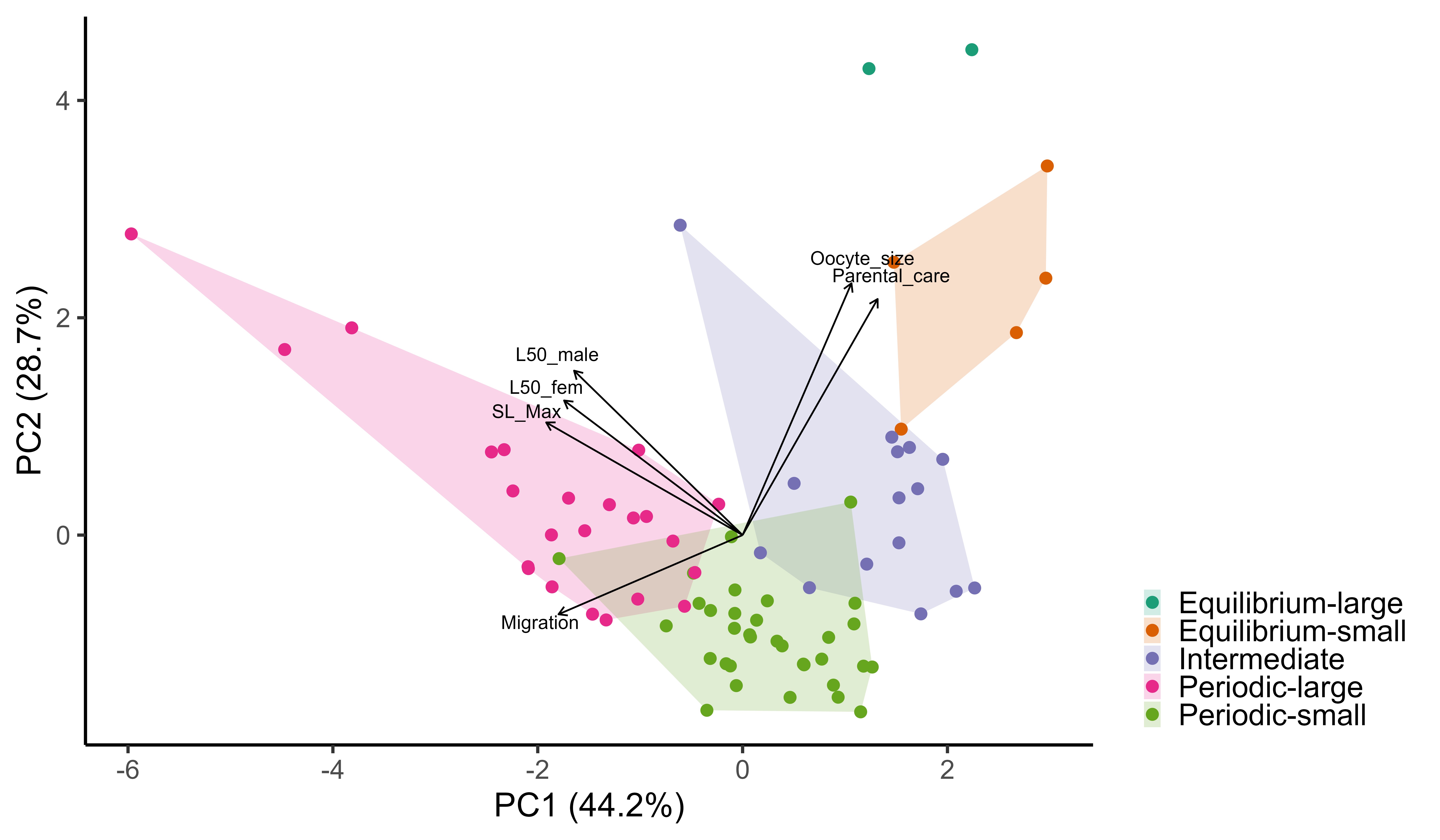
FIGURE 4 | Principal Component Analysis (PCA) of fish reproductive strategies based on functional attributes related to body size, migration, and reproduction. Points represent species, colored according to reproductive strategy, while vectors indicate the direction and relative strength of each functional attribute along the first two principal components (PC1 and PC2). The ordination reveals a continuum of reproductive strategies primarily associated with oocyte size and the presence of parental care, which drive the main axis of variation among species.
Spearman correlation analysis revealed several strong associations among the studied life-history strategies (|ρ| > 0.60, p < 0.05, n = 78; Fig. S2). Parental care was negatively correlated with migration distance (ρ = –0.61), indicating that species exhibiting higher levels of parental care tend to migrate shorter distances. Oocyte size showed a positive correlation with parental care (ρ = 0.68), suggesting that species with larger eggs invest more in parental care. The size at first maturity of males and females (L50) was strongly positively correlated (ρ = 0.73), and maximum standard length (SL Max) was positively associated with L50 of both males (ρ = 0.60) and females (ρ = 0.63), indicating that larger species tend to mature at larger sizes. These patterns highlight coordinated life-history strategies among Amazonian fishes, reflecting trade-offs between reproductive investment, growth, and movement patterns.
Discussion
Over evolutionary timescales, natural selection favors specific attribute combinations that optimize fitness in fishes, leading to distinct life-history and trophic strategies. We found nine trophic categories, five reproductive strategies, and four patterns of migration distributed in seven fish orders. Our results reveal substantial interspecific variation within broad taxonomic groups, with patterns structured by phylogeny, as shown by the pPCA and supported by PERMDISP. This pattern indicates that evolutionary relationships influence attribute diversity within taxonomic groups, while species also exhibit distinct reproductive strategies in response to environmental drivers and biotic interactions. For example, equilibrium strategists are characterized by high parental investment and the production of few, large oocytes (Winemiller, 2005). These tradeoffs are particularly evident in Cichliformes (Winemiller, Rose, 1992). This strategy is often associated with lentic environments, such as tropical wetlands, where food availability and breeding opportunities are extended (Winemiller, 2005). In the Madeira River, however, this strategy was very poorly represented compared to the periodic strategy, which was more prevalent and phylogenetically diverse.
Large rivers like the Madeira are strongly structured by seasonal flood pulses (Junk et al., 1989), which impose selective pressures on fish assemblages. Periodic strategists, dominant in the Madeira River, are adapted to these dynamics by producing numerous small oocytes, lacking parental care, and reproducing synchronously during brief favorable periods (Winemiller, Rose, 1992), closely tracking discharge rates (Röpke et al., 2024). This synchrony, especially prominent among Characiformes, coincides with the onset of the flooding (Menezes, Vazzoler, 1992; Amadio, Bittencourt, 2005; Röpke et al., 2024). In these systems, most fish species synchronize their reproduction with the annual flood pulse. Migratory species especially time reproduction to coincide with the flood pulse, taking advantage of newly inundated floodplains for feeding and spawning (Vazzoler, 1996; Agostinho et al., 2004; Bailly et al., 2008).
The timing of reproduction reflects the strong influence of the flood pulse on life history strategies in Amazonian fishes (Junk, Furch, 1985; Menezes, Vazzoler, 1992; Winemiller, 1989). Offspring survival peaks during floods, providing clear reproductive advantages (Neves dos Santos et al., 2008; Bailly et al., 2008). Flooding also increases food availability and creates extensive floating vegetation zones that serve as nurseries for juveniles of periodic strategists (Sánchez-Botero, Araújo-Lima, 2001). Thus, flood dynamics shape reproductive strategies by triggering spawning events and providing access to floodplains. These areas function as feeding areas, spawning grounds, and nurseries for early life stages (Junk et al., 1989; Agostinho et al., 2004; Winemiller et al., 2008).
Reproductive strategies of Amazonian fishes align closely with predictions based on environmental and hydrological variability. Larval survival and reproductive investment appear to be influenced by habitat-specific pressures and predation (Winemiler, Rose, 1992). Species spawning in lotic, high-flow environments tend to maximize fitness by producing many small eggs, reflecting adaptations to hydrological stochasticity; however, this pattern is especially present in large rivers, where abundance and diversity of piscivorous fish are high. In contrast, species in more stable habitats, such as wetlands, invest in fewer but larger eggs, enhancing larval survival (Dahlberg, 1979; Morrongiello et al., 2012). This trade-off between egg size and fecundity is constrained by female body size, as observed in our dataset, where species with larger eggs exhibited lower fecundity, and vice versa (Kolm, Ahnesjö, 2005). These patterns highlight how the heterogeneous hydrology of the Madeira River shapes the diversity of life-history strategies in its fish assemblages. A minimum viable egg size may constrain further miniaturization, potentially interacting with evolutionary pressures on body size (e.g., Winemiller, Rose, 1992; Kolm, Ahnesjö, 2005). This trade-off helps explain the presence of large migratory species in major rivers worldwide, such as catfishes that spawn thousands of tiny oocytes (Zuanon, Torrente-Vilara, 2025). During the reproductive season, long-distance migratory fish move upriver to reach spawning habitats typically located near the headwaters (Hauser et al., 2019; Silva et al., 2025). Spawning occurs in the main river channel, after which eggs drift passively downstream and larvae hatch further along the river (Lopes et al., 2014).
The high fish diversity in the Madeira River (Queiroz et al., 2013) supports a wide range of ecological adaptations. Variation in reproductive effort, expressed through the trade-off between fecundity and egg size, is not solely constrained by phylogeny but is also shaped by habitat and interaction-related ecological pressures. This variation is particularly pronounced within Siluriformes.
While many large riverine species rely on the production of numerous small oocytes (the most prevalent trade-off among the Characiformes studied), Hypostomus pyrineusi (Loricariidae) represents the opposite end of the spectrum, exhibiting the largest oocytes among the species analyzed (Tab. S1). In Hypostomus, reproductive effort aligns with an equilibrium strategy of low fecundity, large oocytes, and parental care. This species has a prolonged spawning period extending from the late dry season to the peak of the wet season. Eggs are deposited in shoreline burrows, with both sexes participating in offspring care (Lowe-McConnell, 1987). Such extended spawning enhances recruitment success by distributing mortality risk across early developmental stages (Begg, Marteinsdottir, 2000). As bottom-dwelling species, Hypostomus are well adapted to fast-flowing lotic environments, where they feed on microalgae attached to rocky substrates (Buck, Sazima, 1995; Garavello, Garavello, 2004).
A positive correlation between parental care and oocyte size supports the presence of an equilibrium strategy, typified by low fecundity and large oocytes. The evolution of parental care plays a key role in constraining the trade-off between egg size and number (Stearns, 1998). Iglesias-Rios et al. (2022) proposed a threshold oocyte diameter of 1.6 mm as a phylogenetically informed indicator of parental care. However, our data reveal broader variation: species without parental care had oocytes ranging from 0.5 to 2.0 mm, while those with parental care ranged from 1.0 to 4.0 mm. Parental care was primarily observed in Loricariidae, Serrasalmidae, Osteoglossiformes, and Cichliformes, phylogenetically distinct groups exhibiting varying levels of investment.
Cichliformes showed a pronounced phylogenetic effect, with consistently high levels of parental care. In the Amazon, attributes associated with an intermediate strategy align with Winemiller’s (1989) continuous model, a framework that has been observed across diverse marine and freshwater taxa (Winemiller, Rose, 1992; Vila-Gispert et al., 2002; Olden et al., 2006; Tedesco et al., 2008). In highly dynamic systems such as the Madeira River, seasonal fluctuations in water levels and flow create variable habitats, and intermediate strategies can adjust their reproductive timing, offspring number, or growth rates accordingly. This flexibility not only enhances their own persistence but also helps buffer the fish community against hydrological fluctuations, contributing to overall stability. However, as this and other studies have sampled only a fraction of Amazonian fish diversity, the full range of life-history strategies remains to be fully documented.
A negative correlation between oocyte size and migration may be indirectly explained by body size and reproductive output. Many medium- and long-distance migratory species are large-bodied and highly fecund. Theoretical models suggest that producing smaller eggs maximizes reproductive output under high predation and larval mortality (Andersen et al., 2008). These species invest considerable energy in upstream migration and synchronize reproduction with peaks in food availability (Winemiller, Rose, 1992). For instance, Brachyplatystoma filamentosum and B. rousseauxii, which can exceed 80 cm in length, are reported to breed in the upper Madeira basin (Barthem, Goulding, 1997; Barthem et al., 2017; Cella-Ribeiro et al., 2015). Despite this strategy, juvenile survival remains constrained by predation and environmental mortality, underscoring selective pressures in shaping life-history strategies in tropical rivers.
A limitation of our study is the exclusive use of gillnets, which likely underrepresent small and cryptic species with opportunistic strategies. Consequently, the prevalence of these strategies may be underestimated, although dominant functional patterns of the assemblage are effectively captured. Our results support the hypothesis that fish attributes are shaped by both environmental conditions and phylogenetic structure.
Closely related species exhibited similar attributes, reflecting evolutionary constraints, while environmental factors associated with river hydrology influenced variation across the community. These findings highlight the dual role of evolutionary history and ecological context in structuring fish assemblages and underscore their relevance under ongoing and future hydrological modifications in Amazonian rivers. Alterations such as flow regulation by dams (Timpe, Kaplan, 2017; Correa et al., 2022), changes in the magnitude, timing, and predictability of flood pulses (van der Sleen, Rams, 2023), as well as an increased frequency of extreme hydrological events are likely to disrupt the environmental cues (Correa et al., 2022) that underpin life-history strategies developed over evolutionary timescales. Strategies adapted to predictable seasonal flooding may be disproportionately affected, potentially leading to shifts in trait composition, functional homogenization, and increased vulnerability of phylogenetically constrained lineages as hydrological regimes depart from their historical dynamics.
This dataset provides a comprehensive synthesis of functional attributes of Amazonian fishes, offering a valuable resource for functional ecology studies. Beyond describing patterns of attribute variation, it can be applied in predictive frameworks to explore potential changes in community composition and functional diversity under environmental pressures, including damming, altered flow regimes, or climate change. Trait-based models could, for example, identify species most vulnerable to hydrological modification, supporting conservation planning in tropical river systems.
We observed distinct patterns in reproductive and migratory strategies, including correlations among body size, oocyte size, and migration distance, as well as a clear reproductive continuum encompassing equilibrium, periodic, and intermediate strategies. These results suggest that species with different life-history strategies may respond differently to changes in the river’s hydrology. By adopting a functional trait approach, we provide evidence that environmental filters (such as seasonal flood pulses and habitat heterogeneity) shape the distribution of functional strategies in Amazonian fishes. This perspective extends the habitat template model (Southwood, 1977) and life history theory (Pianka, 1970; Stearns, 1998) to the context of the Madeira River, offering insights into how flow regulation may influence community assembly and biodiversity patterns in tropical freshwater ecosystems.
Acknowledgments
We are thankful to Santo Antônio Energia (SAE), Universidade Federal de Rondônia (UFRO), and the Instituto de Estudos e Pesquisas Agroambientais e Organizações Sustentáveis (IEPAGRO) for their logistical and institutional support during sample collection.
References
Agostinho AA, Gomes LC, Veríssimo S, Okada EK. Flood regime, dam regulation and fish in the Upper Paraná River: effects on assemblage attributes, reproduction and recruitment. Rev Fish Biol Fish.2004; 14(1):11–19. https://doi.org/10.1007/s11160-004-3551-y
Albert JS, Reis RE. Introduction to Neotropical freshwaters. In: Albert JS, Reis RE, editors. Historical biogeography of Neotropical freshwater fishes. Berkeley: University of California Press; 2011. p.3–20.
Albert JS, Tagliacollo VA, Dagosta F. Diversification of neotropical freshwater fishes. Annu Rev Ecol Evol Syst. 2020; 51:27–53. https://doi.org/10.1146/annurev-ecolsys-011620-031032
Albert JS, Abrahão V, Akin DR, Allen JG, Ândrade M, Arce M et al. An ecological trait matrix of Neotropical freshwater fishes. Sci Data. 2025; 12(1):1127. https://doi.org/10.1038/s41597-025-04674-w
Amadio SA, Bittencourt MM. Táticas reprodutivas em ambientes de várzea na Amazônia. In: Renno J-F, García-Dávila C, Duponchelle F, Núñez J, editors. Biología de las poblaciones de peces de la Amazonía y piscicultura. Lima: IIAP, /IRD; 2005. p.65–72.
Andersen KH, Beyer JE, Pedersen M, Andersen NG, Gislason H. Life-history constraints on the success of the many small eggs reproductive strategy. Theor Popul Biol. 2008; 73(4):490–97. https://doi.org/10.1016/j.tpb.2008.02.001
Anderson MJ. Distance-based tests for homogeneity of multivariate dispersions. Biometrics. 2006; 62(1):245–53. https://doi.org/10.1111/j.1541-0420.2005.00440.x
Arantes CC, Winemiller KO, Asher A, Castello L, Hess LL, Petrete Jr. M et al. Floodplain land cover affects biomass distribution of fish functional diversity in the Amazon River. Sci Rep.2019; 9(1):16684. https://doi.org/10.1038/s41598-019-52243-0
Bailly D, Agostinho AA, Suzuki HI. Influence of the flood regime on the reproduction of fish species with different reproductive strategies in the Cuiabá River, Upper Pantanal, Brazil. River Res Appl.2008; 24(9):1218–29. https://doi.org/10.1002/rra.1147
Barthem RB, Goulding M, Leite RG, Cañas C, Forsberg B, Venticinque E et al. Goliath catfish spawning in the far western Amazon confirmed by the distribution of mature adults, drifting larvae and migrating juveniles. Sci Rep.2017; 7(1):41784. https://doi.org/10.1038/srep41784
Barthem R, Goulding M. The catfish connection: ecology, migration, and conservation of Amazon predators. New York: Columbia University Press; 1997.
Bayley PB, Castello L, Batista VS, Fabré NN. Response of Prochilodus nigricans to flood pulse variation in the central Amazon. R Soc Open Sci.2018; 5(6):172232. https://doi.org/10.1098/rsos.172232
Begg GA, Marteinsdottir G. Spawning origins of pelagic juvenile cod Gadus morhua inferred from spatially explicit age distributions: potential influences on year-class strength and recruitment. Mar Ecol Prog Ser.2000;202:193–217. https://doi.org/10.3354/meps202193
Brown-Peterson NJ, Wyanski DM, Saborido-Rey F, Macewicz BJ, Lowerre-Barbieri SK. A standardized terminology for describing reproductive development in fishes. Mar Coast Fish.2011; 3(1):52–70. https://doi.org/10.1080/19425120.2011.555724
Buck S, Sazima I. An assemblage of mailed catfishes (Loricariidae) in southeastern Brazil: distribution, activity and feeding. Ichthyol Explor Freshw. 1995;6(4):325–32.
Castello L, Bayley PB, Fabré NN, Batista VS. Flooding effects on abundance of an exploited, long-lived fish population in river-floodplains of the Amazon. Rev Fish Biol Fish.2019; 29(2):487–500. https://doi.org/10.1007/s11160-019-09559-x
Castello L, Hess LL, Thapa R, McGrath DG, Arantes CC, Renó VF et al. Fishery yields vary with land cover on the Amazon River floodplain. Fish Fish.2018; 19(3):431–40. https://doi.org/10.1111/faf.12261
Cella-Ribeiro A, Hauser M, Nogueira LD, Doria CRC, Torrente-Vilara G. Length-weight relationships of fish from Madeira River, Brazilian Amazon, before the construction of hydropower plants. J Appl Ichthyol.2015; 31(5):939–45. https://doi.org/10.1111/jai.12819
Cella-Ribeiro A, Torrente-Vilara G, Lima-Filho JA, Doria CRC. Ecologia e biologia de peixes do rio Madeira. Porto Velho: EDUFRO; 2016.
Correa SB, van der Sleen P, Siddiqui SF, Bogotá-Gregory JD, Arantes CC, Barnett AA et al. Biotic indicators for ecological state change in Amazonian floodplains. BioScience. 2022; 72(8):753–68. https://doi.org/10.1093/biosci/biac038
Dahlberg MD. A review of survival rates of fish eggs and larvae in relation to impact assessments. Mar Fish Rev.1979; 41(3):1–12.
Duarte CM, Alcaraz M. To produce many small or few large eggs: a size independent reproductive tactic of fish. Oecologia. 1989; 80(3):401–04. https://doi.org/10.1007/BF00379043
Duponchelle F, Isaac VJ, Doria CRC, Van Damme PA, Herrera-R GA, Anderson EP et al. Conservation of migratory fishes in the Amazon basin. Aquat Conserv Mar Freshw Ecosyst.2021; 31(5):1087–105.https://doi.org/10.1002/aqc.3550
Duponchelle F, Lino F, Hubert N, Panfili J, Renno J-F, Baras E et al. Environment-related life history trait variations of the red-bellied piranha, Pygocentrus nattereri, in two river basins of the Bolivian Amazon. J Fish Biol.2007; 71(4):1113–34. https://doi.org/10.1111/j.1095-8649.2007.01583.x
Fernandes CC. Lateral migration of fishes in Amazon floodplains. Ecol Freshw Fish. 1997; 6(1):36–44. https://doi.org/10.1111/j.1600-0633.1997.tb00140.x
Fortier L, Leggett WC. A drift study of larval fish survival. Mar Ecol Prog Ser.1985; 25(3):245–57. http://www.jstor.org/stable/24817477
Froese R, Pauly D, editors. 2025. FishBase. World Wide Web electronic publication. Available from: www.fishbase.org. Accessed May 2025
Garavello JC, Garavello JP. Spatial distribution and interaction of four species of the catfish genus Hypostomus Lacépède with bottom of rio São Francisco, Canindé do São Francisco, Sergipe, Brazil (Pisces, Loricariidae, Hypostominae). Braz J Biol. 2004; 64(3B):591–98. https://doi.org/10.1590/S1519-69842004000400006
Hahn NS, Loureiro VE, Delariva RL. Atividade alimentar da curvina Plagioscion squamosissimus (Heckel, 1840) (Perciformes: Sciaenidae) no rio Paraná. Acta Sci Biol Sci. 1999; 21(2):309–14. https://doi.org/10.4025/actascibiolsci.v21i0.4438
Hauser M, Doria CRC, Santos RV, García-Vasquez A, Pouilly M, Pécheyran C et al. Shedding light on the migratory powers of Amazonian goliath catfish, Brachyplatystoma platynemum, using otolith 87Sr/86Sr analyses. Aquat Conserv Mar Freshw Ecosyst.2019; 29(3):397–408. https://doi.org/10.1002/aqc.3046
Helfman G, Collette BB, Facey DE, Bowen BW. The diversity of fishes: biology, evolution and ecology. Wiley-Blackwell; 2009.
Herrera-R GA, Heilpern SA, Couto TBA, Victoria-Lacy L, Duponchelle F, Correa SB et al. A synthesis of the diversity of freshwater fish migrations in the Amazon basin. Fish Fish.2024; 25(1):114–33. https://doi.org/10.1111/faf.12795
Iglesias-Rios R, Lobón-Cervià J, Amaral CRL, Garber R, Mazzoni R. Egg size is a good predictor of parental care behaviour among bony fishes. Ecol Freshw Fish. 2022; 31(3):492–98. https://doi.org/10.1111/eff.12645
Jézéquel C, Tedesco PA, Bigorne R, Maldonado-Ocampo JA, Ortega H, Hidalgo M et al. A database of freshwater fish species of the Amazon basin. Sci Data. 2020; 7(1):96. https://doi.org/10.1038/s41597-020-0436-4
Junk WJ, Bayley PB, Sparks RE. The flood pulse concept in river-floodplain systems. Can Spec Publ Fish Aquat Sci.1989; 106(1):110–27.
Junk WJ, Furch K. The physical and chemical properties of Amazonian waters and their relationships with the biota. In: Prance GT, Lovejoy TE, editors. Key Environments: Amazonia, Pergamon Press; 1985. p.3–17.
King M. Fisheries biology, assessment and management. Wiley-Blackwell; 1995.
Kolm N, Ahnesjö I. Do egg size and parental care coevolve in fishes? J Fish Biol. 2005; 66(6):1499–515. https://doi.org/10.1111/j.0022-1112.2005.00777.x
Lopes CA, Garcia V, Reynalte-Tataje DA, Zaniboni-Filho E, Nuñer APO. Temporal distribution of ichthyoplankton in the Forquilha River, upper Uruguay River, Brazil: relationship with environmental factors. Acta Sci Biol Sci.2014; 36(1):59–65. https://doi.org/10.4025/actascibiolsci.v36i1.17993
Lowe-McConnell RH. Ecological studies in tropical fish communities. Cambridge: Cambridge University Press; 1987.
McGurk MD. Natural mortality of marine pelagic fish eggs and larvae: role of spatial patchiness. Mar Ecol Prog Ser. 1986; 34(3):227–42. http://www.jstor.org/stable/24821275
Menezes NA, Vazzoler AEM. Reproductive characteristics of Characiformes, In: Hamlett WC, editor. Reproductive biology of South American vertebrates. New York: Springer-Verlag; 1992. p.60–70.
Morrongiello JR, Bond NR, Crook DA, Wong BBM. Spatial variation in egg size and egg number reflects trade-offs and bet-hedging in a freshwater fish. J Anim Ecol. 2012; 81(4):806–17. https://doi.org/10.1111/j.1365-2656.2012.01961.x
Neves do Santos R, Ferreira EJG, Amadio S. Effect of seasonality and trophic group on energy acquisition in Amazonian fish. Ecol Freshw Fish. 2008; 17(2):340–48. https://doi.org/10.1111/j.1600-0633.2007.00275.x
Núñez J, Duponchelle F. Towards a universal scale to assess sexual maturation and related life history traits in oviparous teleost fishes. Fish Physiol Biochem. 2009; 35(1):167–80. https://doi.org/10.1007/s10695-008-9241-2
Ohara WM, Queiroz LJ, Zuanon J, Torrente-Vilara G, Vieira FG, Doria CRC. Fish collection of the Universidade Federal de Rondônia: its importance to the knowledge of Amazonian fish diversity. Acta Sci Biol Sci. 2015; 37(2):251–58. https://doi.org/10.4025/actascibiolsci.v37i2.26920
Oksanen J, Simpson GL, Blanchet FG, Kindt R, Legendre P, Minchin PR et al. vegan: Community Ecology Package. Version 2.7-1 [Internet]. CRAN R-Project; 2025. Available from: https://cran.r-project.org/web/packages/vegan/index.html
Olden JD, Poff NL, Bestgen KR. Life-history strategies predict fish invasions and extirpations in the Colorado River basin. Ecol Monogr.2006; 76(1):25–40. https://doi.org/10.1890/05-0330
Pianka ER. On r- and K-selection. Am Nat.1970; 104(940):592–97. https://doi.org/10.1086/282697
Queiroz LJ, Torrente-Vilara G, Ohara WM, Pires THS, Zuanon J, Doria CRC. Peixes do rio Madeira. São Paulo: Santo Antônio Energia; 2013.
R Development Core Team. R:a language and environment for statistical computing [Internet]. R Foundation for Statistical Computing; 2025. Available from: https://www.Rproject.org
Rabosky DL, Chang J, Title PO, Cowman PF, Sallan L, Friedman M et al. An inverse latitudinal gradient in speciation rate for marine fishes. Nature. 2018; 559(7714):392–95. https://doi.org/10.1038/s41586-018-0273-1
Röpke C, Cella-Ribeiro A, Ferreira FC, Araújo TR, Dória CR, Gusmão F et al. The seasonal rate of discharge change as the primary trigger synchronizing freshwater fish reproduction in an Amazonian River. Rev Fish Biol Fish. 2024; 34(4):1619–35. https://doi.org/10.1007/s11160-024-09891-x
Röpke CP, Pires THS, Winemiller KO, Wolf DF, Deus CP, Amadio S. Reproductive allocation by Amazon fishes in relation to feeding strategy and hydrology. Hydrobiologia. 2019; 826(1):291–305. https://doi.org/10.1007/s10750-018-3740-7
Röpke CP, Amadio S, Zuanon J, Ferreira EFG, Deus CP, Pires THS et al. Simultaneous abrupt shifts in hydrology and fish assemblage structure in a floodplain lake in the central Amazon. Sci Rep.2017; 7(1):40170. https://doi.org/10.1038/srep40170
Sánchez-Botero JI, Araújo-Lima CARM. As macrófitas aquáticas como berçário para a ictiofauna da várzea do rio Amazonas. Acta Amaz.2001; 31(3):437–47. https://doi.org/10.1590/1809-43922001313447
Silva AV, Almeida JGL, Ventura SPR, Oliveira R, Peixoto PEC. A meta-analysis on alternative mating tactics: when the main and the alternative yield similar reproductive success. Biol Rev.2025; 100(1):85–98. https://doi.org/10.1111/brv.13129
Southwood TRE. Habitat, the templet for ecological strategies? J Anim Ecol.1977; 46(2):337–65. https://doi.org/10.2307/3817
Stearns SC. Life-history tactics: a review of the ideas. Q Rev Biol.1976; 51(1):3– 47.
Stearns SC. The evolution of life histories. Oxford: Oxford University Press; 1998. https://doi.org/10.1093/oso/9780198577416.001.0001
Su G, Villéger S, Brosse S. Morphological diversity of freshwater fishes differs between realms, but morphologically extreme species are widespread. Glob Ecol Biogeogr.2019; 28(2):211–21. https://doi.org/10.1111/geb.12843
Taborsky M, Brockmann HJ. Alternative reproductive tactics and life history phenotypes. In: Kappeler P, editor. Animal behaviour: evolution and mechanisms. Springer Berlin, Heidelberg; 2010. p.537–86. https://doi.org/10.1007/978-3-642-02624-9_18
Tedesco PA, Hugueny B, Oberdorff T, Dürr HH, Mérigoux S, Mérona B. River hydrological seasonality influences life history strategies of tropical riverine fishes. Oecologia. 2008; 156(3):691–702. https://doi.org/10.1007/s00442-008-1021-2
Timpe K, Kaplan D. The changing hydrology of a dammed Amazon. Sci Adv. 2017; 3(11):e1700611. https://doi.org/10.1126/sciadv.1700611
Torrente-Vilara G, Zuanon J, Leprieur F, Oberdorff T, Tedesco PA. Effects of natural rapids and waterfalls on fish assemblage structure in the Madeira River (Amazon basin). Ecol Freshw Fish. 2011; 20(4):588–97. https://doi.org/10.1111/j.1600-0633.2011.00508.x
van der Sleen P, Rams M. Flood pulses and fish species coexistence in tropical rivers – a theoretical food web model. Environ Biol Fishes. 2023; 106(8):1785–96. https://doi.org/10.1007/s10641-023-01458-2
Vazzoler AEAM. Biologia da reprodução de peixes teleósteos: teoria e prática. Maringá: EDUEM; 1996.
Vila-Gispert A, Moreno-Amich R, García-Berthou E. Gradients of life-history variation: an intercontinental comparison of fishes. Rev Fish Biol Fish. 2002; 12(4):417–27. https://doi.org/10.1023/A:1025352026974
Violle C, Navas M-L, Vile D, Kazakou E, Fortunel C, Hummel I et al. Let the concept of trait be functional! Oikos.2007; 116(5):882–92. https://doi.org/10.1111/j.0030-1299.2007.15559.x
Ware DM. Relation between egg size, growth, and natural mortality of larval fish. J Fish Res Board Can.1975; 32(12):2503–12. https://doi.org/10.1139/F75-288
Winemiller KO, López-Fernández H, Taphorn DC, Nico LG, Barbarino Duque A. Fish assemblages of the Casiquiare River, a corridor and zoogeographical filter for dispersal between the Orinoco and Amazon basins. J Biogeogr.2008; 35(10):1551–63. https://doi.org/10.1111/j.1365-2699.2008.01917.x
Winemiller KO, Rose KA. Patterns of life-history diversification in North American fishes: implications for population regulation. Can J Fish Aquat. Sci.1992; 9(10):2196–18. https://doi.org/10.1139/f92-242
Winemiller KO. Life history strategies, population regulation, and implications for fisheries management. Can J Fish Aquat Sci.2005; 62(4):872–85. https://doi.org/10.1139/f05-040
Winemiller KO. Patterns of variation in life history among South American fishes in seasonal environments. Oecologia. 1989; 81(2):225–41. https://doi.org/10.1007/BF00379810
Wootton RJ. Ecology of teleost fishes, 2nd ed. Dordrecht: Kuwer Academic Publishers; 1998.
Zuanon J, Torrente-Vilara G. Whiskers ahead: catfish migrations in freshwater and marine environments. In: Arratia G, Reis RE, editors. Catfishes, a highly diversified group – Volume 1: their outstanding biology. Boca Raton: CRC Press; 2025. p.249–79.
Authors

Alessandra Pasian Lonardoni1,2 , Cristhiana Paula Röpke2,3, Ariana Cella-Ribeiro4, Marilia Hauser5 and Gislene Torrente-Vilara1,2
[1] Programa de Pós-graduação em Evolução e Diversidade, Universidade Federal do ABC, Av. dos Estados, 5001, Bairro Santa Terezinha, 09210-580, Santo André, SP, Brazil. (APL) alessandralonardoni@yahoo.com.br (corresponding author).
[2] Universidade Federal de São Paulo, R. Doutor Carvalho de Mendonça, 144, Encruzilhada, 11070-100, Santos, SP, Brazil. (CPR) krikaropke@gmail.com, (GTV) gtv@unifesp.br.
[3] Instituto Nacional de Pesquisas da Amazônia (INPA), Coordenação em Biodiversidade, Av. André Araújo, 2936, Petrópolis, 69067-375, Manaus, AM, Brazil.
[4] Instituto Chico Mendes de Conservação da Biodiversidade (ICMBIO), Av. Tancredo Neves, 2106, setor 2, 76887-000, Campo Novo de Rondônia, RO, Brazil. (ACR) ariana.ribeiro@icmbio.gov.br.
[5] Departamento de Ciências Biológicas, Universidade Estadual de Maringá, Av. Colombo, 5790, Jardim Universitário, 87020-900, Maringá, PR, Brazil. (MH) mariliahauser@gmail.com.
Authors’ Contribution 

Alessandra Pasian Lonardoni: Conceptualization, Data curation, Formal analysis, Investigation, Visualization, Writing-original draft, Writing-review and editing.
Cristhiana Paula Röpke: Data curation, Formal analysis, Writing-review and editing.
Ariana Cella-Ribeiro: Data curation.
Marilia Hauser: Data curation, Investigation, Writing-review and editing.
Gislene Torrente-Vilara: Conceptualization, Data curation, Writing-review and editing.
Ethical Statement
Data collection was carried out at a time when approval from an animal ethics committee was not required. Nevertheless, all sampling protocols were strictly followed under a collection permit 251/2007 (Instituto Brasileiro do Meio Ambiente e dos Recursos Naturais Renováveis), July 9, 2007.
Competing Interests
The author declares no competing interests.
Data availability statement
The data supporting the findings of this study are included in the supplementary material of this article.
AI statement
The authors used artificial intelligence (AI) tools exclusively for language editing and text revision. All scientific content, interpretations, and conclusions were produced and reviewed by the authors, who take full responsibility for the manuscript.
Funding
APL received a scholarship from CAPES. GTV and CPR received a grant from Fundação de Amparo à Pesquisa do Estado de São Paulo (FAPESP 22/05832–3; 24/10153–3).
Supplementary Material
Supplementary material SUP
Peer Review
How to cite this article
Lonardoni AP, Röpke CP, Cella-Ribeiro A, Hauser M, Torrente-Vilara G. Fish life-history diversity in Madeira River: linking traits, phylogeny, and environment. Neotrop Ichthyol. 2026; 24(3):e250105. https://doi.org/10.1590/1982-0224-2025-0105
Copyright
This is an open access article under the terms of the Creative Commons Attribution License, which permits use, distribution and reproduction in any medium, provided the original work is properly cited.
Distributed under
Creative Commons CC-BY 4.0

© 2025 The Authors.
Diversity and Distributions Published by SBI
 Accepted March 24, 2026
Submitted June 13, 2025
Epub September 7, 2026